
Why Can't I Stick to a Routine? 7 Real Reasons and the Fix for Each
Routines fail on design, not willpower: sized for your best day, no cue, five changes at once, one miss treated as a quit. Seven reasons, the research, and a...

📺 Related Video: How to Stick to Habits and Routines Without Falling Off!
Video by: How to ADHD · Watch on YouTube
You cannot stick to a routine because the routine was designed for a version of you that does not exist most days. It was sized for your best morning, launched on a burst of motivation, made of five changes at once, tied to no specific cue, and built so that one missed day reads as failure. Any one of those breaks a routine. Most abandoned routines have all five.
None of that is a character flaw. It is a design problem, and design problems have fixes. This guide walks through the seven reasons routines collapse, what the research says about each, and the specific change that repairs it. The last section rebuilds your routine in a week using those fixes.
Reason 1: you built the routine for your best day
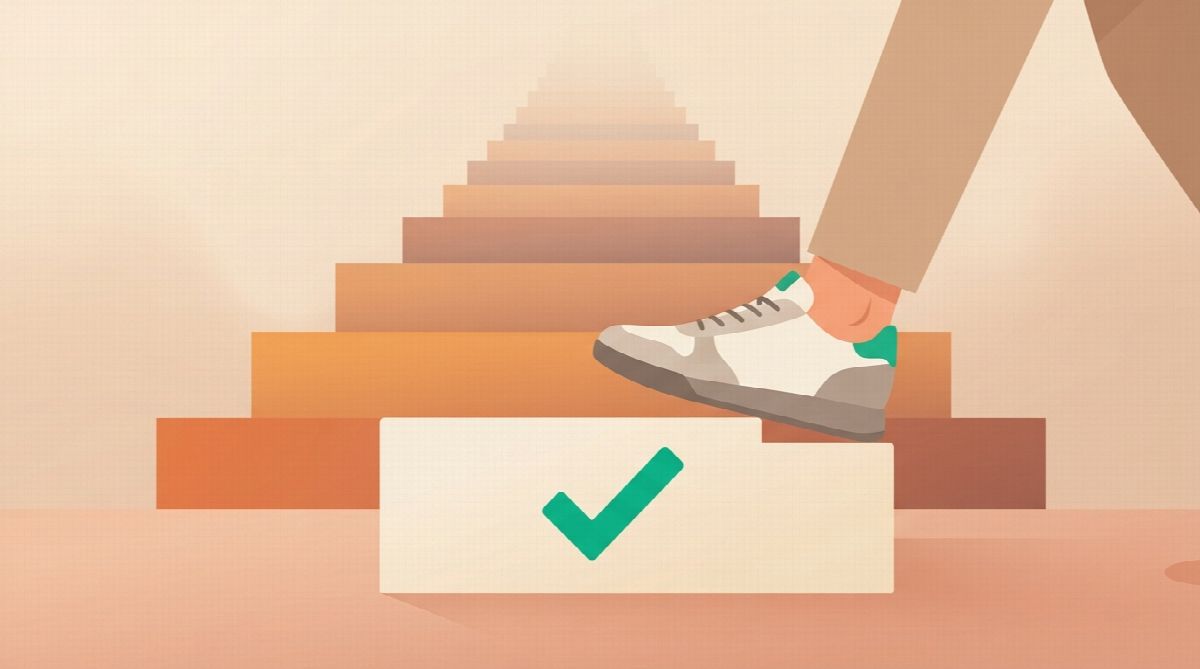
A routine that only works when you are rested, calm, and free by 6am is not a routine. It is a plan for about one week in five.
Most people design their routine in a good mood. They imagine the morning where they wake before the alarm, and they write the routine for that morning: a workout, a journal page, a cold shower, twenty minutes of reading. Then Tuesday arrives with a bad night's sleep and a meeting moved to 7:30, and the routine has no smaller version to fall back on. So it gets skipped, and the skip feels like proof that you cannot do this.
The fix is to size every part of the routine to your worst likely week, not your best. Ask: what is the smallest version of this that still fully counts? One page of reading. Ten minutes of walking. Three lines in the journal. That smallest version is the Floor, the thing you do on the day you have the least. The full version becomes the Ceiling, the thing you do when the day gives you room. Step on the Floor every day. Some days you burst through the Ceiling.
The Floor is not a consolation prize. In a study that tracked people forming a new daily habit, simple actions like drinking a glass of water became automatic faster than elaborate ones like a full exercise set. A routine that shrinks on hard days keeps the repetitions coming, and the repetitions are what build the habit.
Reason 2: you changed five things at once
The number of habits you can start in the same week and keep past the first month is closer to one than five.
The classic failed routine is a stack of new behaviors launched on the same Monday: wake earlier, work out, meditate, journal, no phone before noon. Each one is a new thing your brain has to remember and choose. Together they demand more attention than a normal day has spare, and the first stressful day knocks the whole stack over.
Wendy Wood's research on habits in everyday life found that behaviors performed almost daily in stable contexts run with little conscious thought, while newer, less regular behaviors need active attention to guide them, and come with more stress (Wood, Quinn and Kashy, 2002). Five new behaviors means five things competing for the same limited attention. One new behavior means one.
Pick the habit whose absence bothers you most. Run only that one until it stops feeling like a decision, then add the next. If you are not sure which to pick, our guide to habits versus routines explains why the single anchor habit matters more than the schedule around it.
Reason 3: your routine has no cue
"Every morning" is not a cue. "After I pour my first coffee" is a cue. Routines without a specific trigger depend on you remembering, and remembering is exactly what fails on a busy day.

The evidence on this is unusually strong. A meta-analysis of 94 studies found that people who formed a specific if-then plan ("when X happens, I will do Y") were substantially more likely to follow through on their goals than people who simply intended to (Gollwitzer and Sheeran, 2006). The same review that reported the 66-day habit figure describes habit formation as repeating an action in a consistent context until the context itself triggers the action (Gardner, Lally and Wardle, 2012). The cue is not a nice extra. It is the mechanism.
Write your routine as a chain of cues, one per habit: after I turn off the alarm, I put my feet on the floor and drink the water on the nightstand. After the water, I put on the shoes that are already by the door. Each existing action pulls the next one in. Put the physical objects in the path the night before so the cue is also the equipment.
Reason 4: you are running on motivation
Motivation is a state that comes and goes with sleep, stress, and blood sugar. A routine that needs you to feel like it will run only on the days you feel like it.
New routines usually start on a wave. There is a real phenomenon behind that wave: people are measurably more likely to start goals at temporal landmarks like Mondays, the first of the month, and birthdays. We cover it in our guide to the fresh start effect. The trap is that the landmark supplies the motivation to start and nothing to keep going with. By Thursday the wave is gone and the routine is still sized for the wave.
The fix is to design the routine so that its hardest step requires the least motivation possible. Lower the Floor until the worst version of you can still do it. Remove every decision you can make in advance: what you will do, where, at what cue, with what equipment. Then measure the routine by whether you started, not by how you felt about it. Most days a routine that starts finishes.
Reason 5: one missed day turns into a quit
A missed day does not break a habit. Quitting after the missed day does.
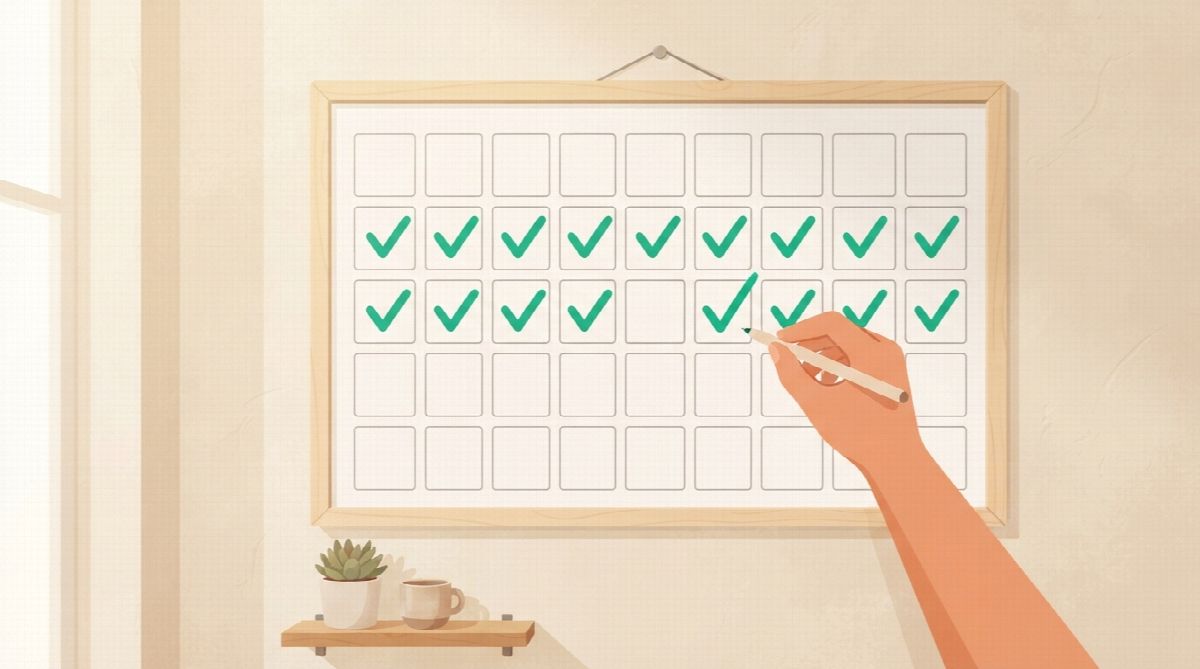
This is the reason that ends more routines than any other, and it is the one the research is clearest on. In the University College London study that produced the famous 66-day average, missing a single opportunity to perform the new behavior did not materially hurt habit formation; automaticity gains resumed after the miss (Gardner, Lally and Wardle, 2012, summarizing Lally and colleagues, 2010). The habit was not damaged by the gap. It was damaged only when the gap became permanent.
The all-or-nothing rule ("I said every day, I missed, so the routine is over") is the actual killer. In a 2021 megastudy that tested 54 interventions to increase gym visits across more than 61,000 people, the most effective single intervention was a small bonus for returning to the gym after a missed workout (Milkman et al., 2021). Rewarding the return beat rewarding the streak.
So write the miss rule into the routine before you need it: a missed day is followed by a Floor day, not by a review of whether you are the kind of person who can do this. Never miss twice in a row, and treat the second day as the only one that matters. If you have already fallen off, our guide to restarting a habit after falling off covers the first week back.
Reason 6: the routine is boring or punishing
Routines built entirely from things you should do and none you want to do will lose to the routine your evening already has, which is built entirely from things you want.
Wood's diary studies found that habitual behavior came with less stress than non-habitual behavior, which is one reason established routines feel effortless and new ones feel like work. Until the new routine crosses that line, it needs something in it that you actually look forward to.
The evidence-backed version of this is temptation bundling. In a field experiment at a university gym, people who could only listen to tempting audiobooks while working out visited the gym 51 percent more often than a control group at the start of the study, and people simply encouraged to bundle visited 29 percent more often; the effect faded over time, especially after a holiday break, and 61 percent of participants were willing to pay for the restriction afterward (Milkman, Minson and Volpp, 2014). Pair the part of your routine you resist with something you only get during it: a specific podcast, a specific coffee, a specific playlist.
The other half is punishment. If your routine is a list of ways you are currently failing, your brain will avoid the list. Track what you did, not what you skipped. Keep the record of showed-up days visible and let the empty squares be empty.
Reason 7: nobody knows you are doing it
A routine that exists only in your head can be quietly cancelled by you at any time, and you are the most sympathetic judge you will ever face.
Telling one person changes the math. Not a public announcement, and not someone assigned to audit you. One person who knows the habit, sees your daily checkin, and cheers when it lands. The cheer is the mechanism: social reinforcement for showing up makes the routine feel witnessed without making a miss feel exposed. Our guide to what an accountability partner actually does covers how to pick that person and what to ask of them.
This is also why routines survive better in small groups than alone. When three or four people are each doing their own daily habit and cheering each other's checkins, a bad day for one person is met with encouragement rather than silence. If you want that without organizing it yourself, a habit tracker with friends gives each person their own habit and a shared feed of showed-up days.
If you have ADHD, the same fixes apply harder
Standard routine advice tends to fail people with ADHD faster, and for the same reasons, not different ones. Working memory holds fewer steps, so cues have to be external and physical. Motivation swings are wider, so the Floor has to be lower. A missed day is more common, so the miss rule matters more.
Two additions help. Make the routine visible in the environment (the shoes by the door, the pill bottle on the kettle, a checklist on the mirror) instead of in an app you have to remember to open. And borrow someone else's presence: doing the routine on a call with a friend or in a group, sometimes called body doubling, gets many people over the starting friction. We cover both in our guides to habit trackers that work with ADHD and body doubling apps. None of this replaces clinical support if you need it.
You already know you can change.
You just need to take the first step. Habit Huddle helps you build habits around your goals, alongside friends who keep you accountable.
Rebuild the routine in seven days
Here is the whole guide as a set of rules you can apply this week, with the old rule each one replaces.
| Old rule | New rule | Why it works |
|---|---|---|
| Design for the ideal morning | Size the Floor to your worst week | Repetitions continue on hard days |
| Start five habits on Monday | Start one, add the next when it feels automatic | Attention is the bottleneck |
| "Every morning" | "After I [existing action], I [habit]" | If-then plans beat intentions in 94 studies |
| Wait until you feel ready | Remove decisions, lower the start cost | Motivation is not a stable input |
| One miss means the routine is over | A miss is followed by a Floor day, never two in a row | Missing once does not hurt habit formation |
| All shoulds, no wants | Bundle the hard part with something you enjoy | Temptation bundling raised gym visits |
| Keep it to yourself | Tell one person who cheers your checkins | Reinforcement for showing up |
A seven-day rebuild looks like this:
- Day 1. Pick one habit. Write its Floor (the smallest version that fully counts) and its Ceiling (the good-day version). If you are turning a big goal into a daily action, the goal to daily habit calculator does the arithmetic.
- Day 1, evening. Choose the cue and stage the equipment. Write the if-then sentence and put it where the cue happens.
- Days 2 to 7. Do the Floor every day. Ceiling days are a bonus, never the standard. Log each day somewhere you can see the run of checkmarks.
- Any missed day. Floor day next. No review, no restart from zero.
- Day 7. If the habit happened six or seven times, keep it exactly the same for another week. If it happened three or fewer, the Floor is too high; halve it. Do not add habit number two until the first one stops feeling like a choice.
Expect the routine to feel like effort for something on the order of two months, which is what the research on how long habits take to form suggests for daily behaviors, with huge variation between people. The effort curve slopes down the whole time. That is the part nobody tells you when they say it takes 21 days.
A routine with people in it
Full disclosure: Habit Huddle is our app, so judge the reasoning rather than the recommendation.
The reasons above are the reasons we built it the way we did. Every habit has a Floor and a Ceiling, so a hard day still counts in full. Each person tracks their own habit inside a small group called a huddle, and the huddle's feed shows only the checkins people made, never the days they did not, so a miss is never exposed and a return is cheered like any other day. A group Checkin Chain grows by one link for every member's checkin each day, which turns showing up into something the whole group builds together.
The trade-offs are real. It is a daily checkin app, so it fits habits you want to do most days and fits weekly goals poorly. It runs on the honor system with no proof required, so it works for people who want witnesses rather than enforcement. And a huddle is only as good as the people in it; if you have nobody to invite, the app can match you with others working on the same habit, but a group of strangers takes a week or two to warm up.
If you have started the same routine four times this year, try starting it once more with one Floor, one cue, and one person. Free to start.
FAQ
Why can't I stick to a routine even when I want to?
Because wanting to is a motivational state and routines have to survive the days when that state is absent. Routines fail on structure, not desire: they are sized for good days, tied to no cue, launched with too many changes, and built so one miss reads as failure. Fix the structure and the same level of wanting is enough.
How long does it take for a routine to stick?
Research on daily habits found automaticity plateaued after an average of 66 days, with a range from about 18 to 254 days depending on the person and the behavior. Simple actions become automatic faster than elaborate ones. Expect roughly two months of effort that gets easier the whole time.
Does missing one day ruin a routine?
No. In the same study, missing a single opportunity did not materially affect habit formation; progress resumed after the miss. What ruins routines is quitting after the miss. Follow every missed day with the smallest version of the habit and never miss twice in a row.
Should I start my routine on Monday?
Only if Monday is tomorrow. Temporal landmarks like Mondays and the first of the month do give a motivation boost, but a routine that depends on that boost fails when it fades. Start today with a version small enough that the day you have can hold it.
What is the best routine for someone who keeps quitting?
One habit, sized to your worst week, attached to an existing daily action, logged where you can see it, and shared with one person who cheers your checkins. Add a second habit only after the first stops feeling like a decision.
Ready to Build Habits With Friends?
Stop failing alone. Join thousands using the #1 habit tracker with friends for real accountability and lasting results.
Prefer mobile? App Store · Google Play
Related Guides
More Habit Huddle articles on building habits with accountability.

Habit Contract: How to Write One That Works (Free Template)
What a habit contract is, what goes in one, what randomized trials say about signed commitments, why the stakes belong on quitting rather than a missed day,...

Family Habit Tracker App: 8 Best Picks by Age, and How to Make It Stick (2026)
Family habit tracker apps compared by age: Joon, Family Rewards, Family Checklist, Kinly, Habit+ Family, HabitShare, Habitica, and Habit Huddle. Plus the hab...

Gamified Habit Tracker: 7 Apps Compared by What the Game Rewards (2026)
Gamified habit trackers compared: Habitica, Finch, Forest, Streaks, Habits Garden, HabitForge, and Habit Huddle, by what the game rewards, what free gets you...