
Habit vs Routine: Which One Builds Lasting Change?
Unlock the difference in the habit vs routine debate. Learn the science of automaticity and how to use routines to build habits that actually stick.
A routine is a sequence of actions you intentionally perform, requiring conscious effort. A habit is a behavior that has become so ingrained it's triggered automatically by a cue with little to no thought, and a 2025 study found that 66.34% of everyday actions were habitually initiated while 87.6% of those habits were carried out habitually rather than through conscious deliberation.
That difference is why so much popular advice fails. People get told to “build better habits,” then they try to force effortful, planning-heavy behaviors into an autopilot bucket too early. They miss a few days, assume they lack discipline, and start over with another cleaner planner, another streak challenge, another burst of motivation.
The core problem is simpler. Often, the wrong tool is used for the job.
If you're serious about habit vs routine, stop treating the two terms like synonyms. A routine is what you use when a behavior still needs intention. A habit is what you earn after enough repetition in a stable context that the behavior starts running with much less friction. That distinction changes how you should approach exercise, hydration, reading, medication, planning, journaling, and almost every New Year's resolution people abandon by February.
Table of Contents
- The Critical Mistake in Your New Year's Resolution
- Habits on Autopilot vs Routines on Purpose
- Comparing Key Differences Between Habits and Routines
- When to Use a Routine and When to Build a Habit
- How to Turn an Effortful Routine into an Automatic Habit
- Using Habit Huddle to Engineer Lasting Change
- Stop Drifting and Start Building
The Critical Mistake in Your New Year's Resolution
Most resolutions fail for a boring reason. People confuse repetition with automaticity.
They say they want a habit, but what they build is a fragile routine that depends on remembering, deciding, and pushing themselves through resistance every day. That can work for a while. It usually collapses the moment life gets noisy.
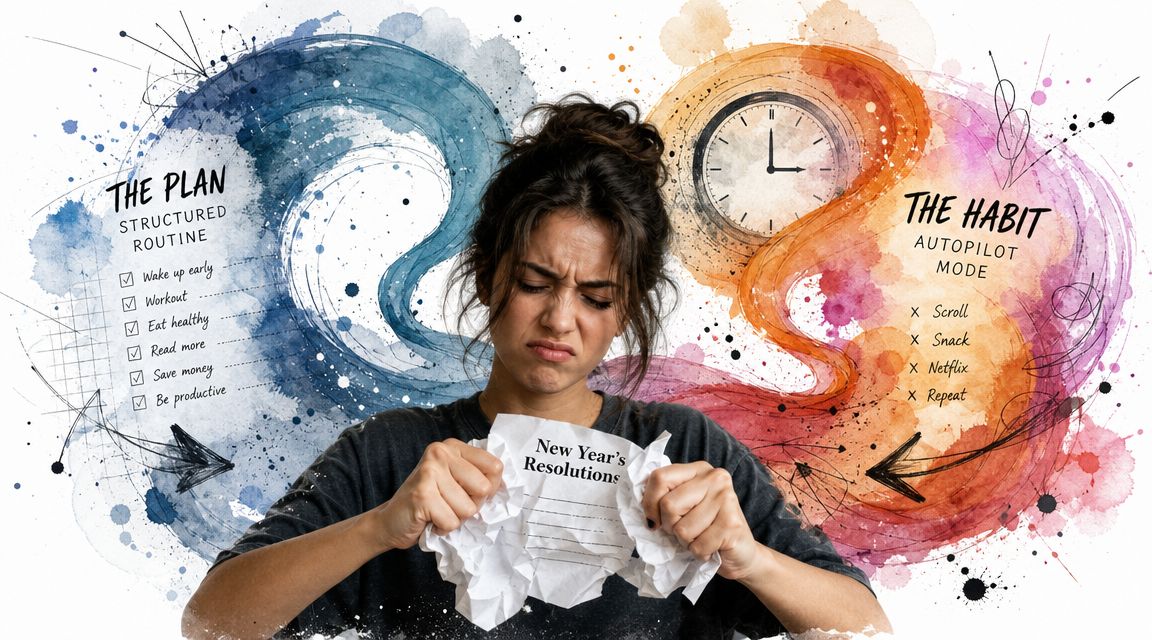
Behavioral science draws a clean line between the two. In this behavioral science explanation of habit and routine, a habit is an automatically triggered response to a contextual cue, while a routine is an intentionally chosen sequence of actions that still requires active decision-making. The difference isn't how often you do it. The difference is whether you still have to talk yourself into it.
Why this mistake keeps people stuck
If you treat every repeated behavior like a habit, you set the wrong expectations.
You expect morning writing to feel as automatic as brushing your teeth. You expect gym attendance to click after a few days. You expect consistency to come from motivation instead of setup. Then, when the behavior still feels effortful, you think something's wrong with you.
Practical rule: If a behavior still requires negotiation, reminders, and internal debate, it's a routine. That's not failure. That's the current stage.
What actually changes outcomes
The goal isn't to shame routines. Routines are useful. They're scaffolding.
The problem starts when people try to skip the middle. They want a polished, automatic behavior without doing the slower work of cue design, repetition, and environmental stability. That's why “just be disciplined” advice falls apart under travel, stress, parenting, illness, and workload spikes.
In practice, lasting change usually starts with a deliberate routine, then graduates into a habit only if the behavior is simple enough, repeated often enough, and tied to a reliable cue. If you don't know which stage you're in, you'll keep applying habit advice to routine problems and routine advice to habit problems.
Habits on Autopilot vs Routines on Purpose
The easiest way to understand habit vs routine is to look at how each one feels in real life.
A routine feels like work because you are still directing it. You notice the choice point. You decide to begin. You manage the steps. If your environment changes, the routine often needs a manual reset.
A habit feels different. Something in the context fires the behavior with much less internal discussion. You don't need a motivational speech to start. The cue does much of the work.
The driving example most people recognize
Learning to drive is a routine-heavy experience. You grip the wheel too tightly, check mirrors on purpose, think about braking distance, and narrate every move in your head. The task eats attention.
Months later, the same route feels almost automatic. You stop at the usual light, turn into the usual lane, and arrive with only partial memory of the smaller decisions. The road cues much of the sequence.
That's the practical distinction. Routines rely on conscious control. Habits rely on cue-triggered efficiency.
| Dimension | Routine | Habit |
|---|---|---|
| Start point | You choose to begin | A cue tends to trigger it |
| Attention needed | High | Lower |
| Mental load | Noticeable | Reduced |
| Reliability under stress | More fragile | More resilient if the cue remains |
| Changeability | Easier to redesign | Harder to alter once ingrained |
Why habits matter so much
This isn't a minor edge case. A 2025 study on habitual behavior in everyday life found that 66.34% of everyday actions were habitually initiated, and 87.6% of those habits were executed habitually rather than through conscious deliberation.
That matters because it reframes self-control. People like to imagine their days are driven by deliberate choices. Much of daily behavior isn't. It's driven by learned patterns attached to context.
Build the right cue-driven actions and your day starts carrying more of the load for you.
What this means for behavior change
If you want a behavior to survive low-energy days, don't ask motivation to do a system's job.
Use routines when a task still needs structure and attention. Use habit-building when a behavior is simple, frequent, and worth putting on autopilot. The strategic question isn't “How do I repeat this more?” It's “Should this stay conscious, or should I train it toward automaticity?”
That's the hinge the entire habit vs routine discussion turns on.
Comparing Key Differences Between Habits and Routines
Most articles flatten this topic into a dictionary definition. That's not useful when you're trying to decide why one behavior sticks and another keeps slipping.
The more practical way to look at habit vs routine is side by side.
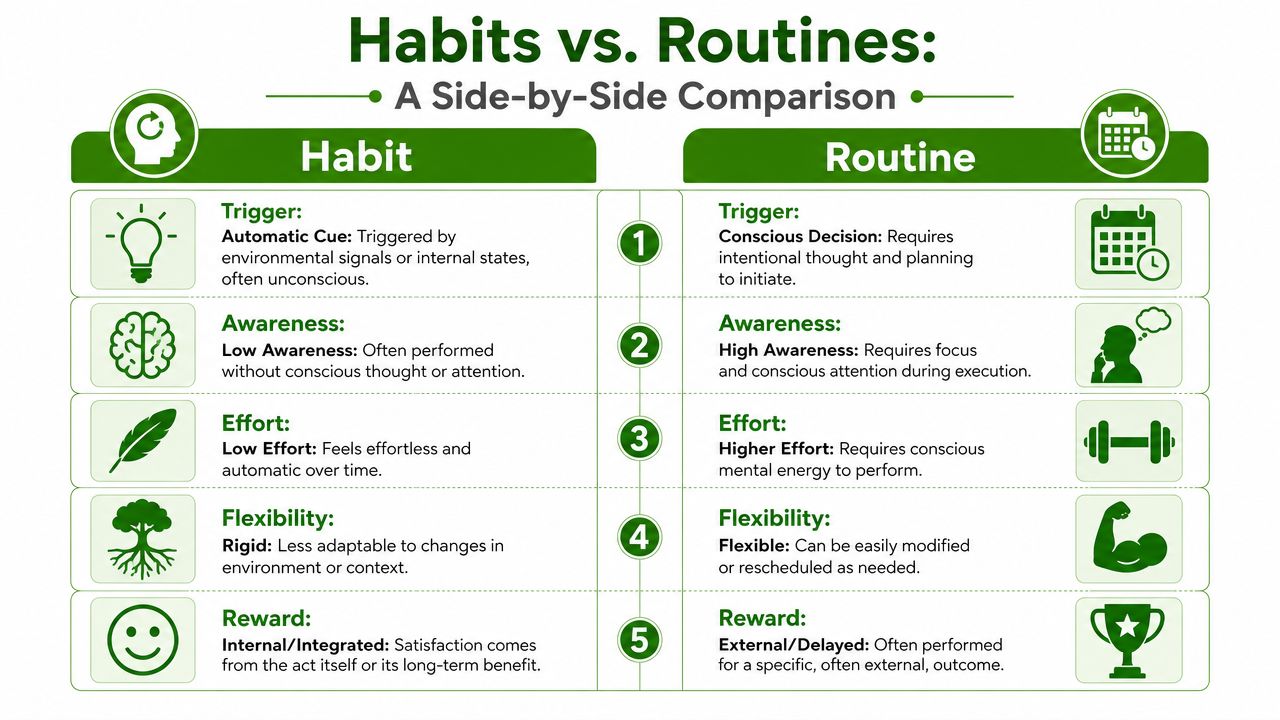
The comparison that matters in practice
| Criteria | Habit | Routine |
|---|---|---|
| Trigger | Starts from a contextual cue | Starts from a conscious decision |
| Awareness | Often low or partial | Usually high |
| Effort | Feels lighter over time | Keeps costing mental energy |
| Flexibility | More rigid once established | Easier to reschedule or edit |
| Best use case | Simple, repeated actions | Complex or variable actions |
| Failure mode | Wrong cue can trigger wrong action | Decision fatigue can stop action |
A few examples make this clearer.
- Hydration after lunch: If you reliably drink water when you sit down to eat, that's moving toward habit because the meal can become the cue.
- Writing a weekly report: That's usually a routine. It needs judgment, adaptation, and active thinking.
- Laying out gym clothes at night and exercising after work: The clothing setup is part of a routine. The moment your shoes go on automatically when you get home, you're closer to a habit.
- A Sunday reset for meals, calendar, and laundry: That's often better kept as a routine because it includes multiple moving parts and changing priorities.
The hidden trade-off
People often assume habit is always better. It isn't.
A habit is more efficient. A routine is more flexible.
That trade-off matters. Automaticity saves energy, but it also depends on stable cues. Routines demand more effort, but they let you adapt to changing circumstances, priorities, and environments without needing the exact same trigger every time.
A quick test for your own behavior
Ask these questions:
- Do I need to decide to do this each time?
- Would the same cue trigger it in a different mood?
- Does the task require judgment or just execution?
- If my day shifts, can I move it without breaking the whole system?
If the task needs judgment, planning, or variation, keep it in the routine category. If it benefits from being fast, repeatable, and almost mindless, it's a strong candidate for habit formation.
The issue often becomes apparent here. They aren't failing to build habits. They're asking habit mechanics to carry behaviors that still need routine management.
When to Use a Routine and When to Build a Habit
The goal isn't to turn your whole life into autopilot. That's where a lot of bad self-help advice goes off the rails.
Some behaviors should become more automatic because conscious deliberation adds no value. Others should stay deliberate because the quality of the outcome depends on thought, adjustment, and judgment. A more nuanced view of which behaviors should remain routines rather than habits argues exactly that, especially for effortful activities like journaling or exercise scheduling.
Keep it as a routine when the task needs judgment
A routine is the right tool when the behavior changes based on context.
Examples include:
- Weekly planning: Your priorities shift. A fixed autopilot sequence can make you efficient at the wrong things.
- Exercise programming: Showing up can become habitual, but deciding what workout fits your recovery, schedule, and goals still needs judgment.
- Journaling: Reflection loses value if you reduce it to a mindless box-check.
- Difficult conversations: No one benefits from handling conflict on autopilot.
These tasks are better managed with calendars, checklists, prompts, and planning blocks. They need conscious engagement.
You already know you can change.
You just need to take the first step. Habit Huddle helps you build habits around your goals, alongside friends who keep you accountable.
Build a habit when the behavior is simple and repeatable
Habits shine when the action is clear, short, frequent, and improved by lower friction.
Good candidates include:
- Taking medication
- Drinking water at a consistent moment
- Putting your phone away before bed
- A brief mobility sequence after brushing your teeth
- Opening a book after dinner
The common thread is simple. These actions don't get better because you re-decide them every day. They get better when you stop having to re-decide them.
If thinking harder won't improve the behavior, reduce the need to think.
Use both for the same goal
This is the part many people miss. One goal can contain both routine and habit elements.
Take exercise. The habit might be changing clothes when you get home. The routine might be following a training plan, adapting intensity, and deciding whether today calls for lifting, walking, or recovery work.
Take reading. The habit might be sitting in the same chair after dinner. The routine might be selecting what to read and deciding how long to stay with it.
Once you see that split, your system gets cleaner. You stop trying to automate the parts that need thought, and you stop wasting thought on the parts that should become automatic.
How to Turn an Effortful Routine into an Automatic Habit
People love the idea that a new habit locks in after 21 days. That story survives because it's neat, not because it's useful.
The better benchmark is slower and far more honest. Foundational research summarized in these habit formation statistics and time-to-automaticity findings found that the average time for a new behavior to become automatic was 66 days, with a range from 18 to 254 days depending on the behavior and person. The same summary notes that simple actions such as drinking water at lunch can become automatic in as few as 18 days, while more complex behaviors such as doing 50 daily sit-ups can take over 250 days.
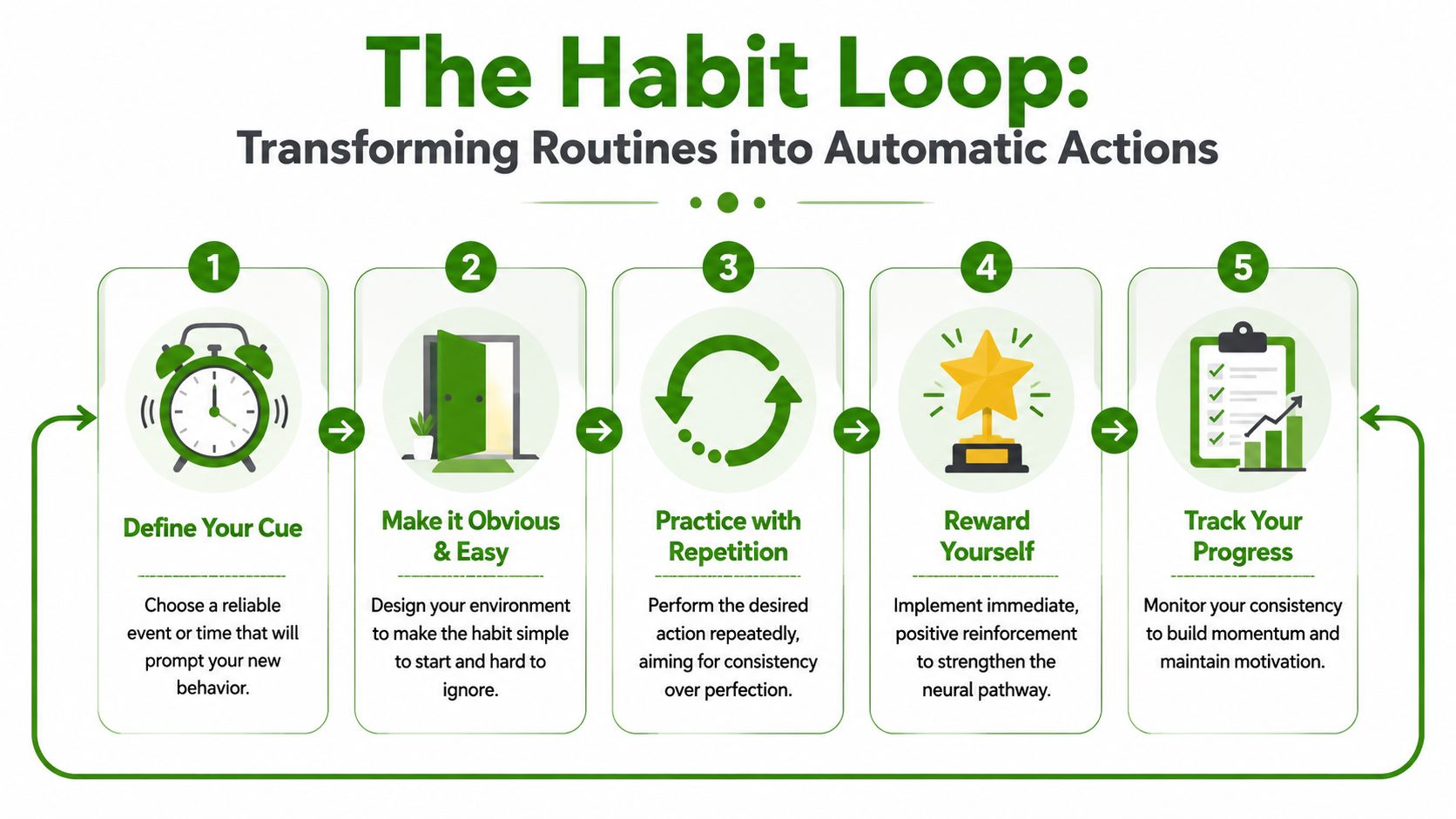
That should change how you build. Stop expecting speed. Start building for stability.
Start small enough to remove negotiation
If the behavior is too big, the routine never gets enough clean repetitions to become automatic.
Don't start with “work out every morning.” Start with shoes on, mat out, and five minutes of movement. Don't start with “read for an hour.” Start with opening the book after a fixed cue.
Smaller actions reduce friction. They also make cue learning easier because the brain isn't trying to absorb a complicated performance standard at the same time.
Attach the action to a reliable cue
The cue is not decoration. It's the ignition switch.
Good cues are events that already happen with high reliability:
- After brushing teeth
- When lunch begins
- Right after logging off work
- As soon as the kettle starts
- When you put your phone on the charger
If you need ideas, these habit stacking examples show how to pair a new behavior with an existing anchor instead of relying on vague intention.
The more stable the cue, the less motivation you need.
Repeat in the same context
A habit grows from consistent pairing, not from heroic effort.
Doing a behavior in five different places, at five different times, with five different starting conditions can still be useful. But it's slower if your goal is automaticity. Stable context helps the brain learn, “When this happens here, I do that.”
This is why people often struggle during travel, illness, new jobs, or parenting changes. The cue map shifts.
Make progress visible without making the system brittle
Tracking helps during the routine phase because the behavior isn't automatic yet. You need reminders, evidence of follow-through, and a way to recover after misses.
A good tracker does two things:
- It confirms repetition
- It prevents all-or-nothing thinking
That's especially important during the long middle, where the behavior still feels effortful even though progress is happening.
Later in the section, this short explainer reinforces the mechanics visually.
Reward completion, not intensity
People sabotage habit formation by tying success to ambitious output instead of consistent execution.
A small action completed at the right cue beats an impressive action done inconsistently. Automaticity grows from repeated cue-response pairings. It doesn't care whether your effort looked dramatic.
That's why the fastest path from routine to habit usually looks unglamorous. Same cue. Small action. Repeated often. No drama.
Using Habit Huddle to Engineer Lasting Change
Most tracking tools blur together two different jobs. They try to manage strategic routines and automatic habit formation with the same interface, then wonder why people burn out or drift off.
The more useful setup is one that supports the transition phase. You need something that helps you repeat a simple behavior, recover quickly when life interrupts, and stay accountable while the action still feels effortful.
What a tool should do during the routine phase
Before a behavior becomes automatic, the system needs to reduce friction rather than add complexity.
Look for a tool that supports:
- One clear behavior at a time: Broad self-improvement dashboards create too many choice points.
- A minimum viable win: This protects consistency on low-capacity days.
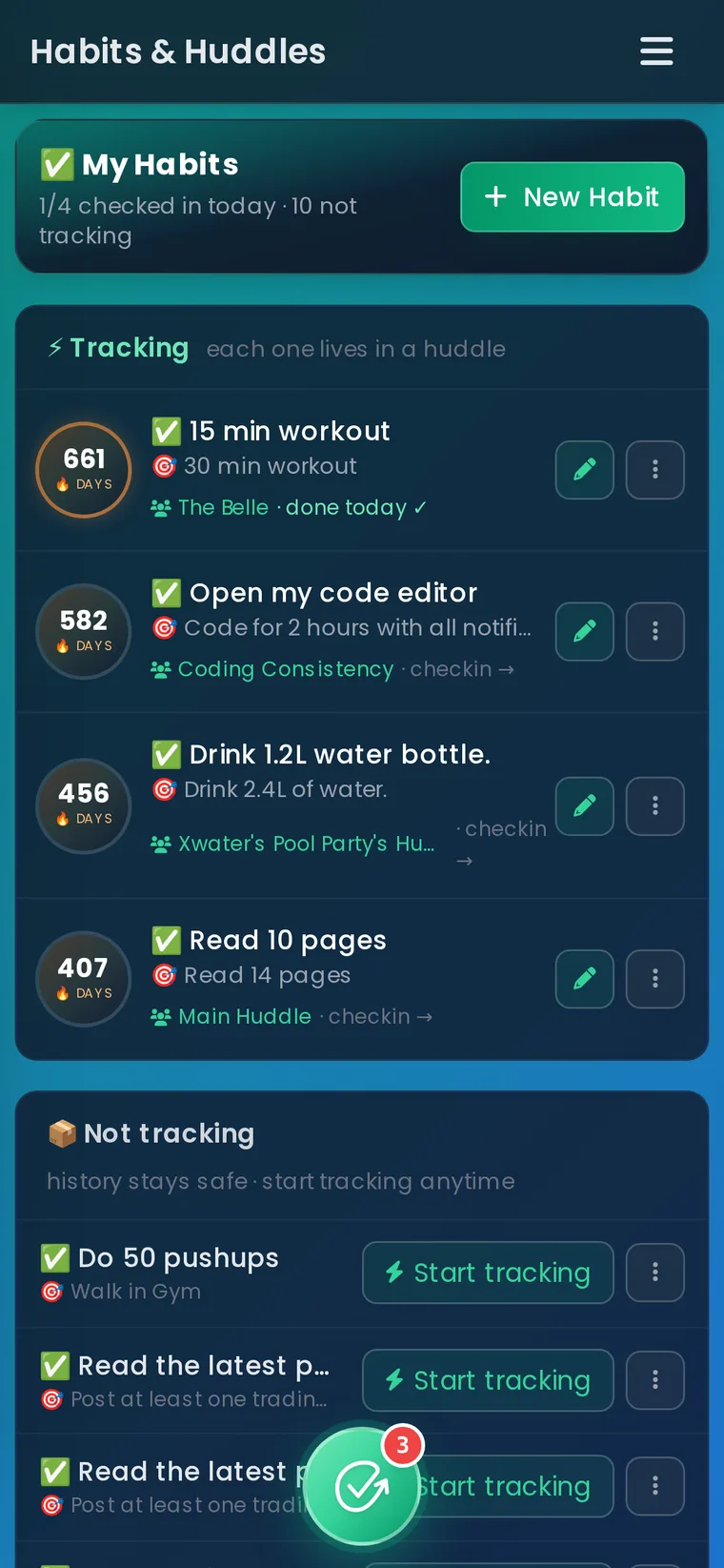
- Visible checkins: You need evidence that repetition is happening.
- Shared accountability: Social visibility matters when the cue-behavior link is still weak.
Habit Huddle fits that use case in a very specific way. It organizes users into small huddles, gives every member a visible streak, and uses a two-tier checkin model with Minimum and Daily Goal so people can preserve consistency without pretending every day has the same capacity. Its group visibility model is close to the accountability approach described in this article on social accountability for habits.
Why that structure matches the science
The early stage of habit building is not glamorous. It is repetitive, often dull, and easy to interrupt.
A social tracker can help if it doesn't overcomplicate the process. The useful part isn't badges or novelty. It's having a small, concrete action, a clear record of completion, and a group that can see whether you're showing up.
The best habit support system doesn't demand intensity. It protects repetition.
Where people still get it wrong
Even with a good app, people overload the system. They start too many behaviors, set goals that are too large, or treat one missed day like proof the habit isn't working.
That's not a tool problem. That's a design problem.
If you're trying to move from routine to habit, keep the setup narrow. One behavior. One reliable cue. One minimum standard you can hit even on ugly days. Use accountability to sustain the repetitions, not to pressure yourself into unsustainable output.
Stop Drifting and Start Building
The useful lesson in habit vs routine isn't semantic. It's operational.
A routine is the structure you use when a behavior still needs conscious control. A habit is what you get when that structure has been repeated in a stable enough way that the cue starts doing more of the work. Confuse the two, and you'll expect automaticity from behaviors that still need planning. Separate them, and you can build much more intelligently.
The bigger shift is dropping streak mythology. A review in the NIH and PMC discussion of routine, adherence, and disruption planning notes that long-term adherence depends more on building a routine around the behavior and planning for disruptions than on perfect short-term adherence. Sustainable change comes from flexible recovery plans, not uninterrupted streaks.
What to do next
Pick one behavior that would improve your day if it became easier to do.
Then define it properly:
- Choose the stage: Is it still a routine, or is it ready to be trained toward habit?
- Shrink the action: Remove ambition until the behavior is easy to start.
- Tie it to a cue: Use something stable that already happens.
- Plan the disruption response: Decide what counts as a minimum on travel days, sick days, and overloaded days.
- Track it: A basic system, or a habit tracking template for daily consistency, is enough if it helps you repeat without overthinking.
You don't need a personality transplant. You need better design.
Build the routine first. Keep repeating until the cue takes over more of the work. That's how lasting change usually happens. Not through motivation spikes, and not through wishful thinking, but through systems that respect how behavior works.
If you want a simple way to track one behavior, keep a minimum standard on hard days, and add social accountability while a routine is still becoming a habit, Habit Huddle is built for that job.
Ready to Build Habits With Friends?
Stop failing alone. Join thousands using the #1 habit tracker with friends for real accountability and lasting results.
Prefer mobile? App Store · Google Play
Related Guides
More Habit Huddle articles on building habits with accountability.

HabitShare Alternatives: 6 Apps for Tracking Habits With Friends (2026)
Looking for a HabitShare alternative? Six social habit trackers compared by model, price, platforms, and what happens on a missed day, plus how to switch wit...

What to Do When You Miss a Workout Day: The 5-Step Comeback Plan
Missed a workout day? What one miss does to your body and habit, according to research, plus a five-step plan for the next 24 hours, when to make it up, and...

Habit Streak App With Friends: 7 Apps Compared (2026)
Seven habit streak apps with friends compared: Habit Huddle, HabitShare, Daily Pact, Habitica, Streaks, Habit Streak duels, HabitStreak.io. What friends see,...