
Step Challenge Kit
Announcement email, rules, fair scoring, and a leaderboard for the kitchen wall.
Length
Format
Daily target
Scoring
Leaderboard rows
The kit updates as you change the settings. Nothing on this page is saved or sent anywhere.
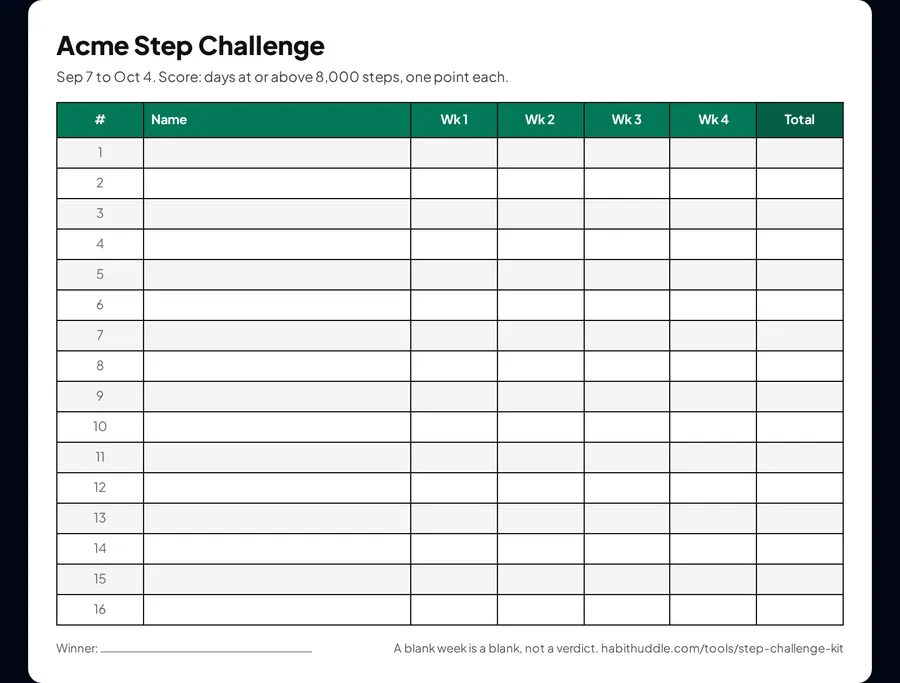
5. The leaderboard (print it, tape it to the kitchen wall)
The wall sheet works for the challenge. The walking habit needs somewhere to live after it. In Habit Huddle everyone checks in each day they hit their number, cheers each other on, and the Checkin Chain grows one link per person per day.
Start a walking huddleHow to run a step challenge at work
Name the company, pick a start date, a length, teams or individuals, and a scoring rule. The kit writes the announcement email, the rules post, a scoring explainer for the skeptics, and the Monday update email. Copy each one, edit the tone, send.
Print the leaderboard and tape it where people get coffee. Fill in one column each Monday from the numbers people send you. Four weeks is the sweet spot: long enough to change a routine, short enough that nobody stops caring.
Any step counter works. The honor system is fine; nobody has ever ruined an office step challenge by lying about steps, but plenty have been ruined by a sign-up form.
Why days on target beats total steps
Total steps is the obvious rule and the worst one. The person who already runs wins on day one, and everyone else knows it by Wednesday.
Days on target gives one point per day at or above the line, however far past it you go. The 4,000 step desk worker who starts walking at lunch can beat the marathoner, which is exactly who the challenge is for.
Percent over baseline is the other fair option: week 1 is unscored, then you compete against your own normal. It takes an honest first week, so it suits a team that already trusts each other.
What happens after the challenge
The wall sheet does its job for four weeks. Then it comes down, and so does the walking, unless the daily habit has somewhere to live.
In Habit Huddle each person checks in on the days they hit their number, friends and coworkers cheer, and the Checkin Chain grows one link per person per day. Misses are nobody else's business; the board only ever shows showing up.
Questions people ask
How do you make a step challenge fair for people at different fitness levels?
Do not score raw totals. Score days on target (one point for every day at or above, say, 8,000 steps, max one point a day) or percent over each person's own baseline week. Both let a beginner beat a runner. Add a 10 minutes of activity equals 1,000 steps rule for anyone who cannot walk much, and let people adjust their target privately.
How long should a workplace step challenge last?
Four weeks. Two weeks ends before the routine forms, and six weeks loses the middle of the pack. If you use percent over baseline scoring, add the baseline week on top.
Do we need an app or wearables for an office step challenge?
No. Every phone already counts steps, and the honor system works fine at office scale. Ask people to send their weekly numbers by Monday noon and keep one leaderboard where everyone sees it. An app earns its place when you want the habit to outlast the challenge, not for the counting.
What if someone misses a week?
Their row has a blank for that week and they keep going. Illness or travel means the week is skipped, not held against them. The board shows points earned, never days missed, so nobody feels watched and nobody quits over one bad week.
More free tools
All toolsWater Bottle Schedule
Weight plus bottle size equals bottles a day, with refill times and a printable fridge sheet.
Screen Time Cost Calculator
Daily phone hours become hours a year, years of life, and what a cut buys back.
Accountability Partner Checkin Sheet
A timed weekly agenda, a bank of questions, and a printable checkin sheet for you and your partner.
A tool shows you the math. Friends make it happen.
Habit Huddle turns one small habit into a daily checkin your friends can cheer for. Free to start, solo or with your people.
Start Free