
Journaling Prompts
One good question a day. Over 200 of them, by theme, with a 30-day sheet to print.
Theme
The floor
One honest sentence. It still counts.
The ceiling
A full page, or ten minutes without stopping.
Nothing on this page is saved or sent anywhere. If journaling brings up something heavy, talk to someone you trust or a professional.
How to use these journaling prompts
Start with today's prompt. It is the same for everyone on a given day, so you can journal on the same question as a friend and compare notes. Tap Next prompt for another one.
Pick a theme when you want a direction: gratitude, calm, self-discovery, New Year, goals, habits, people, morning, evening or creativity. Copy a prompt into your notes app, or copy a link to send it to someone.
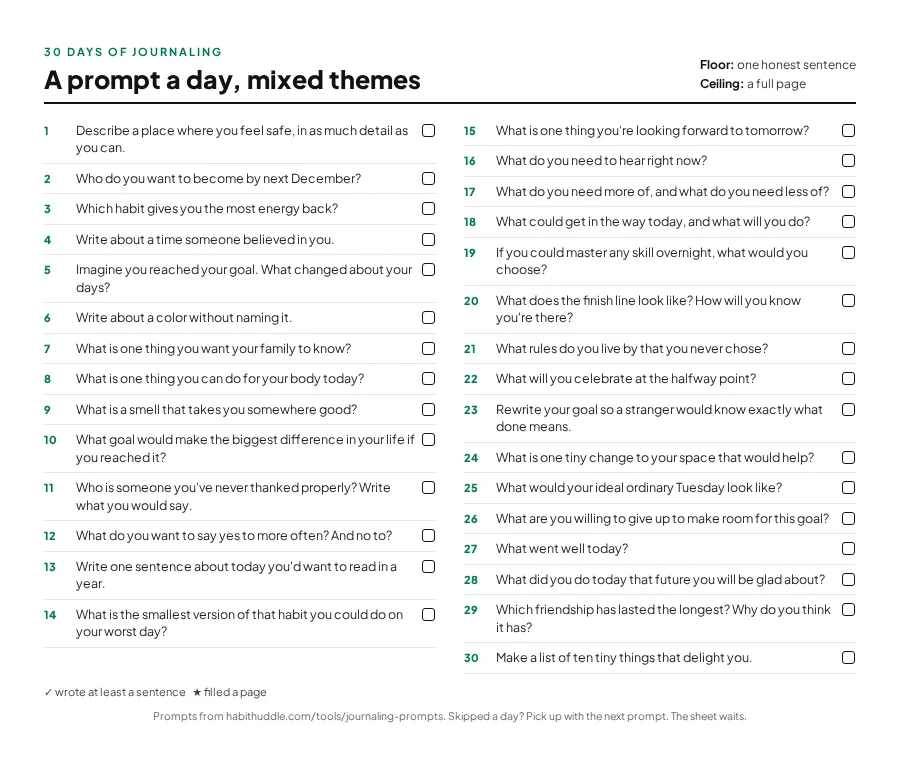
Print the 30-day prompt sheet to keep one question a day on paper. Tick the day when you write a sentence. Star it when you fill a page.
How to start a journaling habit that lasts
Make the floor tiny. One honest sentence counts. Most journals die in the second week because the bar was a full page every night, and the first busy night broke it.
Tie it to something you already do: coffee, the bus, the last minute before sleep. Keep the journal where that moment happens. A prompt removes the blank-page problem, so the only job is to show up.
Then make it social. You don't share what you write, only that you wrote. A daily checkin with a friend who journals too is the easiest way to keep going past day 14.
Journaling prompts for mental health
The calm prompts are gentle on purpose: what is taking up room in your head, what your body needs, what you can let go of. They help you notice and name things, which is often enough to make them lighter.
Psychologist James Pennebaker's research on expressive writing found that writing about thoughts and feelings for 15 to 20 minutes on a few days helped many people feel better. Journaling is not therapy, though. If writing brings up something heavy, stop, and talk to someone you trust or a professional.
Questions people ask
What should I write in my journal?
Anything true. If you are stuck, answer one prompt in a few sentences: what went well today, what is on your mind, what you are looking forward to. You do not need full pages or nice writing. One honest sentence is a journal entry.
How do I start journaling as a beginner?
Pick a time you already have, like coffee or bedtime, and a floor so small you cannot skip it: one sentence. Use a prompt so you never face a blank page. After two weeks, the habit is there and longer entries come on their own.
What are good journaling prompts for anxiety or stress?
Prompts that help you notice and sort: what is taking up the most room in your head, what you can control today and what you can let go of, what can wait until tomorrow, three things that are true and okay right now. The Calm theme has 25 of them. If anxiety is heavy or constant, please talk to a professional too.
How long should I journal each day?
Five to ten minutes is plenty for most people. Some days it will be one line, and that counts. Research on expressive writing used 15 to 20 minute sessions, so on days you want to go deeper, that is a good ceiling.
More free tools
All toolsPomodoro Timer
Focus blocks and breaks that run themselves, with custom lengths and a count of today's sessions.
1% Better Calculator
See what a year of one small daily habit actually adds up to.
Quit Drinking Calculator
What drinking, smoking, or vaping costs you a year, and what that buys instead.
A tool shows you the math. Friends make it happen.
Habit Huddle turns one small habit into a daily checkin your friends can cheer for. Free to start, solo or with your people.
Start Free