
Group Meditation Challenge Apps: 7 Ways to Meditate Together (2026)
The best group meditation challenge app depends on whether you sit together or apart. Compare 7 apps by cost, live sits, programs and friends.
 By Stevan Ljuljdurovic, founder of Habit Huddle
Updated November 7, 2026

📺 Related Video: How to Develop a Meditation Habit
Video by: Yongey Mingyur Rinpoche · Watch on YouTube
The best group meditation challenge app depends on one question: does your group want to sit at the same time, or just sit every day? For live sits with others, Insight Timer runs free live events, and Pinealage sets up small in-person groups near you. For one shared program, Medito's 30-day challenges are free for everyone. For friends who meditate at their own times and want to see each other show up, a challenge tracker like Habit Huddle (our app) works alongside any of them.
Most groups need two apps, not one: one to guide the sit and one to keep the group showing up. A meditation app teaches you to sit. A challenge app is about the people sitting with you.
We read every feature and price in this guide on each app's own site or store listing on November 7, 2026. We did not pay for each plan or run a challenge in every app, so treat this as a close read of what each company states. Nearly every page ranking for this search sells an app, and this one does too.
Sit together or sit apart: pick the kind of app first
Group meditation apps solve one of three problems: meeting at the same time, following the same program, or seeing each other show up. Few apps do all three, so start with the one your group lacks.

- Same time. Everyone sits together, live, by video or in person. This feels most like a class. It also needs a time that suits everyone, every day.
- Same program. Everyone follows the same 30-day course at their own time. It gives the group something to talk about, but the app rarely shows who else is doing it.
- Seeing each other show up. Everyone sits when it suits them and posts it where the group can see and cheer. This works across time zones and night shifts. It does not guide the sit itself.
Friends in three cities usually need the third kind plus a free guided app. A workplace usually needs a tool HR can run. A local group that wants to sit side by side needs the first kind.
Group meditation challenge apps compared
No single app covers every kind of group meditation, so this table sorts them by what the group shares.
| App | Kind | What the group shares | Cost | Best for |
|---|---|---|---|---|
| Insight Timer | Same time | Free live events and community groups | Free; Premium $9.99 a month or $59.99 a year | Live sits with teachers and strangers |
| Pinealage | Same time | In-person meetups of 4 to 7 people | Free download; Premium $6.99 a month | Meeting meditators in your city |
| Medito | Same program | Free 30-day challenges, no group features | Free, no account needed | One free program everyone can afford |
| Headspace | Same program | Shared exercises and a 30-day Guest Pass | $12.99 a month or $69.99 a year after a free trial | Beginners who want structured courses |
| YuMuuv | Seeing each other show up | A company mindfulness challenge | Not listed on its challenge page | Workplace challenges run by HR |
| thyme | Seeing each other show up | Groups with daily meditation and screen time goals | Free, iPhone only | Small friend groups on iPhone |
| Habit Huddle | Seeing each other show up | Daily checkins, cheers and a Checkin Chain | Free plan; pro features from $7.58 a month billed yearly | Friends who meditate at different times |
Apps for sitting at the same time
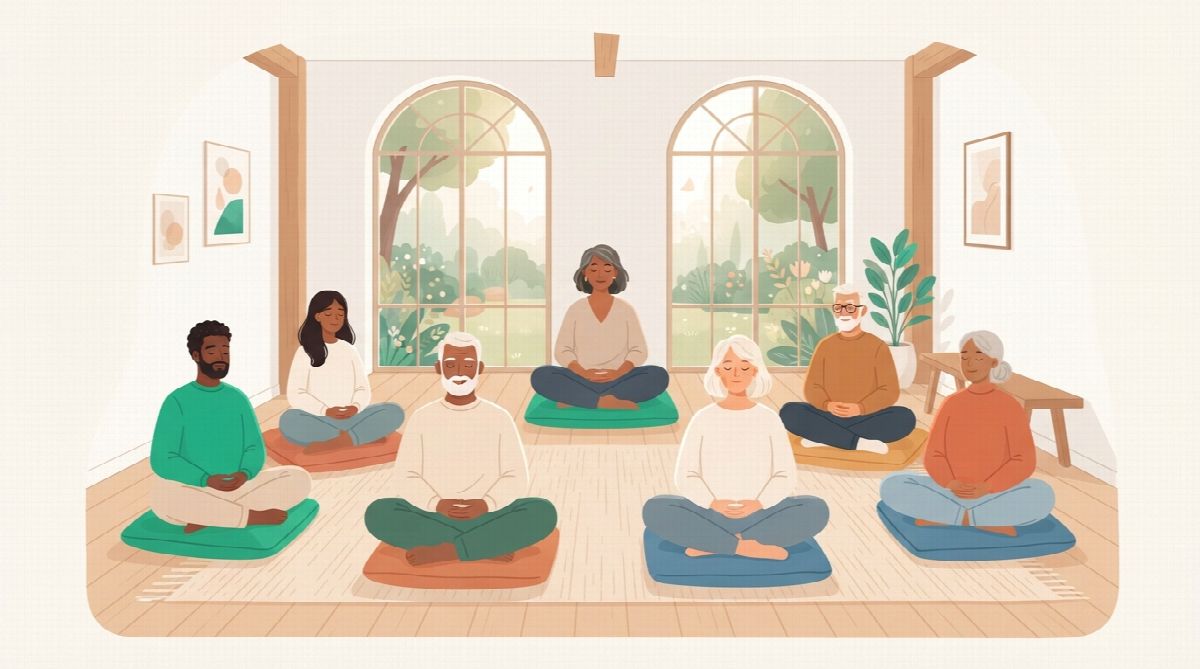
Sitting at the same time is the closest an app gets to a meditation class, and it works best when your group shares a time zone.
1. Insight Timer: free live events and community groups
Insight Timer calls itself the number one free meditation and sleep app, and its iPhone listing shows 4.9 stars from 449,000 ratings. Its Live page offers live sessions with teachers "every hour of the day for free." The free plan also lists community groups, a meditation timer, stats and milestones, and Apple Health mindful minutes. Premium adds courses and offline listening for $9.99 a month or $59.99 a year.
Good for: a group that wants to drop into the same live session, or sit unguided with a timer. Our guide to the online meditation timer covers unguided sits.
Trade-offs: its community groups are organized by interest, such as beginners or a tradition, and are open to strangers. Its listing describes no challenge your own friends can share.
2. Pinealage: small in-person groups near you
Pinealage matches nearby people by location and availability, then sets up in-person meetups. A Psychreg profile says groups usually have four to seven people, who vote on a public meeting place. Its Google Play listing shows Premium at $6.99 a month for unlimited meetups and priority matching.
Good for: people who want to sit beside real people and meet others who meditate.
Trade-offs: it only works where enough nearby people use it, and the Play listing shows 5,000+ downloads. It is not built for friends who live in different cities.
Also: live video
Satsanga runs guided group meditation over video chat, where you join or start a session. Its homepage lists no prices. Small groups can also open a recurring video call and sit with cameras on, which costs nothing and works with any guided track.
Apps for following the same program
A shared 30-day program gives everyone the same session to talk about, even when they sit at different times.
3. Medito: a free 30-day challenge for everyone
Medito is run by a nonprofit and has no paywall, no ads and no account. It offers three free 30-day challenges: Mindfulness, Compassion and Getting Active. Its iPhone app holds 4.9 stars from 4,300 ratings, and its code is open source. The listing mentions streak tracking and gentle reminders, and a recent update lets you set your own day boundary for streaks if you meditate late at night.
Good for: a group where cost matters. Everyone can start the same challenge on the same day for free.
Trade-offs: with no account, there are no friends or groups inside the app. Each person's streak is theirs alone, so the group needs another place to see each other.
4. Headspace: structured courses and a guest pass
Headspace's iPhone app holds 4.8 stars from 974,000 ratings, and its listing prices it at $12.99 a month or $69.99 a year after a free trial. Members can share an exercise or a 30-day Guest Pass with friends who are new to Headspace. After the 30 days, the guest is billed for an annual plan.
Good for: beginners who want a step-by-step course. Our review of whether Headspace is worth it covers the courses in detail.
Trade-offs: everyone pays for their own plan after the guest pass. We found no group challenge or friends list in its listing or on its sharing page.
Calm is the other big name. Its iPhone app holds 4.8 stars from 2 million ratings, and its listing describes daily streaks and mindful minutes. We found no friend or group features in it.
You already know you can change.
You just need to take the first step. Habit Huddle helps you build habits around your goals, alongside friends who keep you accountable.
Apps for seeing each other show up
Seeing friends' sits is what turns a meditation program into a challenge, and it works at any hour.
5. YuMuuv: a workplace mindfulness challenge
YuMuuv's mindfulness challenge is built for HR teams. YuMuuv runs a launch session, supplies communication templates, and adds reminders, progress tracking, rewards and engagement data. Participants log practice by hand or through Apple Health and Google Fit. The page shows 4.7 stars from 1,000+ reviews.
Good for: a company that wants an organized challenge with reporting.
Trade-offs: setup starts with a launch session with their team, and the page lists no price. That is more than a few friends need.
6. thyme: meditation and screen time with friends
thyme is a free iPhone app built around friend groups. Members complete daily meditation and screen time goals to help their group reach three stars a day. It also includes guided meditations and blocks the apps you choose for a window each day.
Good for: a small iPhone group that also wants to cut scrolling.
Trade-offs: its App Store page shows 6 ratings and a last update in August 2023, so test it before you plan a challenge around it. Android friends cannot join.
7. Habit Huddle: daily checkins with friends
This is our app, so judge the reasoning, not the placement. You and your friends join a huddle and each make one checkin a day after you sit. Friends cheer and reply to your checkin. Each member's checkin adds a link to the huddle's Checkin Chain, and your personal streak counts your days.
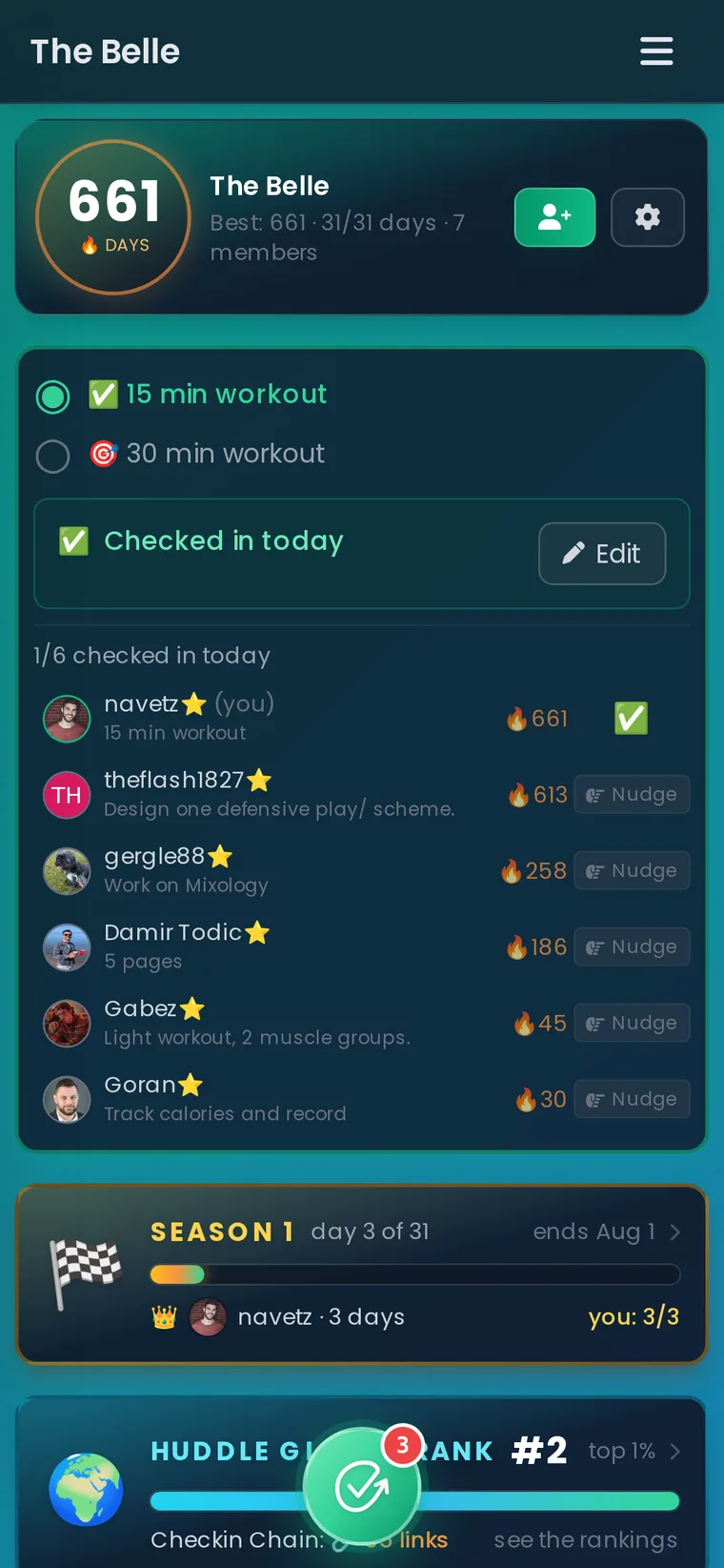
Every habit has a Floor, the smallest sit that still counts on a bad day, such as three slow breaths. Its Ceiling is the full session you burst through on a good day. Nothing announces a missed day to the group. The free plan covers one habit in each huddle, one huddle you lead, checkins with notes, cheers, reminders and a starter streak freeze. Joining a huddle is always free. It runs on the web, iPhone, Android and Discord. Pro features start at $7.58 a month, billed yearly.
Trade-offs, honestly:
- No guided audio. It has no meditations and no timer, so pair it with Medito, Insight Timer or Headspace.
- No live sessions. Everyone sits alone, at their own time, and checkins run on trust.
- Huddles are public to view. Exclusive huddles limit who can join, not who can see. You can use a display name.
- Some checkins are paid. Flex Checkins (how you log a Ceiling day), Photo Checkins and Night Owl Checkins (a sit after midnight that counts for yesterday) are pro features, unless a Habit Huddle Champion subscriber sponsors your huddle.
Does meditating with other people help you keep going?
Most people who start a meditation app stop within a month, and that is the problem a group is meant to solve. A 2019 study of 93 popular mental health apps measured real-world use on Android. On day 30, the median meditation app kept 4.7% of its users. The two peer support apps in the sample kept 8.9%, but two apps are too few to prove much.
Practice also matters for results. A meta-analysis of 43 studies (1,427 people) of MBSR and MBCT, the classic eight-week mindfulness courses, found participants did about 64% of their assigned home practice. That came to about 30 minutes a day, six days a week. More practice went with somewhat better outcomes (r = 0.26 across 28 studies). Both courses are usually taught as weekly group classes.
We know of no trial that tests a meditation app against a meditation group head to head. The closest strong evidence comes from another habit. In a weight loss trial of 166 people, 95% of those who joined with friends and got social support finished the program, compared with 76% of those who joined alone. From month 4 to month 10, 66% versus 24% kept all their weight off. That study was not about meditation, so treat it as a hint and not a verdict.
A group does not make sitting easier. It makes sitting again tomorrow more likely.
When people actually meditate: our data
Most meditation checkins on Habit Huddle happen in the afternoon or evening, not at dawn. We looked at the local time of each person's first meditation checkin of the day, from December 19, 2025 to November 5, 2026: 471 checkin days from 131 people across 136 meditation habits.
| Local time | Share of meditation checkin days |
|---|---|
| Midnight to 5am | 6.4% |
| 5am to 9am | 11.5% |
| 9am to noon | 15.9% |
| Noon to 6pm | 26.1% |
| 6pm to 9pm | 22.1% |
| 9pm to midnight | 18.0% |
Two in five (40.1%) came after 6pm. A checkin's time is when someone posted it, which may be a little after the sit. We left out staff accounts, one unusual day and days with no usable local time. The 2019 app study found a similar shape: meditation app use peaked twice, in the morning and at night.

Two lessons for your challenge:
- Don't make it a sunrise challenge unless your group already gets up early. Let everyone pick their own time.
- Agree when the day ends. A sit at 12:30am can count for today or yesterday, so decide before day 1. Medito lets you move your streak's day boundary, and Habit Huddle uses Night Owl Checkins.
How to run a 30-day group meditation challenge
A good group meditation challenge has a tiny daily minimum, one shared guided app and one place to show up.
- Pick the kind. Sit at the same time if you share a time zone and a schedule. Sit apart if you don't.
- Set a Floor and a Ceiling. The Floor is the smallest sit that counts, like two minutes or three slow breaths. The Ceiling is the full session, such as 10 or 20 minutes. YuMuuv's FAQ calls 5 to 10 minutes a day a common workplace goal.
- Choose one free guided app. Medito's 30-day Mindfulness challenge works because nobody has to pay.
- Set a start date and an end date. Thirty days is long enough to build a routine and short enough to commit to. Our free 30-day challenge tracker prints a page for each person.
- Post after each sit. One line is enough: how long, and one thing you noticed. Cheer the people who posted before you.
- Plan for a missed day. In a study of 96 volunteers building a daily habit over 12 weeks, missing one opportunity did not materially affect how the habit formed. Sit again the next day.
If sitting still makes you anxious, start with short guided sessions with your eyes open. Our guide to the fear of meditation explains why it happens.
Which group meditation app fits your group
Pick by what your group is missing, not by the longest feature list.
- You want to sit at the same time: Insight Timer's live events, or a recurring video call.
- You want to meet in person: Pinealage, if enough people near you use it.
- You want one free program for everyone: Medito.
- You want structured lessons and can pay: Headspace.
- You are running it at work: YuMuuv.
- Your friends meditate at different times and want to cheer each other on: Habit Huddle, plus a free guided app.
For challenges beyond meditation, see our list of the best group challenge apps, or how a habit tracker with friends works.
Start a meditation huddle
Pick a free guided app, then start a huddle for the sit itself. Set a Floor of two minutes, invite two friends and pick a start date. It is free to start.
Ready to Build Habits With Friends?
Stop failing alone. Join thousands using the #1 habit tracker with friends for real accountability and lasting results.
Prefer mobile? App Store · Google Play
Related Guides
More Habit Huddle articles on building habits with accountability.

75 Hard vs 30 Hard: Rules, Real Differences and Which to Do First
30 Hard runs the 75 Hard tasks for 30 days, but it is not official. Compare the rules, what a restart costs, and which one to start with.

Beeminder Alternatives: 8 Options by the Part You Want to Keep (2026)
The best Beeminder alternatives for 2026, sorted by what you want to keep: the money, the data or the pressure. Prices read from each app in November.

Forfeit App Alternatives: 7 Options by Why You Are Leaving (2026)
The best Forfeit app alternatives for 2026, matched to what you want to drop: the subscription, the proof or the money. Prices read from each app in November.