
ADHD Habit Tracker: What Actually Works When Your Brain Fights Routine
Why habit trackers fail ADHD brains and what works instead: low floors, forgiving streaks, body doubling, and real accountability. Find your fit.

📺 Related Video: How to Stick to Habits and Routines Without Falling Off!
Video by: How to ADHD · Watch on YouTube
If you have ADHD and you are searching for a habit tracker, you have probably already tried one. Maybe several. They worked for about two weeks, the novelty wore off, the app disappeared from your mental landscape, and the streak you were proud of turned into a guilt trip in icon form.
Here is the short answer this page owes you: the best ADHD habit tracker is not the one with the most features. It is the one that supplies motivation from outside your own head, forgives a missed day instead of punishing it, and takes less than ten seconds to log. Most trackers are built on the assumption that seeing your own progress is motivating enough. For most ADHD brains, it is not. The rest of this guide explains why that is, what to look for instead, and which type of tracker fits the way your brain actually runs.
Why habit trackers fail ADHD brains
Generic habit tracker advice assumes the hard part is remembering. For ADHD, remembering is only the first of four failure points.
The novelty cliff. A new app is interesting, and interest is fuel. ADHD brains are wired to chase novelty, so week one feels effortless. But the app itself is a habit you now have to maintain, and once it stops being new, opening it becomes one more routine task your brain resists. The tracker quietly joins the graveyard of abandoned systems.
Out of sight, out of existence. If the tracker lives behind two taps and a folder, it may as well not exist. ADHD working memory does not hold "log your habit tonight" alongside everything else the day throws at it. Anything that depends on you spontaneously remembering the tracker will fail exactly on the days you needed it.
All-or-nothing streak collapse. Classic streak mechanics are brutal for ADHD. One missed day resets the counter to zero, and a zero after 34 days of effort does not read as "start again tomorrow." It reads as proof the whole project failed. Researchers call the resulting spiral the abstinence violation effect; anyone with ADHD just calls it Tuesday. One miss becomes a week of misses because the number that was motivating you is gone.
The shame spiral. Many adults with ADHD carry years of "you have so much potential" feedback and are quick to turn a missed checkbox into a verdict about their character. A tracker that greets you with a broken streak and a gray calendar of missed days is not neutral data. It is an accusation, and the natural response is to stop opening the app.
None of this means tracking is useless for ADHD. It means the tracker has to be built, or at least configured, around these failure points instead of pretending they do not exist.
What actually makes a habit tracker ADHD-friendly
When you evaluate any tracker, an app, a paper chart, or a spreadsheet, test it against these five requirements.
- Logging takes seconds, not minutes. Every extra tap is a place to lose the thread. If logging a habit requires navigating menus, you will not log it on hard days, and hard days are the whole point.
- Motivation comes from outside your head. Gamification, real people, or real consequences. ADHD brains struggle to generate motivation for routine tasks from willpower alone, so the tracker has to import it. This is the single biggest difference between trackers that survive and trackers that do not.
- A missed day is recoverable. Look for grace mechanics: streak freezes, forgiving reset rules, or framing that leads with your record instead of your failure. The question is never whether you will miss a day. It is what the tracker says to you the morning after.
- The daily bar is embarrassingly low. The tracker should let you define success as the smallest action that still counts, not the ideal version of the habit. More on this below, because it matters more than app choice.
- It appears where your attention already lives. Widgets, reminders that arrive at the right moment, or a bot inside the chat app you already have open. A tracker you have to seek out will lose to one that shows up.
Notice what is not on this list: charts, analytics, unlimited habit slots, AI insights. Those are nice for brains that are already consistent. They do nothing for the week-three abandonment problem.
Set the floor low enough to step on every day
The highest-leverage change you can make with any tracker is redefining what counts as done.
Most people set habit targets for the person they want to be: 45 minutes at the gym, 30 minutes of reading, a full tidy of the kitchen. Then a low-dopamine day arrives, the full version feels impossible, and the day gets logged as a miss even though a smaller version was completely doable.
The fix is to give every habit a floor: the smallest action that still fully counts. One pushup. One page. One glass of water. The floor is not a consolation prize, it is the habit. Showing up at the floor keeps the pattern alive in your brain and keeps the tracker showing wins, which is what keeps you opening it. On good days you will often do far more than the floor once you have started, because for ADHD the hard part is almost always starting, not continuing.
This matters doubly for ADHD because energy and executive function genuinely fluctuate day to day. A bar that fits Monday's brain will not fit Thursday's. The floor is the bar that fits every version of you, and it takes longer than most people think for a habit to become automatic, so the system has to survive your worst weeks, not just your first one.
Body doubling: borrow someone else's presence
If external motivation is the requirement, body doubling is the ADHD community's proof that it works.
Body doubling means doing a task in the presence of another person, even if they are doing something completely different. The other person is not helping, coaching, or supervising. They are just there, and somehow the dishes get done. ADDitude has documented the technique for years, and clinicians take it seriously: the Cleveland Clinic describes body doubling as a legitimate, low-risk strategy for getting started on tasks that ADHD brains otherwise defer.
The usual explanation is a mix of gentle social pressure, an anchor for wandering attention, and the mild stakes of another human noticing whether you follow through. You do not need to fully understand the mechanism to use it.
Body doubling comes in two forms, and habit trackers can only give you one of them:
- Synchronous: a friend on a video call while you both work, a study-with-me stream, a gym buddy. Powerful, but it needs scheduling, which is its own executive function tax.
- Asynchronous: a small group that sees whether you did the thing today, without needing to be online at the same moment. This is the form a habit tracker can actually deliver, and it is the feature to look for if solo tracking has repeatedly failed you. A checkin that lands in front of three people who will notice its absence carries a different weight than a checkbox only you will ever see. It is accountability, the async cousin of body doubling.
The best ADHD habit tracker, by brain type
There is no single best app. There is a best app for the specific way your motivation fails. This list is organized by that.
If you need a game: Habitica
Habitica turns habits into a retro RPG. Your avatar earns gold and XP for completed habits and takes damage for misses, and party quests mean your teammates suffer if you skip. For dopamine-driven brains that love games, this is genuinely effective, and the party system adds real social stakes. The risk runs the other direction: the RPG layer is itself complex, and when the game stops being novel, the whole system can fall with it. Gamers tend to love it. Everyone else tends to bounce off within a month.
You already know you can change.
You just need to take the first step. Habit Huddle helps you build habits around your goals, alongside friends who keep you accountable.
If shame is your failure mode: Finch
Finch has you raise a small virtual bird by doing self-care tasks. Nothing bad ever happens when you miss a day. The bird never gets sick, never guilts you, and greets you warmly when you return. For people whose tracker history is a series of shame spirals, that zero-punishment design is the point. The trade-off is that Finch is soft by design: if your problem is that nothing external pushes you, a bird that is happy no matter what will not push you either.
If friction is your failure mode: Streaks
Streaks (iOS, one-time purchase) gives you six habit slots, huge tappable rings, and deep Apple Watch integration, so logging takes about two seconds from your wrist. The six-slot cap is a feature for ADHD: it forces prioritization and prevents the classic mistake of tracking fourteen habits at once. It is solo tracking with classic streak mechanics though, so everything in the failure-points section above still applies. Best for people whose only real problem is friction.
If screens are the problem: a paper tracker
A printable habit grid on the fridge is the most ADHD-friendly display technology ever invented: permanently visible, zero taps, satisfying to mark. Several sites offer free ADHD-specific printables. Paper's weakness is everything else: no reminders, no grace mechanics, no one sees it but you, and the grid of empty boxes after a bad week can trigger the same shame spiral as an app. Works best paired with a human who asks about it.
If you need people: Habit Huddle
Full disclosure: Habit Huddle is our app, so judge the reasoning rather than the placement.
Habit Huddle is built around the asynchronous body doubling described above. You pick one habit, set a floor (the "Just Show Up" level, the smallest action that fully counts), and do your daily checkin inside a huddle: a small group of people running their own habits alongside you. Your checkin lands in front of people who notice, applaud, and reply. The huddle also builds a shared Checkin Chain, one link added for every member who checks in each day, so showing up at your floor contributes to something the group owns together. When a chain breaks, the app leads with the record and the restart, not the failure.
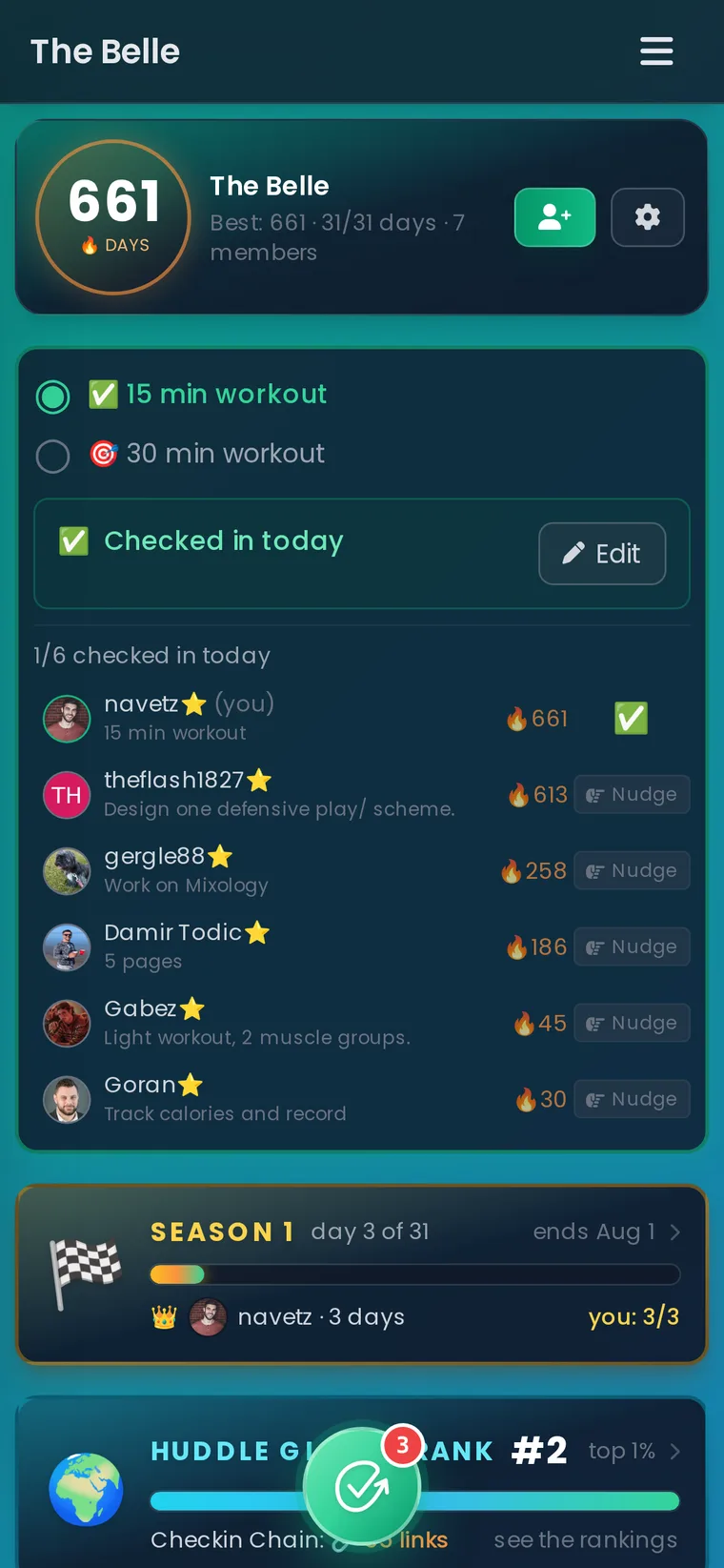
Because the accountability loop is the product, it follows you to where your attention already is: web, iOS, Android, and a Discord bot, so a huddle that already talks on Discord can do checkins without opening another app. Tracking one habit with a huddle is free.
The trade-offs are real. Habit Huddle is deliberately narrow: one behavior at a time on the free plan, not a fourteen-habit dashboard, and there are no ADHD-specific analytics. And the social mechanism only works if your huddle is alive. Three engaged friends beat thirty strangers, and a silent group gives you little more than a solo tracker would. If visibility to others sounds stressful rather than steadying, one of the solo options above will serve you better.
If you need consequences: blocker-style trackers
A newer category (Locky is the best-known example) holds your distracting apps hostage until your habits are done. That is external motivation in its bluntest form: no TikTok until the bed is made. For some ADHD brains this is the only thing that has ever worked, and the immediacy is exactly right. The risks are that it can feel punitive over time, and any system built on restriction invites elaborate workarounds from a brain that treats restrictions as puzzles.
Make any tracker survive week three
Whichever tool you pick, the setup determines whether it outlives the novelty cliff.
- Track one to three habits, never more. Every habit you add divides your attention and multiplies the chance of a bad-day wipeout. Start with one. You can add more after a month of consistency.
- Anchor the habit to something that already happens. "After I pour my morning coffee, I do my one pushup" beats any reminder notification, because the coffee happens regardless of your working memory. These habit stacking examples show the pattern for common routines.
- Size the floor for your worst day, not your average one. If the floor is not doable on a day when everything went wrong, it is not a floor yet.
- Recruit a witness. A friend with the same goal, a group chat, or a huddle. What matters is that a specific human will notice the absence of your checkin. If you are not sure how to structure that, here is what an accountability partner actually does.
- Plan the restart, not just the streak. Write down, in advance, what you will do the morning after a miss: log the miss without commentary and do the floor version before noon. A pre-decided restart is the single best defense against the one-miss-becomes-a-month spiral.
- Put the tracker in your line of sight. Widget on the home screen, paper on the fridge, bot in the Discord server you already read. Never inside a folder.
Try tracking with people instead of promises
If you have cycled through solo trackers and the pattern is always the same, two good weeks and a quiet abandonment, the missing ingredient is probably not a better app. It is other people. That is the entire bet behind Habit Huddle: one habit, a floor you can step on every day, and a huddle of real people who see your checkin and build a chain with you. It is free to start with one habit, and it works in the browser, on iOS and Android, or through the Discord bot. If your brain refuses to be accountable to an app, stop asking it to be. Be accountable to people, and see our guide to picking a habit tracker you can use with friends if you want to compare options first.
Ready to Build Habits With Friends?
Stop failing alone. Join thousands using the #1 habit tracker with friends for real accountability and lasting results.
Prefer mobile? App Store · Google Play
Related Guides
More Habit Huddle articles on building habits with accountability.

HabitShare Alternatives: 6 Apps for Tracking Habits With Friends (2026)
Looking for a HabitShare alternative? Six social habit trackers compared by model, price, platforms, and what happens on a missed day, plus how to switch wit...

What to Do When You Miss a Workout Day: The 5-Step Comeback Plan
Missed a workout day? What one miss does to your body and habit, according to research, plus a five-step plan for the next 24 hours, when to make it up, and...

Habit Streak App With Friends: 7 Apps Compared (2026)
Seven habit streak apps with friends compared: Habit Huddle, HabitShare, Daily Pact, Habitica, Streaks, Habit Streak duels, HabitStreak.io. What friends see,...