
Body Doubling App: 7 Options Compared, from Live Video to Daily Checkins (2026)
Seven body doubling apps compared: Focusmate, Flow Club, Focus101, Dubbii, Caveday, Flown and Habit Huddle, with free tiers, prices, and which format fits ta...

📺 Related Video: What is a "body double," and how does it help?
Video by: How to ADHD · Watch on YouTube
A body doubling app connects you with another person, live or asynchronously, so that their presence helps you start and finish a task you keep putting off. The best-known ones run scheduled video sessions with a stranger or a small group. A quieter category runs on daily checkins instead of live calls, and works better for habits than for one-off tasks.
Below are seven apps compared on format, free tier and price, with the trade-offs of each, plus a short guide to picking the format that fits what you are actually trying to get done. One of the seven is ours, and it says so.
What a body doubling app actually does
Body doubling is using another person's presence to stay on task, and a body doubling app supplies that presence on demand. The term came out of the ADHD community rather than a lab. The first academic study of it, a 2023 survey of 220 people by Tessa Eagle, Leya Breanna Baltaxe-Admony and Kathryn Ringland, found that most participants had used the technique long before they learned its name, and that it covered far more than desk work: studying, dishes, exercise, admin, and the kind of chores that are trivial to do and impossible to start.

The same study proposed that body doubling sits on two continuums. One is space and time: the double can be in the room, on a video call, or simply somewhere you know they are working at the same hour. The other is mutuality: they can be doing the same task as you, a different task alongside you, or just present while you work. Apps differ mainly in where they sit on those two lines, which is why "which body doubling app is best?" has no single answer. A live one-to-one video call and a daily checkin from a friend are both body doubling. They are just built for different jobs.
The How to ADHD channel's explainer below is the clearest short version of why the presence of another person changes what your brain is willing to start.
7 body doubling apps compared
The table lists what each app is, what you get free, and what the paid tier costs. Prices were read from each company's own pricing page or App Store listing in September 2026 and can change; treat them as a starting point, not a quote.
| App | Format | Free tier | Paid | Best for |
|---|---|---|---|---|
| Focusmate | One-to-one video sessions with a matched partner | 3 sessions a week | $8/mo billed yearly, $12/mo monthly | Deep work, writing, anything you keep postponing |
| Flow Club | Hosted group video sessions with a shared agenda | Free trial | $40/mo or $400/yr, 50% off for students and non-profits | People who want structure and a host |
| Focus101 | Matched one-to-one sessions plus group focus rooms | 5 sessions a week, unlimited group rooms | $5.50/mo, $55/yr, or $249 lifetime | Budget-conscious daily users |
| Dubbii | Guided task videos plus live and drop-in sessions, built for ADHD | Free to download | In-app subscription | Chores, self-care routines, admin |
| Caveday | Facilitated three-hour "caves" with sprints, breaks and a guide | 14-day trial | Starter pass $105 per three months | Long blocks of focused work |
| Flown | Group focus sessions and a members' community | Free trial | Paid membership, see site for current rates | Remote workers who want a community around focus |
| Habit Huddle | Daily checkins with friends in a huddle, async | 1 habit you actively track | Paid tiers for more habits and extras | Daily habits rather than one-off tasks |
1. Focusmate
Focusmate is the reference point for live body doubling: you book a 25, 50 or 75 minute slot, get matched with one other person on video, each say what you are going to do, work in near-silence, and report back at the end. The free plan gives you three sessions a week with no card; the Plus plan is $8 a month billed yearly or $12 monthly for unlimited sessions. Focusmate's own pricing page notes that most virtual coworking services start at $20 to $40 a month, which matches what we found.
Best for: tasks you have been avoiding for days, where a fixed appointment with a stranger is exactly the pressure you need. Trade-off: it is an appointment, so it does not help with the small daily things you need to do at 7am with no session booked.
2. Flow Club
Flow Club runs hosted group sessions: a host opens the room, everyone posts their goals, music plays, and the host closes with a round of what got done. It is $40 a month or $400 a year, with a 50 percent discount for students and non-profits and for members who host enough sessions. The host is the difference; sessions feel more like a class than a call.
Best for: people who work better with a facilitator and a set structure. Trade-off: the most expensive option here by a wide margin, and the group format is less personal than a one-to-one match.
3. Focus101
Focus101 pairs you with a buddy for a video session, or drops you into a group focus room, and is the cheapest paid option on the list. The free tier includes five focus sessions a week and unlimited group rooms; premium is $5.50 a month, $55 a year, or $249 for life, and mainly buys HD video and unlimited sessions. You can favourite a buddy and make them a regular.
Best for: people who want Focusmate's model at a lower price and do not mind a smaller pool of partners. Trade-off: smaller community means less predictable matching at off-peak hours.
4. Dubbii
Dubbii is a body doubling app built specifically for ADHD by the couple behind the ADHD Love channel. Instead of matching you with a person, it gives you videos of a host doing the same task alongside you: dishes, laundry, a shower, opening the mail. It also hosts live body doubling sessions and drop-in focus rooms. It is free to download on the App Store with a subscription inside, and its listing claims over 500,000 people helped.
Best for: the chores and self-care tasks that no productivity app takes seriously. Trade-off: the videos are a one-way double; nobody is watching you, which for some people is the point and for others removes the accountability.
5. Caveday
Caveday runs facilitated deep-work "caves": three-hour blocks broken into sprints, with a guide who collects intentions at the start and a quick round of progress at each break. Pricing on the site is a $105 starter pass for three months, with a 14-day free trial. It is the most structured option here.
Best for: knowledge workers who want a full morning of protected focus with a small crowd. Trade-off: three-hour blocks are a commitment, and the price is closer to a coworking membership than to an app.
6. Flown
Flown offers group focus sessions and a members' community for remote workers, with a free trial before a paid membership. Its pricing is not shown as plain text on the pricing page, so check flown.com for current rates before comparing. It sits between Flow Club and Caveday in feel.
Best for: remote workers who want focus sessions with a community around them. Trade-off: less transparent pricing, and like every live option it only helps during a session.
7. Habit Huddle
Habit Huddle is our app, so read the reasoning and judge it for yourself. It is the asynchronous end of the body doubling continuum: every habit you track is a huddle, solo or with friends, and the double is the friend who checks in for the same habit each day. Nobody is on a call. Each habit carries a Floor, the smallest version that fully counts, and a Ceiling for the good days, so the checkin on a bad day is a real checkin. Friends cheer each other's checkins, and a huddle keeps a Checkin Chain that adds one link for every member who checks in that day. Checkins work from the web, the iOS and Android apps, or a Discord bot, so a study server can run it in a channel.
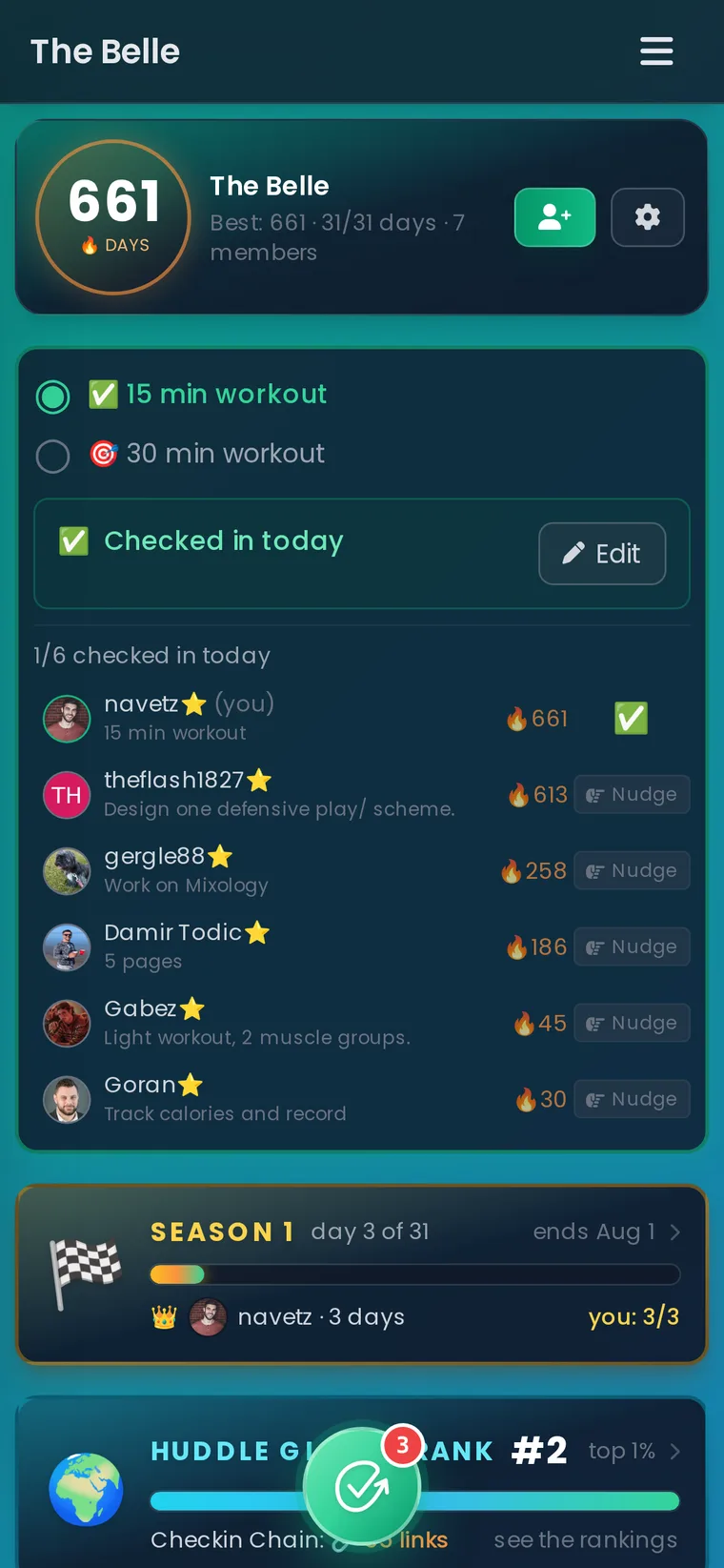
The free plan covers one habit you are actively tracking; paid tiers add more habits and extras. Best for: the daily things, meds, a walk, a page of reading, a study block, where what you need is a person who is doing it too. Trade-off: it is not a live session, so for a single dreaded task on a Tuesday afternoon a Focusmate slot will beat it. Many people use both: a live double for the task, an async double for the habit.
You already know you can change.
You just need to take the first step. Habit Huddle helps you build habits around your goals, alongside friends who keep you accountable.
Free ways to body double without an app
Body doubling does not require an app, and the 2023 survey found people already doing it at cafés, on YouTube and over text. If you want to try the technique before paying for it:
- A "study with me" video. Hours-long videos of someone working at a desk are a one-way double, the same model as Dubbii. Free and always available.
- A Discord accountability channel. Post what you are about to do, work, post that you did it. Our guide to study accountability Discord servers covers how to find one with a live daily channel.
- A friend on a silent call. Two people, one voice call, cameras optional, no talking. The oldest version of the technique.
- A café or library. Presence without any technology at all.
The app versions add matching, scheduling and a record. Whether that is worth paying for depends on the job.
Which format fits which job
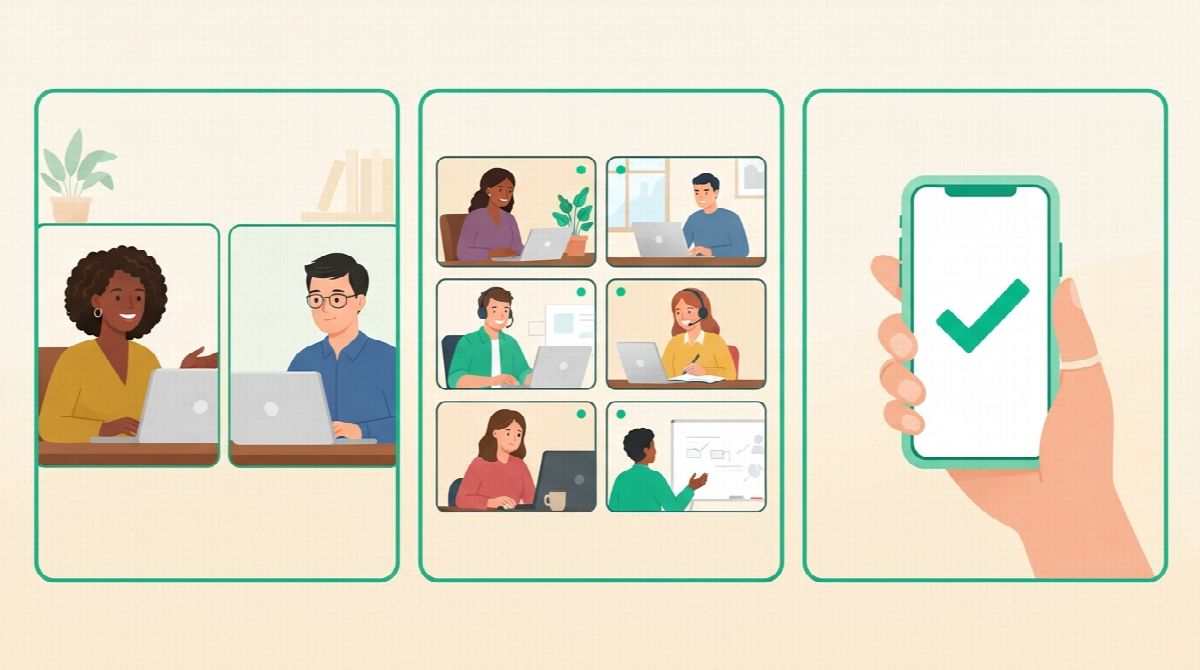
Live one-to-one sessions fit tasks, group sessions fit routines, and async checkins fit habits. Most people who bounce off a body doubling app picked the wrong format for the job rather than the wrong app.
| What you are trying to do | Format that fits | Apps |
|---|---|---|
| Finish one thing you have avoided for days | Live one-to-one session | Focusmate, Focus101 |
| Protect the same working block every day | Hosted group session | Flow Club, Caveday, Flown |
| Get through chores or a self-care routine | Guided task video or live drop-in | Dubbii |
| Keep a daily habit going for weeks | Async checkins with friends | Habit Huddle, a Discord channel |
| Try the technique free | Any of the no-app options above | none needed |
Two questions settle it. Is this a task or a habit? A task ends; a habit repeats, and a live session cannot be booked for every repetition. And do you need someone watching, or someone alongside? Focusmate is watching. A study-with-me video is alongside. Some people find watching motivating and others find it paralysing, and the 2023 survey found both groups in its 220 participants.
How to make body doubling stick
Body doubling works best when the session is scheduled before you need it, the goal is stated out loud, and the same double shows up more than once. Each of those turns a one-off boost into a routine.
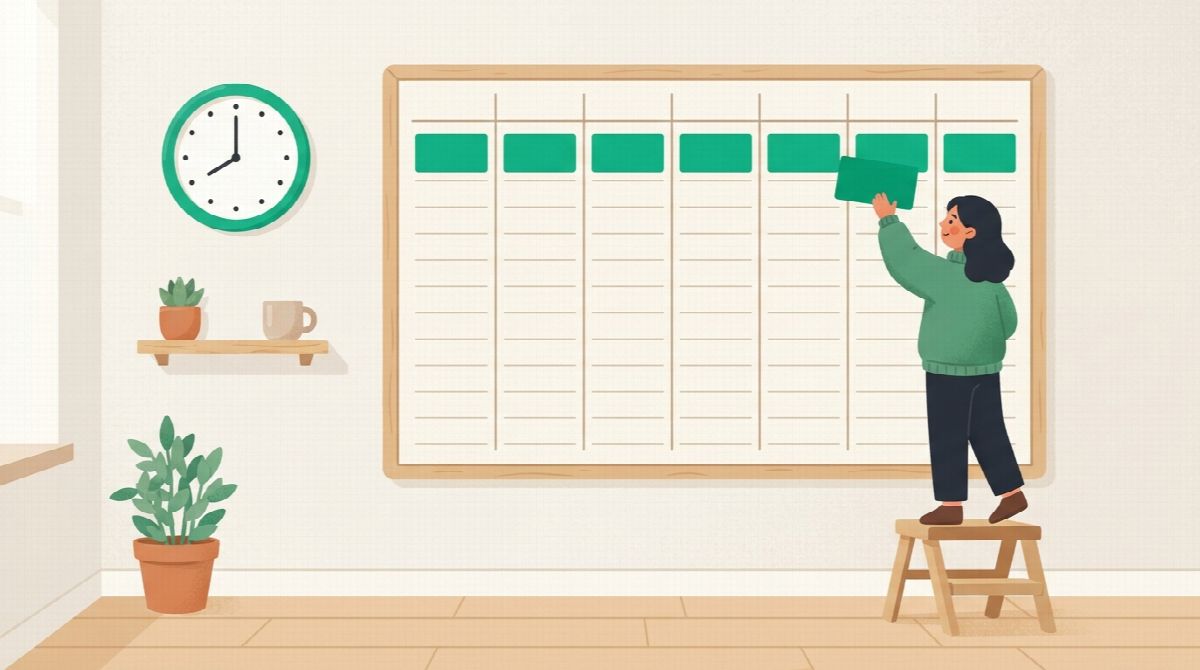
Book it before the day starts. A session booked at 9pm for 9am tomorrow removes the decision from the moment you least want to make it. Every live app lets you schedule ahead; use it.
Say the goal in one sentence. "Write the intro" beats "work on the report". Both Focusmate and Focus101 build this into the first minute of the session, and it is why the format works: a stated goal to a witness is a commitment.
Set a Floor for the session. Decide the smallest outcome that makes the session a success, so a bad session is still a checked box. For a habit, the Floor is the version you can do on your worst day. Get that right and the double's job is just to be there.
Keep the same double. Focus101 lets you favourite a partner; Focusmate lets you rebook with people you liked; in a huddle the double is a friend you chose. Familiar presence is stronger presence, and the survey's mutuality dimension is exactly this: the more the other person is in it with you, the more it helps.
Know when to switch formats. If you have run the same live session every morning for three weeks, the task has become a habit, and a habit is cheaper to keep with a daily checkin than with a daily booking. Move it to the async layer and free the session slot for the next hard thing.
Body doubling for habits, not just tasks
Body doubling was named for tasks, but its most common use in the 2023 survey was routines: studying, exercise, the dishes, the things that come back every day. For those, the double you need is not a stranger for 50 minutes but a person who is doing the same thing on the same days, and a way to see that they did.
That is a huddle. Pick the habit, set the Floor, invite one or two people, and the daily checkin is the body double. If you want to compare the broader field of accountability tools first, our best accountability apps page covers the partner, group and stakes-based models side by side, and the ADHD habit tracker guide goes deeper on why the Floor matters for brains that resist starting. When you are ready, start a huddle at /app and invite your double.
Frequently asked questions
What is the best free body doubling app?
Focusmate's free plan (three one-to-one video sessions a week, no card required) is the most generous live option, and Focus101 gives five free sessions a week plus unlimited group rooms. For daily habits rather than tasks, Habit Huddle's free plan covers one habit with friends. "Study with me" videos on YouTube are free and need no account at all.
Does body doubling work for people without ADHD?
Yes. The technique came out of the ADHD community, but the 2023 survey of 220 people found neurotypical participants using it for the same reasons: generating momentum and staying on task. Most participants had used it long before they knew the name.
Is Focusmate worth paying for?
If you use more than three sessions a week, yes; Plus is $8 a month billed yearly or $12 monthly for unlimited sessions, cheaper than almost every alternative. If three sessions a week covers your hard tasks, the free plan is enough.
Can I body double over Discord?
Yes. Many study and accountability servers run a daily channel where members post what they are starting and what they finished, and some run voice channels as silent coworking rooms. Habit Huddle's Discord bot adds a checkin command to a channel so the record persists.
What is the difference between body doubling and an accountability partner?
Body doubling is presence during the work: someone alongside you while you do it. An accountability partner is a check afterwards: someone you report to. Live apps like Focusmate are body doubling; a daily checkin to a friend is closer to accountability, though the survey's authors treat both as points on the same continuum.
Ready to Build Habits With Friends?
Stop failing alone. Join thousands using the #1 habit tracker with friends for real accountability and lasting results.
Prefer mobile? App Store · Google Play
Related Guides
More Habit Huddle articles on building habits with accountability.
Easy Habit Challenge for Beginners: 20 Ideas You Can Actually Finish
20 easy habit challenges for beginners, each with a two-minute Floor and a stretch Ceiling, plus how long to run one, the four rules that get you past week t...
How Long Does It Take for Exercise to Become a Habit? What Five Studies Found
Exercise takes about six weeks to feel automatic and months to become reliable. What five studies of new gym members actually found, why exercise is slower t...

The Fresh Start Effect: Why January 1 Feels Different, and How to Make It Last
The fresh start effect explained: the 2014 Wharton research behind January motivation, the numbers for Mondays and birthdays, a 2026-2027 fresh start calenda...