
Reading Challenge App With Friends: 8 Apps Compared (2026)
Eight reading challenge apps for friends compared: Goodreads, StoryGraph, Fable, Bookclubs, ReadRats, Reading Rivals, BookBuds, Habit Huddle. What friends se...

📺 Related Video: How I Read 100 Books a Year - 8 Tips for Reading More
Video by: Ali Abdaal · Watch on YouTube
The best reading challenge app with friends depends on what the challenge is actually about. If it is about finishing a number of books, Goodreads and StoryGraph already do that for free. If it is about talking through the same book, Fable and Bookclubs are built for it. If your friends want a scoreboard, ReadRats, Reading Rivals, and BookBuds turn pages and minutes into rankings. If the real goal is that everyone reads a little every day, a daily checkin app like Habit Huddle fits better than any book tracker.
Most friend groups pick the wrong category first. They start a yearly book-count challenge in January, nobody looks at it in March, and the group chat goes quiet. Eight apps are compared below by what friends can actually see, what happens when someone misses, and what it costs. The short version: pick the app that matches the daily behavior you want, not the one with the prettiest bookshelf.
The four kinds of reading challenge apps

Every reading challenge app with friends falls into one of four kinds, and the kind decides whether the challenge survives past week three.
Book counters. You set a number of books for the year and log each finish. Friends can see your total. Goodreads and StoryGraph are the big ones. Great for readers who already read; useless for the friend who has not opened a book since June, because a yearly number gives them nothing to do tonight.
Discussion apps. The challenge is a shared book, read at a shared pace, with chapter discussion along the way. Fable and Bookclubs live here. The pace keeps people moving, but the group has to agree on one book, and the slowest reader sets the tempo.
Competition apps. Pages, minutes, or sessions become points on a leaderboard, usually inside a time-boxed challenge. ReadRats, Reading Rivals, and BookBuds are the current crop, all small and mostly new. Fun for a month with competitive friends; hard on the friend reading a dense 600-page history while everyone else logs novellas.
Daily checkin apps. The challenge is simply "read today," logged with one tap, and friends see today's checkins. Habit Huddle is one; any habit tracker with friends can play this role. Nothing about the book is tracked, which is either the point or the deal-breaker.
A useful way to choose: ask what a friend should be able to do on a random Tuesday night. Log a finished book? Comment on chapter nine? Post 24 pages to a leaderboard? Or tap once to say "I read"? The answer picks the category, and the category narrows eight apps to two or three.
Comparison table
All prices and platforms are as of September 2026 and taken from each app's site or App Store listing. Check before you commit; early-access apps change fast.
| App | Challenge type | What friends see | On a missed day | Price | Platforms |
|---|---|---|---|---|---|
| Goodreads Reading Challenge | Books per year | Your yearly count and finished books | Nothing; the count just waits | Free | iOS, Android, web |
| StoryGraph | Books per year, buddy reads | Progress and spoiler-locked comments in buddy reads | Nothing | Free, paid Plus tier | iOS, Android, web |
| Fable | Book clubs with chapter discussion, reading goals, daily streaks | Club progress and discussion | Daily streak stops | Free to download | iOS, Android, web |
| Bookclubs | Club organizing: polls, meetings, reminders | Meeting RSVPs, polls, message board | Nothing | Free to download | iOS, Android, web |
| ReadRats | Time-bound challenges scored by pages, minutes, sessions, or books | Live ranking with a podium | You drop in the ranking | Free during early access | Web app, mobile apps announced |
| Reading Rivals | Daily streaks, time-boxed quests, friend leaderboards | Streaks, quest progress, leaderboard | Streak resets | Free, readers 13 and older | Web app |
| BookBuds | Timed reading sessions, daily streaks, shared leaderboard | Live sessions and leaderboard | Streak stops | Free to download | iOS |
| Habit Huddle | Daily reading checkin with a Floor and Ceiling | Today's checkins and the huddle's Checkin Chain | Nothing shown to anyone; a freeze can cover it | Free for one tracking habit, paid tiers for more | iOS, Android, web, Discord bot |
Goodreads Reading Challenge
The Goodreads Reading Challenge is the most-used reading challenge with friends because almost everyone already has an account. You pledge a number of books for the year, mark books as read, and your friends see your progress bar. It is free and owned by Amazon, and the app carries hundreds of thousands of App Store ratings.
The weakness is daily motivation. A pledge of 24 books gives you no instruction for tonight, and a friend who is eight books behind in October sees a bar that says so. Nothing in Goodreads nudges anyone to read fifteen minutes today.
Best for: friends who already read steadily and want a shared yearly scoreboard with zero setup.
Trade-off: no daily rhythm, no pace, and a big gap in the progress bar is demoralizing rather than motivating.
StoryGraph
StoryGraph is a stats-first book tracker with a buddy read feature that works well for two or three friends on the same book. Comments are locked behind your progress percentage, so nobody spoils chapter twelve for the friend still on chapter five. Reading goals and challenges sit alongside the stats, and the core app is free with a paid Plus tier.
Social features feel secondary to the analytics, and there is no daily-reading concept at all. A buddy read is a great format for one book. It is not a reading habit.
Best for: pairs who want to read the same book at roughly the same pace without spoilers.
Trade-off: social is bolted on, and there is no way to see whether a friend read today.
Fable
Fable is built around online book clubs with chapter-by-chapter discussion, and its App Store listing adds reading goals and daily streaks. The club format sets a pace, members see each other's progress, and discussion is organized so early chapters cannot be spoiled by later ones. It is free to download and rated 17+ on the App Store.
The catch is that everything revolves around a club reading one book. If your friends want to read different books and still keep each other going, Fable has less to offer, and the streak is personal rather than shared.
Best for: a group that wants to read the same book and talk about it as they go.
Trade-off: one book at a time, and the slowest reader sets the pace for everyone.
Bookclubs
Bookclubs is the organizer's app: polls for what to read next (including ranked choice), meeting scheduling with reminders, RSVPs, a message board, and discussion questions. Its listing claims thousands of clubs use it. It is free to download.
It is not a challenge app. It does not track pages, streaks, or daily reading; it makes sure the meeting happens. Pair it with something from the daily or competition rows if you want accountability between meetings.
Best for: a real book club that meets on a schedule and needs logistics handled.
Trade-off: nothing happens between meetings, and there is no reading log.
ReadRats
ReadRats is a time-bound reading competition. You create a challenge with a start date, an end date, and a scoring mode (pages, minutes, sessions, or books finished), share an invite link, and everyone logs sessions of twenty seconds each, with an optional photo and note. A live ranking with a podium is the whole product. It is free during early access, runs as a web app, and lists iOS and Android as coming soon.
The scoring is honest and the format is fun for a month. It also rewards fast readers of short books, and a leaderboard punishes the friend who reads slowly and carefully.
Best for: competitive friends who want a one-month sprint with clear scoring.
Trade-off: early access, web only for now, and page-count scoring favors easy books.
Reading Rivals
Reading Rivals is a social reading tracker with daily reading streaks, time-boxed "quests" you run with friends, and friend leaderboards. Books are found through Open Library or added by hand. It is free, open to readers 13 and older, and runs as a web app.
It sits between the competition and daily categories, which is a good place to be. It is also new and small, so most of your friends will need to sign up, and the site notes that features may change.
Best for: a small friend group that wants daily streaks plus an occasional quest.
Trade-off: young product, web app only, and streak resets can turn one bad week into a quit.
BookBuds
BookBuds is an iOS app built around timed reading sessions at a shared "virtual bonfire." You start a session, your friends can join, and the app tracks reading time, daily streaks, and a shared leaderboard. It launched in December 2025, is free to download, and carries a modest number of App Store ratings so far.
The live-session idea is genuinely good for friends who like reading at the same time, like a silent book club over the phone. It is iOS only, and the streak logic means a missed day is visible.
Best for: friends who want to read together in real time and count minutes.
Trade-off: iOS only, and it is early days for the app.
Habit Huddle
This is our app, so judge the reasoning rather than the ranking. Habit Huddle is a daily checkin app, not a book tracker. Each friend adds a reading habit with a Floor (the smallest version that still counts, like ten pages or ten minutes) and a Ceiling (what a great night looks like), then joins a huddle with the others. One tap after you read is a checkin. Friends see today's checkins, and the huddle keeps a Checkin Chain that grows by one link for every member with a checkin that day.
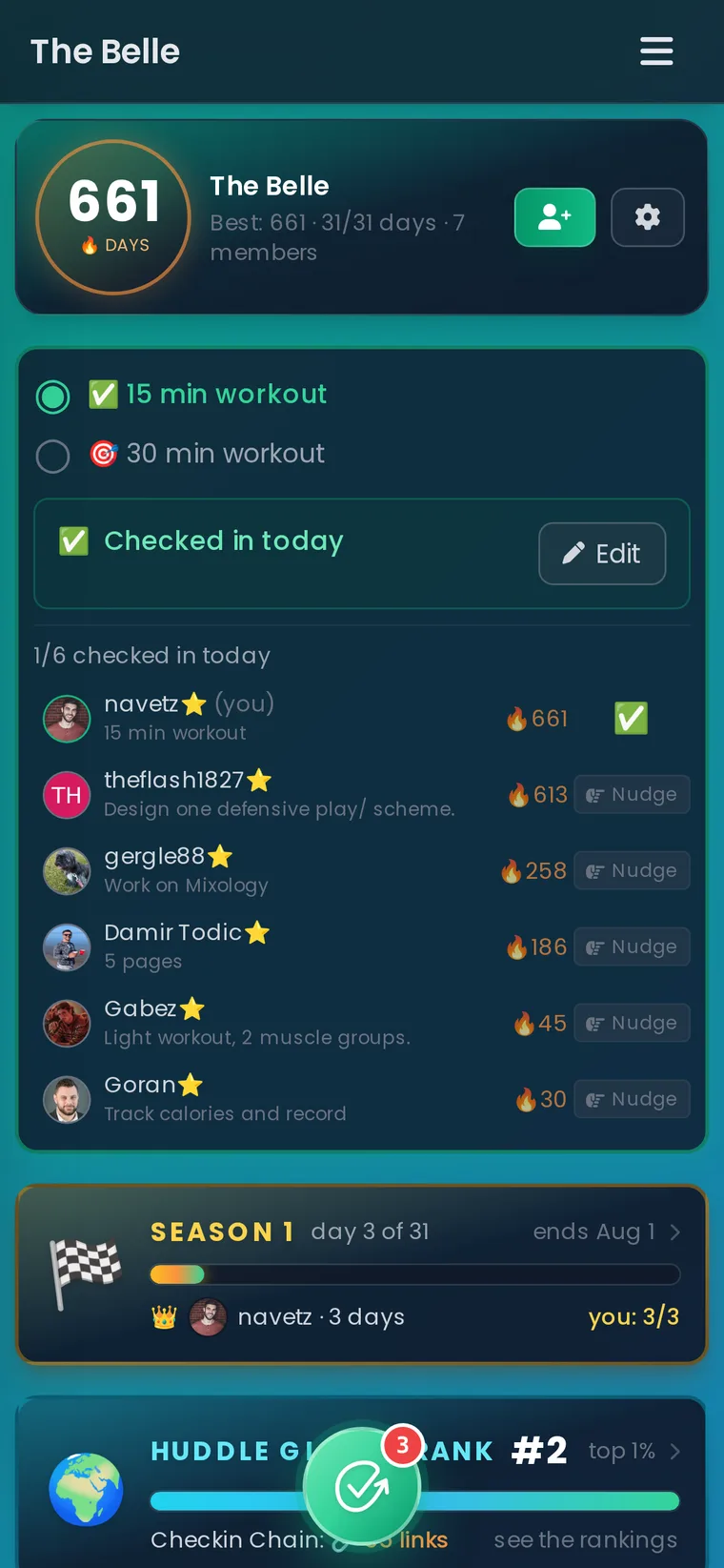
The design choice that matters for friend groups: missed days are invisible. A skipped night shows nothing to anyone, there is no shame column, and a streak freeze can cover a bad day. The cheer is for showing up, and that is the only thing the group tracks. Everyone reads their own book, at their own pace, and the free plan covers one tracking habit you start yourself, with joining a friend's huddle always free. It runs on iOS, Android, the web, and inside Discord through a bot. Users must be 13 or older.
The trade-offs are real. There is no bookshelf, no page count, no reviews, and no discussion thread per chapter. If your group wants to talk about the book, you need a chat somewhere else. Checkins are an honor system, and the value only shows up once at least one other person is in the huddle.
Best for: friends who each want to read a little every day, whatever the book.
Trade-off: tracks the habit, not the books; bring your own discussion.
You already know you can change.
You just need to take the first step. Habit Huddle helps you build habits around your goals, alongside friends who keep you accountable.
How to run a reading challenge with friends that survives week three

Most reading challenges with friends die between the second and third week, and the cause is almost never the app. The cause is a challenge sized for the best reader's best week.
A one-line fix: size the challenge to your busiest friend's worst week, then let everyone read more when they can. That is the Floor and Ceiling idea. A Floor of ten pages or ten minutes is something a nurse on nights can still do. A Ceiling of a chapter or an hour gives the keen reader room to go big without making the Floor feel like failing.
Five steps that hold up:
- Pick the format before the app. Same book or different books? Books, pages, minutes, or days? Decide in the group chat first, then pick from the table above.
- Set a Floor everyone agrees is easy. If anyone says "that's nothing," you have the right number. Ten pages a night for a year is roughly a dozen books, which the 1% better calculator will show you in books, not percentages.
- Give it a start date and an end date. Thirty days is long enough to feel real and short enough to finish. Restart with a new book list on day 31 rather than running an open-ended challenge nobody can win.
- Decide now what a miss means. The strongest rule is "never miss twice." One skipped night is a night; two in a row is a pattern. Say it on day one so nobody has to feel judged on day nine.
- Cheer, never audit. The friend who posts "nice, day 12" keeps the group alive. The friend who asks "did you read yesterday?" ends it. If the app shows who missed, agree not to mention it.
If your group wants a bigger menu of formats, the 30-day challenge ideas with friends post has scoring formats that work for reading as well as fitness, and the easy habit challenge for beginners covers picking a Floor that survives a bad week.
Reading challenge formats that fit friend groups
Which format you choose matters more than which app, so here are the common ones with a Floor and Ceiling each.
| Format | Floor (still counts) | Ceiling (great day) | Best app category | Watch out for |
|---|---|---|---|---|
| Pages per day | 10 pages | A chapter | Daily checkin, competition | Dense books make 10 pages slow; count pages, not chapters |
| Minutes per day | 10 minutes | 45 minutes | Daily checkin, BookBuds | Audiobooks count; say so up front |
| Same book, shared pace | Keep up with the week's chapters | Finish early, wait to discuss | Discussion (Fable, Bookclubs) | The slowest reader sets the pace; pick shorter books |
| Books per month | One book | Two or three | Book counters | Long books get skipped; allow a "half book" month |
| Reading bingo | One square a week | A line by month end | Any, plus a shared chart | Needs one person to make the card |
| Read before screens | Open the book before the phone | 20 minutes before any scrolling | Daily checkin | The hardest one to fake and the best for sleep |
Pick one. Groups that mix "pages" for one friend and "books" for another end up comparing numbers that mean different things, and the comparison is what kills the fun.
What the research says about reading and consistency

Americans read fewer books than they used to, and the drop comes from heavy readers reading less, not from more people reading nothing. Gallup's December 2021 poll found adults read an average of 12.6 books in the prior year, down from 15.6 in 2016 and the lowest since the question started in 1990. The share who read no books at all held steady at 17%, while the share reading more than ten books fell from 35% to 27%. A Pew Research Center survey from early 2021 found 75% of adults had read a book in the previous twelve months in any format, with print still the most common at 65%.
That pattern is exactly what a daily challenge with friends is for. The people who stop reading are not non-readers; they are readers whose evenings got eaten. A ten-page Floor and a friend who cheers when you show up is a cheap way to get those evenings back.
On how long the habit takes: Lally and colleagues tracked people adopting a new daily behavior and found automaticity plateaued after a median of 66 days, with a range from 18 to 254, and a single missed day did not materially hurt the process. A 30-day challenge, then, is a start, not a finish. Plan the second month before the first one ends.
On the miss itself: in a megastudy of 61,293 gym members testing 54 interventions, the best-performing one was a small bonus for returning after a missed workout. The lesson transfers to reading. Make coming back the celebrated act, and the challenge outlives its first bad week.
On why friends help at all: Norcross and colleagues followed New Year's resolvers and found 77% held their resolution at one week but only 19% at two years, and 53% of the eventual successes had slipped at least once along the way. Social support was among the factors that mattered more later in the process, after the first weeks. A reading challenge with friends is not about January; it is about who is still cheering in March.
If you keep falling off and restarting, the how to restart a habit after falling off post covers the first seven days back, and how to focus while reading helps when the pages are open but the mind is not.
Start with one friend and ten pages
You do not need eight apps or a twelve-person club. You need one friend, one Floor, and a place to say "I read" every night.
If your group wants a bookshelf and a yearly number, start with Goodreads or StoryGraph; they are free and everyone has one. If you want a real discussion, use Fable or Bookclubs and pick a short book first. If you want a scoreboard, ReadRats or Reading Rivals will run a sprint.
If you want the simplest version, a huddle where each friend has their own reading habit and a ten-page Floor, Habit Huddle is built for exactly that, and the reading challenge app page walks through the setup. Not sure how many pages to set as a Floor? How many pages a day should I read will find your number, and the habit tracker with friends page shows how the same huddle works for any habit your friends want to add next.
Whatever you pick, decide the miss rule on day one, cheer every checkin, and plan month two before month one ends. The book list can change. The nightly ten pages should not.
FAQ
What is the best reading challenge app with friends?
It depends on the challenge. Goodreads and StoryGraph are best for a shared yearly book count, Fable and Bookclubs for reading and discussing one book together, ReadRats and Reading Rivals for a page or minute leaderboard, and Habit Huddle for a daily "read today" checkin where each friend reads their own book. Pick the daily behavior you want first, then the app.
Do we all have to read the same book?
No. Same-book challenges suit discussion apps like Fable, but they force everyone to the slowest reader's pace and one person's taste. Different-book challenges scored by pages, minutes, or days let each friend read what they like while still keeping each other going. Most friend groups do better with different books and a shared daily Floor.
Is the Goodreads Reading Challenge good for doing with friends?
It is fine for a yearly scoreboard among people who already read regularly. It gives no daily prompt, so a friend who falls behind sees a gap and nothing to do about it tonight. Pair it with a daily checkin app if the goal is to build the habit rather than count the finishes.
How many pages a day should a reading challenge require?
Set the Floor at a number your busiest friend can hit on a bad night, usually ten pages or ten minutes, and let the Ceiling be a chapter or an hour. Ten pages a night adds up to roughly a dozen average-length books a year, which is more than most adults read.
What happens when someone falls behind?
Agree on day one that the rule is "never miss twice" and that nobody comments on misses. A missed night costs one night, not the challenge, and research on habit formation found a single missed day did not derail the process. Cheer the return, and the group survives the week that would otherwise end it.
Ready to Build Habits With Friends?
Stop failing alone. Join thousands using the #1 habit tracker with friends for real accountability and lasting results.
Prefer mobile? App Store · Google Play
Related Guides
More Habit Huddle articles on building habits with accountability.

Why Can't I Stick to a Routine? 7 Real Reasons and the Fix for Each
Routines fail on design, not willpower: sized for your best day, no cue, five changes at once, one miss treated as a quit. Seven reasons, the research, and a...

Habit Contract: How to Write One That Works (Free Template)
What a habit contract is, what goes in one, what randomized trials say about signed commitments, why the stakes belong on quitting rather than a missed day,...
Family Habit Tracker App: 8 Best Picks by Age, and How to Make It Stick (2026)
Family habit tracker apps compared by age: Joon, Family Rewards, Family Checklist, Kinly, Habit+ Family, HabitShare, Habitica, and Habit Huddle. Plus the hab...