
How to Focus While Reading: Actionable Techniques
Struggling with how to focus while reading? Get actionable strategies to eliminate distractions, boost comprehension & build deep reading habits.
You sit down to read with honest intent. The book is open, the article is relevant, the notes are ready. Then your attention slips. A message hits your phone, your brain jumps to tomorrow's tasks, and a page later you realize you've been looking at words without taking any of them in.
That experience usually gets mislabeled as laziness or weak willpower. It's usually neither. Focused reading is a habit built from repeatable conditions, not a personality trait you either have or don't. If you want to learn how to focus while reading, stop looking for one magic tip and start building a system you can reuse: preparation before you begin, active engagement while you read, and accountability that makes the habit stick.
Table of Contents
- Why You Can't Focus While Reading (and Why It's Not Your Fault)
- Setting the Stage for Deep Reading Focus
- From Passive Skimming to Active Engagement
- Build Reading Stamina with Strategic Sprints
- Troubleshooting Your Most Common Reading Distractions
- How to Make Focused Reading a Lifelong Habit
Why You Can't Focus While Reading (and Why It's Not Your Fault)
Many readers think reading focus should feel natural. Sit down, open the page, concentrate. When that doesn't happen, they blame themselves. That's the wrong diagnosis.
Your attention is dealing with an environment that rewards interruption. A 2024 American Psychological Association report discussed by Iris Reading found that many adults feel overwhelmed by the amount of information they consume and struggle to manage attention in digital environments. If you're trying to read well inside that environment, your brain isn't failing. It's responding to the conditions you've given it.
Focus problems during reading are often a systems problem before they're a discipline problem.
That matters because guilt leads to bad solutions. People try to force longer sessions, shame themselves for checking the phone, or keep rereading the same paragraph while mentally elsewhere. None of that trains focus. It just turns reading into friction.
A better way to think about how to focus while reading is this: reading attention is trainable, but it has to be trained deliberately. You need a setup that reduces avoidable distractions, a reading method that keeps your mind active, and a way to notice when the habit is slipping.
Here's the practical trade-off. If you rely on motivation, you'll read well only when conditions happen to be good. If you rely on a system, you'll read well even on ordinary days.
Short version:
- Willpower alone is unreliable. It runs out fast when your environment is noisy.
- Passive reading invites drift. Eyes move, mind wanders, comprehension drops.
- A repeatable routine works better. Preparation, active reading, and review give attention something to hold onto.
People who focus well while reading usually aren't using superhuman concentration. They're using fewer decisions, fewer distractions, and better reading mechanics.
Setting the Stage for Deep Reading Focus
Deep reading starts before the first sentence.
If you begin reading while tired, half-distracted, and surrounded by easy interruptions, you're asking your attention to fight on three fronts at once. Good readers reduce that fight before it begins. College reading guidance notes that concentration improves when learners study while “most alert” and “least tired,” and it recommends tracking distractions by recording the type of reading, minutes until distraction, type of distraction, and time lost so patterns can be corrected instead of guessed at in Cuesta College's reading techniques guide.
Control the reading environment before it controls you
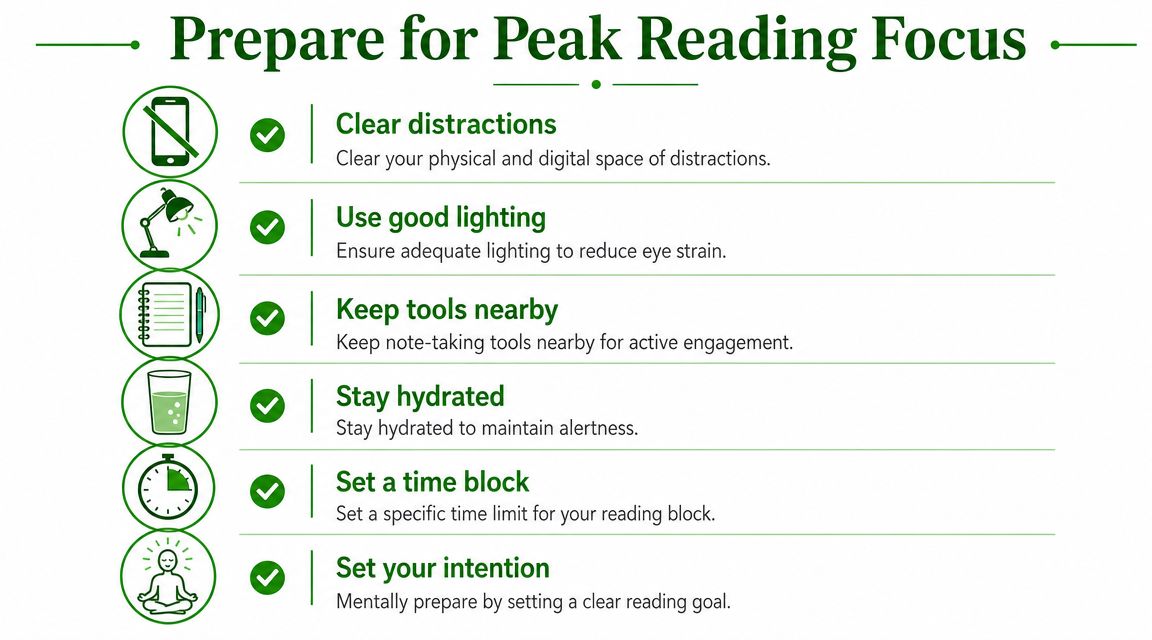
Start with the obvious physical variables, but don't stop at “find a quiet place.”
- Remove the phone from reach. Face down on the desk isn't enough if your hand can grab it automatically.
- Prepare the tools once. Book, article, pen, notebook, water, glasses, charger if needed.
- Set the light and posture. If your eyes strain or your body keeps shifting, attention leaks.
- Use one reading location when possible. A consistent place reduces startup friction.
If you read on a device, make it a reading device for that block. Close tabs you won't use. Silence notifications. Don't leave messaging apps blinking in the corner.
A timer helps too, especially if your brain resists open-ended tasks. If you want a simple way to create a calm start, a meditation timer routine for transitions can work well before reading because it gives your attention a clear switch from scattered mode to focused mode.
Set a job for your attention
A lot of readers lose focus because they never gave their mind a target. “Read chapter three” is too vague. Your attention needs a task.
Try one of these before you begin:
| Reading situation | Better goal |
|---|---|
| Textbook chapter | Find the main argument and three supporting ideas |
| Work document | Identify what action this requires from me |
| Nonfiction book | Pull one useful idea I can apply today |
| Research article | Understand the question, method, and conclusion |
That changes reading from exposure to search.
Practical rule: Never start reading without writing one sentence about why you're reading it.
A short pre-reading routine is enough:
- Preview the headings or opening page.
- Write one question you want the text to answer.
- Decide how long this session will last.
- Begin only when everything you need is already in place.
Many people often misunderstand this point. They treat focus as something that should appear after they start. In practice, focused reading usually begins with a clean setup and a clear purpose.
From Passive Skimming to Active Engagement
Most unfocused reading looks like reading, which is why it's so deceptive. Your eyes move. Pages turn. Time passes. But nothing sticks because your brain never fully joined the task.

Why passive reading fails
Passive reading is the default mode. You let the text wash over you and hope interest carries you through. That works for light material sometimes. It fails badly with dense, abstract, or important material.
A controlled study in Focus Takes Time: Structural Effects on Reading found that when information is structured to be more focused, reading times increase for that section, which points to deeper cognitive processing and helps explain better comprehension and memory for focused information in the study published at PMC. The useful takeaway is simple: slowing down at important passages is not a flaw. It's part of understanding them well.
That's why speed-reading your way through difficult material often backfires. You're not saving time if you have to reread everything later.
Use the chunk and recap method
One of the most reliable reading methods is brutally simple. Read a short section. Stop at a natural boundary. Write a one-sentence summary before continuing.
Academic reading guidance recommends this kind of chunking and summarizing because bounded reading tasks are easier to sustain and easier to comprehend, as described in Jefferson's reading focus guide.
Use it like this:
- Read one small section. Stop at the end of a subsection, heading, or natural break.
- Close the loop. Write one sentence that captures the point in your own words.
- Check for blanks. If you can't summarize it, you probably didn't understand it.
- Then continue. Don't stack confusion.
This method works because it forces retrieval, not just recognition. Recognition says, “that looks familiar.” Retrieval says, “I can explain it.”
If you can't say what you just read in one sentence, keep working before you move on.
A lot of people resist this because it feels slower. It is slower per page. It's faster per understanding.
You already know you can change.
You just need to take the first step. Habit Huddle helps you build habits around your goals, alongside friends who keep you accountable.
Make the text answer you
Active engagement can take a few forms. The best one depends on what you're reading.
- Turn headings into questions. If the heading says “Causes of Inflation,” ask, “What causes inflation according to this author?”
- Write marginal notes. Not highlights everywhere. Short reactions like “main claim,” “example,” or “why?”
- Mark confusion clearly. Put a question mark beside sections you need to revisit instead of pretending you got them.
- Underline sparingly. Highlighting whole paragraphs feels productive and usually isn't.
For readers who drift often, physical action helps. Write, circle, bracket, summarize. Give your hands a role so your mind has fewer chances to wander.
A useful demonstration of active reading ideas is below.
Build Reading Stamina with Strategic Sprints
Trying to read for a long stretch when your focus is weak is like trying to run distance without training. The problem isn't that you can't do it today. The problem is that you keep choosing a format your current attention can't sustain.
Use fixed reading intervals
A practical structure is the Pomodoro method. It breaks reading into 25-minute focus blocks followed by 5-minute breaks, and after four cycles there's usually a longer rest, as described in Mendi's reading focus article. The value isn't novelty. The value is that the session has a clear beginning, a clear end, and a built-in recovery point.
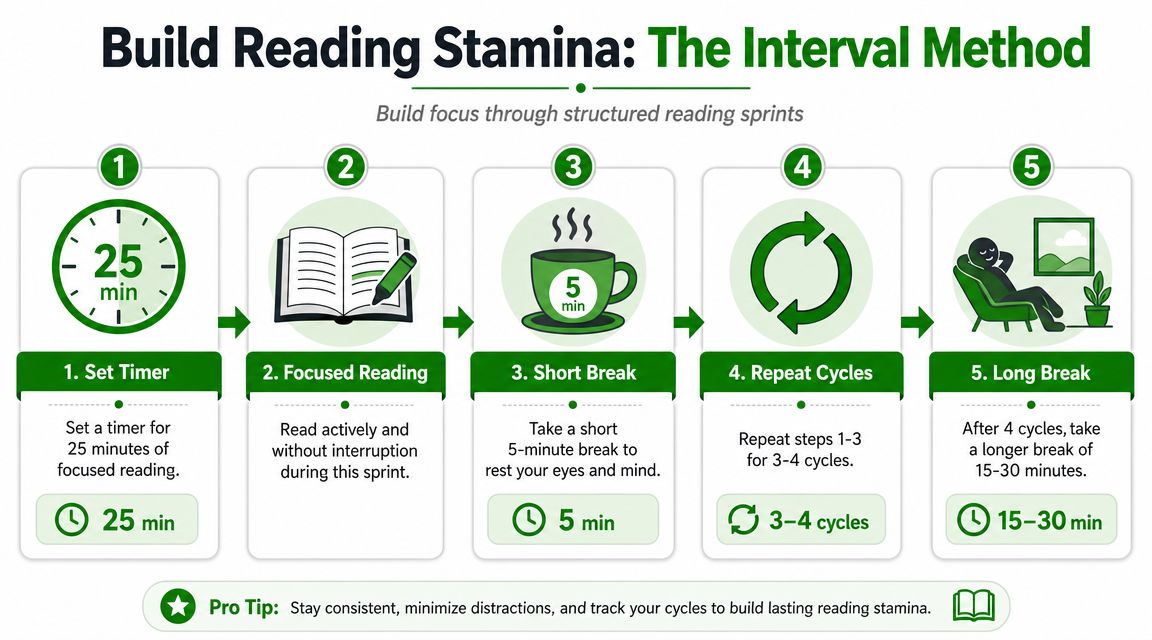
Here's the structure in practice:
- Set the timer for 25 minutes. No switching tasks during that block.
- Read actively. Use notes, questions, or summary lines.
- Stop when the timer ends. Don't bargain with yourself.
- Take a 5-minute break. Stand up, stretch, rest your eyes.
- Repeat. After four rounds, take a longer break.
That break matters. It keeps fatigue from disguising itself as lack of discipline. A tired brain doesn't need a lecture. It needs recovery.
Progress without burning out
If 25 minutes feels too long, start shorter. Build upward only after you can complete several sessions without repeated attention breaks. The practical benchmark from reading guidance is to begin with 5 to 10 minute focus blocks and extend them gradually once you can sustain them reliably, as noted earlier in the Cuesta guidance.
Use progression like this:
| Current reality | Better starting point |
|---|---|
| You lose focus almost immediately | 5 to 10 minutes |
| You can read but drift once or twice | Short fixed blocks with notes |
| You can sustain solid focus | Full 25-minute sprints |
For many readers, consistency matters more than page volume. A daily reading target can be structured around manageable pages and repeatable sessions, but the stronger move is to measure completed focus blocks, not ambition.
Don't train for heroic reading sessions. Train for repeatable ones.
Troubleshooting Your Most Common Reading Distractions
Even a good reading system breaks down in predictable ways. The fix is to diagnose the type of distraction instead of using the same advice for all of them.
When the phone is the real problem
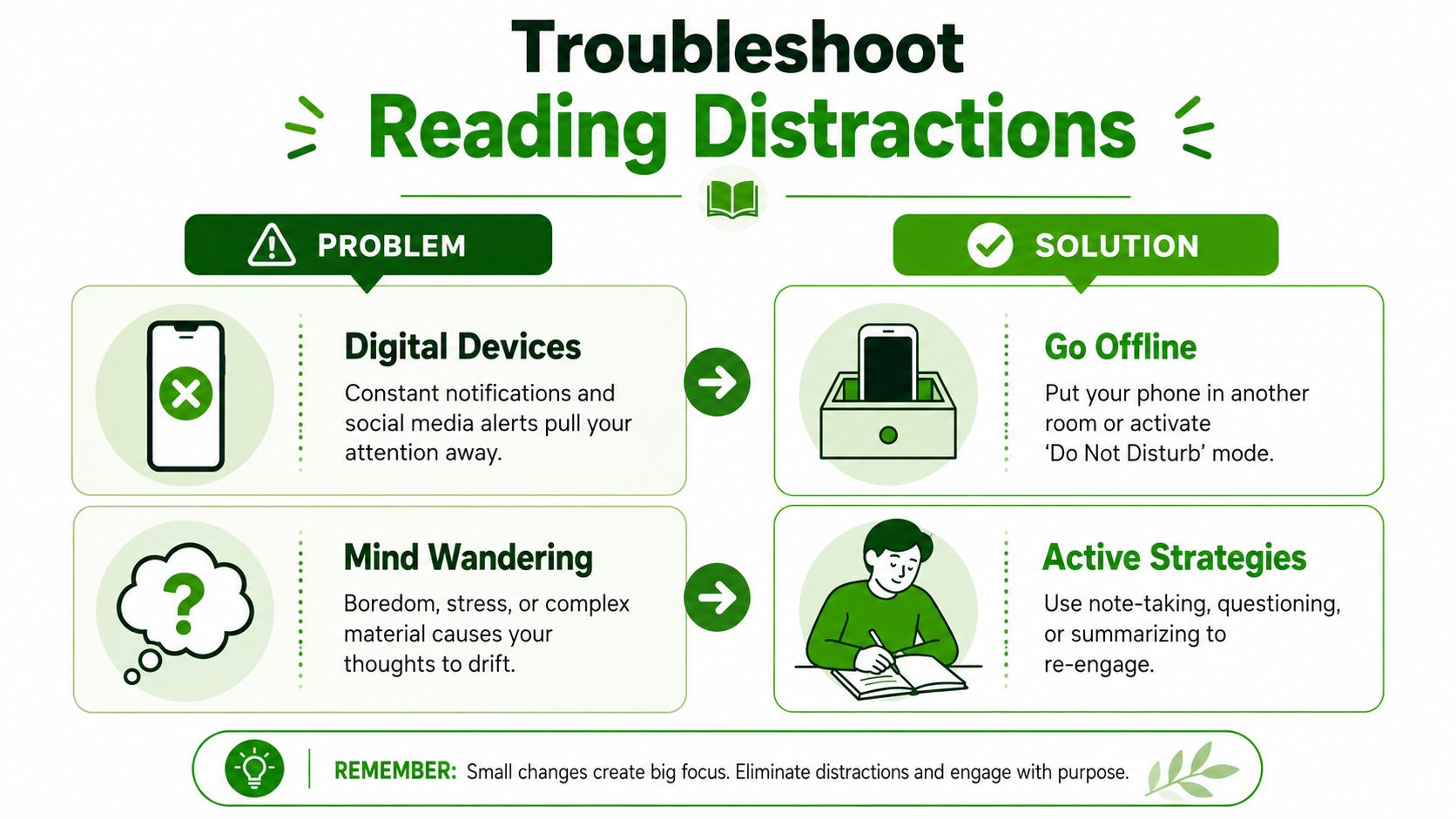
“Turn off distractions” is too vague to help. The phone isn't just nearby. It often acts like a habit loop trigger. You feel friction in the reading, reach for relief, and the phone delivers instant novelty.
Treat this as an architecture problem.
- Increase distance. Put the phone in another room, bag, or drawer.
- Batch interruption windows. Check messages only during planned breaks.
- Use pre-commitment. Decide before reading what the phone is allowed to do.
- Don't trust silent mode alone. A silent phone in sight still invites checking.
The difference is important. You're not trying to “be stronger” than the phone. You're making the phone harder to access when your attention gets shaky.
When your mind keeps leaving the page
Internal distraction needs a different tool. If thoughts keep intruding, don't argue with them in your head. Externalize them.
Keep a small “thought parking lot” on paper. When a task, worry, or reminder pops up, write it down in a few words and return to the sentence. That tells your brain the thought won't be lost, so it doesn't need to keep repeating it.
A reading log can help here too. Track what you were reading, when distraction happened, what kind of distraction it was, and how much time it cost. After a few sessions, patterns become obvious. Some readers always drift on dense material. Others drift when they read late. Others drift the moment the phone is visible.
Attention improves faster when you track failures honestly instead of describing them vaguely.
Know whether the problem is boredom or fatigue
These two feel similar but need different responses.
| If the issue is... | It usually looks like... | Better response |
|---|---|---|
| Boredom | Skimming, checking the clock, hunting for stimulation | Make reading active with questions, notes, and summaries |
| Fatigue | Heavy eyes, repeated rereading, dull comprehension | Stop, break, hydrate, or move the session to a better time |
| Overload | Confusion that compounds fast | Shorten the chunk and recap more often |
If the material is boring, you need more engagement. If you're tired, you need less force and better timing. If the content is too dense, reduce chunk size and work more slowly.
What doesn't work is pretending all three problems have the same answer.
How to Make Focused Reading a Lifelong Habit
Focused reading becomes reliable when you stop judging success by mood and start judging it by whether you showed up to the system.
That system can stay simple. Choose a reading time that matches your real energy. Use the same startup ritual. Read in bounded blocks. Keep one active reading method. Log what broke your focus when the session goes badly. Then repeat tomorrow.
The hidden win is accountability. Not pressure for perfect performance. Accountability for consistency. A good habit system rewards the act of beginning, protects the minimum viable version of the habit, and makes lapses visible before they become a new pattern.
A practical weekly review can fit on one page:
- What time did reading go best?
- What distraction showed up most often?
- Which text types held attention well?
- How many focused sessions did you complete?
- What small adjustment will you make next week?
That kind of review keeps reading from becoming wishful thinking. It turns it into practice.
For readers who want the habit to last, this same mindset applies across other routines too. A broader set of mental health habits that support consistency and attention can make reading easier because focus rarely improves in isolation from sleep, stress, and daily rhythm.
The goal isn't to become someone who never gets distracted. The goal is to become someone who notices distraction quickly, resets cleanly, and keeps the reading habit alive long enough for focus to strengthen.
If you want help turning these reading sessions into a habit that sticks, Habit Huddle gives you a practical accountability system. You can track a simple minimum reading goal, post a daily checkin, and build momentum with a small group instead of relying on motivation alone. It's a clean fit for anyone who wants focused reading to become part of real life, not just a plan for next week.
Ready to Build Habits With Friends?
Stop failing alone. Join thousands using the #1 habit tracker with friends for real accountability and lasting results.
Prefer mobile? App Store · Google Play
Related Guides
More Habit Huddle articles on building habits with accountability.

HabitShare Alternatives: 6 Apps for Tracking Habits With Friends (2026)
Looking for a HabitShare alternative? Six social habit trackers compared by model, price, platforms, and what happens on a missed day, plus how to switch wit...

What to Do When You Miss a Workout Day: The 5-Step Comeback Plan
Missed a workout day? What one miss does to your body and habit, according to research, plus a five-step plan for the next 24 hours, when to make it up, and...
Habit Streak App With Friends: 7 Apps Compared (2026)
Seven habit streak apps with friends compared: Habit Huddle, HabitShare, Daily Pact, Habitica, Streaks, Habit Streak duels, HabitStreak.io. What friends see,...