
Body Doubling for Habits: How It Works and How to Set It Up
Body doubling means doing a hard thing with someone present. How it works for daily habits, what the research says, and how to set one up this week.
 By Stevan Ljuljdurovic, founder of Habit Huddle
Updated November 9, 2026

Body doubling for habits means pairing something you repeat every day with another person's presence, so that starting takes less effort. The other person can sit in the same room, join a call, or show up for their own habit on the same day. You do the habit. They keep you company.
Many people say it works, mostly because it makes beginning easier. The evidence is still thin. It comes mainly from the ADHD community and one 220-person survey, and we found no controlled trial of body doubling for habits. Treat it as a cheap experiment, not a proven method.
This guide covers where the idea came from, which kind of double fits a habit, what our own checkin data shows, and how to set one up this week.
What is body doubling?
Body doubling is using another person's presence to start or stay on something you find hard to do alone. The double does not do the work for you. Understood describes the role as being "a gentle reminder to stay on track just by being present." They might do the same thing, do something else, or read across the room.

The term came out of the ADHD community. The Attention Deficit Disorder Association credits ADHD coach and past ADDA president Linda Anderson with naming it in 1996. Video platforms and paid focus-session apps later carried the idea much further.
The first academic look came in 2023. Tessa Eagle and colleagues surveyed 220 people and reported that most had used the technique long before they learned its name. Their examples ran from studying and dishes to exercise, in places from cafés to YouTube.
How does body doubling work?
Nobody has proven why body doubling works, but the likeliest answer is that another person makes starting easier. Three explanations come up most often in the sources we read. All three are plausible, and none has been tested directly for habits.
- It builds momentum. Eagle's participants named generating momentum as one reason they do it. The ADDA puts it plainly: "getting started is often the hardest part."
- It acts as a cue. A person sitting down to begin is a signal in the room with you. Our view is that this is harder to ignore than a notification.
- It makes hard work feel less lonely. As Patricia Quinn, M.D., writes in ADDitude, "Hard work is simply more fun when someone else is nearby."
Does body doubling actually work?
Research on body doubling is early, so the honest answer is that many people report it helps and nobody has measured how much. Understood says "there isn't much research yet to prove whether or not it's effective." A Europe PMC search on November 9, 2026 turned up no controlled trial of body doubling for habits. Wikipedia's summary says most studies so far are master's theses, and that one found it ineffective, possibly because people need a bond with their double.
The closest solid evidence is about a neighboring idea. A 2016 meta-analysis of 138 experiments covering 19,951 people found that monitoring progress improved goal attainment (d = 0.40). Effects were larger when outcomes were reported or made public, and when progress was physically recorded. That study did not test body doubling, but it does suggest that telling someone what you did carries weight.
Many people say it helps, and it costs almost nothing. Try it for two weeks and judge for yourself.
Why habits need a different kind of body double
A task ends and a habit comes back tomorrow, so the best body double for a habit is one you can repeat without effort. A 50-minute video session is great for the tax return you have avoided since March. You cannot book one for every walk, every page and every sink of dishes. The guides we read were written mainly for one-off jobs like housework, paperwork and homework.
The Eagle paper offers a useful way to think about this. It proposes that body doubling runs along two lines: space and time, and mutuality. In plain terms, how close the other person is in place and moment, and how much of the activity you share. As you move away from "same room, same moment," you give up intensity and gain repeatability.
| Format | How close | Best for | The catch |
|---|---|---|---|
| Same room | Same place, same moment | Chores, homework, a workout together | Both schedules must match |
| Live video or phone call | Different place, same moment | A block of work, one dreaded job | Needs a booking or a willing friend |
| Recorded "with me" video | Different place and moment, one-way | Cleaning or studying when nobody is free | Nobody responds to you |
| Messages in a shared chat | Different place, same day | Short daily habits | Posts get buried in other talk |
| Daily checkin with friends | Different place, same day | Habits you want to keep for months | Nobody is beside you during the habit |
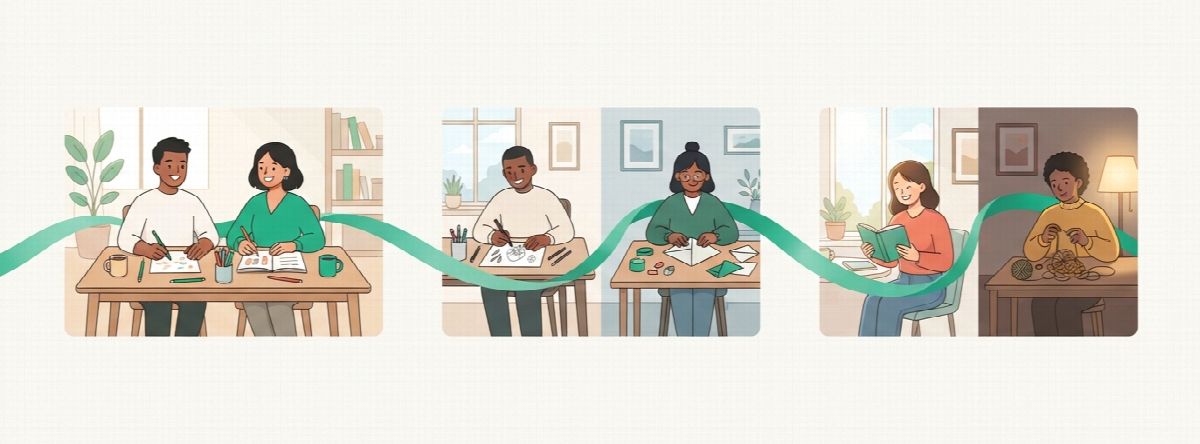
Use the close formats to get a habit started and the light formats to keep it going. A live session in week one gets you moving. A same-day double is what you can still manage in month three.
If you want to compare specific tools, we lined up seven options in our guide to body doubling apps.
You already know you can change.
You just need to take the first step. Habit Huddle helps you build habits around your goals, alongside friends who keep you accountable.
What our checkin data shows
On Habit Huddle, habits with another person in the huddle reached 30 checkin days about seven times as often as habits tracked alone: 16.9% against 2.3%. We took 2,432 habits whose first checkin came between July 3 and October 7, 2026, and counted distinct checkin days through November 6. We left out staff accounts and one unusual day.
| Habit | Habits | Reached 7 checkin days | Reached 14 checkin days | Reached 30 checkin days |
|---|---|---|---|---|
| In a huddle with another current member | 1,222 | 417 (34.1%) | 322 (26.4%) | 206 (16.9%) |
| Alone | 1,210 | 112 (9.3%) | 70 (5.8%) | 28 (2.3%) |
This is a correlation. People who invite a friend may already be more committed, and we counted today's members, so friends who joined later count too.
A third of checkins in shared huddles landed within an hour of another member's checkin. Across 303 huddles and 1,391 people, from July 3 to November 6, 2026, 6,891 of 20,828 members' first checkins of a day (33.1%) came within 60 minutes after someone else's. We cannot say how much of that is people responding to each other and how much is shared routines and time zones.
Our reading is modest. You do not need to be in the same room to feel that someone else is also showing up today.
How to set up a body double for a habit
A body double for a habit needs four decisions: the smallest version, the person, the moment and the place you report it. The steps below take about ten minutes and one message to a friend.
- Pick one habit. Choose the one you most often mean to start and don't.
- Set the smallest version that still counts. Two minutes of tidying, one page, a walk to the corner. Save the bigger version for good days.
- Choose your double. Pick someone you like being around. They do not need the same habit, only the willingness to be there.
- Pick a format from the table. Start closer than you think you need for two weeks, then lighten it.
- Fix the moment. Attach it to something that already happens every day, like after the kettle or before the commute.
- Say it, do it, report it. Send one sentence before you begin, like "ten-minute walk now." Tell them when you are done.
- Plan the comeback. In a study of 96 volunteers building a daily habit over 12 weeks, missing one opportunity did not materially affect how the habit formed. Start again the next day. Our guide to restarting a habit covers a longer gap.
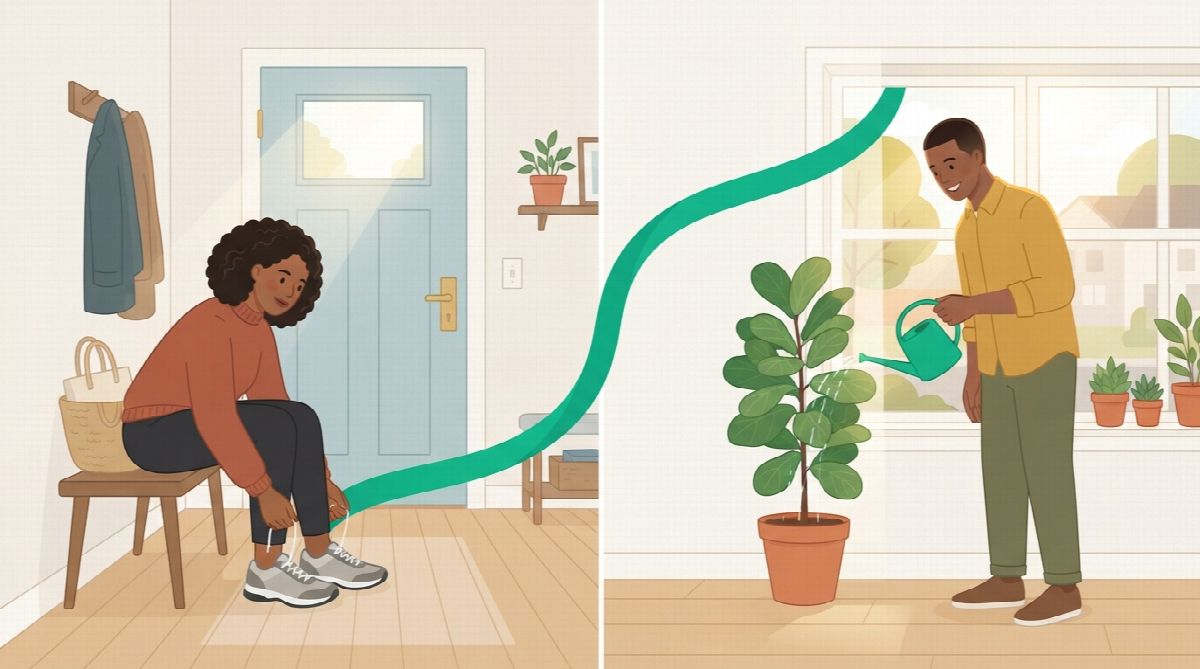
A good double is company, not a referee. If the arrangement starts to feel like being supervised, change the format or change the person.
When body doubling gets in the way
The same presence that helps one person can distract another, so treat your first two weeks as a test. Understood notes that for some people "having someone else around while they're working may be distracting," and that others worry about becoming too dependent on a double.
- If talking pulls you off the habit, agree on silence, or move to a same-day format.
- If you feel watched, choose someone doing their own thing beside you rather than someone looking at what you do.
- If you worry about leaning on it, do one day a week alone, or move from a live double to a same-day one.
Body doubling is a practical strategy, not a treatment for ADHD, and it does not suit everyone with ADHD. If ADHD is part of why habits slip, our ADHD habit tracker guide goes deeper on keeping a habit small enough to start.
Body doubling vs an accountability partner
Body doubling is company during the habit, and an accountability partner is someone you report to after it. One helps you begin. The other gives you someone to tell. One person can do both jobs. If reporting is the part you need, read what an accountability partner actually does.
Try it with one friend
If a friend is the double you want, start a huddle. You each set a Floor, the smallest version of your habit that counts, and a Ceiling to burst through on good days. Each day you make a checkin, your friends cheer it, and every member who makes one adds a link to the huddle's Checkin Chain. See how that looks for ADHD and habits.
It is a same-day double, so it will not help with one dreaded job on a Tuesday afternoon. A live session is better for that. For the things that come back every day, one friend is enough to begin, and it is free to start.
Ready to Build Habits With Friends?
Stop failing alone. Join thousands using the #1 habit tracker with friends for real accountability and lasting results.
Prefer mobile? App Store · Google Play
Related Guides
More Habit Huddle articles on building habits with accountability.

Book Reading Habit Tracker: 9 Apps Compared by the Job They Do (2026)
The best book reading habit tracker depends on what you keep losing: the list, the time, the day or the company. 9 apps compared, plus our reading data.

Group Meditation Challenge Apps: 7 Ways to Meditate Together (2026)
The best group meditation challenge app depends on whether you sit together or apart. Compare 7 apps by cost, live sits, programs and friends.

75 Hard vs 30 Hard: Rules, Real Differences and Which to Do First
30 Hard runs the 75 Hard tasks for 30 days, but it is not official. Compare the rules, what a restart costs, and which one to start with.