
30 Day Challenge Ideas With Friends: 24 Challenges Built for a Group (2026)
24 thirty-day challenge ideas that work with friends, the formats that turn any of them into a group challenge, a January 1 version, the rules that survive w...

📺 Related Video: 4 Guys Do a Push up Challenge For 30 Days, These Are The Results
Video by: Browney · Watch on YouTube
The best 30 day challenge ideas with friends share three traits: the habit is daily, it has a clear yes-or-no test, and the smallest version is something your busiest friend can do on their worst day. Pick one of those and the group finishes. Pick a heroic one and the group is down to two people by day twelve.
Most lists get one of two things wrong. The big 30-day lists, like the 169 ideas on Develop Good Habits, are written for one person doing one thing alone. The "challenges with friends" lists, like wikiHow's thirty, are party games for one afternoon: the whisper challenge, the chubby bunny challenge. Neither helps a group of four that wants to do something every day for a month and still be friends on day 31.
This list is built for that group. It has 24 challenges sorted by what they change, a set of formats that turn any of them into a group challenge, a version for a January 1 start, the rules that keep a group going through week two, and where to track it. If you want the single-person version of the setup, the 30 day habit challenge guide covers that; this page is about doing it together.
How to pick a 30 day challenge a whole group will finish
The right 30 day challenge for a group is the one where every member can hit the minimum on a bad day, not the one that sounds most impressive in the group chat.
Three tests, applied to whatever idea is on the table:
- Is it daily? A challenge that happens three times a week gives everyone four days a week to argue with themselves about whether today counts. Daily habits have no off days to negotiate, and a group can only cheer something it sees every day.
- Is it a yes or a no? "Eat healthier" is not a checkin. "One vegetable with dinner" is. If two friends could disagree about whether a day counted, rewrite it until they cannot.
- Can the busiest friend do the Floor? Give every challenge two versions. The Floor is the worst-day minimum, the thing you do at 11pm with a headache. The Ceiling is the full version you burst through on a good Saturday. Both count as a checkin. A group that agrees on a Floor everyone can hit is a group that is still posting on day 22.
One more rule that sounds obvious and gets ignored: everyone does not have to do the same challenge. The format section below covers how a group with four different habits still runs as one challenge. For now, just know that "same daily checkin, different habits" is the format that survives contact with a real friend group.
Movement challenges
Movement challenges are the easiest to run with friends because the proof is obvious and the Floor is naturally small.
- The daily walk. Floor: ten minutes outside. Ceiling: an hour, or a step target you agreed on. The most finishable challenge on this list, and the one that most often turns into a permanent habit on day 31.
- The pushup ladder. Day one is one pushup, day two is two, day thirty is thirty. Floor: the day's number, in as many sets as you need. Ceiling: all in one set. Every person in the group is doing a different number on any given day only if they started on different days, so start together.
- Ten minutes of mobility. A stretch or mobility routine first thing or before bed. Floor: five minutes. Ceiling: the full routine. Quiet, injury-proof, and the one the friend who "isn't a gym person" will actually do.
- Outside every day. Any activity, as long as it is outdoors. Floor: stand on the porch for five minutes with a coffee. Ceiling: a hike, a ride, a run. A good winter challenge because the Floor is honest about winter.
- The plank minute. Hold a plank every day, adding five seconds a day from 30 seconds. Floor: 30 seconds. Ceiling: the day's target. Two minutes of total effort and a very satisfying day-30 number.
For bigger groups, offices, or anything with teams and scoring, the group fitness challenge ideas guide goes much deeper on formats.
Health and food challenges
Food and drink challenges work with friends because the hard moments are social, and a group that shares those moments is practising exactly the skill the challenge is meant to build.
- The water challenge. A daily water target. Floor: one full bottle before noon. Ceiling: the full target. Boring, and the reason the group has more energy in week three.
- No alcohol for 30 days. Floor: an alcohol-free day. Ceiling: alcohol-free plus the replacement ritual, a walk or an early night. The most-searched group challenge every January, and a natural one to start any month. The Dry January challenge with friends guide covers the rules that keep a mixed group dry.
- One vegetable with dinner. Floor: one. Ceiling: half the plate. The lowest-effort nutrition challenge that changes anything, and one that works across every diet in the group.
- Cook at home. Floor: one home-made meal a day, however simple. Ceiling: every meal. Cheap, and the group chat fills with photos of dinner, which is the kind of proof that keeps a challenge alive.
- Lights out by a set time. Each person picks their bedtime. Floor: in bed with the phone out of reach by that time. Ceiling: asleep by it. The challenge with the biggest day-to-day payoff and the least glamour.
- No added sugar after lunch. Floor: no dessert. Ceiling: no added sugar all day. Easier to define than "no sugar" and easier to keep on a Friday.
Mind and focus challenges
Mind challenges are the ones a group most often skips because the proof is invisible, and the ones a daily checkin helps most, because the checkin becomes the proof.
- Read ten pages. Floor: five pages. Ceiling: a chapter. Ten pages a day is a book a month for most people, and a group reading different books has something to talk about every day.
- Five minutes of meditation. Floor: two minutes with a timer. Ceiling: ten. The challenge with the highest dropout rate when done alone and one of the highest completion rates in a group, because the checkin is the only external signal it ever gets.
- Three lines in a journal. Floor: one line. Ceiling: a page. The Floor is so small it is almost embarrassing, which is the point; nobody skips one line.
- Phone-free first half hour. Floor: no phone for the first fifteen minutes of the day. Ceiling: a full hour. A challenge that improves every other challenge on the list.
- One deep work block. Floor: one 25-minute block with notifications off. Ceiling: two hours. The study-group and remote-worker favourite, and a good match for a Discord server where people already coexist while working.
- Ten minutes of a language. Floor: one lesson in an app. Ceiling: a conversation or a page of reading. Four friends learning four different languages still count the same daily checkin.
Money, home and creative challenges
Money and home challenges are the ones people rarely think to do with friends, and they benefit most from it, because a photo the group is looking forward to is the only thing that gets a drawer cleared at 10pm.
- The no-spend challenge. Floor: nothing bought outside a short agreed list (groceries, transport, bills). Ceiling: nothing at all. Post the day, not the amount; the challenge is the habit, not a public bank balance.
- One thing out a day. Floor: one object donated, recycled or binned. Ceiling: a whole drawer. Thirty objects in thirty days, with photo proof that makes for a satisfying group scroll.
- The daily transfer. Floor: one dollar moved to savings. Ceiling: whatever you decided. The smallest Floor on this list and a habit that compounds long after day 30.
- One sketch a day. Floor: a two-minute doodle. Ceiling: a finished drawing. The friend-group challenge with the best day-30 gallery.
- The daily photo prompt. One prompt a day for the group (a colour, a shape, "something old") and everyone posts one photo. Floor: any photo. Ceiling: the prompt, taken on purpose. The rare challenge that gets better as the group gets bigger.
- 100 words a day. Floor: 100 words of anything. Ceiling: 500. Thirty days later, everyone has a 3,000-word something.
- Message one person. Floor: one genuine message to someone you have not spoken to in a while. Ceiling: a call. The kindest challenge on the list, and the one people say changed the most.
Formats that turn any idea into a group challenge
A group challenge is any of the 24 ideas above plus a format, and the format decides whether the group is still talking to each other on day 31.

| Format | How it works | Best for | Watch out for |
|---|---|---|---|
| Same habit, same Floor | Everyone does one challenge with one minimum | Small groups with one shared goal | The friend for whom the Floor is too high, quietly leaving |
| Same checkin, different habits | Everyone picks their own challenge; the group shares one daily checkin | Most real friend groups, mixed fitness levels, couples | Comparing progress across different habits, so don't |
| The bingo card | A five-by-five card of small habits; each day you tick one square and post it | Big groups, servers, families with kids | Nobody finishes a line because they scatter |
| Team vs team | Two sides, total checkins per side | Offices, Discord servers, big friend groups | The losing side losing interest in week three |
| The relay | Each day one member "carries" the group by posting first | Groups of four to eight who like a ritual | The day the carrier forgets and everyone waits |
Same checkin, different habits is the format to reach for by default. The runner runs, the reader reads, the friend with a newborn does one line in a journal, and what they share is the daily yes. It removes the most common failure of a group challenge, which is one person's challenge becoming everyone's obligation.
Bingo is the format for anything with more than ten people, and the one to use if your group wants variety. Team vs team works when there is already banter to build on. The relay is a small ritual that matters more than it sounds, because the group's first checkin of the day is the prompt for everyone else's.
Whichever you pick, agree the scoring before day one and make it about checkins, not results. A count of days showed up is fair to everyone in the group. A leaderboard of pounds lost or miles run rewards the fittest friend and quietly drops the rest.
The January 1 version
A 30 day challenge with friends that starts January 1, 2027 runs to January 30, and the calendar around it is unusual: January 1 is a Friday, so your group's first checkin is a Friday night, the first weekend is days two and three, and the second Friday, January 8, is the date Strava's data crowned Quitters Day, when the largest share of resolutions get dropped.

That makes a January group challenge both the most popular version of this idea and the one most likely to die early. In a two-year study of New Year's resolvers, 77 percent were still going after one week and only 19 percent after two years, and over half of the eventual successes had slipped at least once along the way. The group is the difference: the study found that social support predicted success once the early weeks had passed.
Three adjustments for a January start:
- Pick the challenge in December, start it January 1, and do not start on January 2. A group that "starts Monday" starts never. The first checkin on a Friday night is a feature: it is the hardest day, done first.
- Choose from the winter-honest rows above. The daily walk with a ten-minute Floor, mobility, reading, the journal, the no-spend month, no alcohol. Save the outdoor-hour challenge for April.
- Plan the second weekend in advance. Decide what the group does when someone misses January 9 (nothing, except cheer January 10) and what you do on January 30 (see below).
Two sister pages cover the January angle in more depth: January habit challenge ideas is a list of 30 challenges sized for a real January, and the New Year habit challenge with friends guide covers running one as a group from the invitation onward.
The rules that keep a group going through week two
Group challenges fail from bad rules more often than from weak resolve. Four rules do most of the work.
1. A miss is one day, not a reset. The classic University College London habit study found that behaviours took a median of 66 days to become automatic and that missing a single day made no measurable difference to whether the habit formed. Write "never miss twice" into the rules and drop restart-at-zero entirely. A 27-out-of-30 month builds nearly the same habit as a perfect one and beats an abandoned challenge by a mile.
2. Cheer the day, never audit the miss. What gets a reaction sets the tone. When a checkin gets a cheer and a missed day gets nothing, people come back. When a missed day gets a comment, people leave, and they leave the group chat too. This is the difference between accountability and surveillance, and only one of them survives week two.
3. Keep the checkin to seconds. A tap, a tick, a photo, a one-line message. The friend who has to write a paragraph about their day stops writing by day six.
4. No money pots, no forfeits. Penalties sound fun on day one and read as pressure by day fifteen, and they push out the person who is struggling most, who is exactly the person the group exists for. If you want stakes, make them positive: the group books something for day 31 that everyone is looking forward to.
Why a group at all? A study by psychologist Gail Matthews at Dominican University found that people who wrote down their goals, committed to a friend, and sent weekly progress reports succeeded far more often than people who only thought about their goals. A daily checkin to friends is that weekly report, seven times as often, with a cheer attached.
You already know you can change.
You just need to take the first step. Habit Huddle helps you build habits around your goals, alongside friends who keep you accountable.
Where to track a 30 day challenge with friends
Where the group tracks the challenge decides whether the checkins are visible, and visible checkins are the whole mechanism.
| Tracker | What it does well | Where it breaks |
|---|---|---|
| The group chat | Zero setup, everyone already has it | Checkins scroll away under memes by day four; no count of anything |
| A shared spreadsheet | One grid, everyone can see the whole month | Nobody opens a spreadsheet at 11pm; no reminders, no cheers |
| A printable tracker | Physical, satisfying, no app | Proof lives in five different kitchens unless people post photos |
| A group habit app | Daily checkins, reminders, a shared count, reactions | Everyone has to install something |
The printable route works well for small groups: the free 30 day challenge tracker printable prints a dated 30-box calendar for any habit with the milestone days marked, and everyone photographs their tick into the chat at night.
For a group that wants the checkins to add up somewhere, this is the part Habit Huddle was built for, so judge the recommendation accordingly. One person creates a huddle for the challenge, each friend picks their own habit with a Floor and a Ceiling (or everyone picks the same one), and everyone checks in once a day. Streaks stay personal, and the huddle grows a Checkin Chain that gains one link for every member who checks in that day, so the shared number rewards showing up rather than who is fittest. Nobody's missed day is announced to anyone; the group sees the checkins, never the gaps. Reminders go only to people who have not checked in yet.
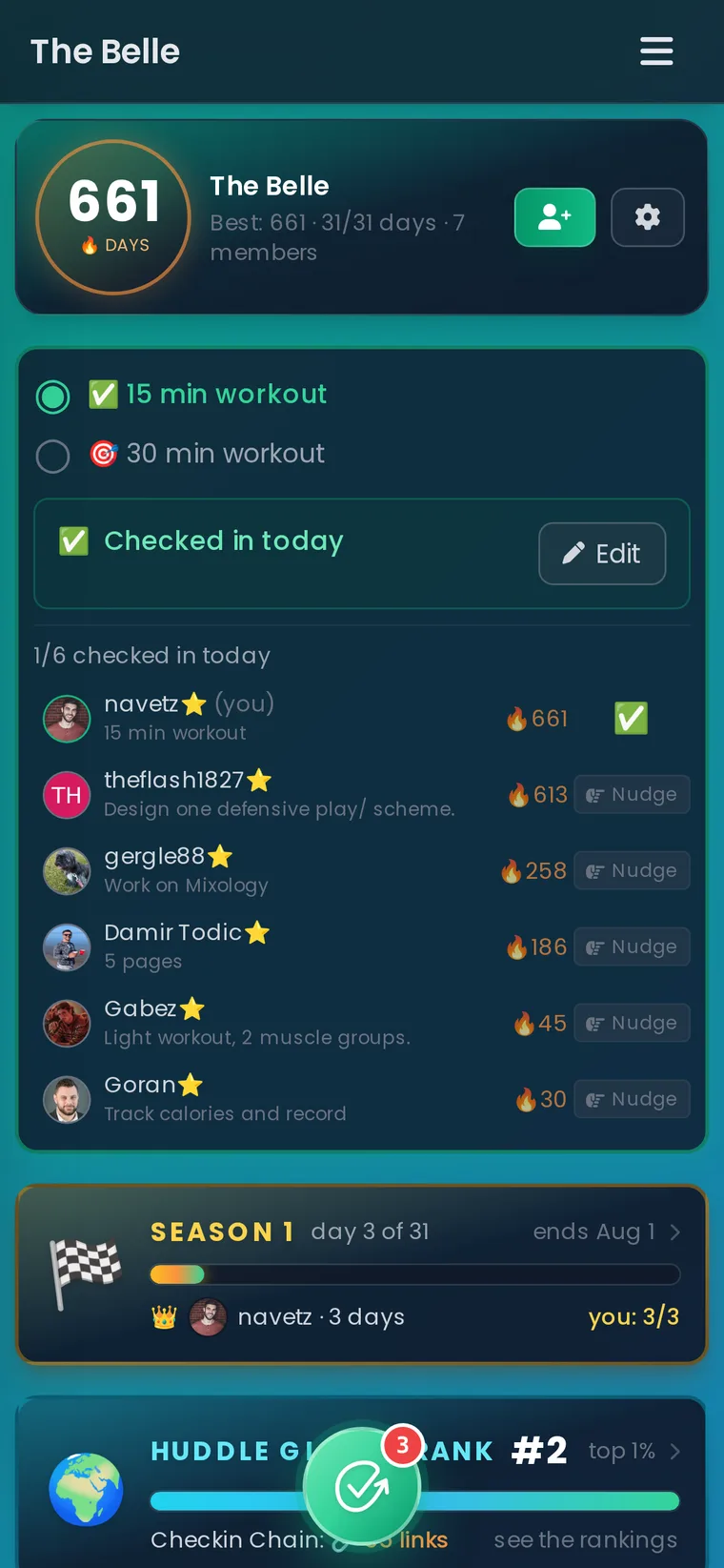
The trade-offs: it tracks days, not miles or pounds, so a scoring-by-results group will want a fitness app alongside it; everyone needs an account; and the free plan covers one tracking habit per person, which fits a 30 day challenge exactly and pinches if someone wants to run three at once. Starting a challenge huddle is free, it works on web, iOS and Android, and if your friends live in a Discord server, the same huddle runs there. The habit tracker with friends page covers how the shared view works.
What to do on day 31
Day 30 is a milestone, not the finish line, and a group that decides in advance what happens on day 31 keeps the habit; a group that does not loses it in a week.
Three good options. Keep the same habit and the same Floor with no end date, for the challenges people want permanently, usually the walk, the reading, the bedtime. Raise the Floor for the next 30 days, for the pushup and plank ladders. Or rotate: the group picks the next challenge from the list, starts together on day 31, and keeps the checkin streak running across challenges. The rotation is the most fun and the reason some groups are still going a year later.
Whichever you choose, book something for day 31. A group that finishes 30 days together has earned a dinner, and a dinner is where the next challenge gets picked.
Frequently asked questions
What is a good 30 day challenge to do with friends?
A daily habit with a yes-or-no test and a minimum everyone can hit on a bad day: a ten-minute daily walk, ten pages of reading, one vegetable with dinner, a no-spend month, or 30 alcohol-free days. Friends do not have to do the same habit; the format that works best for most groups is one shared daily checkin with each person on their own challenge.
How do you do a 30 day challenge with friends online?
Agree the challenge and each person's Floor before day one, pick one place where the daily checkins live (a group habit app, a Discord channel, or a chat where nothing else is posted), checkin once a day where the others can see it, and agree in advance that a miss is one day, not a reset. Cheer the days people show up and never comment on the days they do not.
Should everyone in the group do the same challenge?
Not unless everyone genuinely wants the same thing. Mixed groups do better when each person picks their own habit and the group shares one daily checkin; it removes the comparison problem and the friend for whom the shared challenge was too much. Same-habit challenges work for small groups with one shared goal, like a dry month or a pushup ladder.
What if one friend keeps missing days?
Nothing, beyond cheering their next checkin. A missed day makes no measurable difference to habit formation, and the friend who is missing days is the one the group exists for. If the misses continue, quietly check whether their Floor is too high and help them lower it. Forfeits, money pots and public tallies push that friend out rather than back in.
Is 30 days enough to build a habit with friends?
Thirty days is enough to find out whether a habit fits your life and to get through the hardest early weeks with company, but the research puts the median time for a habit to feel automatic at around 66 days, with a wide range. Plan for day 31 before you start: keep the habit, raise the Floor, or roll the group into the next challenge.
Ready to Build Habits With Friends?
Stop failing alone. Join thousands using the #1 habit tracker with friends for real accountability and lasting results.
Prefer mobile? App Store · Google Play
Related Guides
More Habit Huddle articles on building habits with accountability.

5 stickK Alternatives for 2026 (and What stickK Changed)
stickK changed its terms in 2024: no more friend or charity stakes, and it keeps half of anti-charity money. Five alternatives, for the money or the people.

Is Sweatmates Free? 6 Free Sweatmates Alternatives (2026)
Sweatmates is free to download, but logging a workout needs a subscription. What it costs, what it does well, and six free alternatives for couples and friends.

HabitShare Alternatives: 6 Apps for Tracking Habits With Friends (2026)
Looking for a HabitShare alternative? Six social habit trackers compared by model, price, platforms, and what happens on a missed day, plus how to switch wit...