
Family Habit Tracker App: 8 Best Picks by Age, and How to Make It Stick (2026)
Family habit tracker apps compared by age: Joon, Family Rewards, Family Checklist, Kinly, Habit+ Family, HabitShare, Habitica, and Habit Huddle. Plus the hab...

📺 Related Video: Healthy Habits For Good Mental Health | 10 Evidence-Based Daily Habits And Routines For Kids & Teens
Video by: Mental Health Center Kids · Watch on YouTube
A family habit tracker app is one shared place where every member of the household logs a daily habit and sees the others show up. The right one depends on who is in the family: kids under 13 need a parent-run app with chores and rewards, teens and adults need a social tracker where each person owns their own habit, and families with both usually end up running two tools, one per age band.
This guide compares eight apps by age band with facts read from each vendor's own site in September 2026, lists the habits that work for a whole household, and gives the five rules that keep habit tracking from turning parents into the police.
Why a family is the strongest accountability you already have
Children of two active parents were 5.8 times as likely to be active themselves as children of two inactive parents, in the Framingham Children's Study of 100 four-to-seven-year-olds wearing accelerometers for a year (Moore et al., 1991). The researchers named role modeling and shared activities as the likely mechanisms. In plain terms, the habit a parent keeps is the habit a child inherits.
The effect runs through the whole household, not just downward. In a study of 3,722 couples over 50, a person whose partner became newly active was about 66 percent likely to become active too, against about 25 percent when the partner stayed inactive (Jackson, Steptoe, and Wardle, 2015). And the simplest shared family habit of all, eating together, tracked with lower substance use, better grades, and fewer depressive symptoms across 4,746 adolescents, even after controlling for how connected the family already felt (Eisenberg et al., 2004).
A family is an accountability structure you did not have to build. Everyone already lives in the same place, eats at the same table, and sees each other daily. A tracker just makes the showing up visible.
Kids do not copy the chart on the fridge. They copy the parent who checks it.
What a family habit tracker needs, by age
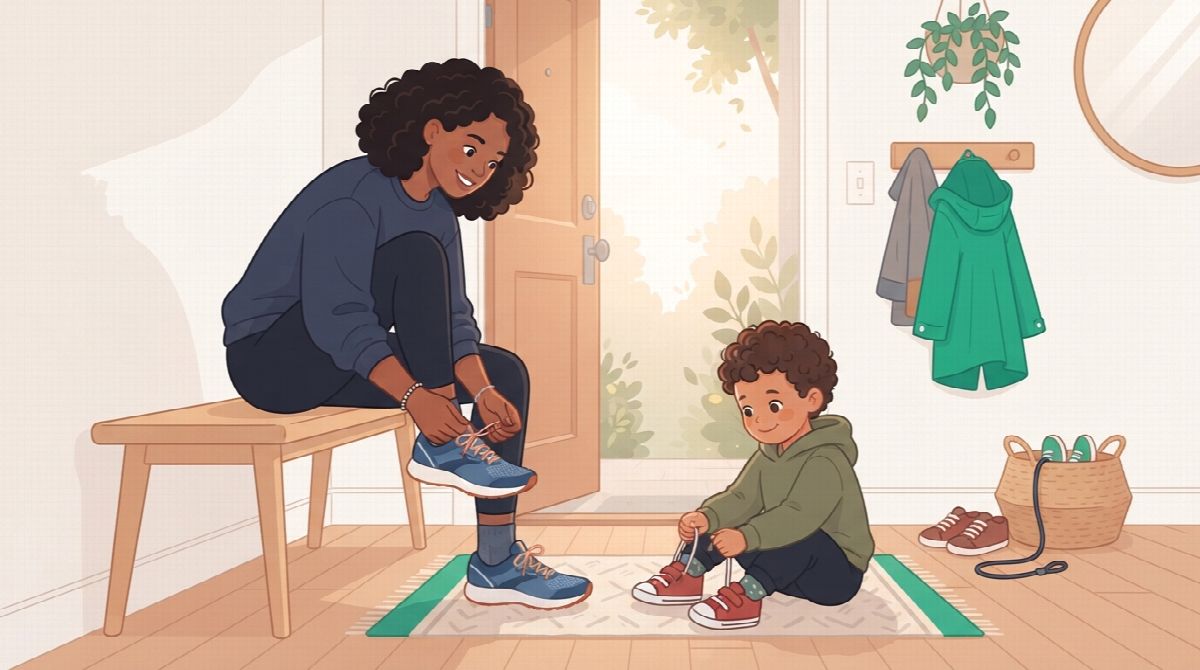
The best family habit tracker is the one built for the ages actually in your house, because a six-year-old and a sixteen-year-old need opposite things from an app. The six-year-old needs a parent to set the tasks and a reward to chase. The sixteen-year-old needs to pick their own habit and not be watched. Most "family" apps quietly serve one band and ignore the other.
| Age band | Who sets the habit | What motivates | What the app needs | Watch out for |
|---|---|---|---|---|
| Under 13 | A parent | Points, a pet, a reward store | Parent approval of tasks, chores and routines, a kid-safe interface | Rewards that stop working the day they stop |
| 13 to 17 | The teen, with input | Autonomy, a streak they own, a cheer from someone they respect | Their own account, their own habit, no penalty mechanics | Anything that feels like monitoring |
| Adults | Each adult | Seeing the other person show up | A shared view, encouragement in one tap, a miss that stays boring | Scorekeeping between partners |
Whatever the band, three tests separate a tool that lasts from one that gets deleted by February:
- Each person owns one habit. A tracker where a parent assigns everything is a chore app, and chore apps stop working the day the reward stops. Even young kids should choose at least one habit themselves.
- Misses stay boring. If a missed day resets a shared score, damages a shared avatar, or docks points, the first bad week ends the whole system. Look for apps where a miss costs nothing beyond the day itself.
- Cheering is easy and auditing is hard. The best family tools make it one tap to celebrate a checkin and give parents no dashboard of who failed. The wrong tool turns dinner into a review meeting.
The best family habit tracker apps in 2026
There is no single family habit tracker app that fits every age, so this list sorts by who each app is really for. Facts below come from each vendor's own website or App Store listing as of September 2026; prices change, so treat them as a starting point.
Joon
Joon is a chore and routine app for kids aged 6 to 12, built for children with ADHD and related conditions. Parents create a task list in the Joon parent app and approve each completed task; the child plays a separate pet game that advances only when real-world tasks get done. It is free to download, with a subscription after a 7-day trial (joonapp.io).
Trade-off: it is a kids' app with a parent dashboard, not a family tracker. Nothing in it tracks the parents' own habits, and teens will find the pet game young.
Family Rewards: Habits and Chores
Family Rewards assigns repeating tasks and habits to anyone in the family, including parents, and lets kids trade earned points for rewards you define. Multiple parents can manage the family from their own devices, and the site claims 24,000+ downloads (familyrewards.app). It is free to start on iOS and Android.
Trade-off: the system includes penalties that take points away, which fails the misses-stay-boring test. Use the bonuses and skip the penalties if you pick it.
Family Checklist
Family Checklist is a free shared checklist where parents and kids see one view of the family routine, organized into health, home, and future habits, with streaks and a printable chore chart maker (family-checklist.com). Its whole pitch is modeling: the parent checks first, the child follows.
Trade-off: it is a checklist more than a tracker, with little history or progress view, and it is aimed at families with younger children.
Kinly
Kinly calls itself a family command center: custom habits per member, streaks, and a rewards store where kids spend points on treats the parents define, with bronze, silver, and gold tiers. It is free to download on iOS (kinlyfamily.com).
Trade-off: it is new, with almost no reviews yet, so expect rough edges and possible changes to what is free.
Habit+ Family
Habit+ Family is a free Android app built for blended families and shared custody: a calendar that can span two households, parent and child profiles on one device, and a routine tracker with an XP system and 600+ predefined family habits, plus budget tools (habit-plus-family.com). An ad-free option is available.
Trade-off: Android only, and it tries to be a calendar, a budget, and a habit tracker at once, so the habit part is one feature among many.
You already know you can change.
You just need to take the first step. Habit Huddle helps you build habits around your goals, alongside friends who keep you accountable.
HabitShare
HabitShare is a free habit tracker built around sharing habits with chosen people. You decide per habit who can see it, so a teen can share the running habit with a parent and keep the journaling habit to themselves, and friends can comment on each other's progress (habitshareapp.com). It is the natural pick for a household of teens and adults who want simple sharing.
Trade-off: the interface is dated and development has been quiet for a while. It tracks and shares, and not much else.
Habitica
Habitica turns habits into a role-playing game: an avatar that levels up, parties with family members, and quests where missed dailies damage the whole party. For families raised on video games, questing together is genuinely fun, and it is free with an optional subscription (habitica.com).
Trade-off: the shared-damage mechanic means one member's rough week hurts everyone's characters, which is exactly the fight generator the misses test warns about. Our Habitica alternatives piece covers the gentler options.
Habit Huddle
Disclosure first: Habit Huddle is our app, so judge this entry on its reasoning.
In Habit Huddle, every habit you track is a huddle, solo or with friends, and a family of teens and adults is a natural huddle. Each person picks their own habit and sets a Floor, the smallest version they can do on their worst day, and a Ceiling to burst through on a good one. A checkin takes seconds, grows a personal streak, and adds a link to the huddle's Checkin Chain, which counts one link for every member who shows up that day. Everyone sees each other's checkins and cheers them in one tap.
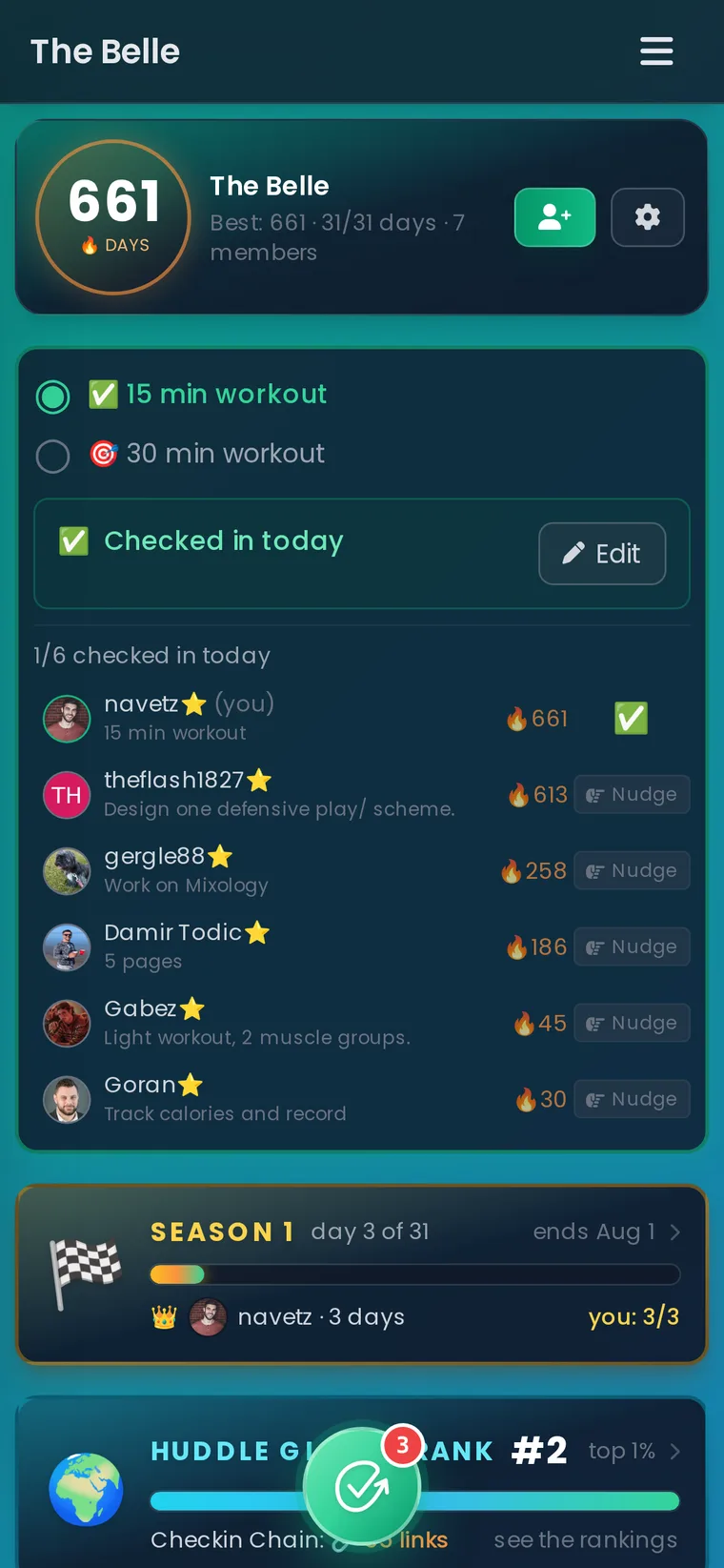
The design choice that matters for families: the app shows checkins, never anyone else's missed days. There is no dashboard of missed days, so a parent cannot turn it into an audit even if they wanted to. It passes all three tests above by design. Free to start on web, iOS, Android, and Discord; the free plan covers one habit you run yourself.
Trade-offs: accounts are for ages 13 and up, so it cannot track a younger child's habits. There are no chores, points, penalties, or a rewards store, because it is a social habit tracker rather than a parenting tool. And the community is smaller than the incumbents above.
Comparison at a glance
| App | Best for | Platforms | Price | What happens on a miss |
|---|---|---|---|---|
| Joon | Kids 6 to 12, ADHD routines | iOS, Android | Free download, subscription after trial | Pet does not advance |
| Family Rewards | Chores and points for the whole house | iOS, Android | Free to start | Optional point penalty |
| Family Checklist | One shared routine, younger kids | App | Free | Streak ends |
| Kinly | Rewards store with tiers | iOS | Free download | Streak ends |
| Habit+ Family | Blended families, shared custody | Android | Free, ad-free option | Less XP |
| HabitShare | Teens and adults, per-habit sharing | iOS, Android | Free | Visible gap in the calendar |
| Habitica | Families who love games | Web, iOS, Android | Free, optional sub | Party takes damage |
| Habit Huddle | Teens and adults who want cheers, not audits | Web, iOS, Android, Discord | Free to start | Nothing shown to others |
Habits worth tracking as a family
The best family habits are daily, take under fifteen minutes, and are things every age can do at their own size. Give each one a Floor everyone can hit on the busiest school night and a Ceiling for the weekend. A few that hold up:
- The after-dinner walk. Floor: to the corner and back. Ceiling: thirty minutes with the dog. Movement plus the only uninterrupted conversation of the day.
- Phone-free dinner. Floor: phones in a basket for the meal. Ceiling: no screens until the table is cleared. The family-meal research above is the reason.
- Reading before bed. Floor: one page, or one picture book for the youngest. Ceiling: twenty minutes. Our guide to how many pages a day to read sizes it.
- Lights out on time. Floor: in bed by the agreed time. Ceiling: no screens for the last half hour.
- A glass of water first thing. Floor: one glass. Ceiling: a full bottle by lunch.
- Ten-minute tidy. Floor: your own room. Ceiling: one shared space too. One timer, everyone at once.
- One kind thing. Floor: name one at dinner. Ceiling: do one for someone outside the house.
- Outdoor time. Floor: ten minutes. Ceiling: an hour on weekends.
Start with one shared habit and let each person add one of their own. Three habits total is plenty for a household; a family that tries to overhaul everything in January is usually tracking nothing by March. If you want a gentle on-ramp, our easy habit challenge for beginners has twenty ideas already sized with a Floor and Ceiling, and how long habits take to form explains why the first two months matter most.

How to run it without turning parents into the police
Family habit tracking fails in one specific way: it starts as a shared project and turns into a parent monitoring everyone else. Five rules keep it on the right side of that line.
- Parents go first. The Framingham study is the whole argument. Log your own checkin before you ask about anyone else's. A parent with a visible streak is worth more than any reward store.
- Cheer, never audit. React to the checkins that happen. A child's or partner's missed day is theirs; your job is to make showing up feel good. The fastest way to kill a family habit is to prosecute the gap at dinner.
- Everyone picks their own. Especially teens. A habit chosen for you is a chore, and a chore needs a reward to survive. A habit you chose needs only someone to notice you did it.
- Size the Floor to the busiest week. Exam week, a work trip, a sick toddler. If the Floor survives that week, the streak survives the year.
- Plan the miss. Agree in advance that a miss is a day, not a verdict, and that the rule is to restart the next morning at the Floor. Our guide on restarting a habit after falling off has the seven-day plan.
Two practical additions help. A five-minute Sunday review, where the family looks at the week together and adjusts anything that is not working, catches problems before they become resentment. And writing the agreement down, even in a light-hearted way, makes it the family's rule rather than a parent's. The free habit contract generator produces a one-page version everyone can sign.
One app or two? Two is fine
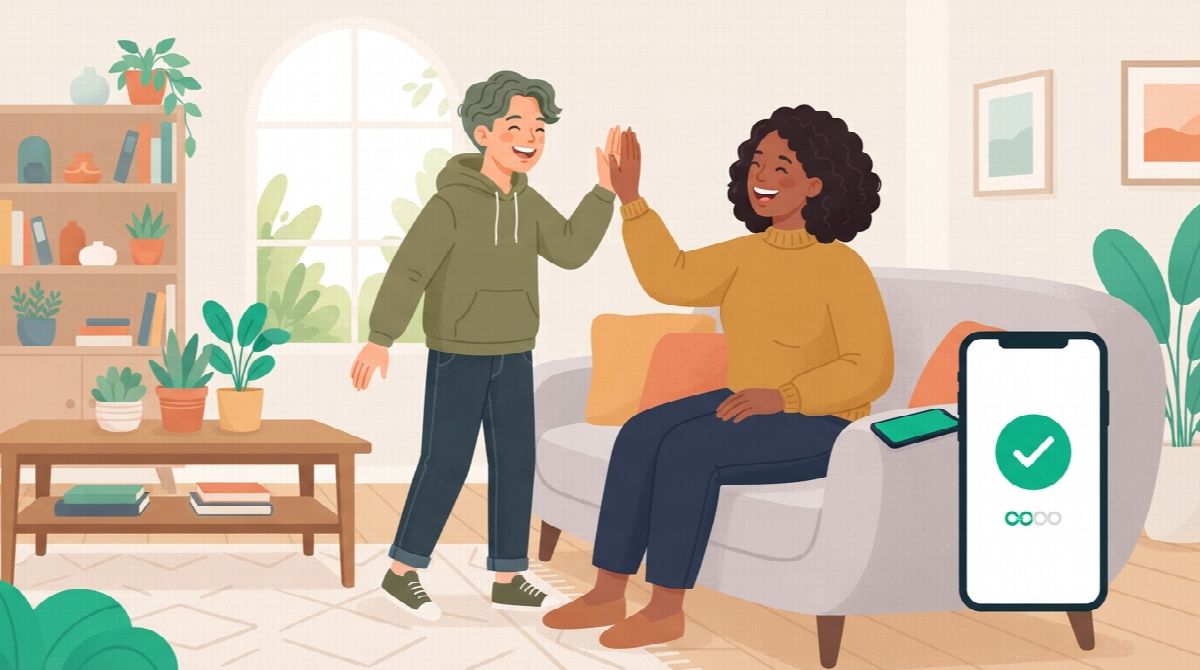
Most families with children under 13 and anyone older will run two tools, and that is the right answer rather than a compromise. A chore-and-rewards app such as Joon or Family Rewards handles the young ones, where a parent sets the routine and approves it. A social tracker such as HabitShare or Habit Huddle handles the teens and adults, where each person owns a habit and the rest of the family cheers.
A paper chart on the fridge is a legitimate third option for the youngest child, and it has one advantage no app has: everyone walks past it. Our shared habit tracker guide goes deeper on the app options, and couples habit tracker covers the two-adult version of all of this.
Start with the people already in your kitchen
You do not need to find an accountability partner. You live with several. Pick one shared habit, size the Floor so the busiest person can hit it, and put the parents' checkins on the board first.
If everyone in the huddle is 13 or older, start a family huddle in Habit Huddle, free, and invite them by link. If not, run the kids' side on a chore app or a fridge chart and the adults' side in a huddle; the walk after dinner will still count for everyone. Either way, the tracking is the small part. The showing up, in front of the people who copy you, is the point. More on the friends version at habit tracker with friends.
Ready to Build Habits With Friends?
Stop failing alone. Join thousands using the #1 habit tracker with friends for real accountability and lasting results.
Prefer mobile? App Store · Google Play
Related Guides
More Habit Huddle articles on building habits with accountability.

Gamified Habit Tracker: 7 Apps Compared by What the Game Rewards (2026)
Gamified habit trackers compared: Habitica, Finch, Forest, Streaks, Habits Garden, HabitForge, and Habit Huddle, by what the game rewards, what free gets you...

Running Accountability App: 8 Picks Compared (Stakes, Streaks, and Friends)
Eight running accountability apps compared: Strava, Nike Run Club, Runkeeper, Oath, RunMatch, RunHawk, StickK, and Habit Huddle, with prices, how runs are ve...

How to Restart a Habit After Falling Off (Without Starting Over)
How to restart a habit after falling off: do the Floor version today instead of Monday, hold it for seven days, write one if-then for what knocked you off, a...