
How to Gamify Working Out So It Still Works After Week Six
How to gamify working out: what to score, which game mechanics last, 6 setup steps and 6 game ideas, backed by trials on points, levels and playing with frie...
 By Stevan Ljuljdurovic, founder of Habit Huddle
Updated October 31, 2026
📺 Related Video: Make Yourself WANT to Train - Effective Gamification
Video by: The Bioneer · Watch on YouTube
To gamify working out, pick one thing to score (usually just showing up), give it a scoreboard such as a streak, points or levels, add a milestone test every few weeks, and bring other people in as rivals, teammates or cheerleaders. That last part is the one that lasts. Points and badges get most people moving for a few weeks. The social layer is what keeps them moving after the novelty wears off.
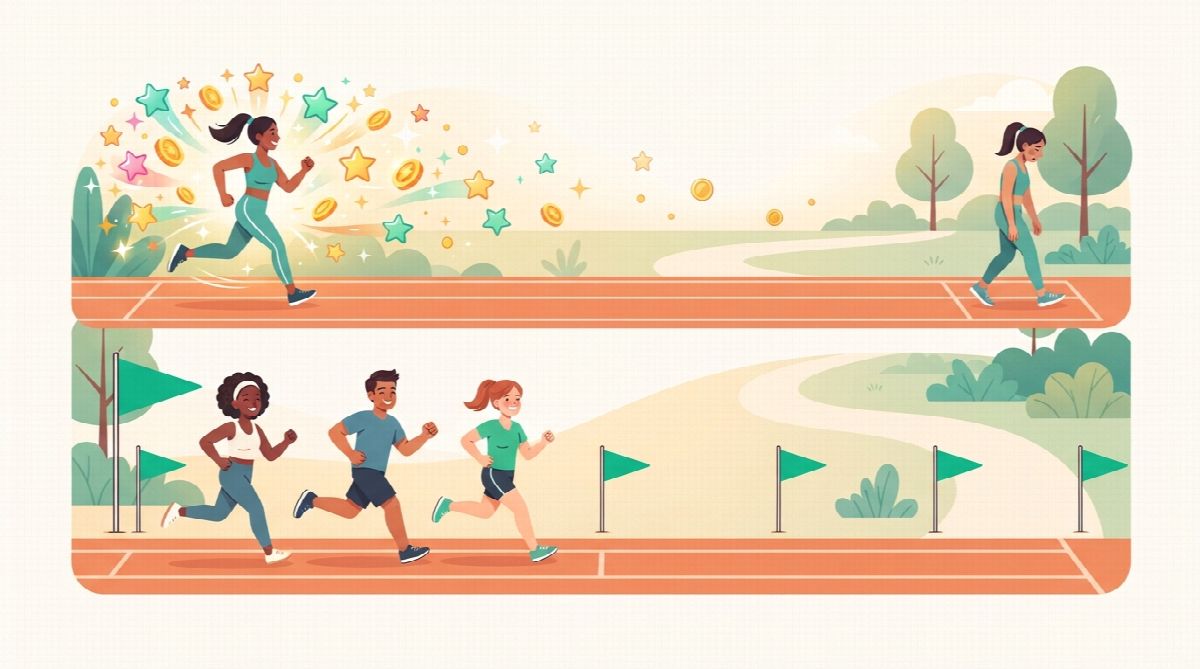
The research backs this up. When young adults downloaded Pokémon GO, their daily steps jumped by 955 in the first week and were back to normal by week six. In a 24-week trial where the game was built around other people, the competitive group was still walking more 12 weeks after the game ended.
This guide covers what works, why most workout games fade, a six-step setup, and game ideas you can start this week, solo or with friends.
What does it mean to gamify working out?
Gamifying a workout means borrowing game mechanics, such as points, levels, streaks, quests and leaderboards, and attaching them to exercise you were going to do anyway. You are not playing a video game. You are giving your training the feedback loop that makes games hard to put down: a clear goal, visible progress and a reason to come back tomorrow.
There are two broad ways to do it:
- Exercise games, where the game is the workout: Pokémon GO, Zombies, Run!, Ring Fit Adventure, dance games at the arcade.
- Gamified tracking, where your normal workout is the move and the game is the scoreboard around it: workout streaks, XP for sessions, fitness challenges with friends, Apple Watch rings.
The second kind is the one most people need, because it works with whatever exercise you already like. It is also where the research on long-term results is strongest.
Does gamifying exercise actually work?
Yes, gamification reliably increases physical activity, but the effect shrinks once the novelty fades unless something else keeps it going. The best evidence comes from randomized trials, not app marketing.
- The big picture. A 2022 meta-analysis in the Journal of Medical Internet Research pooled 16 randomized trials with 2,407 participants. Gamified programs had a small-to-medium effect on physical activity, and they beat equivalent non-gamified programs too. After the programs ended (about 14 weeks of follow-up), the effect was still there but much weaker.
- The novelty curve. In a BMJ study of 1,182 young adults, Pokémon GO players added 955 steps a day in their first week. The boost faded week by week and was gone by week six. A separate study of 32,000 wearable users found the most engaged players added 1,473 steps a day over their first 30 days.
- The social version. In the STEP UP trial, 602 adults played a 24-week step game with points and levels, built around support, collaboration or competition. All three versions beat the control group. Competition did best, adding about 920 steps a day, and it was the only version still clearly ahead 12 weeks after the game stopped.
- The family version. In the BE FIT trial, 200 adults from 94 families played a points-and-levels game as family teams. They hit their step goals on 53% of days, against 32% for the control group, and stayed ahead after the game ended.
The pattern is clear: points get you started, and people keep you going.
What our own data shows
We see the same curve in Habit Huddle, where people log daily checkins for habits like workouts, either solo or in a huddle with other people. We looked at every member whose first checkin fell between July 3 and September 17, 2026, and asked a simple question: were they still logging checkins in their sixth week?
- Started in a huddle of 3 or more people: 21% were still logging checkins in week six (97 of 456).
- Started in a pair: 11% (12 of 110).
- Started solo: 6% (65 of 1,008).
That covers all habits, not only workouts, and it is a correlation, not proof. People who start in a group may be more committed from day one. Still, week six is exactly where Pokémon GO's boost ran out, and the difference between solo and group lines up with what the trials found.
Why most workout games stop working by week six
Most homemade workout games fail for the same four reasons, and all four are fixable.
- The rewards are the point. Badges and points feel great for a few weeks, then they become background noise. A game that only runs on novelty will run out of it, as the Pokémon GO numbers show.
- The game scores the wrong thing. If you award points for reps, max effort or calories, the game pushes you toward junk volume, sloppy form and burnout. A game for beginners should reward showing up.
- One bad day ends the game. A strict daily streak turns a single sick day into "I lost everything," and that is often the day people quit. A game that can't survive a bad week isn't built for real life.
- You are playing alone. Solo games depend on your mood. A game with other people in it gives you a reason to show up on the days your mood says no.
The six steps below are built to avoid all four.
How to gamify your workouts in 6 steps
1. Score showing up, not intensity
The most durable thing to reward is the session itself, not how hard it was. Decide what counts as a "win" for one day, and make the bar low enough to clear on your worst day. We call this your Floor: a 10-minute walk, one set of push-ups, five minutes of stretching. Then set a Ceiling for good days, such as a full 45-minute session.
Score the Floor in full. A 10-minute walk on a terrible day keeps the game alive, and keeping the game alive is the whole point. For more on this, see our guide on how to build an exercise habit.
2. Pick one scoreboard
Choose a single main mechanic, because three overlapping scoreboards are harder to keep up than the workouts themselves. Here is how the common ones compare.
| Mechanic | What it rewards | Best for | How it backfires | The fix |
|---|---|---|---|---|
| Streak | Showing up on back-to-back days | Daily habits, beginners | One missed day feels like losing everything, and people skip rest days to protect it | Count a Floor day in full, and plan rest days or use a streak freeze |
| Points per session | Consistency over a week | People who like numbers | Points for reps or calories reward junk volume | Score sessions, cap points per day, set a weekly target |
| Levels or ranks | Long-term progress | Anyone who has quit after one bad week | Early levels that take too long feel pointless | Make the first level-up land inside the first week |
| Boss fight | A milestone test every 4 to 6 weeks | Strength and running goals | Testing too often invites injury | One test per training block, with good form |
| Leaderboard | Beating other people | Competitive types, coworkers, strangers | The bottom half of the board stops trying | Short rounds, frequent resets, or compare to your own last round |
| Team goal | Everyone showing up | Friends, families, couples | It can start to feel like a duty to the group | Count what each person adds, and never single out who didn't |
Levels are underrated. A streak ends the day you miss, but a level you earned stays earned. That makes levels a good partner for a streak: the streak gives daily urgency, and the level means a bad week doesn't erase your progress.
You already know you can change.
You just need to take the first step. Habit Huddle helps you build habits around your goals, alongside friends who keep you accountable.
3. Add levels and a boss fight
Give the game a long arc: small level-ups every week or two and a bigger "boss fight" every 4 to 6 weeks. A boss fight is one test you repeat each block, such as max push-ups in one set, a timed mile or a plank hold. Beat your last score and you level up.
Keep the boss fight rare. The rest of the time, the game is about showing up. Testing your max every week is how gamified training turns into an injury.
4. Choose how to play: compete, collaborate or support
The social mechanic matters more than any badge, and the right one depends on who you are playing with. Mitesh Patel, the physician who led the STEP UP and BE FIT trials, put it simply in an interview with NPR: competition tends to work better with people you don't know, while collaboration and support work well with friends and family you trust.
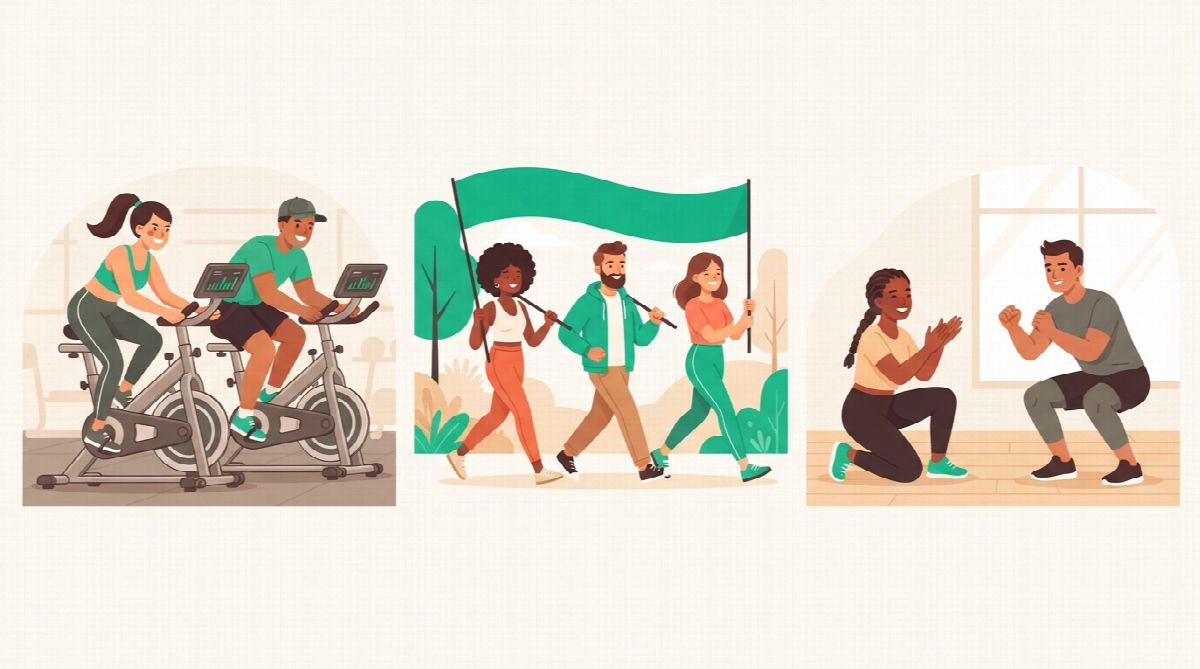
- Compete if you are fired up by rivals. Try a step leaderboard with coworkers or a weekly session count with a friend who is about as fit as you.
- Collaborate if you would rather win together. Set a shared target, such as 100 combined workouts in a month, so every session anyone does moves the whole team forward.
- Support if you mostly need someone in your corner. Share each workout with one or two people who cheer it, however small it was.
People also respond differently. A follow-up analysis of STEP UP found that competition only lifted steps for outgoing, already-motivated participants, and that boost faded after the game ended. Less active, less social participants improved with all three styles, and kept the gains. If you are not sure which type you are, start with support. It is the easiest to keep going, and nobody has to lose. For ready-made formats, see our group fitness challenge ideas.
5. Run it in seasons
Change the rules every 6 to 8 weeks, before the novelty runs out rather than after. Name each block ("the October season"), pick a new boss fight, swap a mechanic or add a theme. Keep your lifetime stats, but reset the season scoreboard so everyone, including whoever fell behind, starts the new round level.
Seasons solve the week-six problem directly. Instead of one long game that gets stale, you get a series of short games with fresh goals.
6. Make rest part of the game
A good workout game never punishes recovery. Build rest days into the rules: weekly targets instead of daily ones ("4 sessions this week"), a streak freeze you earn by staying consistent, or a Floor option like a 10-minute walk that counts on rest days. Your body adapts during rest, so a game that forces you to skip it is working against you.
Workout game ideas you can start this week
You don't need an app to gamify exercise; a deck of cards and some tape will do. Here are six games that work for one person or a group.
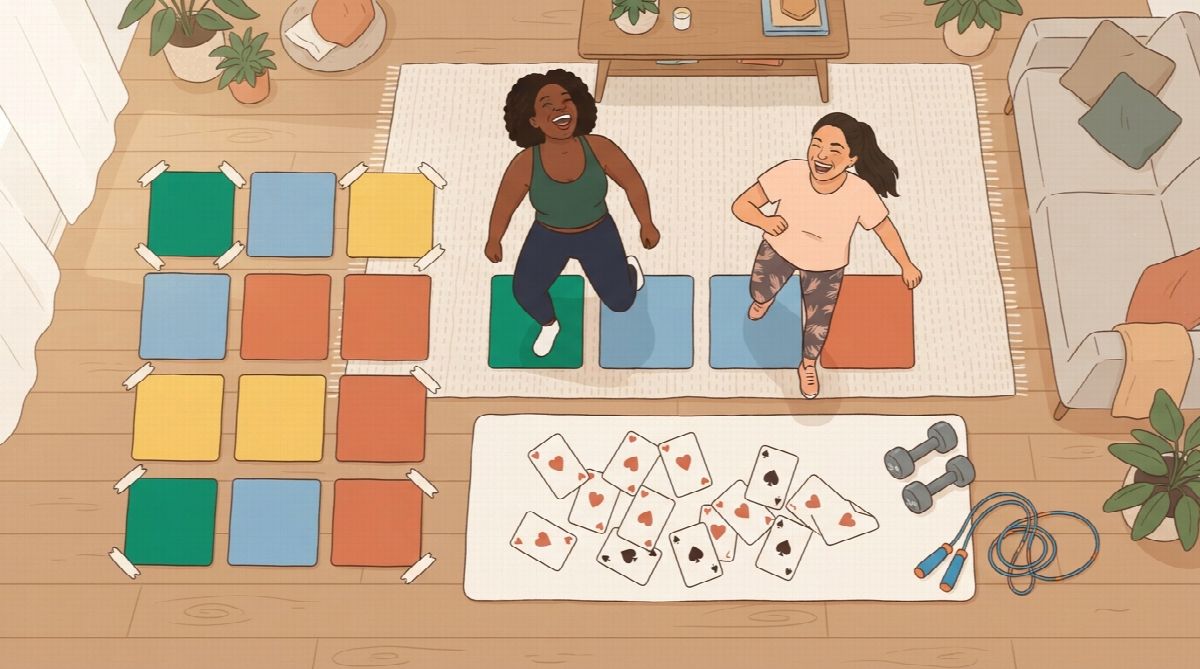
- Deck of cards workout. Assign an exercise to each suit (hearts for squats, spades for push-ups and so on). Flip a card and do that many reps, with face cards counting as 10. Get through half the deck on your first try, then the full deck as a boss fight.
- Workout bingo. Make a 5x5 grid of small tasks: a 10-minute walk, 20 squats, a new running route, a stretch session, taking the stairs. Complete a row for a bingo. Friends can race to the first bingo of the week.
- The virtual trail. Pick a famous route, such as the length of a national trail or the distance between two cities, and add up everyone's walking and running distance until the group "arrives."
- The paper chain. Add one paper link to a chain for every workout anyone in the house does, and hang it where everyone sees it. It is a team goal you can watch grow.
- Boss fight Friday. Once a month, test one thing (max push-ups, a timed mile) and log it. Beat last month's score to level up.
- Two-week duel. Challenge one friend: whoever logs more sessions in 14 days picks where you go for lunch. Then reset and go again.
Apps that gamify exercise
If you would rather have an app keep score, the right one depends on whether you want a game or a scoreboard.
- Exercise games: Pokémon GO and Zombies, Run! turn walking and running into exploration or a story. Ring Fit Adventure on the Nintendo Switch is a full RPG you play by exercising.
- Fitness trackers with game layers: Apple Fitness has activity rings, awards and week-long competitions with friends. Strava has segment leaderboards, monthly challenges and badges.
- Habit trackers with game layers: apps like Habitica and Finch reward showing up for any habit, including workouts. We compared seven of them in our guide to gamified habit trackers.
Whatever you pick, apply the same test: does the app reward showing up, and does it put other people in the game? If you are deciding whether to bring friends at all, our breakdown of working out alone or with friends walks through the trade-offs.
Make it a team game with a huddle
If the social layer is what your game is missing, Habit Huddle is built around it. It is our app, so weigh that.
You start a huddle, invite a few friends, and each set a Floor and a Ceiling for your workout habit. Every day you log a quick checkin, and your friends can cheer it. Each member who logs a checkin adds a link to the huddle's Checkin Chain, so the team goal grows every day people show up. You also earn XP for every checkin day and for cheering others, and climb ranks from Herald up to Immortal. A missed day never costs XP, so your rank survives a bad week.
The trade-offs: it works best when you bring at least one friend, it does not plan workouts or count sets and reps, the free plan covers one active habit, and Ceiling checkins are a pro feature. Floor checkins, huddles, cheers and ranks are free. If you want to see it in action first, the habit tracker with friends page shows how a huddle works.
Ready to Build Habits With Friends?
Stop failing alone. Join thousands using the #1 habit tracker with friends for real accountability and lasting results.
Prefer mobile? App Store · Google Play
Related Guides
More Habit Huddle articles on building habits with accountability.
Accountability Apps for Students: 7 Compared for a Whole Semester
7 accountability apps for students compared: which fix starting, which fix your phone, and which keep a study habit going all semester. Free picks included.
Sober Streak Tracker: 7 Apps Compared by What Happens After a Slip
Compare 7 sober streak trackers by what happens to your count after a slip and who sees your days. Free picks, prices, and how to track sobriety with friends.
How to Work Out When You Don't Feel Like It: 7 Fixes That Work
Don't feel like working out? Name which kind of unmotivated you are, shrink the workout to your Floor, and use these 7 research-backed fixes. Plus when to rest.