
Family Workout App: 8 Compared by Who One Plan Really Covers (2026)
Compare 8 family workout apps: which plans cover several people, what each costs, and which work for kids under 13. Prices checked November 2026.
 By Stevan Ljuljdurovic, founder of Habit Huddle
Updated November 2, 2026
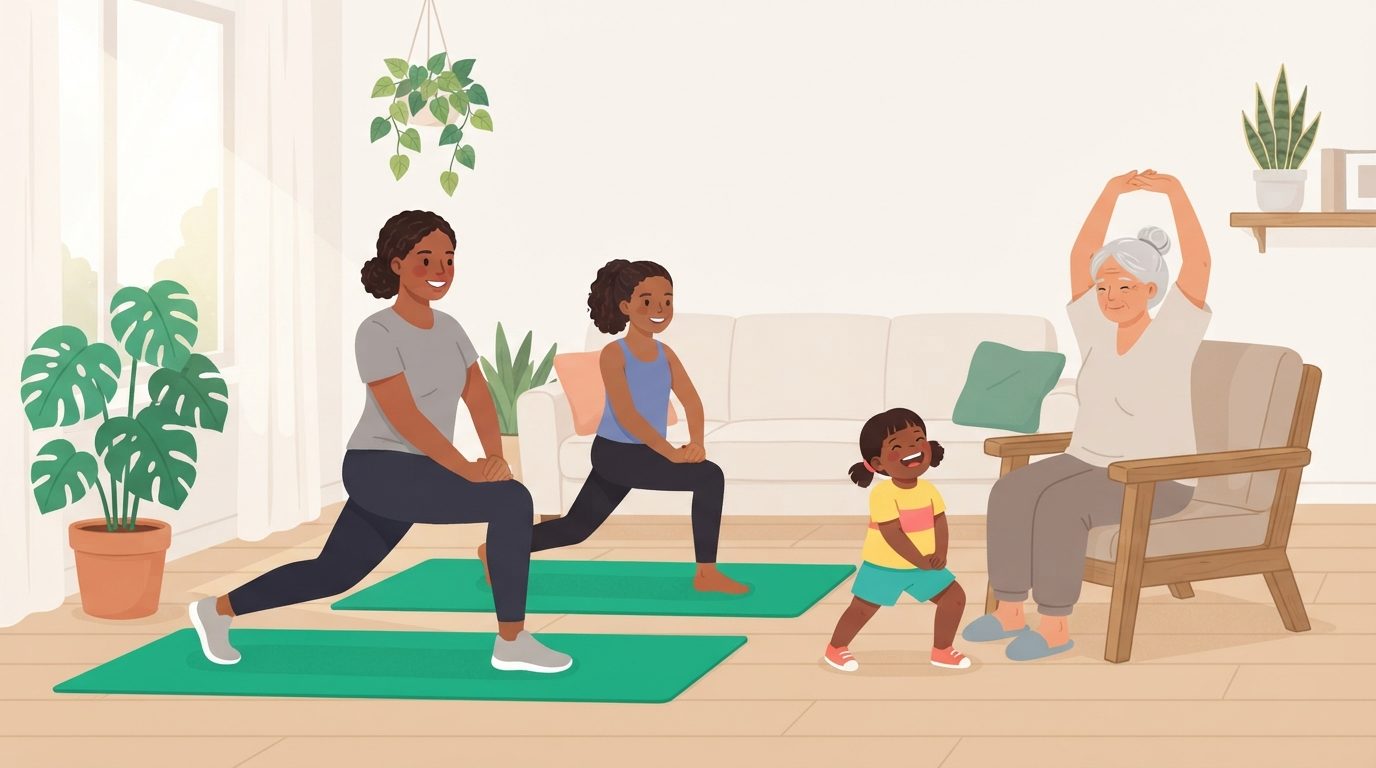
📺 Related Video: Have a Blast With This Family Fun Cardio Workout!
Video by: PS Fit · Watch on YouTube
The best family workout app depends on what "family" means in your house. For one bill that covers several people, Apple Fitness+ shares with up to five family members for $79.99 a year, and Strava's Family plan covers four accounts for $139.99 a year. For kids under 13, Sworkit's Kids workouts are free. For teens and adults on no budget, Nike Training Club costs nothing, and each person signs up on their own.
One catch: a Peloton App Membership comes with one profile, so two adults who want separate histories need two memberships. This guide compares eight apps on who one plan really covers, what it costs, what works for younger kids, and what keeps a family going after the first week. Prices and App Store ratings were checked on November 2, 2026.
"Multiple users" means three different things
A family workout app can share three separate things: the bill, the screen, or the motivation. Most apps do one of these well, so decide which one you are shopping for before you compare prices.
One bill, several people. Everyone has their own account and history under one payment. Apple Fitness+ and Strava's Family plan work this way. This is what a family plan really means, and it is the only one of the three that saves money.
One screen, several people. Everyone follows the same video in the living room. Any video workout app can do this, including the free ones. The catch is the record, because the app logs the person signed in. MyHealthyApple's setup guide says Fitness+ connects one Apple Watch per device at a time, so everyone else in the room works out without stats. That is fine for a seven-year-old and a problem for an adult following a program.
Separate workouts, shared motivation. A parent lifts at 6 am, a teen runs after practice, and a grandparent walks at lunch. They rarely share a room, but they can see each other show up. Social apps do this part, and most of them have nothing to do with billing.
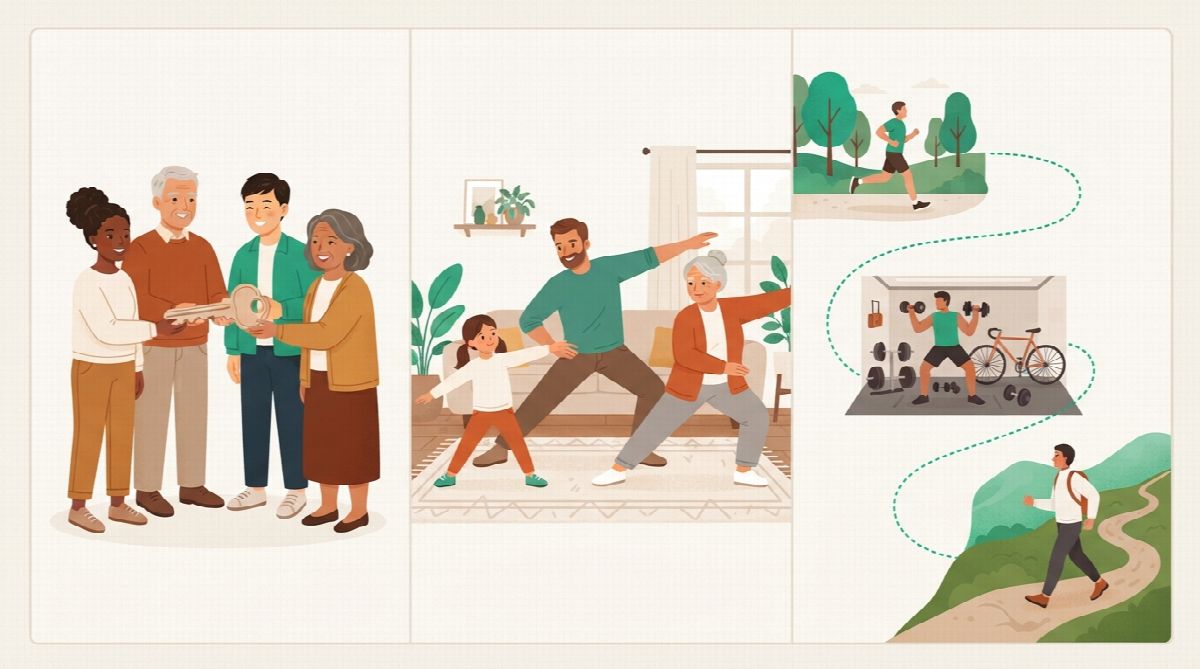
A family plan shares the bill. It does not share the motivation. You may end up with two apps: one for the workouts and one for the people.
8 family workout apps compared
These eight apps cover the main ways a household can share workouts. We read each company's own pages and App Store listing on November 2, 2026. Prices change, so confirm them before you subscribe.
| App | Who one plan covers | Cost to start | App Store rating | Best for |
|---|---|---|---|---|
| Apple Fitness+ | You plus 5 family members | 1-month trial, then $9.99/mo or $79.99/yr | 2.9 for Apple's Fitness app (11.6K ratings) | iPhone households who want classes |
| Strava | 4 accounts on the Family plan | Free to record; Family plan $139.99/yr | 4.8 (380K ratings) | Runners, riders and walkers 13 and up |
| Peloton App | 1 profile per membership | Free version; App One $15.99/mo or $159/yr | 4.9 (819K ratings) | One committed adult |
| Sworkit | No shared plan listed | Kids content free; 7-day trial for the rest | 4.7 (30.6K ratings) | Younger kids and a parent |
| Nike Training Club | Everyone uses their own free account | Free | 4.8 (283K ratings) | Teens and adults on no budget |
| Google Health (Fitbit) | Guardians manage child accounts | Free app; Fitbit Premium $9.99/mo or $79.99/yr | 4.5 (710K ratings) | Kids who wear a tracker |
| FamilyFit | Parents and kids; 1 linked invite free | Free; Unlimited $2/mo or $20/yr | No ratings yet | Parents assigning workouts and rewards |
| Habit Huddle | Everyone you invite, on free accounts | Free to start | 5.0 (2 ratings) | Teens and adults sharing motivation |
Apple Fitness+
Apple Fitness+ is the simplest true family plan for an Apple household. One subscription costs $9.99 a month or $79.99 a year, and Apple says you can share it with up to five family members, each with their own personalized experience. That works out to about $13 per person per year with six people.
Good for: homes where everyone has an iPhone and wants studio-style classes on a phone, iPad or Apple TV.
Weak spot: it runs on Apple devices, so one Android phone leaves that person out. The App Store score above is for Apple's whole Fitness app, not only the workouts.
Strava
Strava's Family plan fits households that run, ride or walk outside. Its subscription page lists four accounts for $139.99 a year, billed yearly only, or about $35 per person per year. A single subscription costs $79.99 a year, and the free version still records your activities.
Good for: teens and adults who already move outdoors and enjoy a feed of each other's activities.
Weak spot: Strava's terms set the minimum age at 13 and say content is public by default unless you are under 18, so adults should review their settings. It is mainly a record of what you did, so it will not lead a living room workout.
Peloton App
The Peloton App has a deep class library, but it is not a family plan. Peloton's membership page says an App Membership gets one profile. On the App Store, App One costs $15.99 a month or $159 a year, and App+ costs $28.99 a month or $289 a year. A free version and a 30-day trial are available.
Good for: one committed adult, or adults happy to pay per person.
Weak spot: two adults on App One pay $318 a year. Households with Peloton equipment need the separate All-Access Membership instead.
Sworkit
Sworkit is a strong starting point with younger kids, because its App Store listing says all Kids content is 100% free. The listing describes the library as kids' workouts for teachers, parents and coaches. Other workouts need a subscription after a 7-day free trial, and listed prices include $9.99 a month and $59.99 a year.
Good for: a parent and a child moving together without paying anything.
Weak spot: we found no shared family subscription on the listing, so each adult who wants the paid library pays separately. Its website now leads with employer wellness programs, so read the app listing to see what households get.
Nike Training Club
Nike Training Club is the free pick for teens and adults. Its App Store listing says Nike Members get free access to strength, conditioning, yoga, pilates, recovery and mindfulness content. There is no family plan because there is no bill to share. Each person needs their own Nike account.
Good for: anyone who wants trainer-led programs without a subscription.
Weak spot: we found no family view on the listing, so nothing connects your accounts. You will need something else for the motivation part.
You already know you can change.
You just need to take the first step. Habit Huddle helps you build habits around your goals, alongside friends who keep you accountable.
Google Health (formerly the Fitbit app)
The Fitbit app is now Google Health, and it suits families who already use trackers. Google's help pages describe a family setup where a guardian manages accounts for children, who get a kid view. A child who reaches 13 upgrades to a standard account. The app is free, and the listing shows Fitbit Premium at $9.99 a month or $79.99 a year.
Good for: parents of younger kids with a Fitbit Ace or another tracker.
Weak spot: it measures activity more than it leads a workout. Google also recommends that a child has their own phone or tablet for the best experience with an Ace device.
FamilyFit
FamilyFit is the one app here built around family workouts from the start. On its site, parents create exercises and workouts, assign them, and kids earn points to redeem for rewards the parents define, such as screen time. One linked invitation to another phone is free. More need FamilyFit Unlimited, at $2 a month or $20 a year in early pricing.
Good for: parents of younger kids who want workouts, tasks and rewards in one place.
Weak spot: the App Store shows no ratings yet, so there is little outside evidence. An assign-and-reward model also suits a seven-year-old better than a sixteen-year-old who wants to pick their own workout.
Habit Huddle
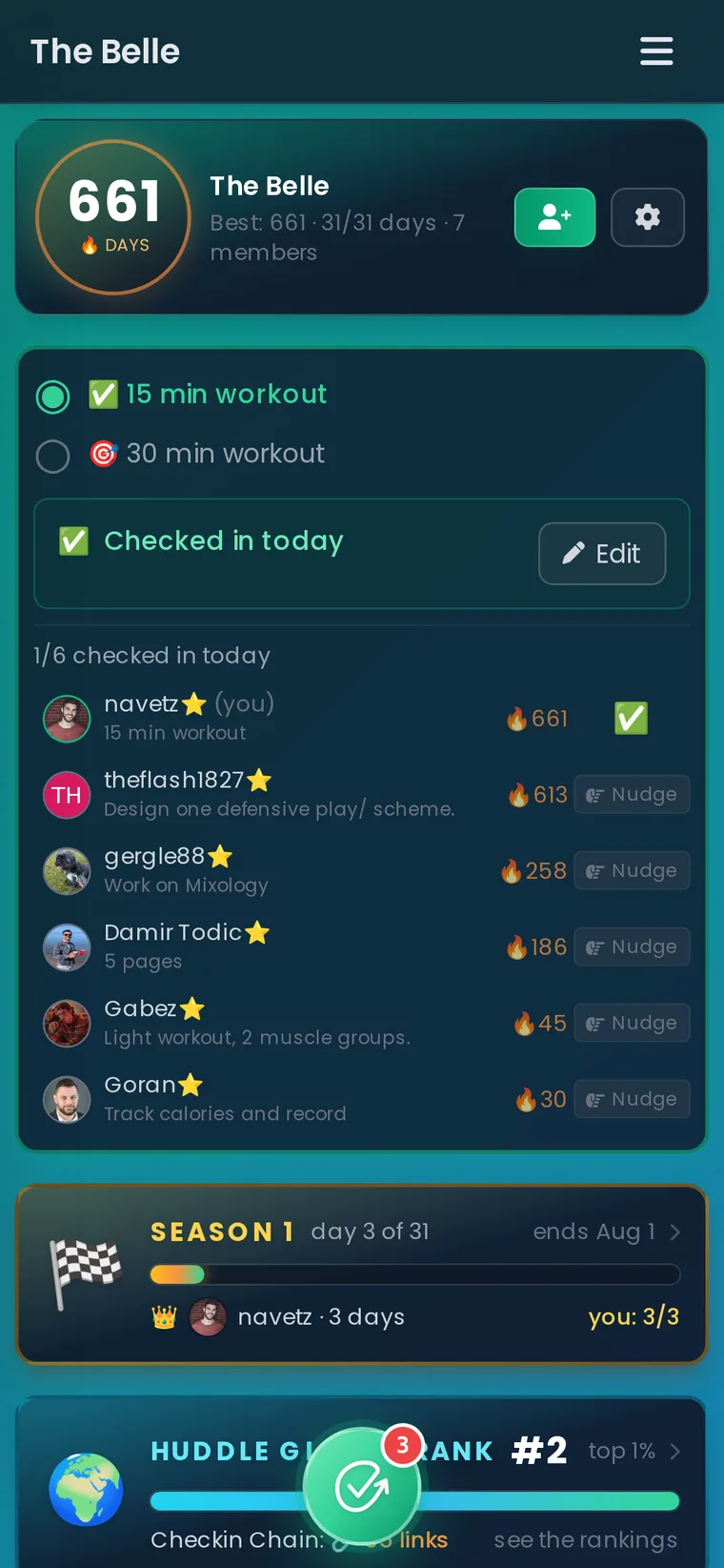
This is our app, so judge the reasoning, not the placement. Habit Huddle is a social habit tracker, not a workout app, so you use it alongside a workout source above. Each person picks their own habit, such as a 20-minute run or 10 push-ups, joins the family's huddle, and posts a checkin when it's done. Everyone in the huddle can cheer it. Each member who shows up adds a link to the huddle's Checkin Chain, and a quiet day is never announced.
Every habit has a Floor, the smallest version that still counts on your worst day.
Trade-offs:
- It has no workout videos or training plans.
- Accounts are for ages 13 and up, so younger kids cannot join.
- Checkins are public. An exclusive huddle controls who can join, but anyone can view it, so teens should use a nickname.
- The free plan covers one active habit. Flex Checkins and Photo Checkins are pro features.
Does working out as a family actually help?
Working out as a family helps, and the strongest evidence points at what parents do themselves. A 2016 review in Obesity Reviews looked at 47 studies of family programs for children aged 5 to 12. A meta-analysis of 19 of them found a small but significant increase in physical activity, and combining goal-setting with reinforcement stood out as a strategy.
The parent's own activity matters too. In the Framingham Children's Study, which tracked 100 children aged 4 to 7 with activity monitors, children of two active parents were 5.8 times as likely to be active as children of two inactive parents. It is a small study with a wide margin of error, and the authors listed genetics among the possible reasons, along with role modeling and shared activities.
Adults influence each other as well. In a study of 3,722 couples aged 50 and over, about 67% of inactive men and 66% of inactive women became more active when their partner newly did, against 26% and 24% when their partner stayed inactive.
The workout a parent keeps doing matters more than the app a parent buys.
Our own numbers point the same way, with a caveat. We looked at 478 workout habits, such as runs, walks, gym sessions and yoga, that got their first checkin on Habit Huddle between July 3 and September 30, 2026. By October 31, 19.0% of those in a huddle with at least one other current member had reached 30 checkin days (23 of 121). For workout habits tracked alone, it was 2.0% (7 of 357). We cannot tell which huddles are families, and part of the gap is selection, since people who invite others may already be more committed.
The same data has a planning lesson: the weekend does not take care of itself. Across 3,240 workout checkin days from July 6 to October 25, 2026, Mondays averaged about 32 workout checkins and Saturdays about 26, the lowest of the week. That leaves out one Saturday with an unusual spike. Consider a weeknight slot your family already shares, rather than assuming Saturday morning will happen on its own.
How to set up a family workout routine
A family workout routine lasts when the adults go first, the plan fits the youngest person, and each person owns one habit.
- Pick the job first. Decide whether you need a shared bill, a shared screen or shared motivation. Buy only for the job you have.
- Start with one shared session a week. Fifteen minutes in the living room or a walk after dinner is enough. The PS Fit video on this page is one free option to try.
- Let each person own one daily habit. A teen who picks their own run is more likely to keep it than one who is assigned it. Our family habit tracker guide covers how to do this by age.
- Set a Floor everyone can hit. A 10-minute walk counts. So do five push-ups. A low Floor keeps the habit alive through exam week or a work trip.
- Parents post first. The research above is the reason. Log your own workout before you ask about anyone else's.
- Cheer what happens. A reply on a Tuesday night does more than a talk about last week. If a week falls apart, here is what to do after a missed workout.
- Use paper for the youngest. A printed 30-day challenge tracker on the fridge works well for a child too young for an account.

If only the two adults are in this, our couples habit tracker guide is the closer fit. If your workout partners are friends and not relatives, see our workout accountability app comparison.
Which family workout apps work for kids under 13?
Age 13 is the dividing line in this category, because several apps set it as their minimum. Strava and Habit Huddle both do. For younger children, look at Sworkit's Kids content, FamilyFit, or Google Health's family setup with a tracker.
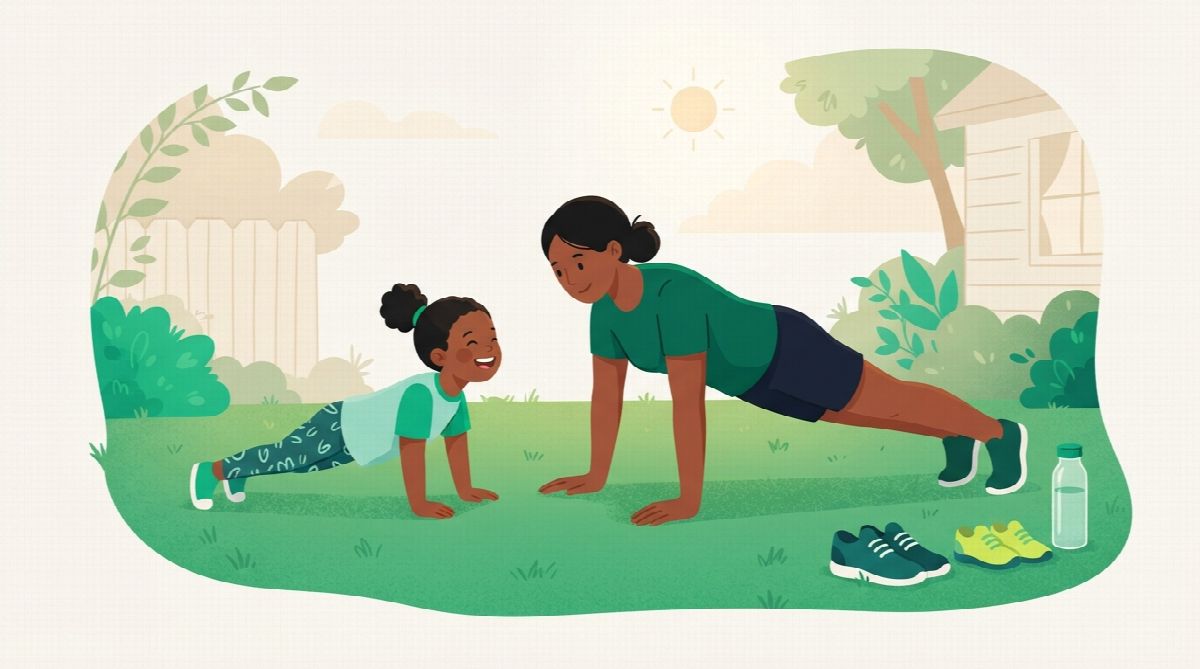
The CDC says children and teens aged 6 to 17 need at least 60 minutes of activity every day, with muscle and bone strengthening at least three days a week. It also notes that younger children usually build muscle through play, such as gymnastics, a jungle gym or climbing trees. So a game in the yard counts, and a young child does not need a program.
Keep it playful, and leave body weight and calories out of it. If a child has a health condition, ask their doctor what fits.
Is a free family workout app enough?
A free family workout app is enough for most households to start. Nike Training Club, Sworkit's Kids content, Strava's free version and Habit Huddle's free plan cost nothing. Give one of them two weeks, because that is long enough to see whether anyone keeps opening it.
Pay when a specific feature solves a specific problem. Apple Fitness+ makes sense when several people in an iPhone household want classes. Strava's Family plan makes sense when several people already use Strava and want its paid features.
Start with one shared workout this week
Pick one session on one night, and put it on the calendar. If everyone in your house is 13 or older and the workouts keep fading after week two, add the people. Start a huddle on Habit Huddle, let each person choose a habit, set a Floor for the worst day, and send the invite link. Starting a huddle is free, joining by invite is free, and a quiet day is never announced. It works the same way for friends, as our habit tracker with friends page explains.
Ready to Build Habits With Friends?
Stop failing alone. Join thousands using the #1 habit tracker with friends for real accountability and lasting results.
Prefer mobile? App Store · Google Play
Related Guides
More Habit Huddle articles on building habits with accountability.

Weight Loss Accountability Apps: 7 Compared by What They Hold You To
Compare 7 weight loss accountability apps: bets, coaching programs, food trackers and friend groups. What each one checks, free picks, and what research says...
How to Gamify Working Out So It Still Works After Week Six
How to gamify working out: what to score, which game mechanics last, 6 setup steps and 6 game ideas, backed by trials on points, levels and playing with frie...

Accountability Apps for Students: 7 Compared for a Whole Semester
7 accountability apps for students compared: which fix starting, which fix your phone, and which keep a study habit going all semester. Free picks included.