
Shared Habit Tracker: Best Apps for Tracking Habits Together (2026)
What a shared habit tracker actually shares, the design mistake that kills most groups, and the best apps in 2026 for tracking habits with friends or family.

A shared habit tracker lets two or more people see and support each other's daily habit progress in one place. Instead of a private checklist, your checkin lands in front of friends, a partner, or family, and theirs land in front of you. Done well, that visibility is the single cheapest boost you can give a new habit. Done badly, it turns a missed day into a small public failure, and that is why most people quit shared trackers within a month.
This guide explains the two models of sharing, the design mistake that kills most shared trackers, which apps handle sharing well in 2026, and how to set one up with your people so it survives past the honeymoon week.
What a shared habit tracker actually shares
Every shared habit tracker follows one of two models, and knowing which one you want matters more than the app you pick.
Shared visibility. Everyone tracks their own habits, and the group sees each other's progress. You run, your friend meditates, your sister reads. The habit is personal; the audience is shared. This is the flexible model, because nobody has to want the same habit.
A joint habit. Everyone commits to the same behavior: a nightly walk, a month of journaling, a no-alcohol January. Progress rolls up into one group scoreboard. This is the intense model, and it shines for defined challenges with an end date. Our 30 day habit challenge guide covers that format in depth.
Most groups do best starting with shared visibility, then layering a joint challenge on top when the group has momentum. The apps below differ mainly in which model they support and how they handle the day someone does not show up.
The mistake that kills shared trackers: broadcasting the gaps
A shared tracker should amplify wins, not misses. Most apps get this backwards: they render every member's calendar, including the empty squares, so a rough week becomes something the whole group can inspect. The person falling behind starts avoiding the app precisely when they need it most, and once one member goes quiet the group usually follows.
The guilt is not even justified by the research. A University College London study that tracked people building real habits found that missing a single day made no measurable difference to whether the habit formed. Habits survive misses. Shared trackers often do not, because the miss is displayed like a scoreboard loss.
So when you evaluate any shared habit tracker, ask one question first: what does the rest of the group see on the day I skip? The best answer is nothing. Your friends should see the days you show up and hear nothing about the days you do not. Cheering works; surveillance quietly empties the group.

Shared habit trackers compared
| App | Sharing model | Group size | Platforms | Free tier |
|---|---|---|---|---|
| Habit Huddle | Shared visibility + joint challenges, misses stay invisible | Small groups | Web, iOS, Android, Discord | Free (1 active habit) |
| HabitShare | Shared visibility, per-habit privacy switch | Friend list | iOS, Android | Fully free |
| SnapHabit | Joint group habits, photo checkins | Small groups | iOS, Android | Free |
| Habitica | Joint quests inside an RPG party | Parties up to 30 | iOS, Android, web | Freemium |
| Notion template | Anything you build, fully manual | Any | Web, iOS, Android | Free with Notion |
Habit Huddle
Full disclosure: Habit Huddle is our app, so judge the reasoning rather than the ranking. It was built around the design rule above: the group sees your checkins, never your gaps.
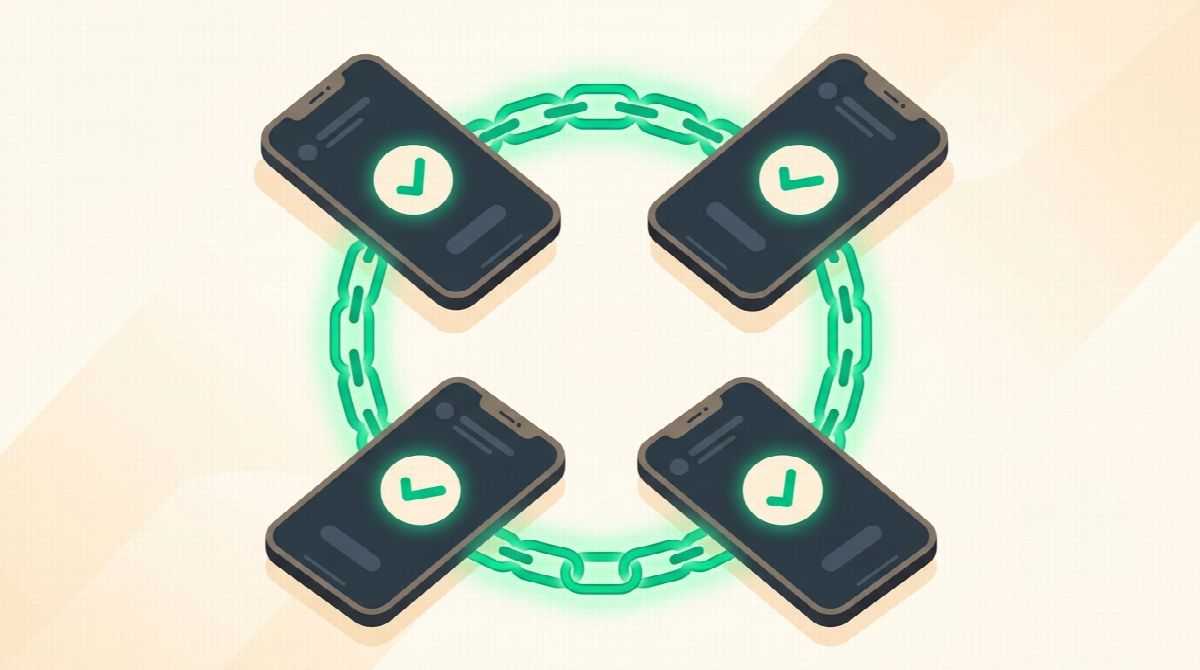
Every habit you track is a huddle. Solo or with friends. Invite people into a huddle and each member's daily checkin shows up for the others to cheer, with reactions and replies. The group also grows a shared Checkin Chain that gains one link for every member who checks in that day, so showing up adds to something collective without anyone's miss being announced.
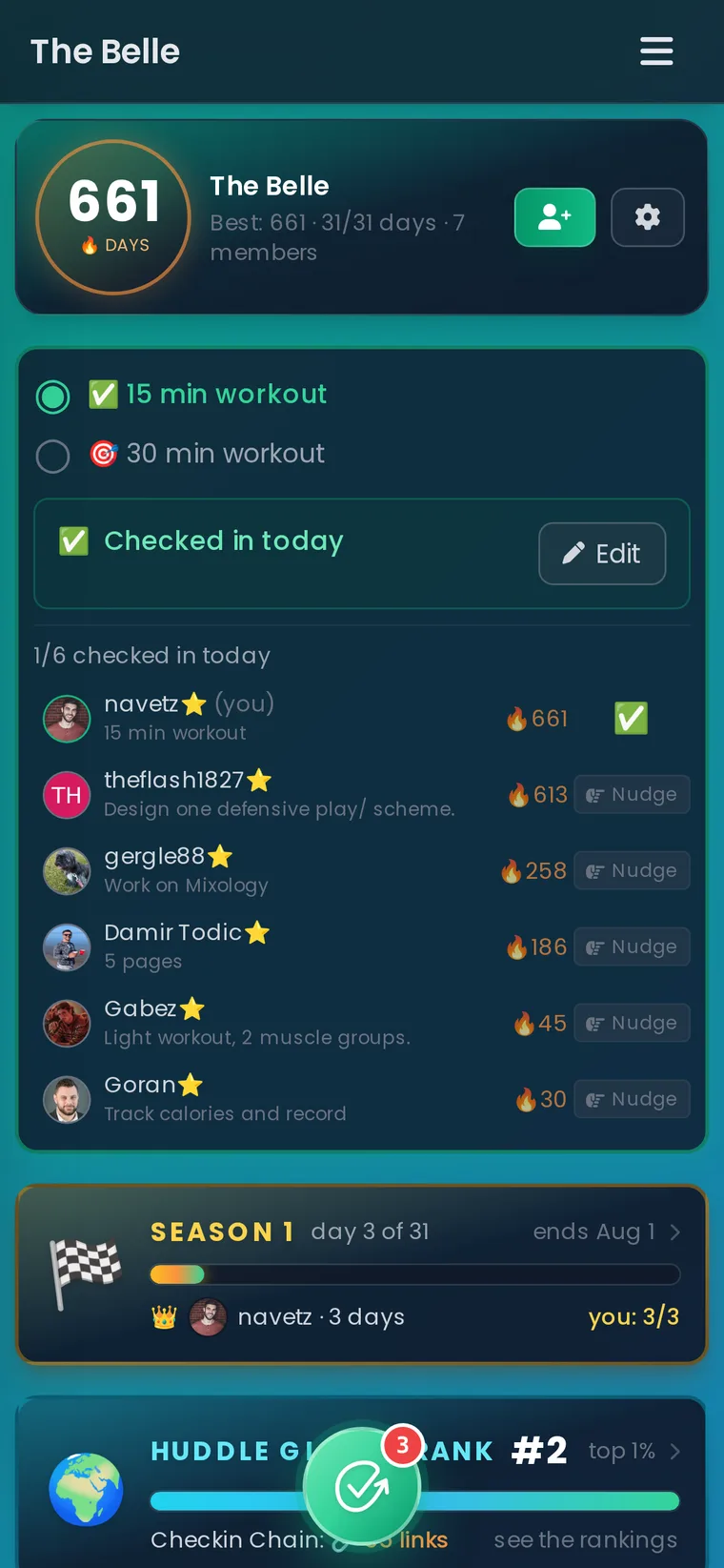
Habits carry a Floor and a Ceiling: the smallest version that still counts on a hard day, and the stretch version worth bursting through when you have energy. That split keeps a tired Tuesday from ending a good run. Huddles are exclusive, so only people you invite see anything, and groups that live in Discord can check in without leaving their server. There is a fuller tour on our habit tracker with friends page.
The honest trade-offs: the free plan includes one active habit, enough for one real shared huddle but not for tracking your whole routine without a paid plan. And if you want a purely private tracker with no social layer at all, this is the wrong tool; the group is the point. You can start a huddle free and invite friends in a minute.
HabitShare
HabitShare is the longest-established social habit tracker, and it is completely free. Everyone tracks their own habits, and a per-habit privacy switch controls exactly which friends see which habit. That switch is the app's best idea: you can share the running habit with your running friends and keep the rest private.
The trade-offs: shared calendars show your empty days to everyone you share with, which is exactly the gap-broadcasting problem described above, and the interface has aged. There is also no joint-challenge structure; it is shared visibility only.
SnapHabit
SnapHabit is built around joint group habits with photo checkins. You invite friends or family into a shared habit, and members can attach a daily photo and note, which makes it feel closer to a tiny group chat than a spreadsheet.
The trade-offs: development has been quiet for a long stretch, so evaluate it before moving a group in, and the photo-first flow adds friction on days you just want to tap done.
Habitica
Habitica turns habits into an RPG: your checkins earn experience, and a party of up to 30 people runs quests together. As a shared tracker it is the joint-habit model with a game layer, and for groups that love the fantasy framing it is genuinely motivating.
The trade-offs: missed days damage your avatar and can hurt your party on quests, which is the guilt mechanic dialed up to maximum. Groups either thrive on it or quit because of it. If your party went quiet, our Habitica alternatives guide sorts the exits by reason.
You already know you can change.
You just need to take the first step. Habit Huddle helps you build habits around your goals, alongside friends who keep you accountable.
A Notion template (or a spreadsheet)
A shared Notion page or Google Sheet is the fully manual option: build a grid, share it, and everyone fills in their row. It costs nothing and bends to any structure your group invents.
The trade-offs are the usual manual ones: no reminders, no mobile-speed checkins, and the grid displays everyone's empty cells by default. Most groups that start here migrate to an app once the novelty of the custom dashboard wears off.
How to set up a shared habit tracker that lasts
The app matters less than the agreements. Groups that stick tend to make four choices at the start.
Keep the group small and chosen. Three to six people who actually know each other beats twenty acquaintances. Accountability comes from the relationship, not the headcount.
Let everyone pick their own habit. Shared visibility with personal habits survives mismatched lives. Save the everyone-does-the-same-thing format for short challenges with an end date.
Set a floor for hard days. Agree that the two-minute version counts. One page, five minutes, one glass of water. The floor is what keeps a bad week from becoming a quiet exit.
Cheer, never police. React to checkins, celebrate milestones, and say nothing about gaps. If someone goes quiet for a few days, a private "how are you doing" beats any public nudge. The group's job is to make showing up feel good, not to make missing feel bad.
A weekly rhythm helps too. A short end-of-week message, what stuck and what did not, gives the group a reflection point that daily checkins alone do not provide. If your group is more accountability-focused than tracking-focused, our guide to accountability apps for friends covers that angle, and social accountability explains why any of this works at all.
Frequently asked questions
Is there a free shared habit tracker?
Yes. HabitShare is fully free, SnapHabit is free, and Habit Huddle's free plan includes one active habit with full sharing, which covers one real group. A shared spreadsheet or Notion page is also free, at the cost of reminders and mobile speed. Most people can run a shared tracker without paying anything.
Can I share a habit tracker with family?
Yes, and family groups follow the same rules as friend groups: let each person pick their own habit, keep the two-minute floor, and celebrate checkins instead of auditing gaps. Shared visibility works well across generations because nobody has to want the same habit. For couples specifically, one or two genuinely joint habits plus private personal ones is the setup that tends to survive.
Do shared habit trackers actually work?
The evidence for social accountability is strong: a Dominican University study by psychologist Gail Matthews found people who committed to a friend and sent weekly progress updates achieved significantly more of their goals than those who kept goals private. The caveat is design: sharing helps when it spotlights wins, and backfires when it broadcasts misses. Pick an app and group culture that do the first.
What is the best shared habit tracker for a group challenge?
For a defined challenge, use the joint-habit model: everyone commits to the same behavior for a set window. Habit Huddle's huddles are built for this, with a shared Checkin Chain the group grows together, and Habitica's quests suit groups that want a game layer. Set the end date up front and pick the smallest daily version that still counts.
Ready to Build Habits With Friends?
Stop failing alone. Join thousands using the #1 habit tracker with friends for real accountability and lasting results.
Prefer mobile? App Store · Google Play
Related Guides
More Habit Huddle articles on building habits with accountability.

HabitShare Alternatives: 6 Apps for Tracking Habits With Friends (2026)
Looking for a HabitShare alternative? Six social habit trackers compared by model, price, platforms, and what happens on a missed day, plus how to switch wit...
What to Do When You Miss a Workout Day: The 5-Step Comeback Plan
Missed a workout day? What one miss does to your body and habit, according to research, plus a five-step plan for the next 24 hours, when to make it up, and...
Habit Streak App With Friends: 7 Apps Compared (2026)
Seven habit streak apps with friends compared: Habit Huddle, HabitShare, Daily Pact, Habitica, Streaks, Habit Streak duels, HabitStreak.io. What friends see,...