
How to Organize a Step Challenge at Work: A Free 4-Week Plan
How to organize a step challenge at work: a free 4-week plan with fair scoring, copy-paste rules, a weekly schedule and what the research really shows.
 By Stevan Ljuljdurovic, founder of Habit Huddle
Updated November 3, 2026

📺 Related Video: Got a Meeting? Take a Walk | Nilofer Merchant | TED
Video by: TED · Watch on YouTube
To organize a step challenge at work, run it for four weeks starting on a Monday, let each person pick a daily step target, and give one point for each day they reach it, up to five points a week. Every phone already counts steps, so nobody has to buy anything. Send one update each Monday, hold a group walk at the end of week 2, and decide before day 1 what happens on day 29.
One person can set this up in an afternoon. Our free step challenge kit writes the announcement email and rules, and it prints a leaderboard for the wall.
A note on sources: all ten results we pulled for this search on November 3, 2026 come from companies that sell wellness or employee engagement products. We sell an app too, and it does not count steps. So judge this guide on its sources. The research is linked, and the plan works with any tracker.
The plan at a glance
A workable office step challenge comes down to seven decisions, and each one has a sensible default.
| Decision | Default | Why |
|---|---|---|
| Length | 4 weeks | Long enough for a routine, short enough to finish |
| Start day | A Monday | Monday narrowly leads our checkin data |
| Scoring | Days on target, up to 5 points a week | A desk worker can beat a runner |
| Target | Each person picks one, 7,000 steps suggested | Self-chosen goals did best in a trial |
| Tracking | Any phone or watch, points sent weekly | Nothing to buy, nothing to install |
| Teams | Random mixed teams of 4 to 6, scored by average | Team size stops mattering |
| Prizes | Small, plus a raffle for anyone with 10 points | The middle of the pack has a reason to continue |
The team size and the 10-point raffle line are our judgment calls. The rest is explained below, including where the evidence runs out.
What a step challenge can and cannot do
A step challenge is a good way to start a month of walking, but the evidence that it changes activity for the long term is weak.
The strongest independent source is a 2020 Cochrane review of workplace pedometer programs, covering 14 studies and 4,762 people. At least a month after those programs ended, they may have had no effect on physical activity, and the authors rated that evidence very low certainty. These were older pedometer programs, not phone apps. Still, the review tells decision-makers that the effects may not last.
Competition does work while the game is running. In the STEP UP trial, 602 adults with a BMI of 25 or higher played a 24-week step game. Compared with controls, competition added 920 daily steps, support added 689 and collaboration added 637. Activity fell in every arm once the game stopped, and only competition stayed significantly above control.
Format may matter less for the people you most want to reach. A later analysis of the same trial found that less active, less social participants gained about 1,100 to 1,200 daily steps in all three formats and kept an effect during follow-up. Extroverted, motivated people gained only from competition, and that gain did not last. A third group, labeled less motivated and at risk, did not respond to any format.
Neither study was run in an office, so treat them as guidance and not as proof.
Vendor numbers need the same care. Pacer reports 40% more steps after people join, and Activy quotes a 5 to 10 times return. Neither page shows a control group.
A step challenge is a good first month, not a finished wellness program. If you need your manager's approval, pitch a cheap, friendly month that gets coworkers talking. Do not promise lower health costs.
Step 1: Pick four weeks, starting on a Monday
Four weeks is the safest length for a first workplace step challenge, though it is a convention and not a tested answer. The guides we read that give a length range from 2 to 8 weeks, and all of them include four. We found no trial that tests the best length.
Our own data can help with the shape of those weeks. We looked at 1,152 Habit Huddle habits, of every kind, with a first checkin between July 3 and August 31, 2026. For each one, we asked whether it got a real checkin in later weeks, where week 3 means days 14 to 20 after the first one.
| Still getting checkins in | Huddle with at least one other current member (n=392) | Alone (n=760) |
|---|---|---|
| Week 3 | 43.4% | 6.2% |
| Week 5 | 33.4% | 3.8% |
| Week 7 | 26.8% | 2.8% |
| Week 9 | 21.9% | 1.1% |
Read this with care. These are habits of all kinds, not step challenges. People who bring others along may also be more committed to begin with, so company may not explain the whole gap. We left out our own accounts and one day with a spike we have not explained (October 17, 2026).
Two things still carry over. Most of the fall comes before week 3, so put your biggest event at the end of week 2. And people with company kept going far more often, so build the challenge around teams and shared walks.
The weekday pattern is useful too. Across 22,704 checkin days from July 6 to November 1, 2026, again without October 17, Mondays averaged 201 per date and Saturdays averaged 174, about 13% lower. Tuesdays and Wednesdays were nearly level with Mondays. That is why we suggest starting on a Monday and capping points at five a week. Weekends become a second chance, not a requirement.
Step 2: Score days on target, not total steps
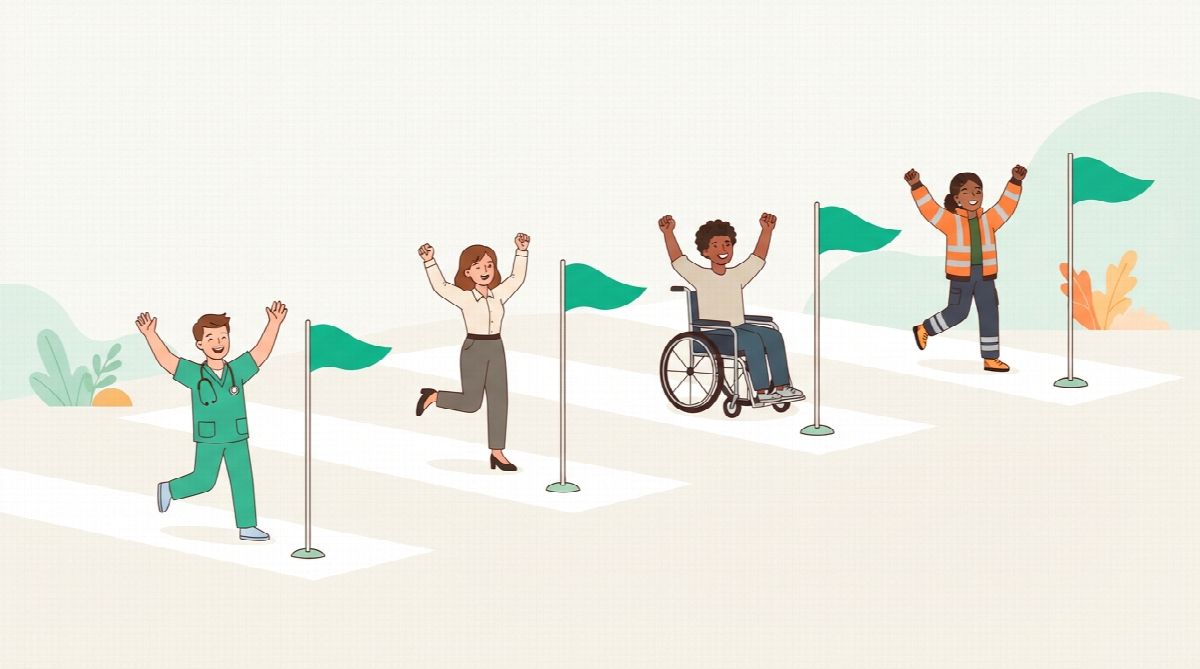
Total steps is the worst scoring rule for a mixed workplace, because a nurse or warehouse picker walks all shift while a desk worker sits. Activy, which says it has run more than 400 challenges, says raw counts discourage everyone else by day 5.
| Scoring rule | How it works | Main problem |
|---|---|---|
| Total steps | Highest total wins | Rewards jobs and existing runners |
| Days on target | 1 point per day at or above your target | Someone can pick a low target |
| Percent over baseline | Compare to your own unscored first week | Needs an honest extra week |
| Capped team average | Steps above a daily cap do not count | Takes a spreadsheet or a platform |
| Active minutes | Count minutes of any movement | Relies more on self-reporting |
We recommend days on target, because it rewards the daily walk and asks for no math. Yes, someone can pick a low target. That person still walks every day, which is the point of the month.
Let people choose their own number. In the ENGAGE trial, 500 adults at elevated cardiovascular risk played a step game with different goal rules. Those who chose their own goal and started right away gained 1,384 daily steps over controls, and the gain held through eight weeks of follow-up. No other goal setup showed consistent gains. These were not office workers, but it is the best direct evidence we found on who should set the number.
If people ask for a suggestion, say 7,000 steps. A 2025 meta-analysis in The Lancet Public Health linked 7,000 steps a day with a 47% lower risk of death from any cause, compared with 2,000 steps. That is an association and not a promise. The authors call 7,000 a more realistic target for some people, and they say 10,000 is still viable for those who are more active.
You already know you can change.
You just need to take the first step. Habit Huddle helps you build habits around your goals, alongside friends who keep you accountable.
Step 3: Set up tracking and teams
Tracking should cost nothing, because every phone already counts steps. Never require a wearable, since that cuts people out before the first day.
Vendors warn hard against manual entry. Pacer calls it the fastest way to lose people, and Activy says it has never seen a manual challenge hold interest past week 2. Both sell platforms, so weigh that. Typing in steps every day is a chore, but reading one number off your phone once a week takes seconds. Wellable, another vendor, also suggests weekly collection to reduce the load.
Our rule of thumb is simple:
- Under about 30 people: collect points weekly and update one leaderboard.
- Over about 30 people: use a free app so your Mondays stay yours. StepUp says it is completely free, supported by ads, and works with just a phone. Stridekick also tracks by phone or wearable and sells a paid level for corporate challenges.
- Need reports for leadership: compare the paid platforms in our step challenge apps for work roundup.
Mix departments when you draw teams, and score each team by the average of the members who reported. A team of six then has no edge over a team of four. Remote staff join the same way. Ask them to walk at the same hour as the kickoff walk and post a photo.
Plan for people who cannot walk much. Some use a wheelchair, some are injured, and some are pregnant. Publish a minutes rule from the start so nobody has to ask: 10 minutes of any activity counts as 1,000 steps. That lines up with the roughly 100 steps a minute of moderate walking covered in our guide to how many steps are in a 30 minute walk.
Step 4: Write the rules once, in one message
Clear rules head off step challenge arguments, and they fit in one message. Copy this and fill in the brackets:
Dates: Monday, [start date] to Sunday, [end date].
Who: Anyone here, any job, any fitness level. It is opt-in. Use a nickname on the leaderboard if you like.
Your target: Pick your own daily step number before we start. Not sure? Try 7,000.
Points: 1 point for each day you reach your target, up to 5 points a week.
Other movement: 10 minutes of any activity counts as 1,000 steps.
Tracking: Any phone or watch. Send your points to [name] by Monday noon.
Teams: [Name] will draw mixed teams. Team score is the average of the members who reported.
Sick or traveling? Pick it back up when you can. Your points stay yours.
Prizes: [Team prize]. Anyone with 10 points or more enters the raffle.
Want the longer version? The step challenge kit also writes the announcement email, the Monday update and a scoring explainer for the skeptics.
Step 5: Keep the prizes small and spread out
Small prizes open to most people make more sense than one big prize for the top stepper, because the middle of the pack needs a reason to keep going. Pacer and Vantage Fit both advise rewarding consistency and milestones, not only rank.
Good options cost little:
- A raffle for a gift card, open to anyone with 10 points
- A team lunch for the winning team
- A charity angle, which Activy says it uses in 51% of its challenges
- A public thank-you for the most improved team
A gift card is simple. A reward that changes what someone pays for health insurance is not. The U.S. Department of Labor has separate rules for wellness programs tied to a group health plan, so ask your benefits contact first.
Step 6: Run it week by week
Running a step challenge takes a short list of small actions, and most of them take minutes.
| When | What to do |
|---|---|
| 2 weeks before | Get your manager's yes, pick dates, and ask them to walk too |
| 1 week before | Send the announcement, the rules and a way to sign up |
| Friday before | Share the teams and ask everyone to pick a target |
| Week 1, Monday | Send a kickoff note and hold a lunch walk |
| Every Monday | Send one update: team standings, milestones, one good story |
| End of week 2 | Hold your biggest event: a group walk and the first raffle draw |
| Week 3 | Move one regular meeting outside |
| Week 4, Friday | Hold a final walk and ask who wants to keep going |
| Monday after | Share results, hand out prizes, and say what comes next |

Keep every update about the people who showed up. Name the most improved team, share a story, and thank whoever organized the walk. Never post a list of who has not logged. A challenge should run on cheers.
Walking meetings are a simple way to add steps without adding time. Nilofer Merchant's short TED talk, embedded on this page, makes the case. The research has a useful limit. In one set of experiments, walking raised scores for 81% of participants on a test of creative idea generation, but only for 23% on a test of convergent thinking. So walk for a brainstorm, and stay seated for the budget review.
For more formats to run after this one, see our workplace wellness challenges and our walking challenge app comparison.
Plan day 29 before day 1
A step challenge needs an exit plan, because gains tend to shrink once the game stops. Both the Cochrane review and STEP UP point that way. So in week 4, ask one question: who wants to keep walking?
Then give them something to join:
- Keep the walk. Leave the lunch walk on the calendar and let one person own it. This is free and needs no app.
- Run it again. Hold a fresh round next season, as Pacer also suggests.
- Make it a daily habit. Move the people who want to continue into a small crew.
The third option is what we build, so judge the reasoning. In Habit Huddle, each person sets a walking habit with a Floor, the smallest walk that counts on a slammed day, and a Ceiling to burst through when the calendar allows. A 10-minute walk and a 10,000-step day both count as showing up. Coworkers cheer each checkin, and the crew grows a Checkin Chain, with one link for each member's checkin that day. A quiet day is never announced.
The trade-offs are real. Habit Huddle does not count steps or sync with wearables, so it cannot run your step leaderboard. It has no HR dashboard. Huddles are public by design, so anyone can view them, and a coworker who wants to stay anonymous can use a display name.

It is free to start, and joining by invite is free. Start a walking huddle on the last Friday of the challenge, and send the link to whoever said yes. If your team is spread out, our page on habit tracking for remote teams shows how that works.
Ready to Build Habits With Friends?
Stop failing alone. Join thousands using the #1 habit tracker with friends for real accountability and lasting results.
Prefer mobile? App Store · Google Play
Related Guides
More Habit Huddle articles on building habits with accountability.
Family Workout App: 8 Compared by Who One Plan Really Covers (2026)
Compare 8 family workout apps: which plans cover several people, what each costs, and which work for kids under 13. Prices checked November 2026.

Weight Loss Accountability Apps: 7 Compared by What They Hold You To
Compare 7 weight loss accountability apps: bets, coaching programs, food trackers and friend groups. What each one checks, free picks, and what research says...
How to Gamify Working Out So It Still Works After Week Six
How to gamify working out: what to score, which game mechanics last, 6 setup steps and 6 game ideas, backed by trials on points, levels and playing with frie...