
Walking Challenge App: 5 Best Picks for 2026 (and How to Keep Walking After the Challenge Ends)
Compare the 5 best walking challenge apps: Pacer, StepUp, The Conqueror, Strive, and Habit Huddle, plus how to run a challenge your friends will finish.

📺 Related Video: This 30 Day Walking Challenge Will Change Your Life
Video by: Walking is Fitness · Watch on YouTube
The best walking challenge app depends on what keeps you moving: Pacer for solo challenges with a built-in pedometer, StepUp for free step competitions with friends or coworkers, The Conqueror for virtual map adventures with medals, Strive for workplace step challenges, and Habit Huddle for a daily walking habit you build with friends instead of a one-off contest.
That last distinction matters more than app store ratings. Most walking challenges work for exactly as long as the challenge runs. The leaderboard closes, the medal arrives, and the walking stops.
This guide compares the five apps honestly, then covers how to set up a challenge that turns into a habit you keep.
What to look for in a walking challenge app
A good walking challenge app needs three things: tracking that fits your setup, a challenge format that motivates you specifically, and something that keeps you walking after the challenge ends.
Tracking. Most apps read steps from your phone's motion sensor or sync with Apple Health, Google Fit, or a wearable. Automatic tracking removes friction but ties the challenge to step counts, which favors people with more free time rather than people making the biggest change.
Challenge format. There are three common ones. Leaderboards rank everyone by steps. Virtual journeys convert your distance into progress along a mapped route. Consistency challenges count the days you showed up rather than the steps you logged.
Life after the challenge. Ask what happens on day 31 of a 30-day challenge. If the answer is "join another paid challenge", the app is designed for repeat purchases, not for your habit.
The 5 best walking challenge apps compared
| App | Best for | How it tracks | Price model |
|---|---|---|---|
| Pacer | Solo challenges, routes, casual walkers | Built-in pedometer, GPS | Free, optional premium subscription |
| StepUp | Free step challenges with friends or coworkers | Syncs phone and wearables | Free |
| The Conqueror | Virtual journeys with a physical medal | Manual or synced distance | Pay per challenge |
| Strive | Workplace and team step challenges | Syncs phone and wearables | Free tier for groups |
| Habit Huddle | A daily walking habit with friends, not a contest | Manual daily checkin | Free, optional pro features |
1. Pacer: best all-round walking app with challenges
Pacer bundles a pedometer, GPS route tracking, and a rotating set of walking challenges into one app, so you don't need a wearable to join. It offers distance challenges, virtual races, and organized walking club events, plus themed challenges with medals.
Trade-offs: the free version carries ads and the social layer is a large anonymous community rather than your actual friends. Competing against strangers motivates some people and does nothing for others.
2. StepUp: best free step challenge with friends
StepUp is built for exactly one thing: free step challenges against people you know. You create a challenge, invite friends, family, or coworkers, and everyone's synced steps feed a shared leaderboard.
Trade-offs: it is leaderboard-only. If someone in your group walks 20,000 steps a day for work, everyone else is competing for second place by day three, and the app has no other format to fall back on.
3. The Conqueror: best virtual walking journeys
The Conqueror turns your real-world distance into progress along famous routes like Route 66 or the Camino de Santiago, and mails you a physical medal when you finish. Seeing yourself move along a map is genuinely motivating, and the medals are well made.
Trade-offs: you pay per challenge, so a year of walking gets expensive, and the model rewards distance rather than consistency. There is no group pressure to show up on the days you don't feel like it.
You already know you can change.
You just need to take the first step. Habit Huddle helps you build habits around your goals, alongside friends who keep you accountable.
4. Strive: best for workplace step challenges
Strive runs group step challenges with team leaderboards and syncs with the usual trackers, and its free tier covers casual groups. If you're organizing a company challenge, it handles the admin work that spreadsheet-based challenges dump on one volunteer.
Trade-offs: it is competition-first, and workplace step contests inherit the leaderboard problem with an extra twist: nobody wants their activity ranked in front of colleagues. For a deeper look at that format, see our guide to step challenge apps for work.
5. Habit Huddle: best for making walking stick after the challenge
Full disclosure: Habit Huddle is our app, so judge the reasoning, not the ranking.
Habit Huddle doesn't count your steps. You create a huddle for your walking habit, set a Floor (the minimum that counts, like a 15-minute walk) and a Ceiling (the goal you're building toward, like 10,000 steps), invite friends, and everyone checks in on the days they walk.
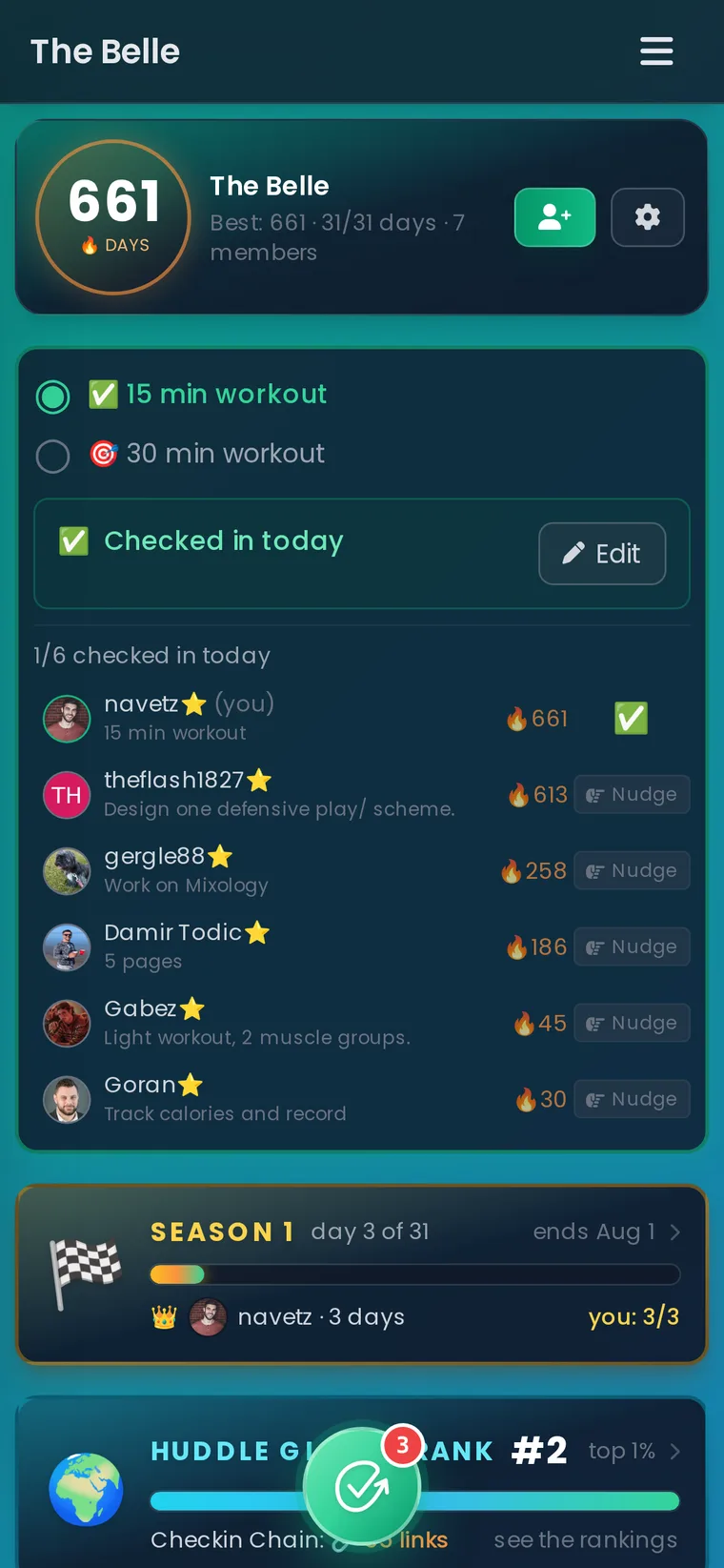
Each day someone checks in, they add a link to the group's Checkin Chain. The chain measures showing up, so the friend who did a slow 15 minutes counts the same as the one who did five miles. Friends cheer each checkin, and the momentum comes from adding your link, not from beating anyone.
Trade-offs: checkins are manual, so there is no automatic step syncing and no verification beyond trusting your friends. If you want GPS routes, calorie counts, or a stats dashboard for your steps, pair it with a pedometer app or use Pacer instead.
Why leaderboard challenges fizzle (and what works instead)
Most walking challenges quietly demotivate the majority of participants. A leaderboard has one winner, a few contenders, and a long tail of people who can see by week two that they can't catch up. Once the ranking is settled, the bottom of the board stops opening the app.

Consistency-based formats avoid this by scoring the thing everyone can control: whether you walked today. A meta-analysis of 138 studies published by the American Psychological Association found that prompting people to monitor their progress reliably increased goal attainment, and the effect grew when progress was reported publicly or recorded (Harkin et al., 2016). You get that benefit from logging the walk at all. The step total is optional.
The practical version: if your group includes mixed fitness levels, mixed schedules, or anyone who has quit a challenge before, pick a format where a short walk and a long walk both count as a win.
How to run a walking challenge with friends that actually sticks
A walking challenge sticks when the daily bar is low enough that nobody has an excuse and the group can see each other showing up.

-
Set a floor everyone can clear on their worst day. A 10-minute walk is a fine minimum. A 30-minute walk is roughly 3,000 to 4,500 steps depending on pace, which we break down in how many steps are in a 30-minute walk. Ambition goes in the ceiling, not the minimum.
-
Count days, not steps. Score the challenge on how many days each person walked. This keeps the retiree, the new parent, and the marathon trainer in the same challenge without anyone sandbagging or giving up.
-
Make checkins visible and cheer them. The motivating part of a group challenge is your friends seeing you show up. A quick photo from the walk beats a number on a leaderboard.
-
Pick an end date, then keep the group. Run the first challenge for 30 days. When it ends, don't disband: the group that just walked for a month together is the asset. Roll into a new month with a slightly higher ceiling.
If you want more formats to rotate through, our list of group fitness challenge ideas has options that work for mixed-ability groups.
Start a walking challenge your friends will finish
If the consistency-first format sounds like your group, Habit Huddle is built for it. Create a walking huddle, set your Floor and Ceiling, and invite your friends with a link. Every walk adds a link to your group's Checkin Chain, and it's free to start.
It works best for groups who care more about everyone still walking in March than about who won January.
FAQ
What is the best free walking challenge app? StepUp is the best free app for step competitions with people you know, and Pacer's free tier is the best all-round option for solo challenges. Habit Huddle is free for consistency-based walking challenges with friends.
How do I set up a walking challenge with friends? Pick a format (steps, distance, or days walked), set a minimum everyone can hit on a busy day, and use an app that shows the group each person's progress. Counting days walked keeps mixed-fitness groups engaged longest.
How many steps should a walking challenge target? For inactive beginners, 5,000 to 7,000 steps a day is a realistic target, and even a 10-minute daily walk is a meaningful start. Setting the bar too high early is the most common reason people drop out in week one.
Do walking challenge apps actually work? They work while the challenge runs: tracking and social visibility both reliably increase activity. The common failure is stopping when the challenge ends, which is why formats built around a repeatable daily habit outlast 30-day contests.
Ready to Build Habits With Friends?
Stop failing alone. Join thousands using the #1 habit tracker with friends for real accountability and lasting results.
Prefer mobile? App Store · Google Play
Related Guides
More Habit Huddle articles on building habits with accountability.

HabitShare Alternatives: 6 Apps for Tracking Habits With Friends (2026)
Looking for a HabitShare alternative? Six social habit trackers compared by model, price, platforms, and what happens on a missed day, plus how to switch wit...
What to Do When You Miss a Workout Day: The 5-Step Comeback Plan
Missed a workout day? What one miss does to your body and habit, according to research, plus a five-step plan for the next 24 hours, when to make it up, and...
Habit Streak App With Friends: 7 Apps Compared (2026)
Seven habit streak apps with friends compared: Habit Huddle, HabitShare, Daily Pact, Habitica, Streaks, Habit Streak duels, HabitStreak.io. What friends see,...