
How Many Steps in a 30 Minute Walk? About 3,000 to 4,400
A 30 minute walk is roughly 3,000 to 4,400 steps depending on speed and stride. See the numbers by pace and what that means for a daily step goal.
A 30 minute walk usually adds up to 3,000 to 4,400 steps for most adults. That big range is exactly why the usual one-number answer is incomplete, because your real number depends on how fast you walk and how long your stride is.
Most advice stops at “about 3,000 steps.” That's useful, but it can also be misleading. Two people can both walk for the same 30 minutes and finish with very different step counts, while both still get an effective workout. If you want to know how many steps in a 30 minute walk applies to you, the better question is not “What's the average?” but “What's my pace, my stride, and my repeatable daily target?”
That's where this guide gets more practical. You'll get the common benchmark, learn how to estimate your personal number, and then turn that number into a habit you can keep.
Table of Contents
- The Question Everyone Asks About a 30 Minute Walk
- Your Pace Dictates Your Step Count
- How Your Stride Length Changes the Math
- Calculate Your Personal 30 Minute Step Count
- From Estimation to Accurate Tracking
- Turn Your 30 Minute Walk Into a Daily Habit
The Question Everyone Asks About a 30 Minute Walk
The standard answer is straightforward. A 30-minute walk typically yields 3,000 to 4,400 steps for most adults, and that time block has become a common public-health benchmark because 3,000 steps in 30 minutes at about 100 steps per minute lines up with at least moderate-intensity walking for many adults, consistent with guidance referenced alongside major health organizations in this walking benchmark overview.
That's the useful part.
The less useful part is pretending that one number fits everyone. If you're shorter, you may rack up more steps in the same half hour. If you have a longer stride, you may cover more ground with fewer steps. If you stroll, your total can sit at the lower end of the range. If you walk with purpose, you can land much higher.
Why the average can confuse people
Readers usually get stuck in one of three places:
- They compare step counts, not effort. Your friend's higher total doesn't automatically mean they had a better walk.
- They mix up time and distance. A 30-minute walk is a time target. Step count is the output.
- They assume lower steps means lower benefit. Often it just means a different body size or stride pattern.
Practical rule: Use the public benchmark as a starting point, not a verdict.
The better goal
The best number is the one you can measure, repeat, and build into your week. If your normal 30-minute walk is below the headline number, that doesn't mean it “doesn't count.” It means you need a personal baseline instead of a generic one.
That baseline starts with pace.
Your Pace Dictates Your Step Count
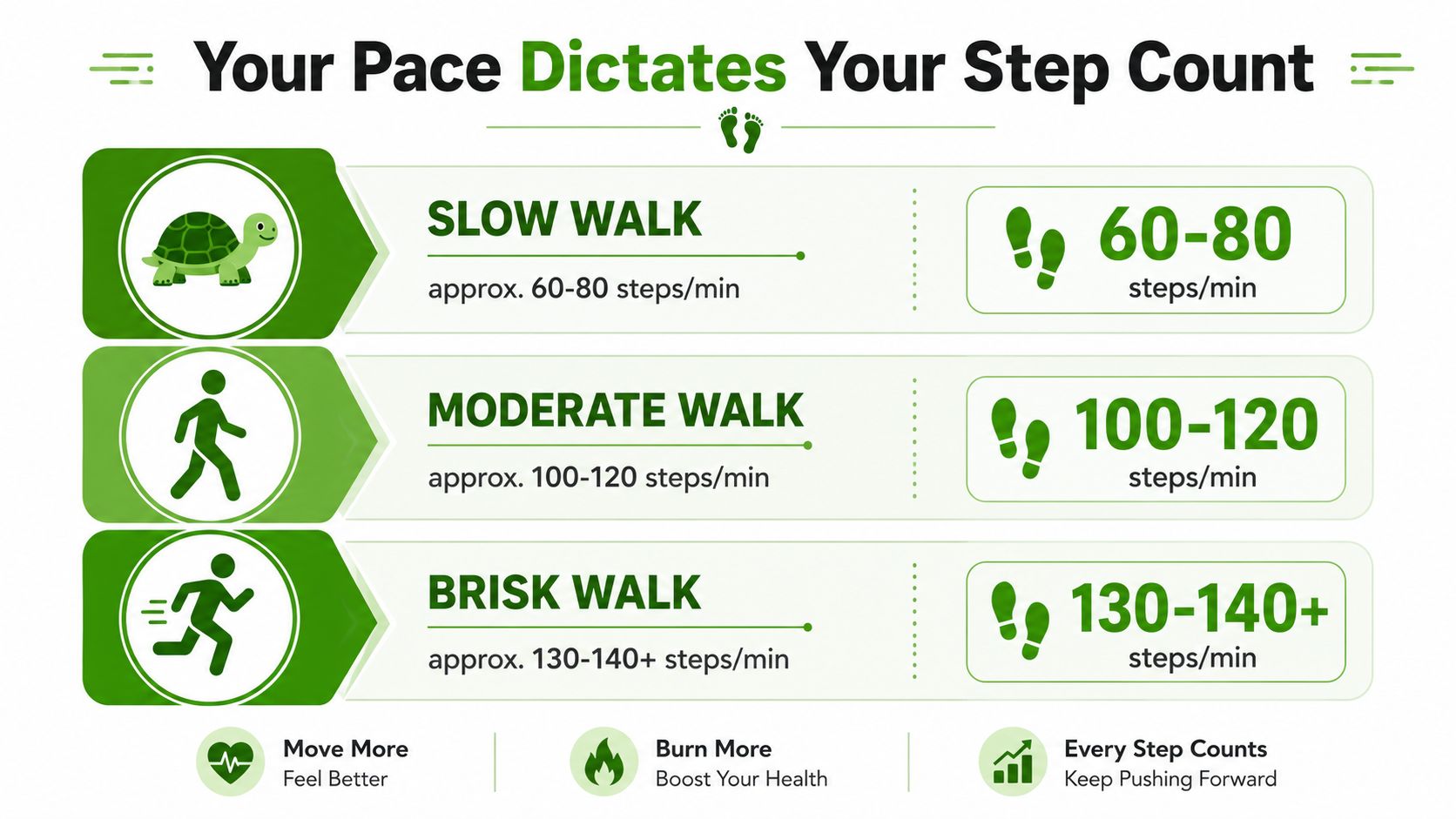
Speed drives the count more than anything else. If you want a practical answer to how many steps in a 30 minute walk, start with cadence, meaning steps per minute.
Research has shown that walking at about 100 steps per minute corresponds to at least moderate-intensity physical activity in healthy adults, and sustaining that pace for 30 minutes produces about 3,000 steps, as described in this cadence and moderate-intensity walking review.
Why pace matters most
Think of pace as the metronome of your walk. Every minute, you're either taking fewer steps at a relaxed rhythm or more steps at a stronger rhythm. Over 30 minutes, small differences add up fast.
You don't need lab gear to estimate this. Walk naturally for one minute and count your steps. Better yet, repeat it a few times on different days. You'll quickly notice whether your default pace is easy, moderate, or brisk.
A good sanity check is how the walk feels:
- Easy pace: You can chat freely and don't feel much change in breathing.
- Moderate pace: You can talk, but it's not effortless.
- Brisk pace: You're moving with intent and speaking in shorter bursts.
If you like comparing fitness tools and group-friendly tracking ideas, this roundup of social fitness apps for accountability can help you decide how you want to monitor your walks.
A simple pace table
Here's a practical way to consider it:
| Pace | Steps Per Minute (SPM) | Total Steps in 30 Minutes |
|---|---|---|
| Slow walk | Approx. 60 to 80 | Approx. 1,800 to 2,400 |
| Moderate walk | Approx. 100 to 120 | Approx. 3,000 to 3,600 |
| Brisk walk | Approx. 130 to 140+ | Approx. 3,900 to 4,200+ |
This table is an estimation tool, not a medical test. It helps you stop guessing.
If your count changes from day to day, that's normal. Hills, traffic lights, fatigue, weather, and whether you're walking the dog can all shift your pace.
How Your Stride Length Changes the Math
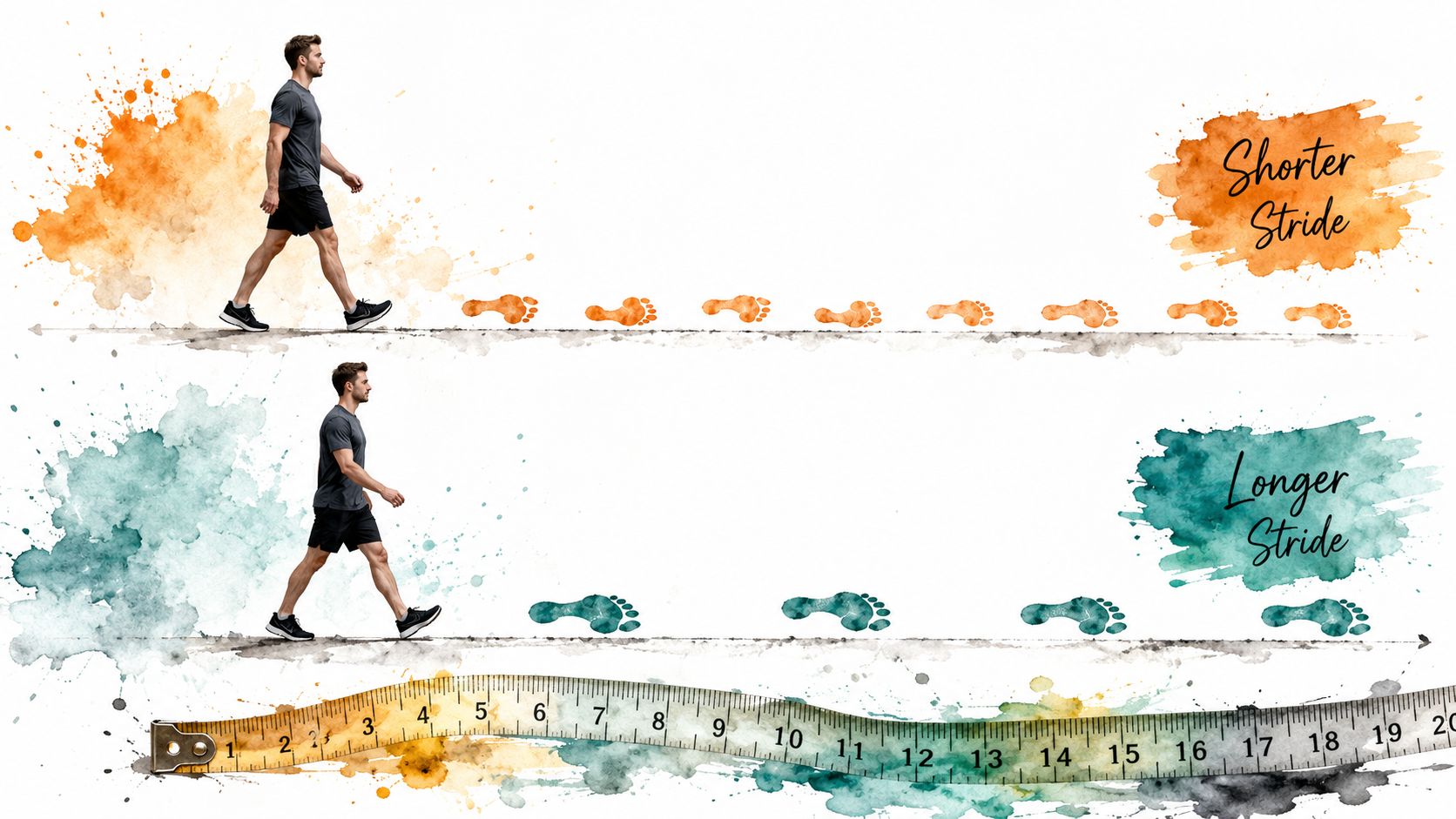
Two people can walk side by side for the same 30 minutes, keep roughly the same speed, and still finish with different totals. That isn't an error. It's stride length.
Same time, different step counts
Stride length is the distance you cover with each step. A person with a longer stride usually needs fewer steps to cover the same path. A person with a shorter stride usually needs more.
That's why step comparisons often go sideways. One walker isn't automatically working harder just because their step total is higher. They may take shorter steps.
A few things often affect stride naturally:
- Height and leg length: Taller walkers often cover more ground per step.
- Walking style: Some people naturally take quick, compact steps.
- Terrain: Tight turns, uneven paths, and crowded sidewalks shorten stride.
- Footwear and comfort: Stiff shoes or tired legs can change your gait.
You already know you can change.
You just need to take the first step. Habit Huddle helps you build habits around your goals, alongside friends who keep you accountable.
Two easy ways to measure stride length
You can estimate stride length at home with almost no equipment.
Method one uses a measured path.
Mark a start line and an end line on a flat surface. Walk the path at your usual pace. Count your steps. Divide the distance by the number of steps. That gives you an average step length for that walk.
Method two uses visible footprints.
Lightly wet the soles of your shoes, or use chalk if you're outside. Walk normally on a surface where prints show up. Measure the distance from one footprint to the next footprint of the same foot, then divide if needed to estimate your average step pattern more carefully.
A few tips make this more useful:
- Walk naturally. Don't stretch your stride just because you're measuring.
- Use several steps. One step can be odd. A short series is more realistic.
- Repeat once or twice. Your second try is often cleaner than the first.
Your stride in real life is rarely fixed. It changes slightly with mood, shoes, terrain, and pace.
That's okay. You're not trying to produce a perfect biomechanics report. You're trying to get close enough to make your 30-minute goal personal and believable.
Calculate Your Personal 30 Minute Step Count
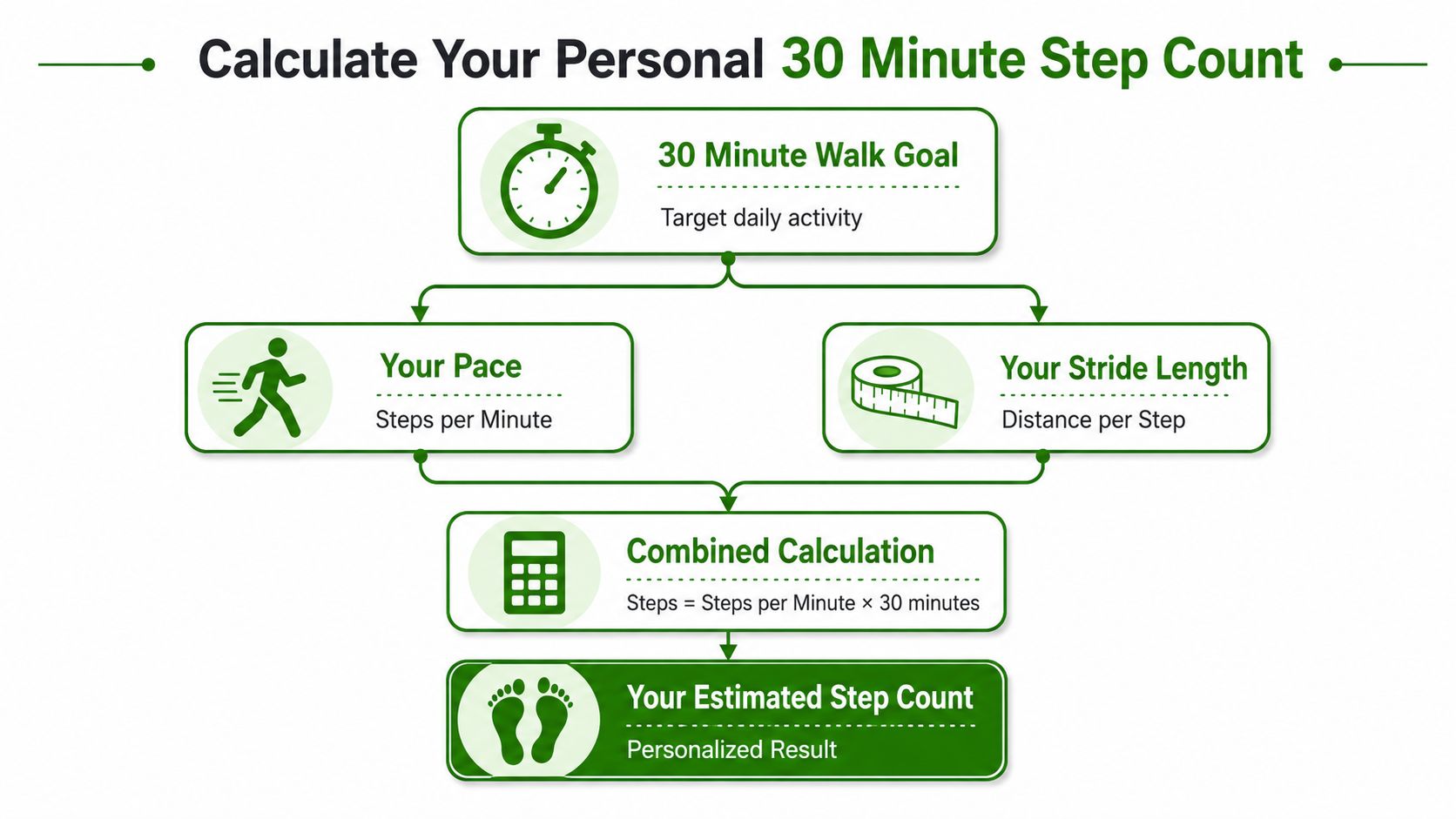
Once you know your pace and have a rough sense of your stride, the math becomes simple.
The fastest formula
The quickest formula is:
Steps = steps per minute × 30
If you count your cadence and get an average of 96 steps per minute, multiply by 30. If your pace is 112 steps per minute, multiply that by 30. That immediately gives you a personal estimate for a half-hour walk.
Stride length adds context, not complication. If your count seems “low” compared with someone else's, a longer stride may explain it. If your count seems high, a shorter stride may explain that.
Worked examples you can copy
Here are a few simple examples without pretending there's one correct result for everyone.
Brisk Bella walks with a quick rhythm and naturally short steps. She counts her cadence for a minute during a normal training walk, then multiplies that number by 30. Her total lands toward the upper end of the common range.
Steady Marcus walks at a moderate, repeatable pace. His steps per minute sit close to the moderate benchmark. His half-hour total comes out near the middle of the typical range, and that's a strong target because he can hit it consistently.
Long-Stride Nina has a taller frame and covers ground comfortably with fewer steps. Her total may look lower than a shorter friend's, even when both finish the same route in the same amount of time.
Use this mini process:
- Count your cadence: Walk for one minute and count steps.
- Multiply by 30: That gives you your half-hour estimate.
- Check your feel: Was it easy, moderate, or brisk?
- Compare against reality: See what your phone or wearable reports after a few walks.
A personal estimate beats a borrowed benchmark because you'll actually trust it.
If you want one practical takeaway, it's this: your “right” 30-minute number is the one that matches your body and your real walking style, not the number that looks nicest on social media.
From Estimation to Accurate Tracking
Estimating is great for understanding the math. Tracking is better for consistency.
You've got two common options. The first is the pedometer already built into your phone. The second is a wearable such as an Apple Watch, Fitbit, or Garmin device. Both can work. The main difference is how consistently they capture movement.
Phone versus wearable
A phone is convenient because you already own it. If it stays in your pocket during the whole walk, it can give you a practical running total. The weakness is obvious. If you leave it on a desk, your walk disappears from the record.
A wearable usually solves that problem because it stays on your body. That often makes your daily log more complete, especially if you walk in short bursts throughout the day rather than in one dedicated session.
Here's a quick comparison:
| Tool | Best for | Watch out for |
|---|---|---|
| Smartphone pedometer | Simple tracking with no extra device | Missed steps if you don't carry it |
| Fitness watch or band | More consistent automatic tracking | Another device to charge and wear |
What to track each day
Don't track everything. Track what helps you act.
A useful walking log includes:
- Time walked: Did you complete the full half hour or a shorter block?
- Step total: What did your device record?
- Walk type: Easy, moderate, or brisk.
- Pattern: One continuous walk or smaller chunks.
If you want a cleaner system for reviewing streaks and daily consistency, this guide on how to track progress gives a practical framework you can adapt to walking.
A week of real tracking usually teaches you more than a month of guessing.
Turn Your 30 Minute Walk Into a Daily Habit
Knowing your number matters. Repeating it matters more.

The biggest mistake people make isn't miscalculating steps. It's treating walking like an optional extra that only happens when the day goes smoothly. Most days don't go smoothly. Your walking habit has to survive busy calendars, weather, low motivation, and random interruptions.
One long walk or smaller walks
You do not need a perfect uninterrupted block every day. A 2023 UK Biobank analysis found that three weekly 30-minute brisk walks conferred meaningful benefits, while spreading activity more evenly across days improved cardiovascular outcomes, which supports the idea that shorter walks can still work well for consistency, as described in the verified research summary provided for this article.
That matters because many people can fit walking into life more easily in smaller chunks than in one clean block.
Try patterns like these:
- Commute split: Walk part of the trip before work and part after.
- Lunch reset: Use a midday break for one short walk.
- Evening buffer: Walk after dinner instead of scrolling on the couch.
Missing the ideal session doesn't mean skipping movement. It means switching formats.
After you've tested your personal pace, you can turn that into a realistic minimum. Maybe your full goal is a 30-minute walk, but your fallback is a shorter outing that keeps the routine alive.
Make the walk non-negotiable
Most habits stick when they're attached to a cue. Put your walk after something that already happens every day.
Good anchors include:
- After coffee: Shoes on, out the door.
- After lunch: Walk before reopening your laptop.
- After work: Use the walk as the mental line between job and home.
- After dinner: Keep it light and repeatable.
This short video gives a useful visual prompt for thinking about habit-friendly walking routines:
If you need help setting a routine you'll follow, this guide on how to start a habit is a good place to begin.
The win isn't hitting the exact same step count every day. The win is making walking automatic enough that you keep showing up, even when the walk is shorter, slower, or less impressive than planned.
If you want help turning a 30-minute walk into a streak you keep, try Habit Huddle. It's built for simple daily accountability, so you can set a minimum walk, aim for a bigger daily goal when you have the time, and keep momentum going with a small group instead of relying on motivation alone.
Ready to Build Habits With Friends?
Stop failing alone. Join thousands using the #1 habit tracker with friends for real accountability and lasting results.
Prefer mobile? App Store · Google Play
Related Guides
More Habit Huddle articles on building habits with accountability.

Family Habit Tracker App: 8 Best Picks by Age, and How to Make It Stick (2026)
Family habit tracker apps compared by age: Joon, Family Rewards, Family Checklist, Kinly, Habit+ Family, HabitShare, Habitica, and Habit Huddle. Plus the hab...

Gamified Habit Tracker: 7 Apps Compared by What the Game Rewards (2026)
Gamified habit trackers compared: Habitica, Finch, Forest, Streaks, Habits Garden, HabitForge, and Habit Huddle, by what the game rewards, what free gets you...
Running Accountability App: 8 Picks Compared (Stakes, Streaks, and Friends)
Eight running accountability apps compared: Strava, Nike Run Club, Runkeeper, Oath, RunMatch, RunHawk, StickK, and Habit Huddle, with prices, how runs are ve...