
How to Build an Exercise Habit That Actually Sticks
The four moves that turn exercise into a habit: a tiny floor version, a fixed cue, a plan for missed days, and friends who cheer you on. Research included.
📺 Related Video: How To Build a Fitness Habit (Simplified)
Video by: trainer winny · Watch on YouTube
Building an exercise habit comes down to four moves: shrink the workout until it is too small to skip, tie it to a cue that already exists in your day, decide in advance what happens when you miss, and put at least one other person in the loop. Motivation starts the habit. Those four moves are what keep it running after motivation leaves.
This guide walks through each move, what habit research actually says about how long the process takes, and the quiet mistakes that kill most exercise habits somewhere around week three.
How long it takes to build an exercise habit
Forming an exercise habit takes about two months of repetition for most people, not the mythical 21 days. The famous 21-day figure came from a 1960s plastic surgeon describing patients adjusting to their new appearance, not from behavior research. A University College London study led by Phillippa Lally tracked 96 people building everyday habits and found automaticity took 66 days on average, with a range from 18 to 254 days depending on the person and the habit.
The encouraging part of the same research: missing a single day made no measurable difference to the final outcome. One skipped workout does not reset anything. The habit is built by the trend, not by any single day.
You also do not need to white-knuckle all 66 days. A Wharton team led by Katy Milkman paid people to exercise for just 28 days and found many were still exercising ten months later. Repetition during a window of high motivation is what plants the habit. Your job is to protect the streak of repetitions while it is young, using the tools below, until showing up stops requiring a decision.
For the general version of this timeline question, see our full breakdown of how long it takes to form a habit.
Start smaller than feels worth doing
The single most common reason exercise habits die is that the daily version is too big. Day one energy says "45 minutes, five days a week." Day nine reality says "I have twenty minutes and no interest," and because the plan only counts the full workout, the day counts as a failure and the plan quietly ends.

The fix is to define two versions of the habit and hold them apart:
- A floor: the smallest version that still counts. Ten pushups. One walk around the block. Putting on your shoes and stepping outside. It should be small enough that doing it on your worst day is easier than explaining why you skipped.
- A ceiling: the full workout you are aiming for when time and energy allow.
On good days you burst through the ceiling. On terrible days you step on the floor, keep the habit alive, and lose nothing. What the floor protects is the identity of being someone who shows up, and identity is what is actually under construction during those first 66 days. A hard week can cost you four full workouts and leave the habit itself untouched.
Consistency beats intensity while a habit is young. Habit researchers consistently find that repetition of a simple, stable behavior builds automaticity faster than an impressive routine performed irregularly.
Anchor the workout to a cue you already have
A habit is a behavior attached to a trigger, so a workout without a fixed trigger is not becoming a habit no matter how many times you do it. "I'll exercise when I have time" outsources the decision to willpower every single day. Research on habit formation shows behaviors become automatic fastest when they happen in a consistent context: same cue, same time, same place.
Three practical anchors:
- Stack it on an existing routine. Directly after the morning coffee, directly after the school drop-off, directly after closing the work laptop. The existing routine becomes the starting gun.
- Stage the environment the night before. Shoes by the door, gym bag in the car, workout clothes laid out. Each staged object is a cue you cannot avoid seeing.
- Write one sentence: "When X, I will Y." Psychologists call this an implementation intention. In a randomized study of 248 adults, motivational material alone increased people's intention to exercise but not their actual exercise. Adding one written when-then plan dramatically increased the number who followed through.
Keep the workout itself boring and stable at first. The same routine at the same time in the same place wires in faster than a novel workout every day. Variety is a reward for later, once starting is automatic.
If evenings keep swallowing your plan, temptation bundling is the classic patch: pair the workout with a pleasure you only allow during exercise, like your favorite show only while on the treadmill. Milkman's research team found this pairing measurably increased gym attendance.
You already know you can change.
You just need to take the first step. Habit Huddle helps you build habits around your goals, alongside friends who keep you accountable.
Decide now what a missed day means
Every exercise habit will hit missed days, so the plan has to include them or the plan is fiction. Milkman's team describes the "what-the-hell effect": when a rigid goal breaks, people do not adjust it, they abandon it. One missed Tuesday becomes a lost week, which becomes a lapsed gym membership.
Two rules defuse it:
- Never miss twice. One miss is a data point. Two in a row is the start of a new habit, the wrong one. The day after a miss is the most important workout of the month, and it only needs to be the floor version.
- Budget free passes up front. Give yourself two or three per month, guilt-free. Milkman's research found that people who set ambitious goals with a small allowance for failure did better than people with rigid goals, because the allowance keeps a bad day from turning into a verdict on the whole project.
A missed workout is a scheduling event, not a character flaw. The people who end up with a permanent exercise habit are not the ones who never miss. They are the ones who come back the next day without drama.
Add other people, the strongest tool available
Exercise habits built alone rely on discipline, and habits built with people get to rely on something more durable: a group of people who are glad every time you show up. The effect runs deeper than gym buddies. A 32-year study of 12,067 people by Christakis and Fowler found health behaviors spread through social networks like a contagion. You drift toward what your group treats as normal, so a group where daily movement is normal quietly pulls you along.
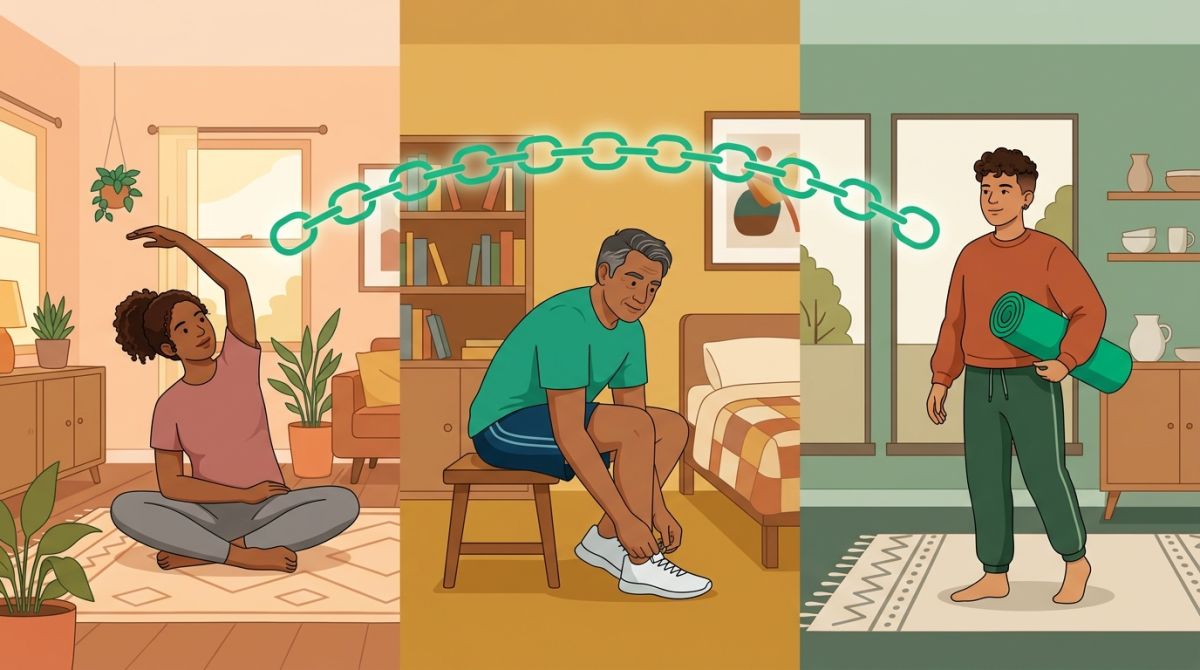
You do not need a workout partner at the same gym at the same hour. Lighter-weight structures work:
- A daily checkin. Everyone reports that they did their thing, in a group chat or a shared app. The point is showing up where someone claps for it, not proving effort.
- A shared challenge window. A 30-day pact with two friends gives the habit a social start date and a story. Our guide to running a 30 day habit challenge covers the format.
- An existing group. A running club, a class with regulars, a Discord fitness channel. Borrowing an existing group's normal is faster than building your own.
Make the checkin about wins, not surveillance. The version of accountability that lasts is friends cheering the days you show up. Guilt-based versions feel motivating for about a week and then become one more reason to avoid the group. Pick people and tools that celebrate the checkin and shrug at the gap.
One quotable rule covers this whole section: the best predictor of your exercise habit in six months is whether anyone else knows about it today.
Track it where someone can cheer
Tracking turns an invisible effort into a visible trend, and visible trends are motivating even with an audience of one. A meta-analysis of 122 behavior change interventions found self-monitoring explained more of the difference between effective and ineffective programs than any other single technique.
This is the job Habit Huddle was built for. You set a floor and a ceiling for your exercise habit, so terrible days still count, and you do a daily checkin that your friends see and cheer. Exercise with a couple of friends in a huddle and every member's checkin adds a link to the group's Checkin Chain, which gives three separate people a reason to show up on the same Tuesday. It is free to start, works in the browser or the mobile apps, and takes about two minutes to set up. If you want the group version specifically, start with a habit tracker built for friends.
A paper calendar and a pen also work. What matters is that the record exists somewhere you cannot quietly ignore, and ideally somewhere at least one other person will notice the row of checkmarks growing.
A four-week starting plan
Week one: pick the floor, not the dream. Choose an exercise floor so small it is nearly silly, attach it to one fixed cue, and write the when-then sentence. Do the floor every day. Ignore intensity completely.
Week two: keep the cue, add one ceiling day. One full workout on the day of the week that is historically easiest for you. The other days stay floor-only.
Week three: recruit. Tell two people, start a group chat or a huddle, and begin the daily checkin. This is the week solo plans historically die, and it is the best week for the social layer to come online.
Week four: add a second ceiling day and schedule your free passes for the month ahead. By now the floor days should feel nearly automatic. That feeling is the habit arriving.
From there it is repetition. If you want a deeper dive into staying with it once the novelty is gone, read our guide on how to work out consistently, and if the social angle is what you need, see how a fitness accountability app keeps a group moving.
Ready to Build Habits With Friends?
Stop failing alone. Join thousands using the #1 habit tracker with friends for real accountability and lasting results.
Prefer mobile? App Store · Google Play
Related Guides
More Habit Huddle articles on building habits with accountability.

HabitShare Alternatives: 6 Apps for Tracking Habits With Friends (2026)
Looking for a HabitShare alternative? Six social habit trackers compared by model, price, platforms, and what happens on a missed day, plus how to switch wit...
What to Do When You Miss a Workout Day: The 5-Step Comeback Plan
Missed a workout day? What one miss does to your body and habit, according to research, plus a five-step plan for the next 24 hours, when to make it up, and...

Habit Streak App With Friends: 7 Apps Compared (2026)
Seven habit streak apps with friends compared: Habit Huddle, HabitShare, Daily Pact, Habitica, Streaks, Habit Streak duels, HabitStreak.io. What friends see,...