
10 Best Fitness Accountability Apps of 2026 (Compared by Who Is Watching)
The best fitness accountability apps of 2026, compared by the pressure they apply: small-group checkins, public feeds, coaches, and training logs. With frien...

📺 Related Video: Reaching Your Fitness Goals is All About Accountability | Ron 'Boss' Everline
Video by: Bodybuilding.com · Watch on YouTube
The best fitness accountability app is the one whose pressure model matches how you actually follow through, not the one with the most features. Some people stay consistent when a small group notices every checkin. Others need a public feed, a coach who follows up, or a training log that makes missed sessions impossible to ignore. This guide compares 10 apps by the kind of accountability they apply, so you can pick the one built for your wiring.
How to choose a fitness accountability app
Start with the mechanism that gets you moving on a low-motivation day, then pick the app that applies it with the least friction. There are five basic models: small-group visibility, public social feeds, coach oversight, data feedback, and daily logging.
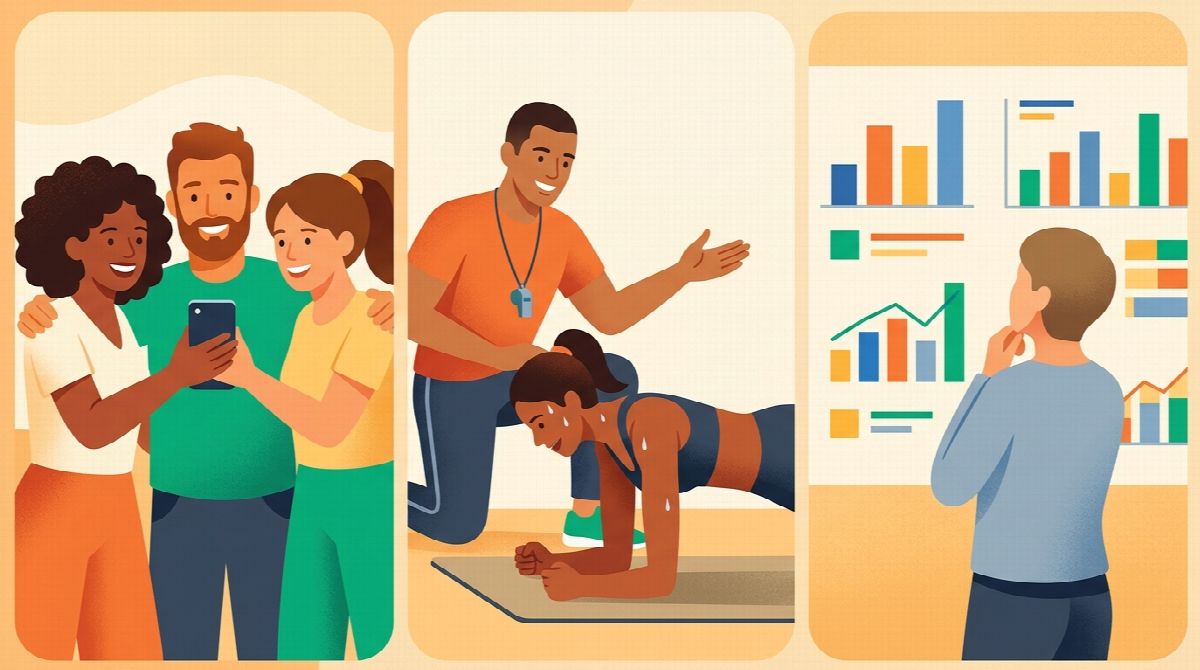
The research says accountability mechanics work, and that the type matters. In the STEP UP randomized clinical trial of 602 overweight and obese adults, every social gamification arm significantly increased physical activity, with the competition arm adding about 920 steps per day over controls, and it was the only arm whose gains held after the intervention ended, according to the trial published in JAMA Internal Medicine. A separate survey of 552 adults found fitness app and tracker users had almost twice the odds of meeting aerobic activity guidelines as non-users (odds ratio 1.91). And a nationwide study of fitness app users found social features help through two distinct pathways, support and comparison, and that comparison can backfire for people who hate being ranked.
So the question is not whether accountability works. It is which kind you will still respond to in week three. Ask yourself:
- Who do you want watching? People you know, strangers on a feed, a paid coach, or just your own record?
- Support or competition? Leaderboards energize some people and quietly push others to quit.
- What breaks your consistency today? Skipped sessions need visibility. Overtraining needs recovery data. No plan at all needs a coach.
1. Habit Huddle: small-group accountability for daily consistency
Full disclosure: Habit Huddle is our app, so judge the reasoning, not the ranking. It applies the narrowest and most personal form of pressure on this list: a small group of people you actually know, watching one habit.
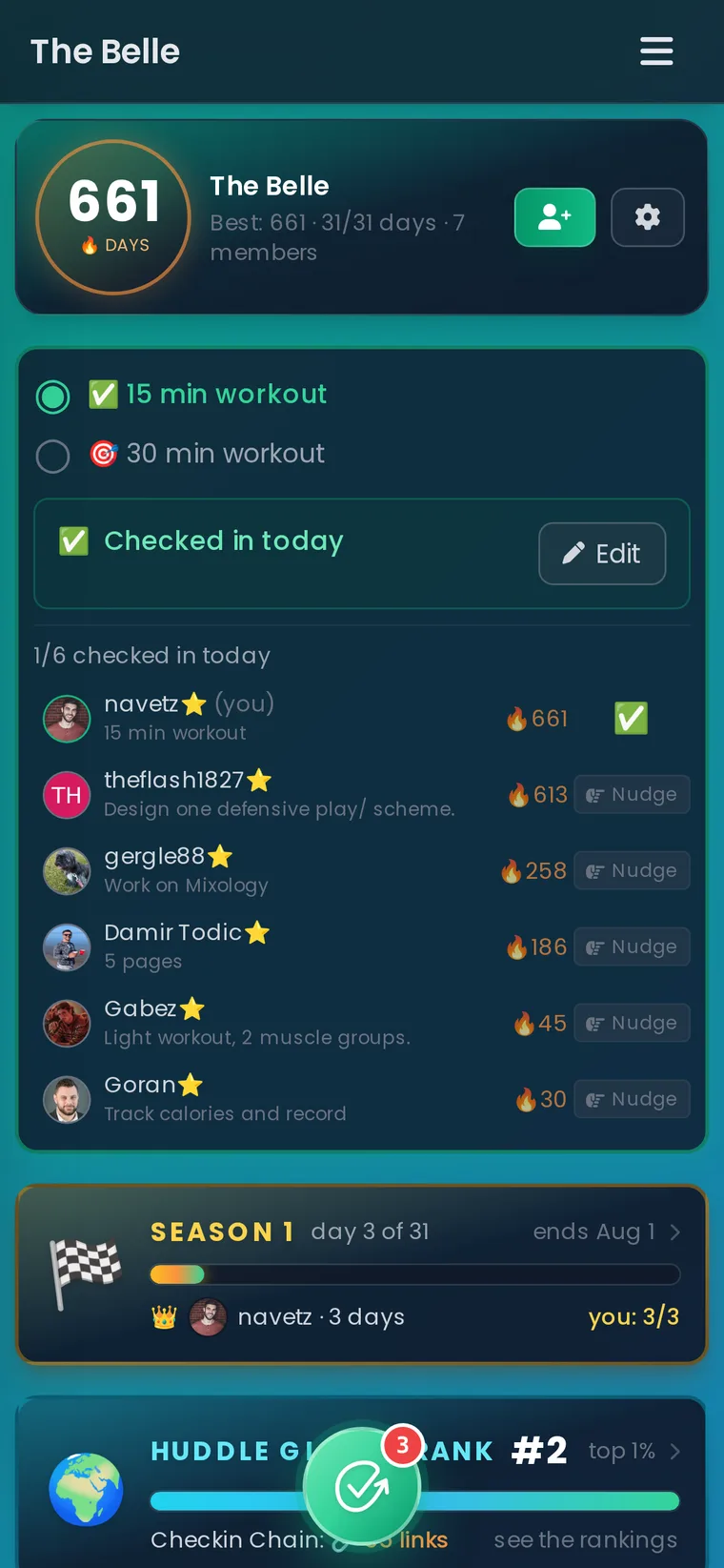
Your group forms a huddle around a shared behavior, everyone posts a one-tap daily checkin, and the group builds a Checkin Chain that grows a link for every member who checks in that day. Every checkin gets seen and cheered by people whose opinion you actually care about, which is a very different feeling from logging a workout into a void.
The mechanic that matters most is the Floor and the Ceiling. Every habit has a worst-day version (the Floor) and a full version (the Ceiling). On a rough day you step on the Floor, a ten-minute walk instead of the full workout, and your consistency survives. On a good day you burst through the Ceiling. That single rule attacks the most common way fitness habits die: not laziness, but the all-or-nothing spiral after the first imperfect day. Checkins work on iOS, Android, the web, and through a Discord bot, so a group can keep the loop where it already talks.
The trade-offs are real:
- One behavior per huddle. It is built for focused follow-through, not a multi-habit command center or deep performance analytics.
- No wearable sync or GPS. A checkin is your word, with an optional photo. Data-driven athletes will want a tracker beside it.
- It needs a live group. Social accountability only works when other people participate. A quiet huddle applies no pressure.
It is free to start. Use it if your motivation improves when familiar people can see whether you showed up. For the psychology behind that, see our guide to workout accountability with friends.
2. Strava: public accountability for endurance training
Strava is public accountability for runners, cyclists, and multisport people. It turns training into a social feed with clubs, segments, challenges, and comments, so your consistency is legible to everyone who follows you. If you will go out for a run partly because you do not want to vanish from the feed, Strava understands your psychology.
The trade-off is the flip side of the same feature. Public feeds motivate people who like being seen and drain people who feel judged by every off day. That comparison pathway is exactly the one the research flags as double-edged. If you want visibility without an audience of strangers, a smaller-circle app fits better; our roundup of social fitness apps breaks the options down by motivation style. Visit Strava.
3. Stridekick: low-friction step challenges for mixed groups
Stridekick is the easiest way to hold a mixed group accountable to movement, because it connects most major wearables or just a smartphone. Shared step challenges, leaderboards, and light social interaction keep families, friend circles, and workplaces in the same game regardless of device brand. Creating a basic challenge is free.
It is built around movement metrics, so it measures what your device saw rather than asking you to commit to a behavior. Lifters and yoga people are largely invisible to a step count, and there is no training prescription. For running a structured group event, see our guide to fitness challenge apps.
4. Google Health app (formerly the Fitbit app): device-backed daily accountability
The Google Health app, which replaced the Fitbit app, applies accountability through routine exposure to your own data: steps, sleep, activity, coaching prompts, and friend comparisons inside an ecosystem many people already own. For self-directed users, having every signal in one daily home base keeps health behaviors from slipping out of sight.
The weakness is passivity. Seeing data is not the same as acting on it, and dashboard-only accountability fades fast for people who need someone to notice a missed day. It fits Fitbit and Pixel Watch owners who are already good at self-correction. Visit the Google Health app.
5. WHOOP: recovery-driven accountability
WHOOP asks a different question than "did you work out?" It asks whether you are training and recovering in line with your actual readiness. Strain, recovery, and sleep scores, weekly reports, and team views make invisible behaviors part of the accountability loop, which suits serious athletes and people who tend to overtrain.
Data-driven accountability has a ceiling, though. Some people become excellent observers of their habits without changing them, and others let a readiness score dictate too much. It also requires hardware plus an ongoing membership. Visit WHOOP.
6. Future: a real coach watching
Future is for people who know they will not train just because an app sends reminders. A dedicated remote coach builds your program, checks in, reviews adherence, and adjusts around travel and life. Another person noticing when you disappear is the strongest form of accountability money can buy, and pricing reflects that: $50 for the first month, then $199 per month as listed on Future's site.
The trade-off is cost and coach fit. When the relationship clicks, it works. When it does not, it is expensive friction. Best for busy professionals and former athletes who miss structured oversight.
7. ABC Trainerize: coach-managed client accountability
ABC Trainerize is a coach-operated system rather than a consumer app. Trainers and studios use it to deliver programs, habit checkins, messaging, and progress tracking to clients in one place. The accountability arrives through an organized coaching relationship, which beats scattered texts and spreadsheets.
On your own it is rarely the right pick; the experience depends on how actively your coach runs it. Choose it when your trainer already operates their business through it.
8. JEFIT: log-driven accountability for lifters
JEFIT is old-school in a way that still works: a lifting app built around logging, routines, a large exercise library, and progress analytics with a light social layer. If your accountability style is "I do better when every set exists on record," missed sessions and stalled progress become impossible to mentally revise later.
The interface is more functional than modern, and nobody follows up when you skip. It suits intermediate lifters who self-correct from visible history.
9. Hevy: lightweight social lifting accountability
Hevy gives lifters fast logging plus a small social feed: you follow friends, post sessions, and compare lifts without the app becoming a full social network. A little peer visibility built into the normal workout flow is exactly the right dose for many gym regulars.
The limitation is group structure. If you want a closed group making an explicit daily commitment together, Hevy's follow model feels loose. It delivers peer visibility, not group commitment.
10. MyFitnessPal: nutrition accountability
Many people shopping for a workout app actually leak consistency at the kitchen table. MyFitnessPal's accountability model is daily food logging backed by a huge database, barcode scanning, reminders, and integrations with most trackers. For weight loss or basic nutrition adherence, that visibility can matter more than any workout leaderboard.
Logging only works while you log, and entry friction is the usual failure point. Use it when food awareness demonstrably changes your behavior.
You already know you can change.
You just need to take the first step. Habit Huddle helps you build habits around your goals, alongside friends who keep you accountable.
Quick comparison
| App | Accountability model | Best for | Price model |
|---|---|---|---|
| Habit Huddle | Small-group daily checkins, Checkin Chain | Friends, families, Discord communities | Free to start |
| Strava | Public feed, clubs, challenges | Runners, cyclists, multisport | Freemium |
| Stridekick | Group step challenges, any device | Mixed-device casual groups | Free basic challenges |
| Google Health app | Personal data dashboard | Fitbit/Pixel owners, self-directed | App free, paid tier for deeper insights |
| WHOOP | Recovery and strain scores, teams | Performance athletes | Membership plus hardware |
| Future | 1:1 remote coach | People who need human oversight | $50 first month, then $199/mo |
| ABC Trainerize | Coach-delivered programs and checkins | Clients of coaches and studios | Via your coach |
| JEFIT | Workout logging and analytics | Lifters who self-correct from data | Freemium |
| Hevy | Logging with a friend feed | Lifters wanting light peer visibility | Freemium |
| MyFitnessPal | Daily food logging | Nutrition-first goals | Freemium |
Accountability with friends vs accountability from strangers
A fitness accountability app with friends and one built on a public feed apply completely different pressure, and most people only respond to one of them.
Friends already know your context. When a friend cheers a checkin, it lands, because they know what your week looked like. Habit Huddle, Stridekick, and a shared GymRats challenge all work this way: a closed group of people you picked.
Strangers scale better. A public Strava feed or an open challenge gives you an audience without needing anyone in your life to care about your training schedule, which is why it works for people whose friends do not exercise.
Two practical notes. First, friend-based accountability dies quietly when the group is too big or too quiet, so start with three committed people rather than twenty invitations. Second, competition against strangers can demotivate anyone who compares themselves unfavorably, which is the exact failure mode the research on comparison pathways describes.
If your accountability group is a workplace, our guide to step challenge apps for work splits the free and paid options, and group fitness challenge apps covers challenge formats for friend groups. For gym-specific consistency, see gym accountability apps.
Match the app to your motivational style
Most fitness apps do not fail at onboarding. They fail in the boring middle, when novelty is gone and the plan collides with travel, stress, and bad sleep. What survives that stretch is accountability matched to personality, not discipline.

- Social people need visibility. Pick Habit Huddle for a small circle you know, Strava for a public audience, Stridekick for casual group challenges, or Hevy for gym friends.
- Private strugglers need a person. Future or a Trainerize-based coach beats any feed if you ignore notifications and badges.
- Data lovers need action loops. WHOOP, the Google Health app, and JEFIT work when metrics clearly change your next decision.
- Perfectionists need flexible targets. All-or-nothing systems break fast. A Floor-style minimum that keeps imperfect days alive outlasts them.
The most common mistake is not picking a bad app. It is picking an app built for a different motivational style, then concluding you lack discipline. You probably just need different pressure. For the wider category beyond fitness, see our guide to the best accountability apps.
FAQ
What is the best fitness accountability app?
The best fitness accountability app depends on who you want watching. Habit Huddle is the strongest pick for small-group accountability with people you know, Strava for public endurance training, Future for paid coach oversight, and JEFIT or Hevy for lifters who stay consistent by logging. Match the app's pressure model to what actually gets you moving on a bad day.
Do fitness accountability apps actually work?
Yes, when the mechanism fits you. The STEP UP randomized trial found social gamification increased activity by up to 920 steps per day versus controls, and a survey of 552 adults found app and tracker users had nearly twice the odds of meeting aerobic activity guidelines. The research also shows comparison-based features can backfire for people who dislike being ranked, so the type of accountability matters as much as having it.
What is a good free fitness accountability app?
Habit Huddle is free to start for a whole group, Strava's free tier includes the social feed and challenges, Stridekick offers free step challenges across mixed devices, and JEFIT and Hevy both have capable free logging tiers. Paid options mostly buy human coaching (Future, ABC Trainerize) or deeper data (WHOOP).
Can an app replace a human accountability partner?
An app can replicate most of what a partner does: visible checkins, streaks, reminders, and a record you cannot quietly rewrite. What it cannot fully replace is a person who follows up when you disappear. The practical middle ground is an app that puts real people you know in the loop, or paid coaching if you need guaranteed follow-up.
What is the best fitness accountability app to use with friends?
For a closed group of friends, Habit Huddle runs daily checkins on any exercise habit with cheers from the group, Stridekick runs free step challenges across mixed devices, and GymRats runs workout-photo challenges on iPhone. Public-feed apps like Strava work better when your friends do not train and you want an audience instead.
What is the best gym accountability app for lifters?
JEFIT fits lifters who stay on track when every set is logged and analyzed, and Hevy fits those who want fast logging plus a feed their friends can see. If your gym consistency depends less on the log and more on someone noticing whether you went at all, a daily group checkin in Habit Huddle around the habit "train today" works alongside either logger.
Keep showing up, visibly
If your main goal is exercise consistency through shared momentum, try Habit Huddle. It does not ask you to manage a giant wellness operating system. It asks you to show up daily, visibly, inside an exclusive group of people you picked, with a Floor that keeps rough days alive and a Ceiling to burst through on strong ones. Free to start, and the setup takes about a minute.
Ready to Build Habits With Friends?
Stop failing alone. Join thousands using the #1 habit tracker with friends for real accountability and lasting results.
Prefer mobile? App Store · Google Play
Related Guides
More Habit Huddle articles on building habits with accountability.

HabitShare Alternatives: 6 Apps for Tracking Habits With Friends (2026)
Looking for a HabitShare alternative? Six social habit trackers compared by model, price, platforms, and what happens on a missed day, plus how to switch wit...
What to Do When You Miss a Workout Day: The 5-Step Comeback Plan
Missed a workout day? What one miss does to your body and habit, according to research, plus a five-step plan for the next 24 hours, when to make it up, and...
Habit Streak App With Friends: 7 Apps Compared (2026)
Seven habit streak apps with friends compared: Habit Huddle, HabitShare, Daily Pact, Habitica, Streaks, Habit Streak duels, HabitStreak.io. What friends see,...