
How to Work Out Consistently: Build Lasting Habits
Tired of starting & stopping? Learn how to work out consistently with our practical system for goal setting, habit design & accountability. Stay fit!
Most workout advice fails because it assumes the problem is character. It tells you to want it more, wake up earlier, and stop making excuses. That sounds tough-minded, but it breaks down the moment life gets messy. A good week at work, a bad night of sleep, a sick kid, sore knees, travel, or simple mental fatigue can knock out a routine that depended on motivation.
That's why the better question isn't “How do I become more disciplined?” It's how do I build a workout system that still works on imperfect days. People who learn how to work out consistently usually stop chasing heroic effort. They reduce friction, define an easier fallback, protect time in the calendar, and make the habit visible to someone besides themselves.
If your routine has started strong and then vanished a few weeks later, that doesn't mean you're lazy. It usually means the plan was too rigid, too vague, or too dependent on how you felt that day.
Table of Contents
- Why Willpower Is Not the Answer to Workout Consistency
- Redefine Your Goal From an Outcome to a Process
- Design Your Flexible Two-Tier Workout Plan
- Schedule Your Workouts Like Unbreakable Appointments
- Leverage Social Accountability with a Habit Huddle
- Troubleshoot Common Consistency Killers
Why Willpower Is Not the Answer to Workout Consistency
The most common fitness mistake is turning consistency into a moral issue. You miss workouts, then decide the problem is weak willpower. So you respond by making the next plan stricter. That usually makes the next crash worse.
Willpower is unreliable because it changes with stress, sleep, mood, hunger, and schedule load. A system survives those swings. A motivation-based routine doesn't. If you've ever trained hard for two weeks and then quit entirely, you've seen this firsthand. The issue wasn't effort. The issue was design.
People often copy routines built for ideal conditions. They choose a demanding program, an inconvenient gym, a time slot they don't actually control, and a workout length that only fits on calm days. Then they judge themselves when that setup fails. A better approach starts with the assumption that your week will include friction.
Practical rule: If a plan only works when you feel inspired, it isn't a plan. It's a mood.
That applies whether you lift, walk, cycle, or run. Endurance athletes learn this quickly because pacing, recovery, and repeatability matter more than random hard efforts. If running is part of your routine, this breakdown of advice for runners seeking endurance is useful because it reinforces the same point. Sustainable progress comes from repeatable structure, not hype.
Behavior change works better when you stop asking, “How do I push harder?” and start asking, “What makes showing up easier?” That means fewer decisions, a clear fallback option, and an environment that nudges action. Habit design matters more than self-criticism. If you want a deeper look at that mindset shift, the psychology in this piece on behavior change psychology is worth reading.
A strong workout identity doesn't come first. It comes later, after enough repeated reps of showing up.
Redefine Your Goal From an Outcome to a Process
A lot of people sabotage consistency by choosing a goal they can't complete this week. “Lose weight.” “Get toned.” “Build muscle.” “Get fit again.” Those are outcomes. They matter, but they don't tell you what to do today at 7 AM when the alarm goes off and your legs feel heavy.
Outcome goals create emotional whiplash
Outcome goals are emotionally expensive. You can do good work for days and still see little visible change. That gap creates doubt. People start bargaining with themselves, changing programs too quickly, or quitting because their effort doesn't seem to “count” yet.
Process goals fix that problem because they define success by behavior. You can complete a process goal today. That gives you a win loop your brain can use.
A useful example:
- Outcome goal: lose body fat
- Weak version: work out more
- Process goal: complete two strength sessions and one long walk this week
That shift sounds small, but it changes everything. You now control the target directly.

Build a process goal you can actually execute
Use S.M.A.R.T. goals, but apply them to the process rather than the physical result.
Here's what that looks like in practice:
- Specific: “I'll do strength training on Tuesday and Friday.”
- Measurable: “Each session will include my planned lifts or my bodyweight routine.”
- Achievable: “The plan fits my real week, not my fantasy week.”
- Relevant: “This supports my health, energy, and fitness aim.”
- Time-bound: “I'll follow this for the next month before adjusting.”
The science behind this matters. A study discussed in the Journal of Behavioral Medicine found that repeated behaviors take an average of 66 days to reach automaticity, and participants who kept a consistent workout time reached a self-reported adherence rate of 87.4% (Psychology Today summary of the study). The takeaway isn't that you need a perfect streak. It's that timing and repetition beat emotional intensity.
The fastest way to feel successful is to define success as a behavior you can repeat, not a body change you have to wait to see.
If you're starting from scratch, keep the process almost boringly simple. One of the biggest errors I see is writing a goal that already assumes your future self is more organized than your current self. Start with the version you can execute under ordinary stress. Then expand.
A good first step is setting a habit that's small enough to survive a rough week. This guide on how to start a habit is helpful if you tend to overbuild in week one and disappear by week three.
Design Your Flexible Two-Tier Workout Plan
Rigid plans look serious on paper. They fail in real life. A better workout system has room for both strong days and low-capacity days without turning either one into a crisis.
The cleanest way to do that is a two-tier habit framework. You create one floor and one target.
Use a Minimum goal and a Stretch goal
Your Minimum goal is the smallest version of the habit that still counts. It keeps the identity and the rhythm alive. Your Stretch goal is the full session you'd like to complete when energy, time, and focus are available.
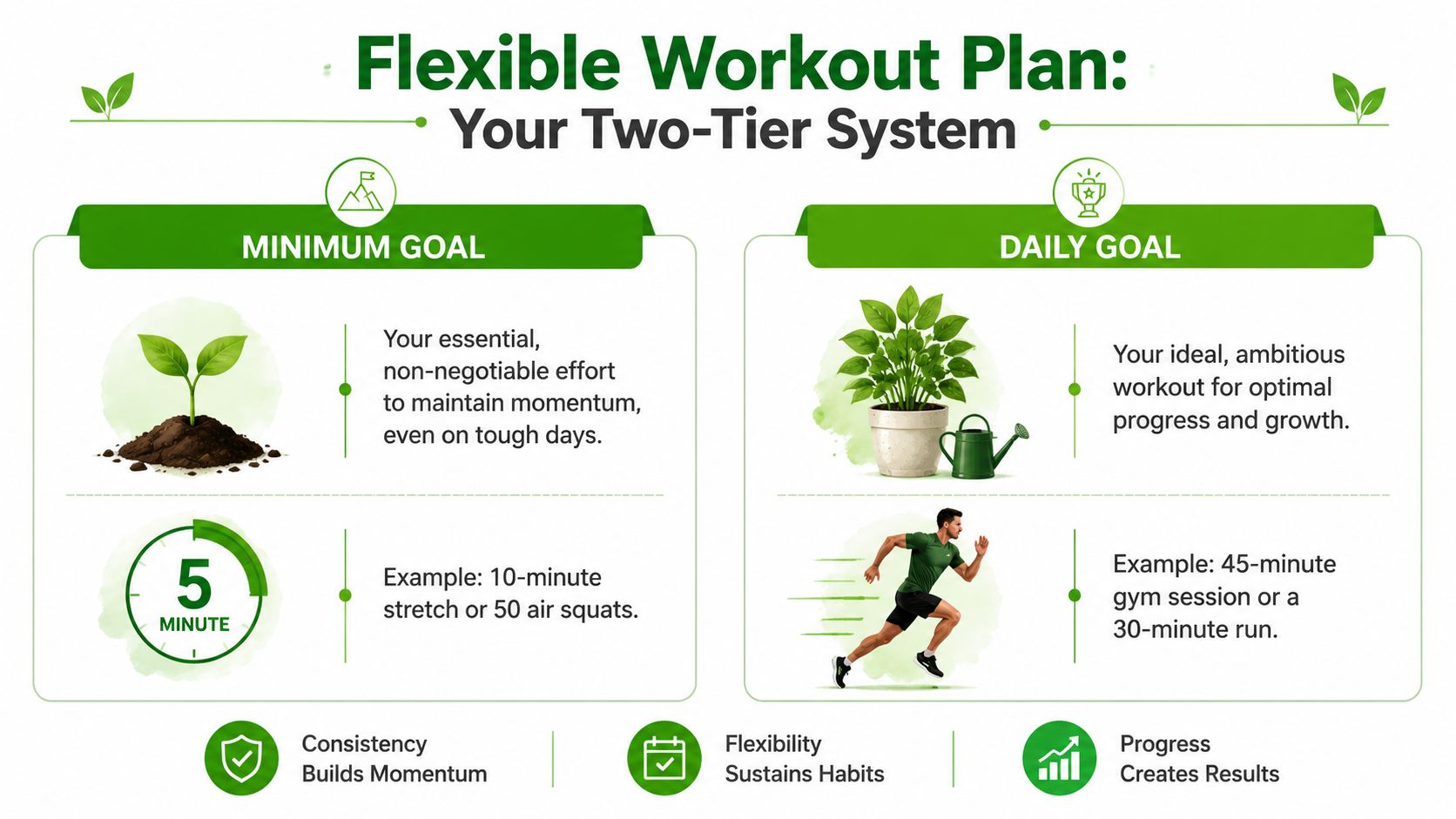
This framework works because it removes the false choice between “do the whole workout” and “do nothing.” The need isn't for more ambition. It's for a smarter fallback.
Examples:
Walking habit
- Minimum goal: 10-minute brisk walk
- Stretch goal: 35-minute walk with hills
Strength training habit
- Minimum goal: one circuit of push-ups, squats, rows, and planks
- Stretch goal: full gym session with your planned sets
Running habit
- Minimum goal: easy jog or walk-run
- Stretch goal: full programmed run
Home mobility habit
- Minimum goal: short stretch routine
- Stretch goal: full mobility and core session
A low floor doesn't make you soft. It makes you consistent.
Coach's note: Protect the habit first. Optimize the workout second.
This matters even more when your energy fluctuates. According to the verified data, 68% of adults abandon workout routines not because they lack time, but because they ignore fatigue signals and burn out, and matching training intensity to daily capacity improves long-term adherence by 42% compared with fixed weekly plans (YouTube source). In practice, that means a hard interval session can become a moderate walk or easy mobility session on a depleted day, without labeling that day a failure.
A short demonstration can help make this concrete:
What this looks like in real life
The two tiers are often built backward. They choose an exciting Stretch goal, then tack on a desperate fallback later. Do the opposite. Build the Minimum first.
Ask these questions:
- What can I complete when I'm busy, tired, and annoyed?
- What version can I do at home with no setup?
- What version helps me feel “still in the game” rather than starting over tomorrow?
Then build the Stretch goal from there.
A good two-tier plan also respects training intent. Minimum doesn't mean random. It should still point in the same direction as your larger goal.
For example:
| Goal | Minimum goal | Stretch goal |
|---|---|---|
| Improve general fitness | short walk plus bodyweight moves | longer mixed cardio and strength session |
| Build strength | abbreviated lift or bodyweight circuit | full lifting session |
| Run more consistently | easy run or walk-run | longer or structured run |
| Reduce stiffness | quick mobility flow | fuller mobility and strength session |
The hidden benefit of this system is psychological. You stop negotiating from zero every day. You already know what counts, what's ideal, and what to do if the day goes sideways. That's how to work out consistently without turning exercise into a weekly test of character.
Schedule Your Workouts Like Unbreakable Appointments
People often say exercise is a priority while leaving it unscheduled. That means it competes with every other demand in the day, and those demands usually win. If you want consistency, the workout has to move from a vague intention to a reserved slot.
You already know you can change.
You just need to take the first step. Habit Huddle helps you build habits around your goals, alongside friends who keep you accountable.
Your calendar is a behavior tool
Treat workouts like meetings that require a time, a place, and a default plan. “I'll work out tomorrow” is too soft. “I train at 6:30 AM in the garage before coffee” is behaviorally useful.
This isn't about becoming rigid. It's about reducing decision fatigue. Every extra choice creates another exit ramp.
The scheduling case is strong. Research tracked by the American Society of Sports Medicine found that new gym members who worked out at least four times per week for six weeks were able to automate the habit, with proper scheduling and consistent frequency identified as the main drivers of long-term retention (Gyms4You summary). The practical lesson is simple. Repetition on the calendar matters more than bursts of enthusiasm.
A few tactics work especially well:
- Choose a repeatable window: pick a time you can defend most weeks, not the time that sounds most ambitious.
- Attach the workout to an existing cue: after coffee, after school drop-off, after shutting the laptop, after brushing your teeth.
- Pre-decide the format: know whether that block is for lifting, walking, mobility, or running.
- Remove startup friction: lay out shoes, fill the water bottle, save the workout, charge your headphones.
Put the workout in the calendar before the week begins. If it only lives in your head, it will lose to whatever feels urgent.
Protect a repeatable workout window
The best workout time is the time you can repeat. Some people force themselves into a popular routine they hate, like very early mornings, then wonder why they keep resisting it. Others schedule evening training in a slot that family logistics destroy every other day.
Find your golden hour by looking at your actual week, not the week you wish you had. Then protect it.
If you want a simple template, a digital planner can help you time-block sessions and see the week as a whole. This 2026 workout planner is a practical example of how to map workouts into a real schedule instead of relying on memory.
Use a short rule for rescheduling too. Don't skip by default. Move the appointment once, to a specific backup slot, or downgrade it to your Minimum goal. That keeps the pattern intact.
One more point matters here. Scheduled exercise works best when the block is realistic. A shorter session you can repeat beats a longer session that keeps getting postponed. When people ask how to work out consistently, this is often the answer they don't want because it sounds less exciting. But consistency grows from protected time, not from intention.
Leverage Social Accountability with a Habit Huddle
Private goals feel safe. They also disappear unnoticed. When nobody can see the plan, nobody notices when the pattern starts slipping. That's one reason solo consistency is harder than people admit.
Why private goals stay fragile
Accountability isn't about shame. Good accountability creates visibility, structure, and encouragement at the exact moment your brain starts bargaining. “I'll do it tomorrow” sounds persuasive in private. It sounds weaker when someone expects your check-in.
The data supports that. Accountability partners increase adherence by 40%, and 74% of people who track progress and follow a fixed schedule maintain consistency beyond 6 months, compared with 31% of those who rely on motivation alone (Reddit source cited in the verified data).
That doesn't mean you need a drill sergeant. It means you need a simple structure where effort is visible.
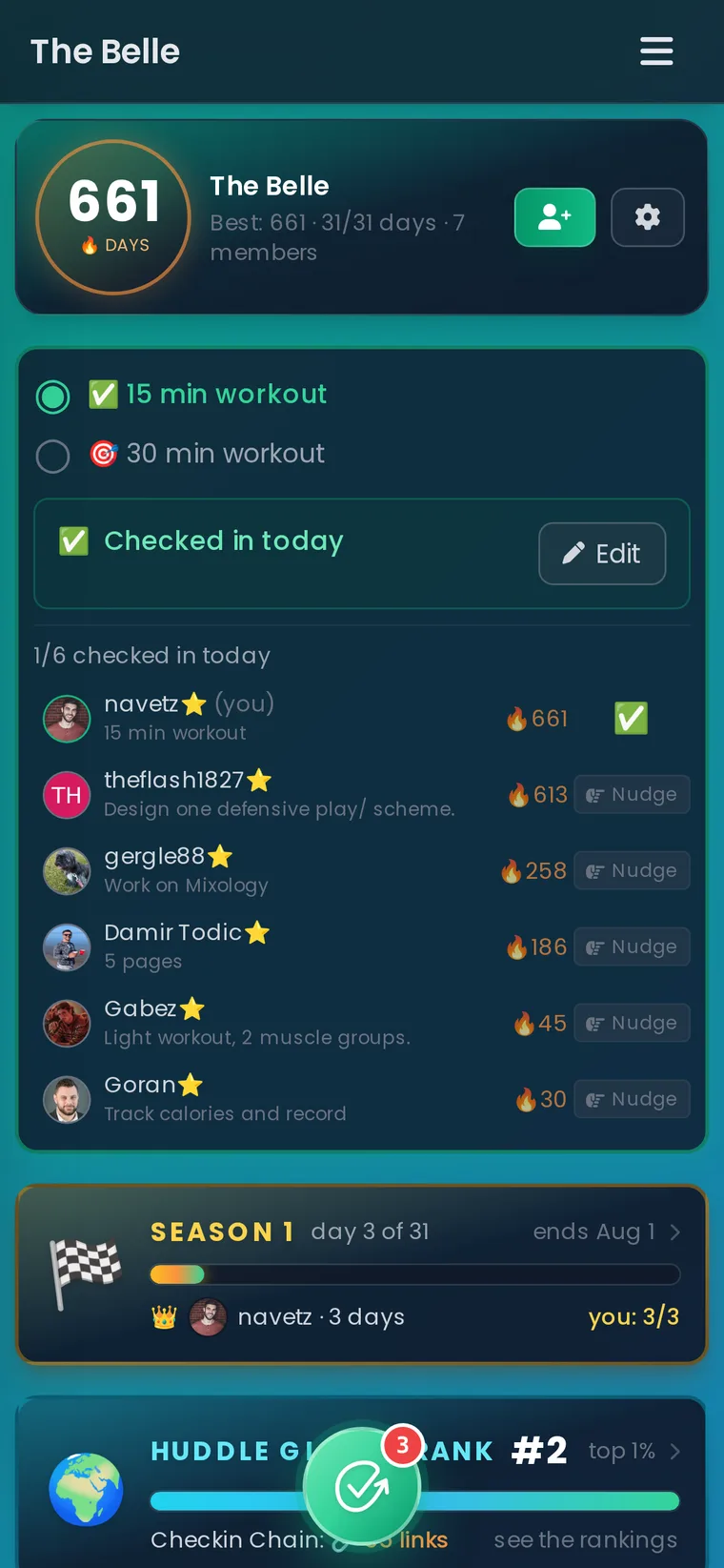
What effective accountability actually looks like
The strongest accountability systems share a few traits:
- The target is clear: everyone knows what counts as a completed workout.
- The bar has two levels: a Minimum and a stronger version, so people don't vanish after one messy day.
- Check-ins are lightweight: if reporting is annoying, people stop reporting.
- Progress is visible: not to punish, but to keep momentum social.
That social layer matters even outside close friend groups. Online communities can also support consistency if they're specific and active rather than generic and performative. This roundup of Gym Membership Tips' advice on online communities is useful if you're trying to find a format that creates actual follow-through rather than passive scrolling.
A lot of people say they want accountability when what they really want is inspiration. Inspiration feels good. Accountability changes behavior. If you want the psychology behind that distinction, this article on social accountability explains why group visibility often succeeds where self-promises fail.
Shared consistency works because it makes today's decision visible before the habit goes cold.
Social accountability also softens the perfectionism trap. In a healthy group, people don't disappear because they had one poor week. They downgrade the goal, check in truthfully, and keep moving. That's the kind of environment that supports long-term exercise habits.
Troubleshoot Common Consistency Killers
Even a strong system gets tested. The difference is that a good system has answers ready before the friction shows up. Quitting often doesn't stem from one bad day ruining everything. Instead, it occurs because one bad day triggered a spiral of all-or-nothing thinking.
When your schedule is chaos
This is common with caregivers, shift workers, frontline staff, and anyone whose week changes fast. The usual advice, “just schedule three to five sessions,” can feel detached from reality.
For high-variance lifestyles, the better model is smaller and more adaptable. Verified data shows that a 2 to 3 achievable workouts per week model using 20 to 30 minute blocks increases consistency by 57%, and that 61% of consistency-related queries from caregivers and similar groups stem from schedule chaos (Georgy Dillon PT).
That changes the planning standard. Instead of asking, “What's my ideal training week?” ask, “What survives a disrupted week?”
Use this rule set:
- Anchor two workouts first: place them in the two slots you can usually protect.
- Keep one floating session: not tied to a specific day, only to a short window that opens up.
- Shrink the session before you cancel it: a shorter workout still preserves continuity.
- Pre-plan your exercise menu: choose a few go-to sessions so you don't waste time deciding.
When you miss days and feel like you failed
People often turn a small interruption into a long layoff. They miss Tuesday, feel behind on Wednesday, and by Monday they've mentally “fallen off.”
The fix is procedural, not emotional.
Use a recovery rule:
- Never try to punish a missed workout. Don't cram extra volume into the next day.
- Restart at the next scheduled slot. Not “when you feel ready.”
- Use the Minimum goal for the first day back.
- Log the return as a win.
That last point matters. The habit isn't built by perfect streaks. It's built by repeated returns.
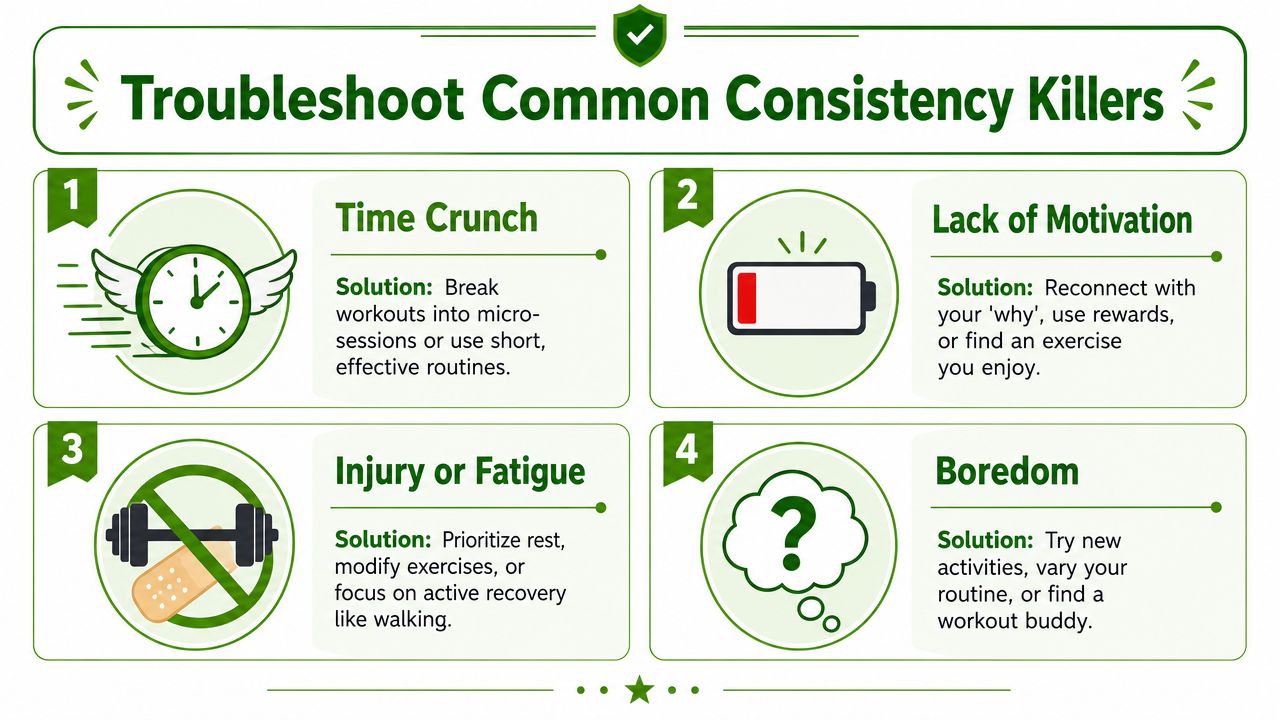
When boredom, fatigue, or travel break the pattern
Boredom usually means one of two things. Either the plan has become stale, or it was never satisfying to begin with. You don't need endless novelty, but you do need enough variation to stay engaged.
A simple fix is to rotate the mode while protecting the schedule. Keep the same workout slot, but swap the activity. A lifting day can become a kettlebell circuit. A run can become a bike ride or brisk walk. A gym session during travel can become a hotel-room bodyweight circuit or mobility flow.
Fatigue is different. It isn't always laziness in disguise. Sometimes it's a legitimate signal that the current plan is too aggressive for your recovery, stress load, or life season. That's where the Minimum goal earns its keep. It lets you continue the habit without pretending your body has the same capacity every day.
Here's a simple decision table you can use.
| Barrier | Why It Happens | The System-Based Fix |
|---|---|---|
| Time crunch | The workout only exists in a long format that doesn't fit busy days | Use a Minimum version and shorter scheduled blocks |
| Missed workouts | You interpret one interruption as failure | Resume at the next slot and use the Minimum goal first |
| Fatigue | The plan ignores recovery and daily energy variation | Downgrade intensity, keep the appointment, choose active recovery |
| Boredom | The schedule is repetitive even if the time block works | Keep the time, rotate the modality or session style |
| Travel | Your routine depends on one location or setup | Create a portable version with bodyweight, walking, or mobility |
| Unpredictable week | The plan assumes stable conditions | Anchor fewer sessions and leave one flexible slot |
The people who stay consistent aren't the ones who never get disrupted. They're the ones who know what to do when disruption arrives.
If you want to know how to work out consistently, that's the answer. Build a system that expects friction. Define a minimum that still counts. Put sessions on the calendar. Make the effort visible to other people. Then stop treating every rough week like a verdict on your character.
If you want a simple way to put this into practice, Habit Huddle gives you the exact structure that is often lacking. You can create a small group, assign one habit, and check in with a Minimum or Daily Goal so imperfect days don't break momentum. The social visibility helps turn intention into follow-through, and the setup is quick enough that you can start using it before your motivation fades.
Ready to Build Habits With Friends?
Stop failing alone. Join thousands using the #1 habit tracker with friends for real accountability and lasting results.
Prefer mobile? App Store · Google Play
Related Guides
More Habit Huddle articles on building habits with accountability.

HabitShare Alternatives: 6 Apps for Tracking Habits With Friends (2026)
Looking for a HabitShare alternative? Six social habit trackers compared by model, price, platforms, and what happens on a missed day, plus how to switch wit...
What to Do When You Miss a Workout Day: The 5-Step Comeback Plan
Missed a workout day? What one miss does to your body and habit, according to research, plus a five-step plan for the next 24 hours, when to make it up, and...

Habit Streak App With Friends: 7 Apps Compared (2026)
Seven habit streak apps with friends compared: Habit Huddle, HabitShare, Daily Pact, Habitica, Streaks, Habit Streak duels, HabitStreak.io. What friends see,...