
The 6 Best Group Challenge Apps in 2026 (Fitness, Steps, Habits, and More)
The 6 best group challenge apps of 2026 compared by what your group counts: workouts, steps, miles, daily habits, or money staked. Prices and honest trade-offs.

📺 Related Video: 4 Guys Do a Push up Challenge For 30 Days, These Are The Results
Video by: Browney · Watch on YouTube
The best group challenge app depends on what your group wants to count: workouts, steps, miles, daily habits, or money on the line. No single app does all five well, which is why most "one app fits everyone" recommendations quietly fail by week two.
Here is the short version. For workout challenges use GymRats, for step challenges across mixed devices use Stridekick, for running and cycling use Strava, and for money stakes use StepBet. For a challenge built on daily habits that your group keeps after the end date, use Habit Huddle. Every entry below includes prices and a real trade-off.
First, pick what your group counts
A group challenge lives or dies on its unit of measurement, so pick the unit before you pick the app. Workouts, steps, distance, and daily checkins each favor different apps, and they create different challenges: steps reward volume, workouts reward showing up, and daily checkins reward consistency on any habit at all, including reading, saving money, or staying off your phone.
The unit also decides who can win. A step challenge between a marathoner and a desk worker is over before it starts, while a checkin challenge levels the field because everyone's daily action is scaled to their own life. If your group is mixed in fitness, schedules, or goals, count consistency instead of output.

The 6 best group challenge apps in 2026
One disclosure before the list: Habit Huddle is our app. We put it first because habit-based group challenges are exactly what it was built for, but every entry includes real trade-offs, so judge the reasoning.
| App | Challenge unit | Best for | Price |
|---|---|---|---|
| Habit Huddle | Daily checkins on any habit | Groups that want the habit to outlast the challenge | Free plan, optional paid plans |
| GymRats | Logged workouts | Workout challenges with photo proof | Free with in-app purchases |
| Stridekick | Steps, any device | Mixed Apple/Fitbit/Garmin/Android groups | Free tier, paid for orgs |
| Strava | Miles and segments | Runners and cyclists | Free core, paid subscription |
| Habitica | Dailies in an RPG party | Groups that want a game | Free, optional $4.99/mo |
| StepBet | Steps with money staked | People who need real stakes | Entry fees per game |
1. Habit Huddle: best for challenges built on daily habits
Habit Huddle runs group challenges as huddles, exclusive invite-only groups where each member tracks a habit and posts a daily checkin. The challenge unit is consistency: every member's checkin adds a link to the group's Checkin Chain, one shared number the whole group keeps alive together. That makes it cooperative by default, and it works for any habit your group picks, not just fitness: reading, waking up early, no-spend days, practice time.
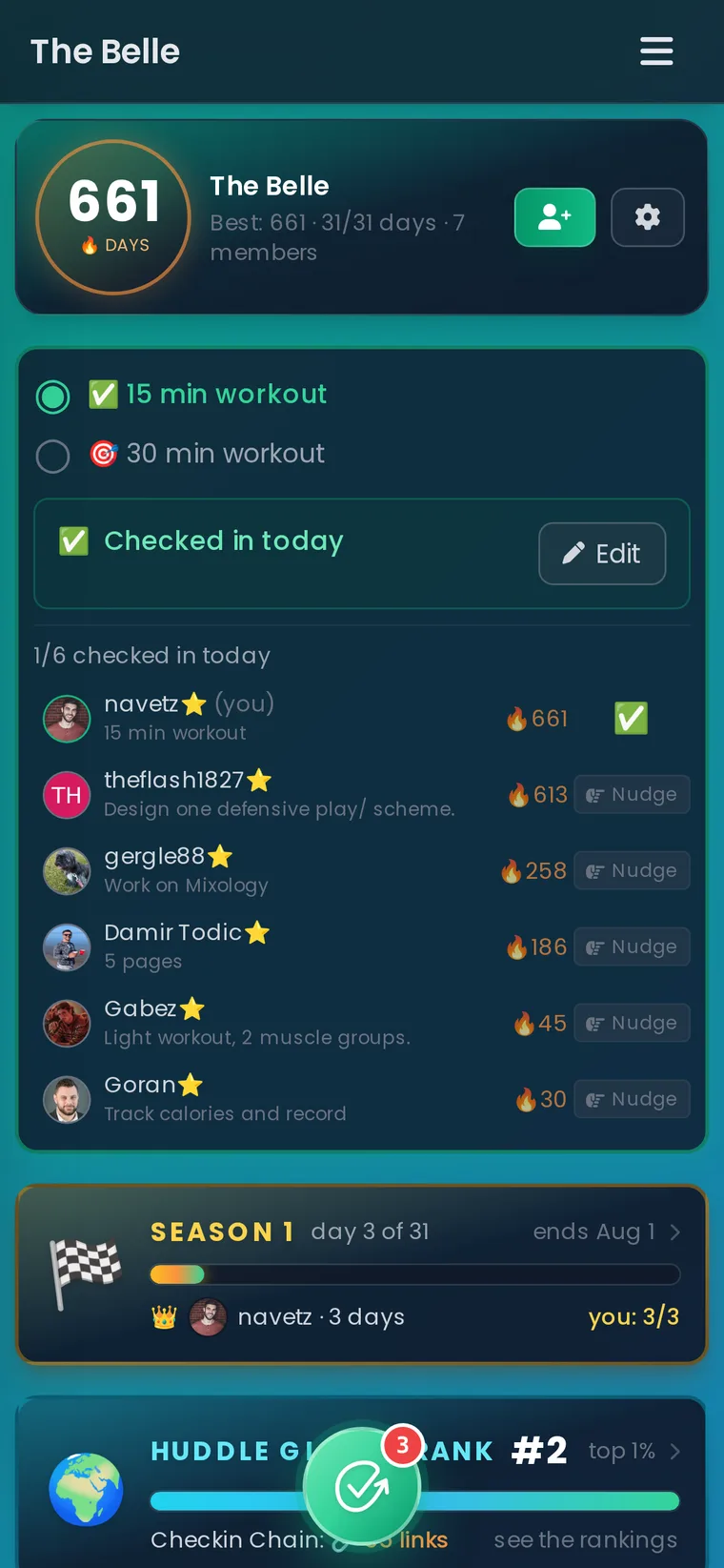
Each member sets a Floor, the smallest version of the habit that counts on an awful day, and a Ceiling to burst through on strong ones, so different fitness levels and schedules stay in the same challenge. Checkins carry notes, GIFs, applause, and replies, which is what keeps a 30-day challenge from going silent at day 12.
Trade-offs: there are no step-count integrations or device leaderboards, so a group that wants raw output numbers compared should look at Stridekick or GymRats. The community is smaller than the big fitness names, and competitive rankings are per-season rather than per-challenge. The free plan covers a full huddle around one habit.
2. GymRats: best for workout challenges
GymRats runs invite-only group challenges where every workout counts: you log a session with a photo and a title, and the feed doubles as proof and trash-talk material. Hosts can set custom scoring by workouts, duration, or checklist, and it imports from Apple Health. It is free with in-app purchases.
Trade-off: it is iPhone-only, so a mixed iPhone-and-Android group needs a different pick. Our full fitness competition app comparison covers it in more depth.
3. Stridekick: best for step challenges across any device
Stridekick has run device-agnostic step competitions for years. Apple Watch, Fitbit, Garmin, and phone-only steps all land on one leaderboard, and it offers six challenge formats including streak and custom-activity modes. The free tier covers casual friend groups; paid plans target bigger organizations, and if that is your situation our step challenge app for work guide compares the corporate options.
Trade-off: it is steps-first, so lifters, swimmers, and non-fitness challenges are underserved.
4. Strava: best for running and cycling groups
Strava is where endurance competition already lives. Clubs host their own leaderboards, monthly challenges hand out medals, and segments rank you against everyone who has covered the same stretch of road. The core is free, with deeper leaderboard and analysis features in the paid subscription.
Trade-off: competition is open-world rather than private-group by default, which is either the appeal or the problem depending on whether your group wants strangers on the board.
5. Habitica: best for groups that want a game
Habitica turns habits into an RPG: your party of 2 to 10 people progresses through boss quests only when members complete their dailies, and public challenges let bigger groups compete on shared task lists. It is free, with an optional subscription around $4.99 a month.
Trade-off: the game layer is the point. If your group does not care about leveling up a pixel warrior, the mechanics read as overhead instead of motivation.
6. StepBet: best when your group wants money on the line
StepBet, from the WayBetter family, assigns each player a personalized step goal from their own history, then has everyone bet real money on hitting it. Finishers split the pot; anyone who misses forfeits the buy-in. Loss aversion does the motivating, and because goals are personalized, a casual walker and a runner can join the same game.
Trade-offs: entry fees are real money, it is step-based only, and games run on WayBetter's calendar rather than your group's. It suits joining structured games more than designing a custom challenge.
Worth knowing: if everyone in your group happens to wear an Apple Watch, the built-in Activity competitions run a free seven-day points duel with zero setup. Limited, but the price is right.
You already know you can change.
You just need to take the first step. Habit Huddle helps you build habits around your goals, alongside friends who keep you accountable.
Does a group challenge actually change behavior?
The evidence says yes, and the social part is doing the heavy lifting. In a large randomized trial published in JAMA Internal Medicine, every gamified condition that added social support significantly increased physical activity, and the competition arm added about 920 steps per day over control. A group challenge app is that study's design turned into a product: a shared goal, visible progress, and people you know watching it move.
The catch is that the effect runs on participation, not on downloads. A challenge where half the group stops logging by day ten stops working for everyone, which is why the design choices below matter more than the app you pick.
Design a challenge your group actually finishes
Most group challenges are lost at the design stage, not at the willpower stage. Four choices decide it:
- Length: 30 days or less. Momentum survives a month. Our 30-day habit challenge guide has a full week-by-week structure.
- A bar everyone can clear. If the minimum day is only achievable for the fittest member, the rest are spectators by week two. Personalized goals (StepBet) or per-person Floors (Habit Huddle) keep everyone in the game.
- Visible daily progress. The group needs one place where showing up is seen and cheered the same day, not a spreadsheet someone updates on Sundays.
- A plan for missed days. Someone will miss a day; that is normal, not fatal. Decide up front that a miss just means checking in again tomorrow, so nobody quietly drops out over one bad Tuesday.
If you want ready-made formats to run with these rules, our group fitness challenge ideas list has 25 of them with rules included.

Start the challenge that outlasts its end date
The best outcome of a group challenge is not the final leaderboard; it is the habit still standing in month three. If that is the goal, run your challenge where the habit will keep living afterward: start a huddle in Habit Huddle, have each person pick their habit with a Floor and a Ceiling, and grow one Checkin Chain together for 30 days. It runs on the web, joining takes one link, and the free plan covers a full huddle around one habit. When the challenge ends, nobody has to move apps to keep going.
FAQ
What is the best free group challenge app?
Habit Huddle's free plan covers a full huddle around one habit, GymRats is free with in-app purchases for workout challenges, and Stridekick's free tier handles casual step challenges. Habitica is free for gamified group quests. StepBet is the only pick here that requires money by design.
Which group challenge app works across iPhone and Android?
Stridekick is the safest pick for mixed devices in step challenges, since Apple Watch, Fitbit, Garmin, and phone-only steps share one leaderboard. Habit Huddle and Habitica also run on both platforms and on the web. GymRats is iPhone-only.
How long should a group challenge last?
Thirty days or less. That is long enough to build momentum and short enough that most of the group finishes. Anything longer works better as a sequence of monthly challenges with fresh starts than as one long slog.
Should a group challenge be competitive or cooperative?
Match it to the group's spread. Similar fitness levels and thick skins do well on a leaderboard; mixed groups usually last longer with a cooperative structure, where the group builds one shared number and every member's contribution counts the same. Cooperative designs also survive individual bad weeks better, since the group total keeps moving while one member catches up.
Ready to Build Habits With Friends?
Stop failing alone. Join thousands using the #1 habit tracker with friends for real accountability and lasting results.
Prefer mobile? App Store · Google Play
Related Guides
More Habit Huddle articles on building habits with accountability.

HabitShare Alternatives: 6 Apps for Tracking Habits With Friends (2026)
Looking for a HabitShare alternative? Six social habit trackers compared by model, price, platforms, and what happens on a missed day, plus how to switch wit...

What to Do When You Miss a Workout Day: The 5-Step Comeback Plan
Missed a workout day? What one miss does to your body and habit, according to research, plus a five-step plan for the next 24 hours, when to make it up, and...

Habit Streak App With Friends: 7 Apps Compared (2026)
Seven habit streak apps with friends compared: Habit Huddle, HabitShare, Daily Pact, Habitica, Streaks, Habit Streak duels, HabitStreak.io. What friends see,...