
Forfeit App Alternatives: 7 Options by Why You Are Leaving (2026)
The best Forfeit app alternatives for 2026, matched to what you want to drop: the subscription, the proof or the money. Prices read from each app in November.
 By Stevan Ljuljdurovic, founder of Habit Huddle
Updated November 4, 2026

📺 Related Video: The FINAL App to Beat Procrastination (Live 2025 on EASY Mode) | Forfeit App Review
Video by: Ibrahim Abouzied · Watch on YouTube
The best Forfeit app alternative depends on which part of Forfeit you want to drop: the subscription, the proof or the money. If the money works but the monthly fee does not, try Beeminder or stickK. If you want someone to look at your proof without a charge, try RankUp or SendProof. If you would rather have friends than a fine, try Habit Huddle (our app) or Focusmate.
Before you switch, check what you are paying now. Forfeit's own FAQ lists a subscription at $10.99 a month in the US, while its App Store listing shows Premium at $7.99 and Pro at $12.99. Stakes are separate. We read every price in this guide on each product's own site or App Store page on November 4, 2026. We did not buy each paid plan, so treat this as a close read of what each company states, not a lab test.
What Forfeit does and costs in November 2026
Forfeit is a strict, well-reviewed app, and for many people it is the right tool. You set a task, a deadline and a consequence, then send evidence before the deadline. Evidence can be a photo, a timelapse, your GPS location, Apple Health data, a screen-time limit or your own word. According to its site, AI or a person reviews photo and video proof before you are charged.

Here is what its own pages said on November 4:
- The subscription: the app is free to download. The FAQ puts the subscription at $10.99 a month in the US, and the App Store also lists weekly plans ($3.99 and $5.99) and yearly plans ($59.99 and $99.99). Reviewers disagree on what the free version allows, so confirm inside the app.
- The stake: separate from the subscription. You lose it only if you fail.
- Where lost money goes: "For now it is retained by Forfeit." The company says it is building an option to send the money to friends or your own savings.
- Other consequences: Forfeit can text a friend, email someone or block your apps instead, so money is only one option.
- Appeals: a person reviews each appeal within 12 hours, under a strictness rule you lock in when you set the goal.
- Rating: 4.8 stars from 370 ratings. Its listing claims a 94% success rate across more than 75,000 forfeits. That is a company figure, and it counts only people who chose to set one.
Why people look for a Forfeit alternative
Most people leave Forfeit for one of four reasons, and each reason points to a different replacement.
- They pay twice. The subscription bills every month, and the stake comes on top when you slip. One App Store reviewer called it the best accountability app they had used, then left in May 2025 because the monthly price did not work on a student budget.
- The company keeps the stake. Another reviewer wrote that this "feels a little like the ref having a dog in the fight."
- Proof takes work. A photo suits a gym visit. It suits "no drinking this week" far less, and self-verify puts you back on the honor system.
- The threat stops helping. For a habit you are still figuring out, a charge after a hard week can feel like a penalty for being human.
Behind all four sits one hard fact: few people want this deal. In a trial of 2,538 people trying to quit smoking, published in the New England Journal of Medicine, 90.0% of those assigned to a reward program accepted it. Only 13.7% of those assigned to a program with a $150 refundable deposit did.
Forfeit alternatives compared
No single app replaces all of Forfeit, so this table sorts the options by what is on the line and who looks at your proof.
| App | What is on the line | Who looks | Where lost money goes | Cost | Best for |
|---|---|---|---|---|---|
| Forfeit | Money, or a text, email or app block | AI, a person or your phone's data | Forfeit, for now | Free download; subscription $7.99 to $12.99 a month | Proof checked by someone else |
| Beeminder | A pledge that climbs after each slip, usually from $5 | Your data, synced or typed | Beeminder | Free core plan; premium $8, $16 or $81 a month | Goals you can count |
| stickK | Money (optional) | You, plus a referee if you add one | An anti-charity or stickK | Free; no fee on new staked contracts | One long goal with a referee |
| RankUp | Your rank, which decays if you go quiet | Your squad sees photo proof and can dispute it | No money involved | Free; Pro $9.99 a month or $59.99 a year | Friends who like to compete |
| SendProof | Your streak | A friend approves or rejects each photo | No money involved | Free; Plus $2.99 a month | One reliable friend as referee |
| FineStreak | An optional fine, set on its website | An AI agent calls or texts, then asks for proof | Charged to your card through Stripe | 7 days free, then $5 to $20 a month | People who forget to open the app |
| Habit Huddle | No money; your streak and your friends' cheers | Friends see each checkin; no one rules on it | No money involved | Free plan; pro features from $7.58 a month billed yearly | Daily habits with friends |
| Focusmate | A booked session with a real person | Your session partner, live | No money involved | 3 free sessions a week; Plus $8 a month billed yearly | Starting work you keep putting off |
1. Beeminder: money only when you slip
Beeminder charges nothing until you fall off a goal you set. You pick something countable, such as pages, workouts or steps, and Beeminder draws a "bright red line" toward it. Cross the line and you "derail." Its pricing page says creating a goal is free and you can sometimes start with $0 at risk. After a derail, the threat starts at $5 and climbs.
Good for: anyone who wants money on the line without a monthly bill. Data from apps and trackers can flow in automatically, which removes much of the honor system.
Trade-offs: you must add a payment method to create goals, the money goes to Beeminder, and the graphs take some learning. The iPhone app holds 4.2 stars from 77 ratings. The premium plans cost $8, $16 or $81 a month.
2. stickK: a contract and a referee, with no fee
stickK is free and works in a browser, and it changed more than most comparison pages admit. Its commitment contract terms, last updated June 12, 2024, removed the $5 creation fee on new staked contracts. They also removed charity and friend recipients. Lost money now goes to an anti-charity or to stickK, and stickK keeps 50% of what goes to an anti-charity.
Good for: a single long goal with a person you trust as referee.
Trade-offs: a staked contract can be cancelled only if a licensed physician faxes a medical form, and the iPhone app holds 2.6 stars from 26 ratings. Our stickK alternatives guide has the full terms.
3. RankUp: proof for your squad, with no charge
RankUp keeps the proof and removes the money. You finish a timed session, upload a photo, earn XP and climb from E rank to S rank. Your squad can dispute a fake, and your rank decays if you go quiet.
Good for: friends who enjoy beating each other, across the gym, study or deep work.
Trade-offs: it is new, released in July 2026, with 5.0 stars from only 8 ratings. Other members can see your proof, and the pressure comes from a falling rank, which not everyone finds motivating. Pro costs $9.99 a month or $59.99 a year.
4. SendProof: one friend, approve or reject
SendProof is the plainest version of proof without money. You send a photo, and a friend or a small circle approves or rejects it. Only approved days count toward your streak.
Good for: people with one friend who will really open the app every day.
Trade-offs: proof is photo-only for now, and a rejected photo breaks your streak unless you resubmit or use a freeze. It is very new, released in May 2026, with 5.0 stars from 3 ratings. Plus costs $2.99 a month.
You already know you can change.
You just need to take the first step. Habit Huddle helps you build habits around your goals, alongside friends who keep you accountable.
5. FineStreak: an AI agent that calls you
FineStreak reverses who makes the first move. An AI agent calls or texts at the times you pick, then asks for a photo, your location, a screenshot or your step count. Its own comparison page says fines are optional, are set up on its website, and are left out of the iPhone app entirely.
Good for: people whose real problem is forgetting, since a ringing phone is hard to overlook.
Trade-offs: it is still a subscription, at 7 days free and then $5 to $20 a month. The App Store release is from September 2026, with 5.0 stars from 6 ratings. The caller is software, not someone who knows you.
6. Habit Huddle: friends instead of a fine
This is our app, so judge the reasoning, not the placement. Habit Huddle replaces the stake with a few friends. You each bring a habit to a huddle and checkin once a day, and cheers and replies land on your checkin. There is no stake to set and no proof to submit.
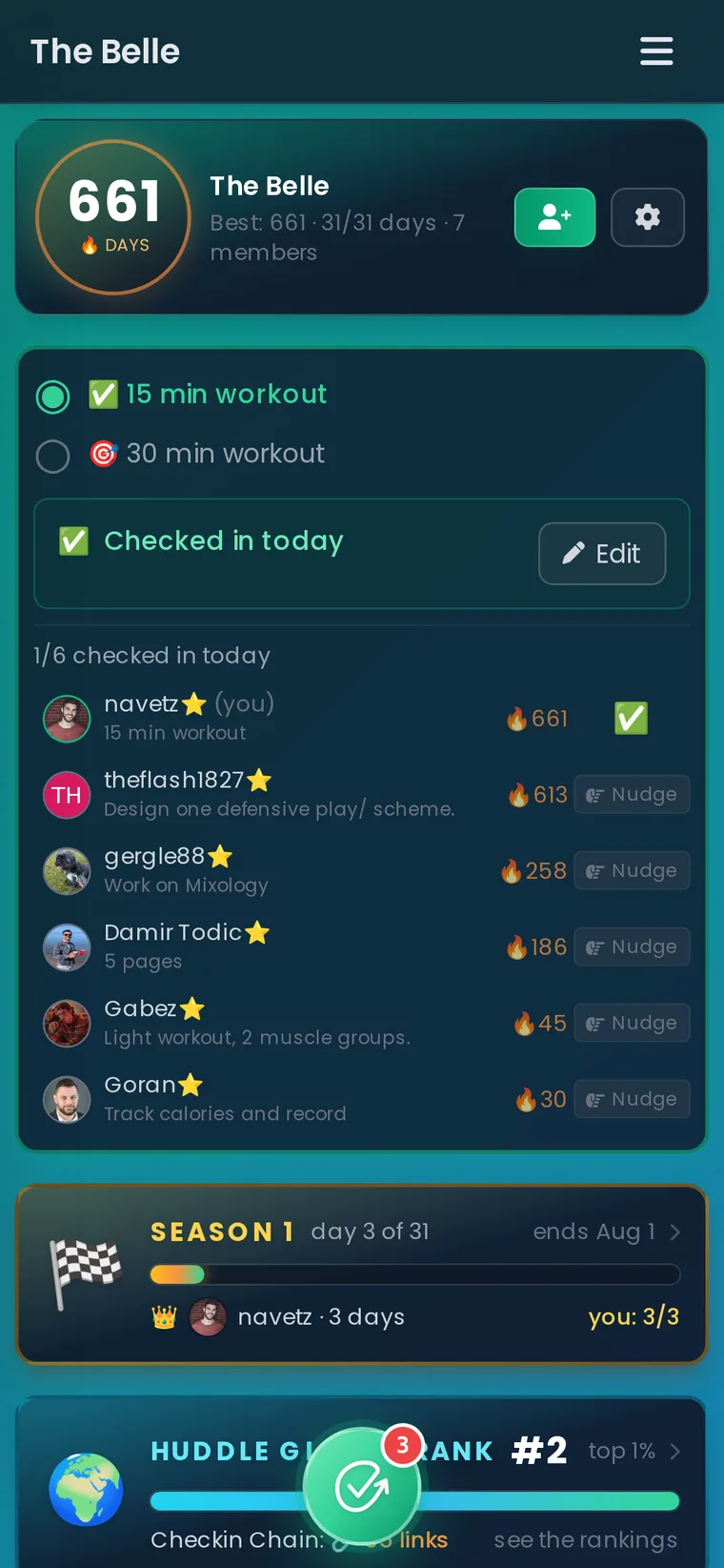
Every habit has a Floor, the smallest version that still counts on a bad day, and a Ceiling, the version you aim to burst through on a good one. Each member's checkin adds one link to the huddle's Checkin Chain that day, and your personal streak sits alongside it. Your Stats calendar keeps a quiet record, but no notification, feed post or bot message announces a missed day. The huddle celebrates who showed up.
The free plan covers one active habit, daily checkins with notes and GIFs, replies and cheers, reminders, and a starter streak freeze on your second checkin day. Friends join your huddle by invite for free. It runs on the web, iPhone, Android and a Discord bot, for ages 13 and up. Pro features start at $7.58 a month, billed yearly.
Trade-offs, honestly:
- No stakes. If a charge is the only thing that moves you, this will feel too soft.
- No verification. Checkins run on trust. From August 1 to October 31, 2026, 29.4% of checkin days in huddles with other people carried a written note nobody required (14,017 checkin days from 1,161 people, staff accounts and one unusual day left out). A note is not proof, though, and no one rules on it.
- Friends do not always answer. Across those same days, 18.4% got a cheer or a reply from another member within 24 hours. That is far from every day, which is why it works best with people you already know.
- Everything is public to view. Huddles are exclusive to join, but anyone can view them. You can use a display name instead of your real name.
- Some checkins are paid. Flex Checkins, Photo Checkins and Night Owl Checkins are pro features, unless a Habit Huddle Champion subscriber sponsors your huddle.
7. Focusmate: a person waiting for you
Focusmate pairs you with a real person for a timed video work session, so the pressure comes from someone expecting you. Its pricing page lists 3 free sessions a week and Plus at $8 a month billed yearly, or $12 billed monthly.
Good for: work goals where starting is the hard part.
Trade-offs: it does not track a habit over weeks, and your partner is usually a stranger.
Also worth a look: a contract with a friend
The option Forfeit says it is still building already exists on paper. Write the goal and the stake on one page, and have a friend sign it. If you slip, you buy dinner or do their dishes for a week, and the stake stays between friends. Our free habit contract generator builds the page, and our guide to the habit contract covers which terms hold up.
Do you need money on the line at all?
Money stakes are a strong tool for the small share of people willing to sign them. In a 2008 trial of 57 people in JAMA, those on a deposit contract lost a mean of 14.0 pounds over 16 weeks, against 3.9 for the control group. By seven months, the difference from the control group was no longer statistically significant.

Stakes can also last. In a commitment contract study of smokers, 11% of those offered the contract took it. People randomly offered it were 3 percentage points more likely to pass a test at six months, and the effect held at a surprise test at 12 months. In the $150 deposit trial of smokers, researchers estimated quit rates 13.2 percentage points higher with deposits than with rewards, among the 13.7% or so who would accept either program.
The people half has a longer tail. In a classic weight-loss study of 166 people, 76% of those who joined alone completed treatment, and 24% kept their weight loss in full. Among those who joined with friends and got social support built in, 95% completed it and 66% kept it off. A meta-analysis of 138 studies (19,951 people) found that tracking progress helps people reach goals, and helps more when the results are reported or made public. Our explainer on social accountability goes deeper on why.
We see a similar pattern in our own data. We looked at 1,872 people who made their first Habit Huddle checkin between July 3 and October 3, 2026. The 253 whose first checkin got a cheer or a reply from another member within 24 hours averaged 7.3 checkin days out of their first 28. The other 1,619 averaged 4.1. In week four, 27.7% of the cheered group still made a checkin, against 13.7%. (We left out staff accounts.) This is a correlation, not proof: people who join with active friends get more cheers and may have stuck with it anyway.
The quotable version: a stake charges you for the day you fail, and a friend gives you a reason on the day you show up. Plenty of people want both.
Which Forfeit alternative fits you
Pick by your reason for leaving, not by the feature list.
- The subscription is the problem, and the money works: Beeminder, or stickK for one long goal.
- You want proof checked, without a charge: RankUp if your friends compete, SendProof if one friend will do it.
- You keep forgetting to open the app: FineStreak.
- You want friends showing up with you every day: Habit Huddle. See our accountability apps with friends roundup for more options like it.
- Your goal is focused work: Focusmate.
- You want a lost stake to go to a friend: a written contract with a friend.
- Forfeit works and the price is fine: stay. Strict proof with real appeals is hard to beat, and a text to a friend is already a choice inside the app.
For the wider category, see our list of the best accountability apps.
How to switch without losing your momentum
End your running goals before you stop using the app, because a stake you forgot about can still charge you. Forfeit says disconnecting screen-time tracking counts as a failure, so close those goals before you remove any permissions.
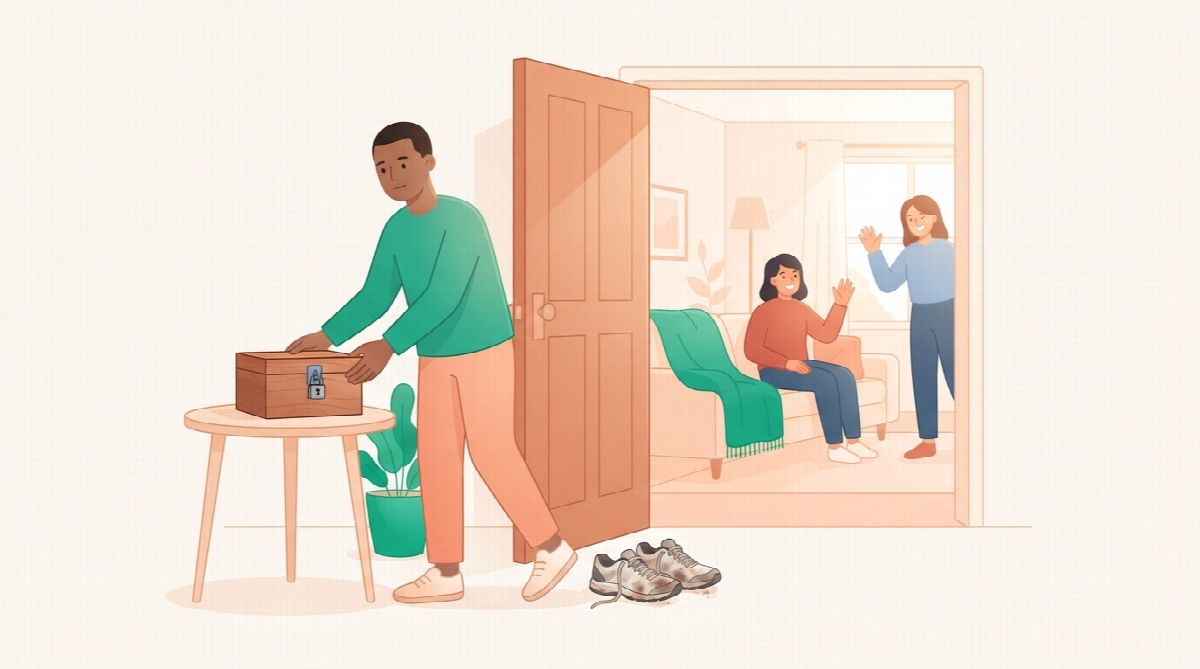
- Close or appeal what is still running. Look at each goal's next deadline first.
- Cancel where you bought it. Deleting an app does not end a subscription. Cancel in your App Store or Google Play settings.
- Shrink the goal to a daily Floor. "Gym by 7 or lose $20" becomes "10 minutes of movement." Keep the bigger version as your Ceiling.
- Pick your people before your app. Name the two or three friends you would want to see your progress. If you cannot name anyone, a money or proof app is the safer pick.
- Keep a small stake if it helped. A friendly bet with a friend keeps the sting and drops the subscription.
Start a free huddle with your friends
If the fine was never the part you liked, try the version where people cheer when you show up. Start a huddle, set your Floor and Ceiling, and invite the friends you named in step 4. It is free to start, and there is nothing to forfeit.
Ready to Build Habits With Friends?
Stop failing alone. Join thousands using the #1 habit tracker with friends for real accountability and lasting results.
Prefer mobile? App Store · Google Play
Related Guides
More Habit Huddle articles on building habits with accountability.

How to Organize a Step Challenge at Work: A Free 4-Week Plan
How to organize a step challenge at work: a free 4-week plan with fair scoring, copy-paste rules, a weekly schedule and what the research really shows.

Family Workout App: 8 Compared by Who One Plan Really Covers (2026)
Compare 8 family workout apps: which plans cover several people, what each costs, and which work for kids under 13. Prices checked November 2026.

Weight Loss Accountability Apps: 7 Compared by What They Hold You To
Compare 7 weight loss accountability apps: bets, coaching programs, food trackers and friend groups. What each one checks, free picks, and what research says...