
Fear of Meditation: Why It Happens & How to Start Safely
Experiencing a fear of meditation? You're not alone. Learn the causes of meditation anxiety and discover gentle, step-by-step strategies to start safely.
You sit down because you want calm. You close your eyes, take a breath, and within seconds your chest tightens. Your thoughts get louder. Your body feels trapped. Instead of peace, you feel alarmed.
That experience can be confusing and embarrassing. Many people assume meditation should feel soothing right away, so when fear shows up, they conclude they're doing it wrong. They aren't.
Fear during meditation is a real human response to stillness, uncertainty, and inner attention. For some people, it feels like simple restlessness. For others, it can feel much sharper, especially if anxiety, chronic stress, or unresolved trauma is already living in the nervous system.
Table of Contents
- Its Not Just You The Reality of Meditation Fear
- The Science Behind Your Fear of Meditation
- How to Meditate When You're Afraid to Meditate
- Knowing When to Pause and Seek Help
- Using Habit Huddle for Safe and Social Practice
- Your First Step Toward Mindful Practice
Its Not Just You The Reality of Meditation Fear
If you've felt a wave of panic while trying to meditate, you're not unusually sensitive. You're having an experience that researchers and clinicians now take seriously.
A large U.S. study from 2022, reported by New Scientist on long-term negative effects from meditation, found that over 10% of regular meditators experienced negative effects lasting at least one month, including increased anxiety and depersonalization. That matters because it directly challenges the old idea that meditation is always safe for everyone in every form.
For a lot of people, the fear of meditation starts with a mismatch between expectation and reality. They expect a quiet mind. Instead, they meet the part of themselves that has been bracing all day. When the usual distractions disappear, the nervous system may finally reveal how activated it already was.
Why this feels so personal
Meditation often removes your favorite coping tools all at once. No scrolling, no talking, no task, no movement, no quick escape. If control helps you feel safe, stillness can feel exposed.
That's one reason fear during meditation often overlaps with the same concerns people have around panic, surrender, or feeling mentally uncontained. If that theme resonates, this guide on managing anxiety and control issues can help you put language to what your mind may be protecting against.
Fear in meditation doesn't automatically mean meditation is bad for you. It often means your system needs a gentler entry point.
A kinder way to frame it
Try replacing "Why can't I meditate?" with "What is my nervous system reacting to right now?"
That small shift changes everything. It moves you out of self-judgment and into observation. You stop treating fear as proof of failure and start treating it as information.
Some people can sit and feel relief. Others need movement, structure, open eyes, or very short practices before stillness feels tolerable. That's not avoidance. That's skillful pacing.
The Science Behind Your Fear of Meditation
Meditation can look passive from the outside, but inside the brain and body, a lot can happen very quickly. Fear often appears when the brain's threat detector treats internal experience as if it were danger.
Why silence can feel threatening
When you get quiet, your attention turns inward. That sounds simple, but for an anxious or trauma-shaped nervous system, inward attention can feel intense. The body notices heartbeat, muscle tension, pressure in the chest, memories, and unfinished emotion. The brain may misread those sensations as signs that something is wrong.
A useful analogy is a smoke alarm that's too sensitive. It isn't broken because it goes off. It's trying to protect you. But when it reacts to steam the same way it reacts to fire, the signal becomes confusing. Meditation can bring you close enough to your inner experience that this alarm starts sounding.
Clinical research summarized in this review of meditation-related unwanted effects found that focused attention meditation can increase unwanted effects, while body awareness practices are associated with fewer adverse events. One reason is that body-based attention can reduce the kind of mental looping linked with fear and distress.
Meditation challenges are broader than most people realize
This isn't just about being "bad at relaxing." In 2017, Lindahl and colleagues published a taxonomy of over 50 distinct types of meditation-related challenges. Their review, available in the PLOS One paper on meditation-related challenges, also noted that some studies reported adverse effects in 25 to 87% of participants.
That wide range tells us something important. Meditation isn't one single experience. The effects depend on the person, the method, the duration, the setting, and what the nervous system is already carrying.
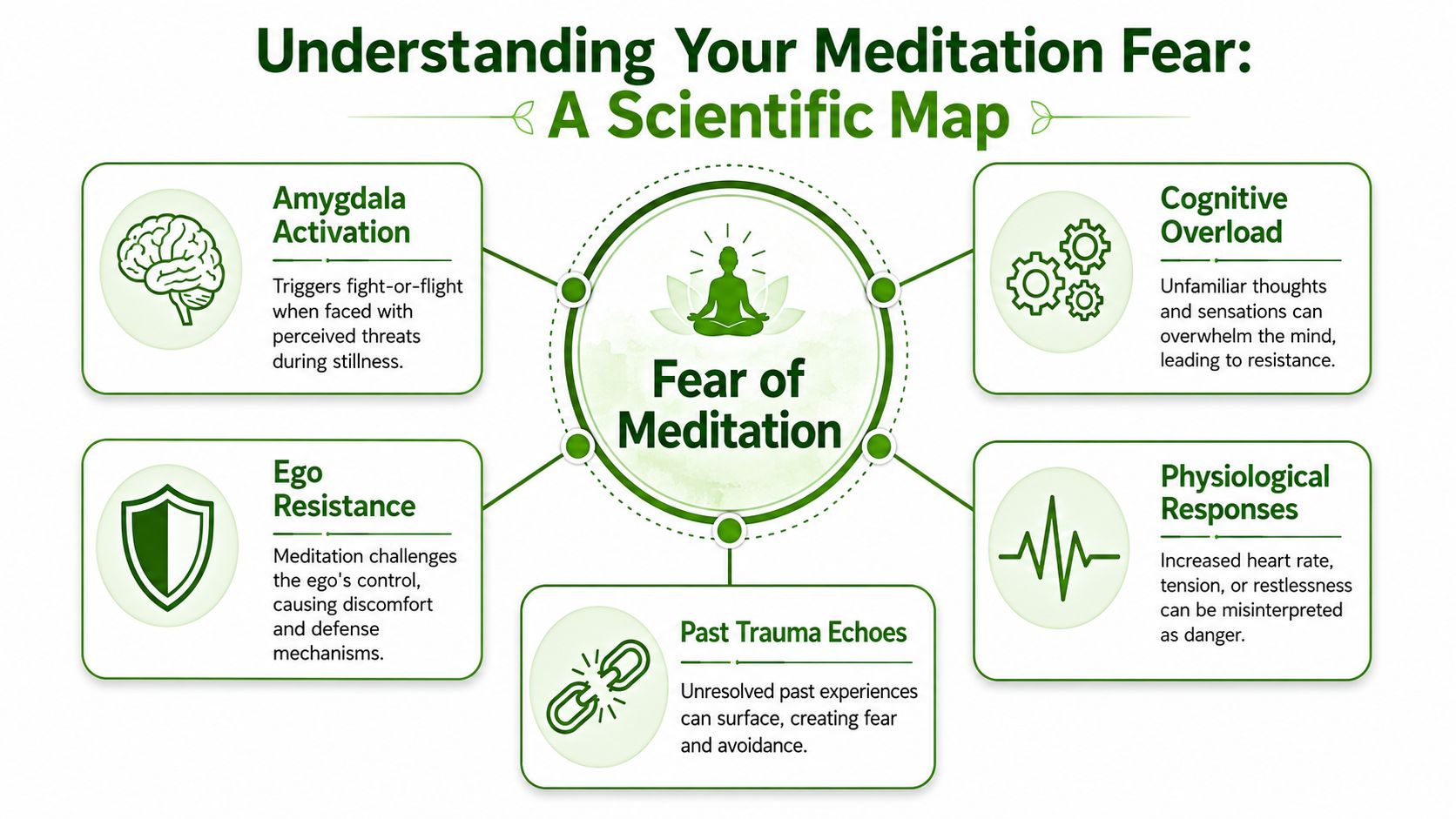
Here are some common mechanisms behind the fear of meditation:
- Threat detection: Stillness can feel unfamiliar, and unfamiliarity can trigger alarm.
- Cognitive overload: Without external tasks, thoughts may rush forward all at once.
- Loss of control: Some people feel frightened by not directing every moment of attention.
- Body misinterpretation: Normal arousal, like a faster heartbeat, may get read as danger.
- Trauma echoes: Quiet can uncover memories, sensations, or emotional states that were previously held down.
Practical rule: If a practice makes you feel trapped, narrow the goal. Don't aim for calm. Aim for contact with one safe sensation.
If you want added nervous-system support outside meditation itself, these techniques for anxiety relief can pair well with a gentler mindfulness approach.
How to Meditate When You're Afraid to Meditate
The safest way to work with the fear of meditation is to stop treating meditation like a test of endurance. You don't need to force long silent sits. You need a practice your nervous system can trust.
Start with less than you think you need
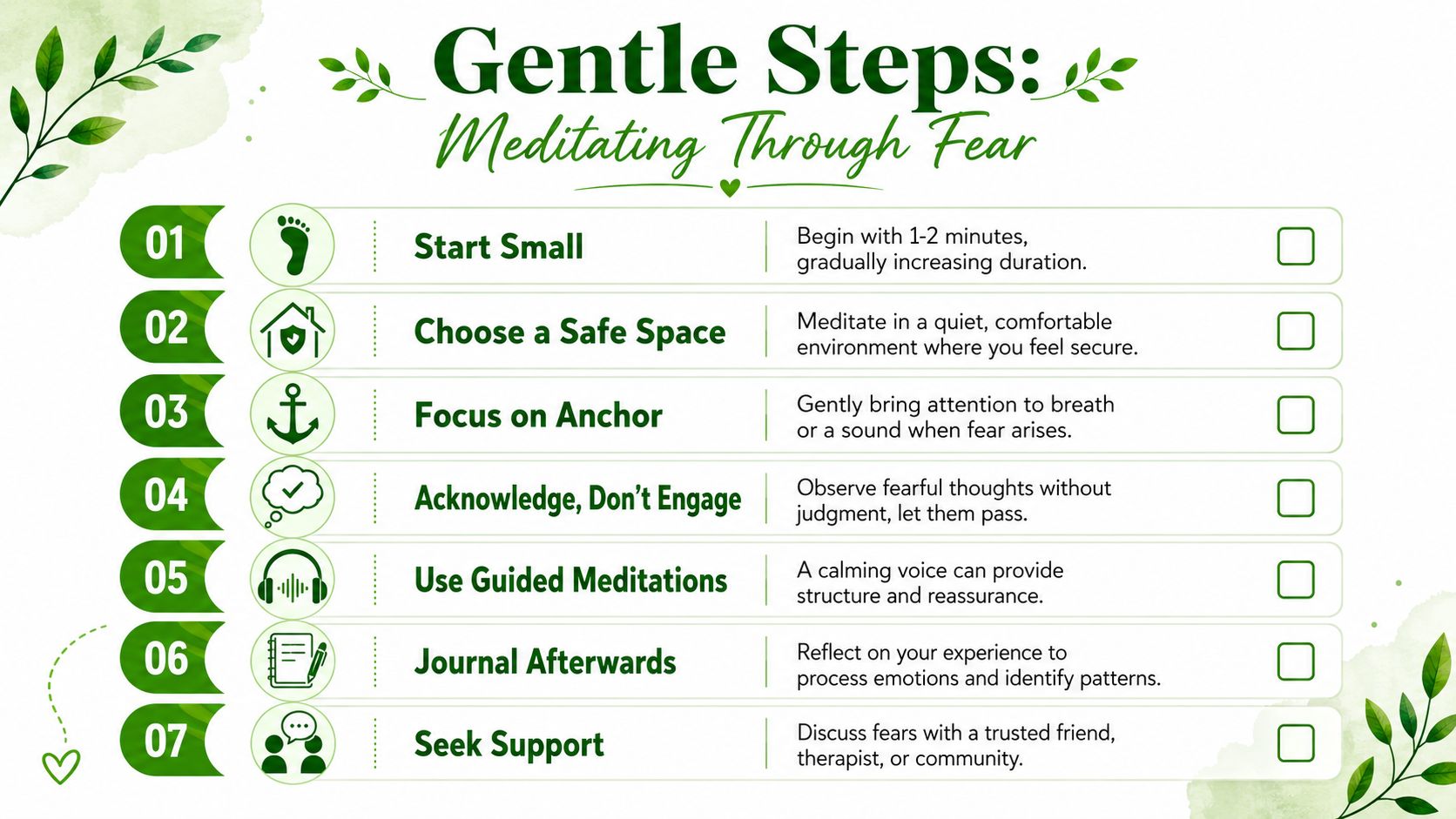
If meditation scares you, start so small that your body doesn't feel ambushed.
That might mean:
- Sitting for three breaths.
- Standing by a window for one minute.
- Not closing your eyes at all.
- Stopping while you still feel okay.
Short practices teach your system, "We can go near this and come back safely." Long practices can be useful later, but early on they often create a sense of being stuck.
A timer helps because it removes the mental burden of wondering how long you've been in it. If you want a simple setup, an online meditation timer can create a clear beginning and end without extra friction.
You already know you can change.
You just need to take the first step. Habit Huddle helps you build habits around your goals, alongside friends who keep you accountable.
Choose body-based practices first
If inward focus on thoughts makes things worse, shift attention to sensation and movement. Research has shown that body awareness practices are linked with fewer adverse events than focused attention practices, as noted earlier in the clinical review.
Try these options:
- Walking meditation: Feel one foot, then the other. Count steps if you need structure.
- Hand grounding: Rub your palms together and notice warmth, texture, and pressure.
- Supported body scan: Keep your eyes open and notice contact points, like feet on floor or back on chair.
- Sound anchoring: Listen to a fan, rain, or a steady piece of non-vocal music.
The point isn't to empty your mind. The point is to give your brain a safe object that isn't as likely to pull you into spirals.
Build a repeatable safety routine
A predictable entry and exit helps the body relax because it knows what comes next. Use the same sequence every time for a while.
A simple routine might look like this:
| Stage | What you do | Why it helps |
|---|---|---|
| Arrive | Look around the room and name a few objects | Orientation reduces the sense of threat |
| Ground | Press feet into the floor or hold a pillow | Physical contact builds containment |
| Practice | Stay with one anchor for a brief period | Narrow focus lowers overwhelm |
| Exit | Open your eyes fully and move your body | Clear endings prevent lingering activation |
Don't judge the session by whether you felt peaceful. Judge it by whether you stayed in contact with yourself.
If you can notice fear and stay connected to one anchor, you're already practicing successfully.
A few more ways to make meditation feel safer:
- Use guided audio: A calm voice can reduce the sense of being alone with your thoughts.
- Sit near an exit: Choice matters. Your body relaxes more when it knows you can leave.
- Keep a journal nearby: Write one sentence after practice: "What did I notice?" This turns vague dread into trackable information.
- Prefer regular over heroic: A tiny daily practice usually works better than rare, intense sessions.
Knowing When to Pause and Seek Help
Some discomfort is part of learning meditation. Some experiences are signs to slow down and get support. Knowing the difference protects you.

A 2024 study described in the Journal of Clinical Psychology discussion referenced here reported that 18% of beginners misattribute trauma-related flashbacks to "normal meditation fear," which can delay needed therapy. That's why a basic screening framework matters.
Green lights and red flags
Use this simple distinction.
Green light experiences usually mean the practice is challenging but still workable:
- Restlessness: You want to get up, but you still feel basically present.
- Boredom: The mind complains that nothing is happening.
- Brief worry spikes: Thoughts get louder, then settle when you reorient.
- Mild emotion: Sadness, irritation, or tension comes and goes without flooding you.
Red flag experiences suggest the practice may be activating trauma, dissociation, or severe anxiety:
- Flashback-like material: You feel pulled into past events instead of present awareness.
- Dissociation: You feel unreal, far away, numb, or disconnected from your body.
- Panic that escalates: The fear keeps rising rather than settling with grounding.
- Lingering destabilization: You feel emotionally worse for hours after practice.
- Loss of orientation: You can't easily tell where you are or what time it is.
If you hit a red flag, the answer isn't to push harder.
What to do if a red flag shows up
First, stop the meditation. Open your eyes. Name what you see. Feel your feet. Touch something solid. Speak out loud if that helps.
Then reduce the intensity of your practice for the future. Choose movement, open-eye grounding, or external anchors instead of silent inward focus.
This short video can help if you need a reminder that pausing is part of practice, not failure.
When meditation repeatedly leads to flashbacks, dissociation, or severe panic, it's time to work with a trauma-informed therapist rather than trying to solve it alone.
Professional help is especially important if meditation starts uncovering material that feels bigger than simple stress. A good clinician won't tell you to "just keep sitting." They can help you titrate attention, build safer resources, and decide whether mindfulness needs to be adapted.
Using Habit Huddle for Safe and Social Practice
Many people think meditating with others will automatically make it easier. Sometimes it does. Sometimes it doesn't.
A future-dated report from 2025, described as a Global Wellness Institute report on group mindfulness anxiety, stated that 32% of users in group mindfulness sessions reported higher anxiety because of social pressure. That fits what many anxious meditators already know firsthand. Being watched, compared, or expected to "do it right" can make the fear of meditation worse.

Why group meditation can raise anxiety
In a group setting, attention often splits in two directions. One part of you tries to follow the practice. Another part monitors how you look, whether you're behind, and whether other people seem calmer than you.
That creates a few predictable problems:
- Performance anxiety: You start trying to appear relaxed instead of noticing what's true.
- Comparison pressure: Someone else's ease makes your own struggle feel more visible.
- Fear of exposure: Internal discomfort feels socially risky when others are nearby.
For people with a sensitive nervous system, accountability works best when it supports consistency without demanding emotional exposure.
How to make accountability feel safer
Low-pressure structure is usually better than intense shared sessions. That's one reason some people do better with asynchronous check-ins than with live group meditation.
A safer social setup often includes:
- Small commitments: Set a minimum like one minute of breathing or one grounding exercise.
- Private flexibility: Let people complete the practice on their own schedule.
- Clear permission to modify: Walking, eyes-open practice, and short sessions all count.
- Simple check-ins: Report completion, not depth, insight, or spiritual success.
If you're exploring tools built around consistency rather than performance, this guide to a group accountability app shows how social structure can support habits without turning them into a stage.
The core principle is simple. Accountability should lower fear, not amplify it. If your current setup makes you dread showing up, the format needs adjusting.
Your First Step Toward Mindful Practice
The fear of meditation doesn't mean you're failing. It means your system is responding to something that feels unfamiliar, intense, or unsafe. That response deserves respect.
For some people, meditation starts as relief. For others, it starts as negotiation. They need shorter sessions, open eyes, more movement, and stronger anchors in the body. That's still meditation. It's just adapted to reality instead of fantasy.
The most important distinction is this: discomfort isn't always danger, but danger signals shouldn't be talked away as "part of the process." Restlessness and boredom can be workable. Flashbacks, dissociation, and escalating panic deserve a pause and, often, professional support.
Start with one small action today. Sit for three breaths with your eyes open. Or stand and feel your feet on the floor for a minute. Or write down, without judgment, "Meditation feels scary for me right now."
If you want help making that first step consistent, this guide on how to start a habit offers a practical way to build from small wins instead of waiting for perfect motivation.
Fear is a signal to proceed with care. It isn't a command to give up.
If you want gentle accountability while building a mindfulness routine, Habit Huddle gives you a simple way to show up consistently without turning meditation into a performance. You can keep the goal small, check in daily, and build confidence one calm, manageable step at a time.
Ready to Build Habits With Friends?
Stop failing alone. Join thousands using the #1 habit tracker with friends for real accountability and lasting results.
Prefer mobile? App Store · Google Play
Related Guides
More Habit Huddle articles on building habits with accountability.
Habit Contract: How to Write One That Works (Free Template)
What a habit contract is, what goes in one, what randomized trials say about signed commitments, why the stakes belong on quitting rather than a missed day,...

Family Habit Tracker App: 8 Best Picks by Age, and How to Make It Stick (2026)
Family habit tracker apps compared by age: Joon, Family Rewards, Family Checklist, Kinly, Habit+ Family, HabitShare, Habitica, and Habit Huddle. Plus the hab...

Gamified Habit Tracker: 7 Apps Compared by What the Game Rewards (2026)
Gamified habit trackers compared: Habitica, Finch, Forest, Streaks, Habits Garden, HabitForge, and Habit Huddle, by what the game rewards, what free gets you...