
Habit Contract: How to Write One That Works (Free Template)
What a habit contract is, what goes in one, what randomized trials say about signed commitments, why the stakes belong on quitting rather than a missed day,...

A habit contract is a short written promise that names one habit, the smallest version of it you will do every day, how long the promise runs, what happens if you quit, and who witnesses it. You sign it. Your witness signs it. Then you keep it somewhere both of you will see.
That is the whole tool. The rest of this guide covers what goes in one, what the research actually says about signed commitments, the two design choices that decide whether yours survives past week two, a template you can copy in a minute, and the mistakes that turn a good contract into a guilt machine.
What a habit contract is
A habit contract is a written, signed agreement that makes a habit specific, gives it a deadline, attaches a consequence to abandoning it, and puts a second person's name on the page. It is a contract with yourself that someone else has read.
James Clear popularized the modern version in Atomic Habits, where it appears as a signed agreement with witnesses and concrete penalties, and his site still hosts a free printable version. The idea is much older: behavioral contracting has been used in clinical psychology since the late 1960s, and economists have spent two decades testing its cousin, the commitment device, where the consequence is automatic rather than social.
The distinction matters when you write yours. A commitment device (a deposit that a service keeps if you fail) enforces itself. A habit contract is enforced by a person. That makes it weaker on paper and much easier to actually start, which is the trade the research below keeps pointing at.
What goes in a habit contract

A working habit contract has six parts, and the two that most templates skip are the ones that keep it alive: a floor for bad days and a rule for what a missed day means.
| Part | Weak version | Strong version |
|---|---|---|
| The habit | "Exercise more" | "Walk outside" |
| The Floor (bad-day minimum) | Missing | "Ten minutes, any pace, any weather" |
| The Ceiling (good-day version) | Missing | "A 5K or a 45-minute hike" |
| The term | "Until it sticks" | "30 days, starting Monday, renewable" |
| What counts as done | Unstated | "A checkin by bedtime, the Floor counts in full" |
| The stakes | "$5 every time I miss" | "If I quit before day 30, $50 to a cause I cannot stand" |
| The witness | Nobody, or "everyone on Instagram" | One named person who signs and cheers |
The habit. Write one habit on each contract. If you write three, you will keep the easiest one and feel like you broke the other two. Pick the one whose absence bothers you most.
The Floor and the Ceiling. The Floor is the smallest version that still fully counts: ten minutes, one page, one glass of water. The Ceiling is your best-day version. You step on the Floor every day and burst through the Ceiling when you have it in you. Writing both down is what lets a sick day or a late flight stay inside the contract instead of ending it.
The term. Thirty days is the right first contract. It is long enough to matter and short enough that the end date is real. Renew it in writing on day 30 rather than signing for a year you cannot picture.
What counts as done. Say it plainly: "the Floor counts in full." A checkin at the Floor is not a half day. This single sentence removes the most common way people talk themselves out of a habit at 9pm.
The stakes. Put them on quitting, not on a single miss. More on why below, because it is the decision most contracts get wrong.
The witness. One person, named, who signs. Their duties are to know the promise exists and to cheer when you show up. Not to audit.
Do habit contracts work? What the research says
Signed commitments with real consequences reliably change behavior while the contract runs, for the people willing to sign one. Both halves of that sentence are backed by trials, and both matter.
In a 2008 randomized trial at the Philadelphia VA published in JAMA, participants who signed a deposit contract for weight loss lost a mean of 14.0 pounds over 16 weeks against 3.9 pounds for the monthly weigh-in control group. About half of the contract group hit the 16-pound target versus roughly one in ten controls. Then the contract ended and the difference at seven months was no longer statistically significant. The authors' own conclusion: the incentive worked while it was on.
The catch is who signs. In a 2015 trial of 2,538 smokers in the New England Journal of Medicine, 90 percent of people offered a pure reward program accepted it, but only 13.7 percent accepted a program that required a $150 refundable deposit. Among the minority who would have accepted either, the deposit version produced a quit rate about 13 percentage points higher. Deposits work better; almost nobody wants one.
The same pattern shows up in the field. A commitment savings account for smokers in the Philippines was taken up by 11 percent of the people offered it, raised six-month quit rates by about 3 percentage points across everyone offered, and the effect held at a surprise 12-month test. A 2014 JAMA viewpoint by Rogers, Milkman, and Volpp summarizes the wider literature the same way: commitment devices are effective and underused, mostly because people decline to bind themselves.
Two more findings shape the template below. A meta-analysis of 94 studies found that writing an if-then plan ("if it is 7am, then I put on my shoes") has a medium-to-large effect on follow-through, which is why the contract names a time and a trigger and not just a habit. And in a 2021 megastudy of more than 60,000 gym members published in Nature, the most effective of 54 interventions was a small bonus for returning after a missed workout. Planning for the miss beat every attempt to prevent it.
Put together: a habit contract is worth signing, its power is mostly in the specificity and the second signature, and the stakes should be sized so you will actually sign.
Put the stakes on quitting, not on a missed day
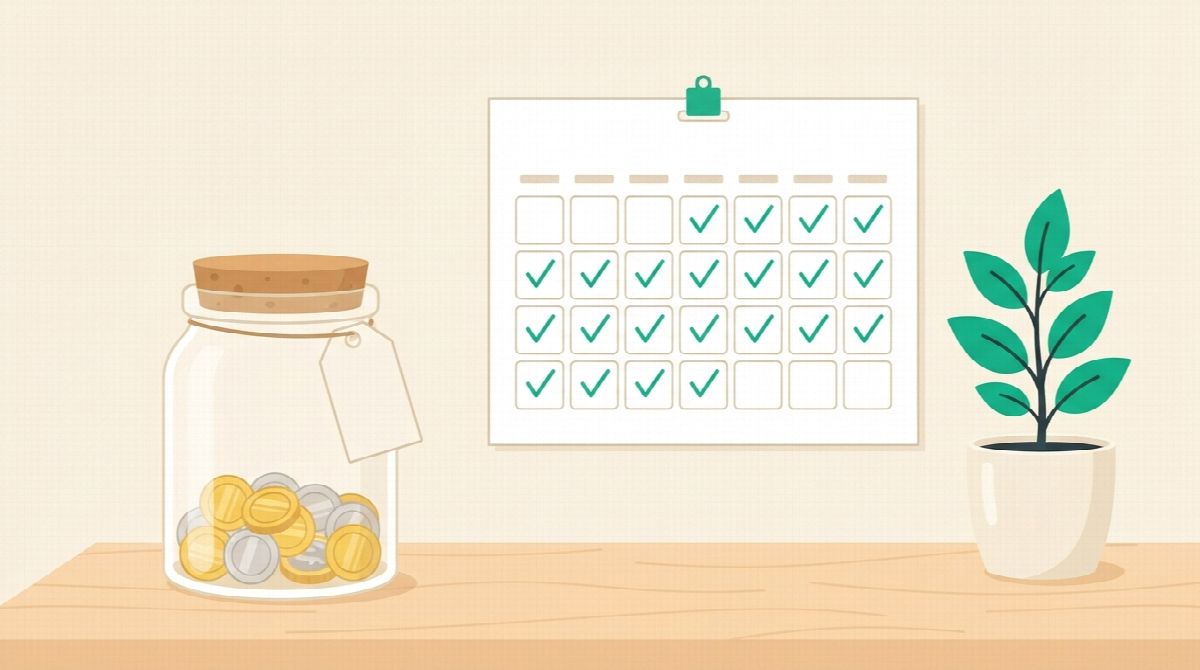
The stakes in a habit contract should trigger when you abandon the habit, never when you miss one day. A per-miss penalty turns the first bad Tuesday into a bill, a shame spiral, and a quiet decision that the whole thing was stupid.
Every habit contract template online uses the per-miss model, and it is the reason most of them are in a drawer by week three. A missed day is not a breach. Everyone misses days. The 66-day median in Lally's habit-formation study came with a range of 18 to 254 days and plenty of missed days inside it, and the gym megastudy above found that the single best thing you can do about a miss is make the return easy.
So write the miss into the contract explicitly: "A missed day is a missed day. It gets no penalty and no makeup. The one thing this contract does not permit is quietly quitting." Then define quitting so it cannot be argued with at the time: three missed days in a row, or seven in the term, whichever you would honestly call giving up.
The stakes themselves should be a wince, not a wound. Money to a cause you dislike is the classic and it works precisely because it is not a donation you can feel good about. Fifty dollars is plenty for a first contract. If the number is big enough that you would negotiate with your witness rather than pay, it is too big, and the contract will end in a negotiation.
The strongest stake is often not money at all. Telling your witness "I quit" out loud, in person, is a consequence most people will do a great deal to avoid. If you know that about yourself, write it in and skip the jar.
You already know you can change.
You just need to take the first step. Habit Huddle helps you build habits around your goals, alongside friends who keep you accountable.
The witness: cheer, do not police

The witness on a habit contract works when their job is to know the promise exists and to cheer the days you show up. It fails when their job is to catch the days you do not.
This runs against the usual advice, which asks you to pick an "enforcer" with some authority over you. Enforcement is what makes a contract feel like a contract, and it is also why people stop telling their enforcer the truth. The social accountability guide covers why: the visible, cheered checkin is what carries a habit, and being watched for misses is what makes people leave. A witness who sees your checkins and says nothing about the gaps is doing the job exactly right.
Pick someone who will actually see you do the habit or hear about it the same day. A partner, a housemate, a friend who runs at the same hour. If you are choosing between a friend who will be kind and a friend who will be strict, choose kind and give them a copy of the contract. The paper carries the strictness so the person does not have to.
The best witness has a contract of their own. Two people, two habits, both signatures on both pages: that is the whole idea behind an accountability partner, and it removes the awkward power imbalance of one person policing another. If you want a weekly rhythm for that pairing, the accountability partner checkin sheet is a twenty-minute agenda built for two.
A habit contract template you can copy
Copy this into a note, fill the blanks, print it, and sign it with your witness. It is written for one habit and a 30-day term, which is the right first contract for almost everyone.
HABIT CONTRACT
I, ________, commit to the following every day for 30 days, beginning ________:
Habit: ________ The Floor (the smallest version that fully counts): ________ The Ceiling (my best-day version): ________ When and where: If it is ________ (time), then I ________ (first action) at ________ (place). What counts as done: A checkin by bedtime. The Floor counts in full.
A missed day is a missed day. It gets no penalty and no makeup. Quitting means ________ (three misses in a row / seven misses in the term). The one thing this contract does not permit is quietly quitting.
Should I quit before day 30, I will ________ (the stakes). No renegotiating from the couch.
________ signs as my witness. Their duties are to know this promise exists and to cheer when I show up.
Signed: ________ Date: ________ Witnessed: ________ Date: ________
Filled in, it reads like this: "I, Priya, commit to walking outside every day for 30 days beginning Monday. The Floor is ten minutes at any pace. The Ceiling is a 5K. If it is 7am, then I put on my shoes at the front door. Quitting means three missed days in a row. Should I quit before day 30, I will give $50 to a cause I cannot stand. Dan signs as my witness."
If you would rather have a printable page with room for up to five habits, each with its own Floor and Ceiling, the habit contract generator builds one in your browser and saves nothing. Free contract PDFs also exist from James Clear and 101 Planners; they use the per-miss penalty model, so cross that clause out and write in the quitting rule above.
How long a habit contract should run
Sign for 30 days, then renew on paper. A month is long enough for the habit to stop feeling like a project and short enough that the end date is a real event rather than a vague future.
The 66-day figure that gets quoted as "how long a habit takes" is a median across very different habits, so a 30-day contract will usually end before the habit is automatic. That is fine. The renewal is the point: on day 30 you sit down with your witness, look at the month, and decide whether to sign again, raise the Floor, or swap habits. A contract that renews three times has done more than a 90-day contract most people would never have signed.
If you are starting from zero, or restarting after a fall, make the first term shorter still. Two weeks at a Floor so small it is almost embarrassing beats a heroic 30 days that ends on day nine. The guide to restarting a habit after falling off walks through that reset, and the easy habit challenges for beginners list is a good place to pick a Floor-sized habit.
Five mistakes that break habit contracts
- Signing for a goal instead of a habit. "Lose ten pounds" cannot be a daily checkin and cannot be cheered. Write the daily behavior and let the goal take care of itself.
- No Floor. A contract with only a full-size habit breaks on the first sick day. The Floor is what makes it survivable.
- Per-miss penalties. Covered above. Misses are normal; quitting is the breach.
- A witness who audits. If your witness's first message of the day is "did you do it?", you will start dodging them. Ask for cheers, share your checkins, and let the gaps pass in silence.
- Terms only you understand. "Quitting" must be defined in numbers on the page. So must "done." Ambiguity is where the 9pm negotiation lives.
Make the contract live
Paper holds the promise. The hard part is the daily checkin that proves you kept it, and the witness who sees it without having to ask.
Habit Huddle is our app, so judge the reasoning rather than the recommendation. Every habit you track is a huddle. Solo or with friends. You set a Floor and a Ceiling for the habit, exactly the way the contract does, and post one checkin a day. Your witness joins the huddle with their own habit; each checkin adds a link to the huddle's Checkin Chain, and they can cheer each one. Missed days are invisible to everyone but you, which is the "cheer, do not police" clause enforced by design rather than by willpower. The habit tracker with friends page shows how a two-person huddle works day to day.
The honest trade-offs: there are no money stakes and no automatic penalties, so if a deposit is what moves you, pair the app with a paper contract or a stakes service. And checkins run on the honor system; nobody verifies your ten-minute walk with GPS. Those are choices, not gaps: this is a tool for the 90 percent who would not sign a deposit, built so the daily part is easy and the social part is kind.
Start a huddle, invite your witness, and set the Floor the contract names. Free to start.
Ready to Build Habits With Friends?
Stop failing alone. Join thousands using the #1 habit tracker with friends for real accountability and lasting results.
Prefer mobile? App Store · Google Play
Related Guides
More Habit Huddle articles on building habits with accountability.

Family Habit Tracker App: 8 Best Picks by Age, and How to Make It Stick (2026)
Family habit tracker apps compared by age: Joon, Family Rewards, Family Checklist, Kinly, Habit+ Family, HabitShare, Habitica, and Habit Huddle. Plus the hab...

Gamified Habit Tracker: 7 Apps Compared by What the Game Rewards (2026)
Gamified habit trackers compared: Habitica, Finch, Forest, Streaks, Habits Garden, HabitForge, and Habit Huddle, by what the game rewards, what free gets you...

Running Accountability App: 8 Picks Compared (Stakes, Streaks, and Friends)
Eight running accountability apps compared: Strava, Nike Run Club, Runkeeper, Oath, RunMatch, RunHawk, StickK, and Habit Huddle, with prices, how runs are ve...