
5 stickK Alternatives for 2026 (and What stickK Changed)
stickK changed its terms in 2024: no more friend or charity stakes, and it keeps half of anti-charity money. Five alternatives, for the money or the people.

📺 Related Video: Carrots and Sticks: Unlock the Power of Incentives to Get Things Done
Video by: Microsoft Research · Watch on YouTube
The best stickK alternative depends on which half of stickK actually worked for you: the money or the people. If you want sharper money stakes, Beeminder (pledges that climb after every slip, tied to your own data) and Forfeit (photo proof reviewed by AI or a person) are the closest replacements. If what kept you going was the referee and the supporters, a social app like Habit Huddle (daily checkins with friends, no money) or Focusmate (live work sessions with a partner) fits better.
Before you switch, know that stickK itself changed. Its commitment contract terms, last updated June 12, 2024, removed the charity and friend options for new staked contracts. Lost money now goes to an anti-charity or to stickK, and stickK keeps half of what goes to an anti-charity. Most comparison pages still describe the old setup.
What changed at stickK, in its own words
stickK's current terms make it a different product from the one most reviews describe. The summary at the top of its contract terms reads: "We removed our $5 Commitment Creation Fee for new staked Commitments, and we have eliminated new charity and friend/foe recipient Commitments." Several older help pages still explain how to send stakes to a friend or a charity. The terms are the newer document, and they are the contract you sign.
Here is what the terms say today, in plain words:
- Where lost money goes: an anti-charity you pick (an organization whose views you oppose) or stickK itself.
- What stickK keeps: when an anti-charity is the recipient, stickK deducts 50% of forfeited stakes to cover costs and pay for its service.
- A missing report counts as a failure. You have 24 hours after a daily reporting period and 72 hours after a weekly one. Miss that window and the period is marked a Failure, which triggers the charge.
- Your referee's word is final. If your referee reports a failure, it stands, even if you reported success.
- Cancelling is hard. A staked contract can only be cancelled if a licensed physician faxes stickK's Medical Excuse form.
- Age limits: no one under 18 can put money on a contract, and no one under 13 can make one at all.
None of this is hidden. It is simply stricter, and less generous to the people around you, than the stickK of the 2008 press coverage. If you liked the idea of a friend collecting your lost stakes, that option is gone for new contracts.
What stickK still does well
stickK is still free to use without money, and it works for any goal you can write down. You define a goal, pick a reporting schedule, invite a referee who confirms your reports, and add supporters who get email updates. The Commitment Journal gives your referee and supporters a place to follow along. Quitting smoking, writing a thesis or calling your grandmother every Sunday all fit the same template.
The idea behind it is sound. stickK was built by Yale economists Dean Karlan and Ian Ayres, and the research on commitment devices is real. A commitment savings account for smokers in the Philippines, studied by Karlan and colleagues, raised six-month quit rates by about 3 percentage points across everyone offered it, and the effect held at a surprise 12-month test. stickK's own figure, cited on Wikipedia, is that 78% of users with money on the line and a referee reach their goals, against 35% who put no money down. That is the company's claim, not an independent study.
The app is the weak spot. In October 2026 the stickK iPhone app held 2.6 stars from 26 ratings, with its last update in February 2026.
Why people look for a stickK alternative
Most people leave stickK for one of four reasons, and each one points to a different replacement.
- They wanted a friend to get the money. That was the warm version of a commitment contract, and new contracts no longer offer it.
- Weekly self-reports felt slow. On a weekly contract, a bad Tuesday does not register until the report is due days later.
- The stakes made them anxious instead of motivated. A hard-to-cancel contract with your card attached is a lot of pressure for a habit you are still figuring out.
- The people part was thin. Supporters get emails. There is no daily place where friends show up together.
Behind all four sits a bigger fact: money stakes are powerful, but very few people agree to them. In a 2015 trial of 2,538 smokers in the New England Journal of Medicine, 90% of people offered a pure reward program accepted it, but only 13.7% accepted a program that required a $150 refundable deposit. Deposits work better for the few who sign. Most people never sign.
stickK alternatives compared
No single app replaces all of stickK, so the table below sorts the options by what is on the line and who checks.
| App | What is on the line | Who checks | Where lost money goes | Cost | Best for |
|---|---|---|---|---|---|
| stickK | Money (optional) and reputation | You, plus a referee | An anti-charity or stickK | Free; stakes optional | Long goals with a strict referee |
| Beeminder | A pledge that climbs after each slip, usually from $5 | Your data, synced or typed | Beeminder | Free to start; payment method required; premium plans | Goals you can count |
| Forfeit | A stake you set per habit or task | AI or a human reviewer checks your proof | Forfeit, for now | Free app with paid tiers | Proof checked by someone else |
| Habit Huddle | No money; your friends' cheers | Friends see each daily checkin | No money involved | Free plan; pro features paid | Daily habits with friends |
| Focusmate | A booked session with a real person | Your session partner, live | No money involved | Free 3 sessions a week; Plus $8/mo billed yearly | Starting work you keep putting off |
| A contract with a friend | Whatever you agree | Your friend | Your choice, such as dinner or a donation | Free | Bringing back stickK's friend option |
Prices and policies were checked on each product's own site in October 2026. They change, so confirm before you pay.
1. Beeminder: money stakes, tied to your data
Beeminder is the closest match if the money was the part that worked. You set a goal with a number attached, such as pages written, workouts or steps, and Beeminder draws a "bright red line" toward it. Fall below the line and you "derail." On its pricing page, Beeminder explains that creating a goal is free and you only pay when you derail. You can sometimes start with $0 at risk. After a derail, the amount at risk goes up, starting with the threat of a $5 charge.
Good for: anyone whose goal is countable and who wants rising stakes. Data from trackers and apps can flow in automatically, which removes much of the honor system.
Trade-offs: you must add a payment method to create goals, the money goes to Beeminder (that is its business model), and the graphs take some learning. If you want a deeper look, we compare it with other options on our Beeminder alternative page.
2. Forfeit: someone else checks your proof
Forfeit fixes stickK's biggest gap, which is verification. You set a habit, a deadline and a stake, then submit evidence such as a live photo or a timelapse. According to Forfeit's site, AI reviews the evidence and anything ambiguous goes to a person before you are charged.
Good for: people who know they would fudge a self-report. The App Store listing showed 4.8 stars from 368 ratings in October 2026.
Trade-offs: forfeited money is "retained by Forfeit" for now, per its site, which says it is building an option to send money to friends. Like stickK, it runs on the threat of loss, with no reward for a good week.
You already know you can change.
You just need to take the first step. Habit Huddle helps you build habits around your goals, alongside friends who keep you accountable.
3. Habit Huddle: the people half, without the money
This is our app, so judge the reasoning, not the placement. Habit Huddle is a habit tracker built around a few friends instead of a contract. You and your friends join a huddle, each with your own habit, and checkin once a day. Everyone sees the checkins, and cheers and replies land on yours. There is no money to lose and nothing to report weekly.
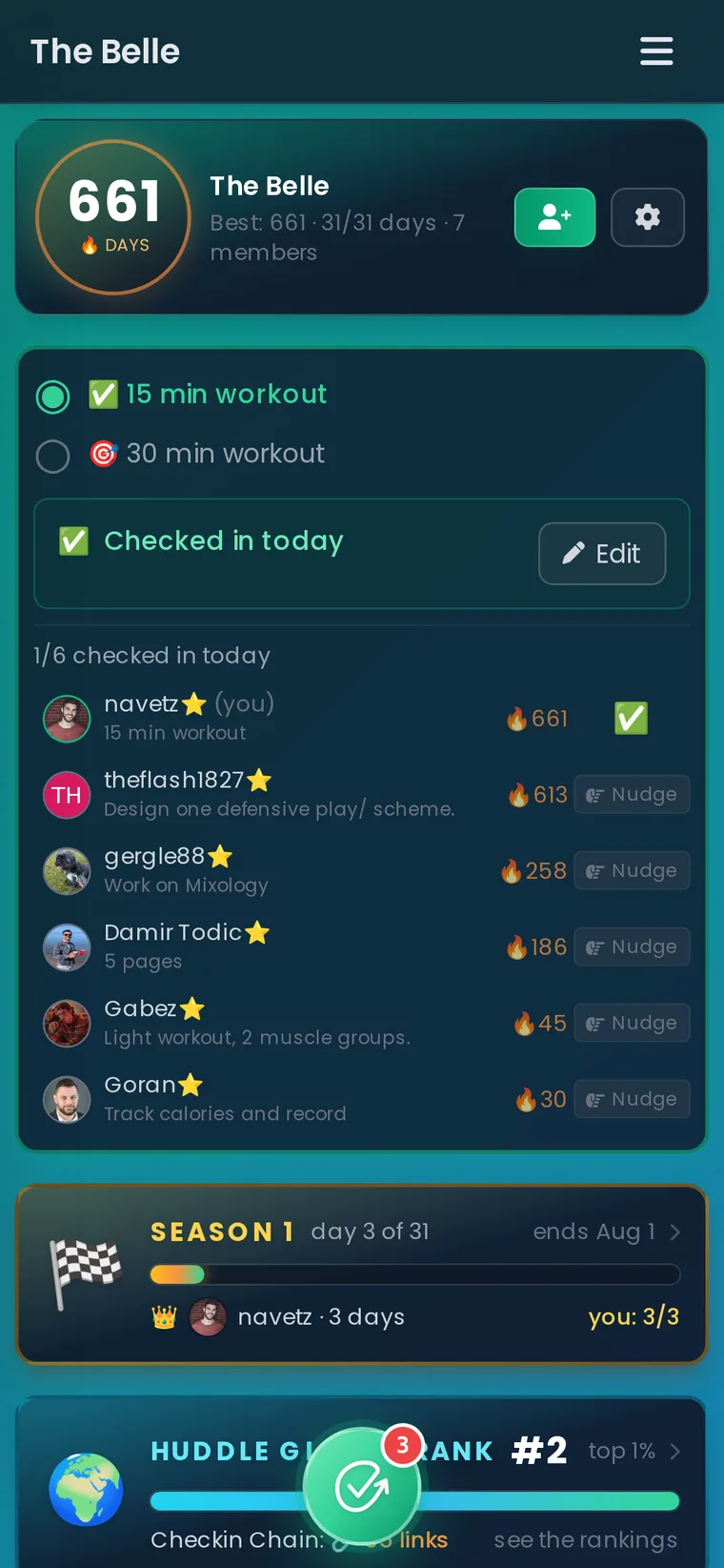
Every habit has a Floor, the smallest version that still counts on a bad day (say, two pages of reading), and a Ceiling, the version you aim to burst through on a good one. Each member's checkin adds one link to the huddle's Checkin Chain for that day, and your personal streak sits alongside it. Nobody gets a message when you skip a day: the huddle celebrates who showed up.
What the free plan covers: one active habit, daily checkins with notes and GIFs, replies and cheers, reminders, and a starter streak freeze on your second checkin day. Friends join your huddle by invite for free, with no cap on how many. It runs on the web, iPhone, Android and a Discord bot.
Trade-offs, honestly:
- No stakes at all. If losing money is the only thing that moves you, this will feel too soft. Pair it with a friend contract (option 5).
- No referee verdict. Friends see your checkins, but no one rules on them. It runs on trust.
- Some checkins are paid. Ceiling checkins (Flex Checkins), Photo Checkins and Night Owl Checkins are pro features. Members of a huddle sponsored by a Habit Huddle Champion subscriber get them free inside that huddle.
4. Focusmate: a person waiting for you
Focusmate pairs you with a real person for a timed video work session. You both say what you will work on, then work. The pressure comes from someone expecting you, not from money. Its pricing page lists a free plan of 3 sessions a week and Plus at $8 a month billed yearly, or $12 billed monthly.
Good for: work goals where starting is the hard part, like the thesis that sat in your stickK contract for months.
Trade-offs: it does not track a habit over weeks, and your partner is usually a stranger, not someone who knows your goal.
5. A contract with a friend: stickK's old friend option, by hand
If what you miss is the friend option, you can rebuild it in ten minutes. Write the goal, the schedule and the stake on one page, and have a friend sign it as your witness. Agree on what happens if you slip: you buy dinner, you donate to their cause, or you do their dishes for a week. Our free habit contract generator builds the page for you, and our guide to the habit contract covers which terms tend to hold up.
Good for: people who liked stickK's structure but want the stakes to stay between friends.
Trade-offs: no automatic charge, so it works only if your friend will actually collect. Keep the stake small enough that collecting it is easy and friendly.
Which matters more: the money or the people?
The research says money works while it is on, and people keep working after the money is gone. In a 2008 randomized trial at the Philadelphia VA published in JAMA, people who signed a deposit contract for weight loss lost a mean of 14.0 pounds over 16 weeks, against 3.9 pounds for the control group. Once the contract ended, the difference at seven months was no longer statistically significant.
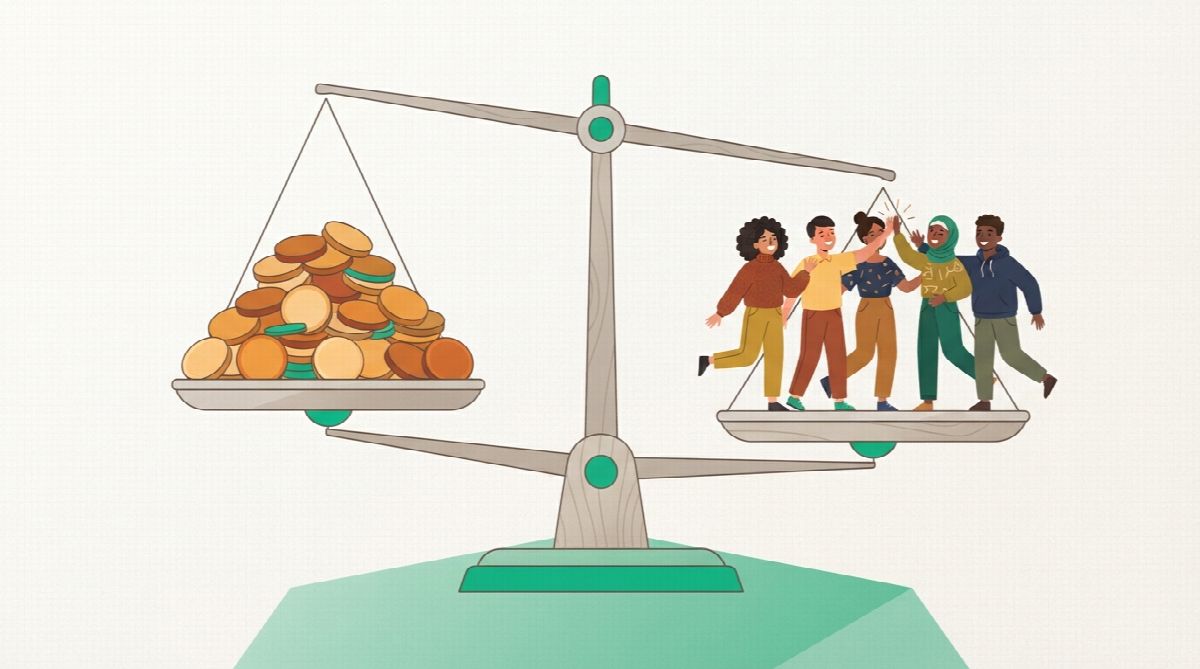
Friends show a longer tail. In a classic weight-loss study by Wing and Jeffery, 76% of people who joined alone completed the program, and 24% maintained their results in the months after. Among people who joined with three friends and got social support built in, 95% completed it and 66% maintained their results. We dig into more of that research in working out alone or with friends.
We see a similar pattern in our own data. We looked at 1,732 people who made their first Habit Huddle checkin between July 3 and September 25, 2026. The 303 whose first checkin got a cheer or a reply from another member averaged 6.7 checkin days out of their first 28. The 1,429 whose first checkin got none averaged 4.1. In week four, 25.1% of the cheered group still made at least one checkin, against 14.1%. (We left out cheers from our founder's own account.) This is a correlation, not proof: people who join with active friends get more cheers and may have stuck with it anyway.
The quotable version: a stake makes skipping expensive, but a friend makes showing up worth it. Plenty of people need both.
Which stickK alternative fits you
Pick by the part of stickK you want to keep, not by the feature list.
- You want money on the line and a number to track: Beeminder.
- You want money on the line and someone else to check your proof: Forfeit.
- You want friends showing up with you every day, no money: Habit Huddle.
- Your goal is focused work and starting is the problem: Focusmate.
- You want your stakes to go to a friend again: a written contract with a friend.
- You liked stickK and the 2024 terms do not bother you: stay. A free stickK contract with no money and a strict referee is still a solid tool.
For a wider look at the category, see our roundup of the best accountability apps, and our explainer on social accountability for why the people half works.
How to move a stickK commitment to something new
Finish or wind down your current contract before you start the replacement. A staked stickK contract cannot be cancelled without a medical excuse, so plan around its end date instead of abandoning it. A missed report counts as a Failure, and that triggers a charge.

- Shrink the goal to a daily Floor. "Lose 15 pounds by June" becomes "a 10 minute walk every day," which you can actually do on your worst day. Keep the big goal as your Ceiling.
- Pick your people before your app. Name the two or three friends you would want to see your progress. If you cannot name anyone, a money app like Beeminder or Forfeit is the safer pick.
- Decide whether money stays. If stakes helped you, keep a small one in a friend contract. If they stressed you out, drop them and see how two weeks go.
- Start on a fresh date. A Monday or the first of the month gives the new habit a clean beginning.
- Expect a slip and plan the comeback. In a 2021 megastudy of more than 60,000 gym members published in Nature, the most effective of 54 interventions was a small bonus for returning after a missed workout. A slip is normal. The comeback is the skill.
Start a free huddle with your friends
If the referee and supporters were the best part of stickK for you, try the version where they show up every day. Start a huddle, set your Floor and Ceiling, and invite the friends you would have named as supporters. It is free to start, and there is no contract to sign.
Ready to Build Habits With Friends?
Stop failing alone. Join thousands using the #1 habit tracker with friends for real accountability and lasting results.
Prefer mobile? App Store · Google Play
Related Guides
More Habit Huddle articles on building habits with accountability.

Is Sweatmates Free? 6 Free Sweatmates Alternatives (2026)
Sweatmates is free to download, but logging a workout needs a subscription. What it costs, what it does well, and six free alternatives for couples and friends.

HabitShare Alternatives: 6 Apps for Tracking Habits With Friends (2026)
Looking for a HabitShare alternative? Six social habit trackers compared by model, price, platforms, and what happens on a missed day, plus how to switch wit...
What to Do When You Miss a Workout Day: The 5-Step Comeback Plan
Missed a workout day? What one miss does to your body and habit, according to research, plus a five-step plan for the next 24 hours, when to make it up, and...