
The 8 Best Apps for Fitness Competition, Picked by How You Want to Compete
The best fitness competition apps compared by format: group leaderboards, duels, money stakes, and cooperative challenges, plus how to keep them fair.

📺 Related Video: How to Get Points on Apple Watch Competition (explained)
Video by: Foxtecc · Watch on YouTube
The best app for fitness competition depends on the format your group actually wants: a head-to-head duel, a group leaderboard, a ranked ladder, money on the line, or a cooperative goal where everyone can win. Pick the format first and the app choice gets easy. For most mixed groups of friends, GymRats (any workout counts, photo proof) or Stridekick (steps across any tracker) is the right starting point; Strava owns endurance competition, StepBet adds cash stakes, and Apple Watch owners already have a free one-on-one option built in.
This guide ranks eight apps by the kind of competition each one actually runs, then covers the part most lists skip: how to keep the contest fair when your group spans different fitness levels, and what to do when competition starts demotivating half the group.
First, pick your competition format
Every fitness competition app is built around one core format, and mismatching format to group is the main reason challenges die by week two.

| Format | How it feels | Best app for it |
|---|---|---|
| Group leaderboard | Everyone sees a ranked list, updated daily | GymRats, Stridekick |
| Head-to-head duel | You versus one rival, short window | Apple Watch competitions |
| Segment or ladder | Compete against everyone who ever tried | Strava, Hevy |
| Money stakes | Hit your goal or lose your buy-in | StepBet |
| Cooperative | The group wins together or not at all | Habit Huddle |
A leaderboard rewards your most competitive friends. A duel works when two people are evenly matched. Money stakes work when motivation is the problem, not fitness. And a cooperative format is the one that keeps beginners in the game past the first week, because nobody is stuck at the bottom of a ranking.
The 8 best fitness competition apps
1. GymRats: best all-around group competition
GymRats runs invite-only group challenges where every workout counts: you log a session with a photo and a title, and the feed doubles as proof and trash-talk material. Hosts can set custom scoring (workouts, duration, or checklist style), and it imports from Apple Health. It is free with in-app purchases and holds a 4.9 rating on the App Store across thousands of reviews.
The catch: it is iPhone-only, so a mixed iPhone-and-Android friend group needs a different pick.
2. Stridekick: best for mixed devices
Stridekick has run device-agnostic step competitions for years. Apple Watch, Fitbit, Garmin, and phone-only steps all land on one leaderboard, and it offers six challenge formats including streak and custom-activity modes. The free tier covers casual friend groups; paid plans target bigger orgs.
If your group's devices don't match, this is the safest choice. The limit is the metric: it is steps-first, so lifters and swimmers are underserved.
3. Strava: best for runners and cyclists
Strava is where endurance competition already lives. Segments rank you against everyone who has ever run or ridden the same stretch of road, monthly challenges give you medals to chase, and clubs host their own leaderboards. The core is free, with deeper leaderboard and analysis features in the paid subscription.
Strava's competition is open-world rather than private-group by default, which is either the appeal or the problem depending on whether your group wants strangers on the board.
4. Apple Watch Activity competitions: best free duel
If two of you both wear an Apple Watch, the built-in Activity competition is the lowest-friction option in this list: a 7-day duel scored on how much of your rings you close each day, up to 600 points per day. It is free, already installed, and surprisingly effective for a week.
The hard limits: exactly two people per competition, and both need a Watch. There is no group format.
5. StepBet: best if money motivates you
StepBet, from the WayBetter family, assigns you a personalized step goal from your history, then has you bet real money on hitting it. Finish the game and you split the pot with the other finishers; miss and your buy-in stays in the pot. Loss aversion does the motivating.
It works best for people who have tried and abandoned free challenges. The trade-offs are real: entry fees, step-based only, and the pressure cuts both ways.
6. Strive: best for rotating metrics
Strive runs free challenges from one to ten weeks that can score miles, exercise minutes, move calories, or weight-loss percentage, so a group can change the win condition between rounds instead of racing the same number all year. That variety keeps long-running groups from going stale, though it leans on Apple Watch data for the richer metrics.
7. Hevy: best for lifters
Strength does not fit step leaderboards, and Hevy is the app built around that fact. It is a free workout tracker for iOS and Android with a 4.9 rating across both stores, and its social layer lets you follow friends, compare logged workouts, and track personal records. Competition here is implicit (who is showing up, whose lifts are moving) rather than a formal ranked ladder, which suits most gym friend groups better than a scoreboard would.
You already know you can change.
You just need to take the first step. Habit Huddle helps you build habits around your goals, alongside friends who keep you accountable.
8. Habit Huddle: best when the group should win together
Full disclosure: Habit Huddle is our app, so judge the reasoning rather than the ranking. It belongs on this list as the cooperative option, because some groups are motivated by rankings and some are quietly destroyed by them.
In Habit Huddle, your group tracks a shared challenge as a huddle. Each day, every member who logs a checkin adds a link to the group's Checkin Chain, so the score measures collective showing up rather than who beat whom. Missed days are invisible to other members by design; what your group sees is checkins to cheer, never a list of who fell behind. Everyone sets their own Floor (the bare-minimum version of the habit) and Ceiling (the burst-through-it version), which is how a beginner and an athlete compete in the same huddle without the beginner getting buried.
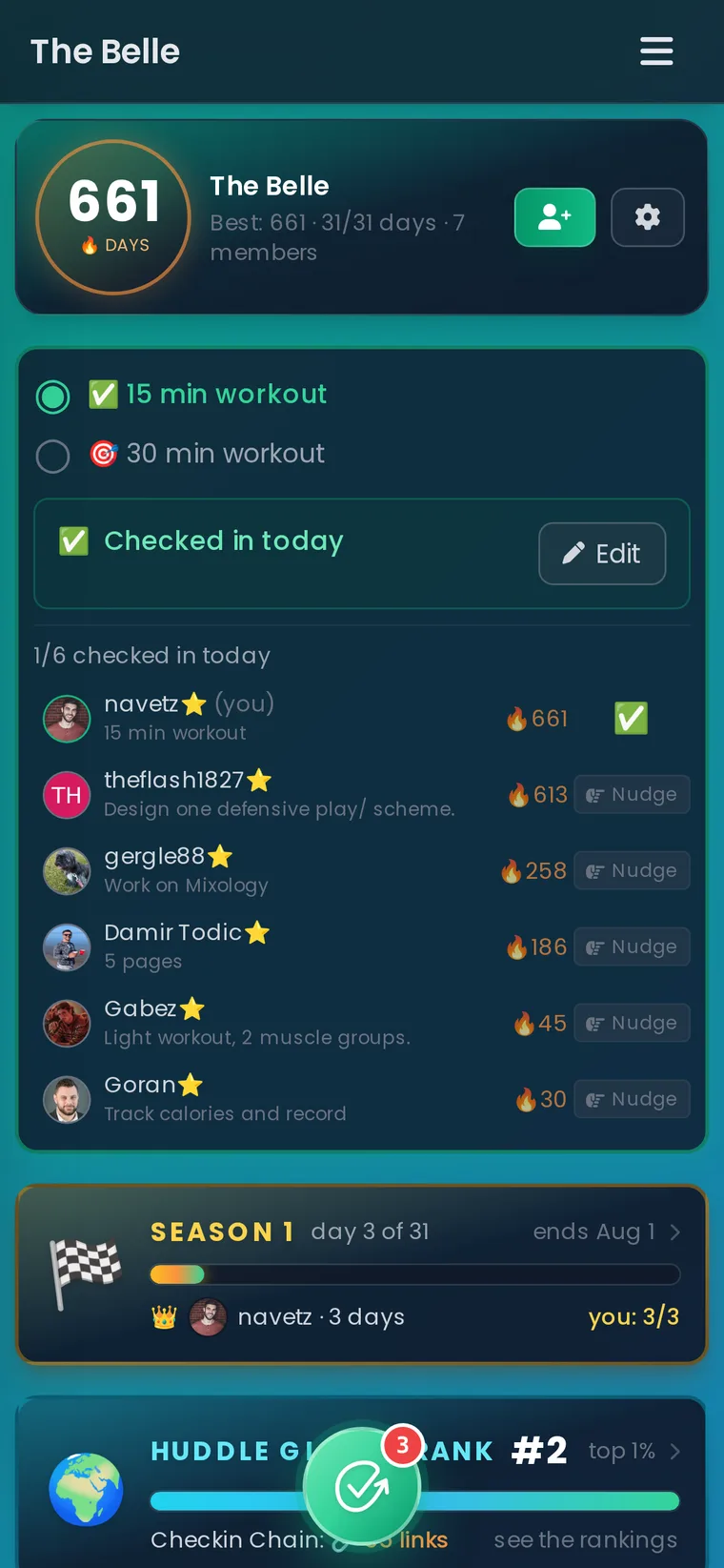
The honest trade-offs: checkins are manual (there is no step counting or wearable sync), and there is no leaderboard at all, so if your group genuinely wants a ranking, pair it with one of the apps above instead. It is free to start on web and Discord at habithuddle.com/app.
Comparison table
| App | Platforms | Price | Format | Metric |
|---|---|---|---|---|
| GymRats | iOS | Free + IAP | Group challenge | Any workout, photo proof |
| Stridekick | iOS, Android, web | Free tier | Group leaderboard | Steps, 6 formats |
| Strava | iOS, Android | Free + paid | Segments, clubs, challenges | Runs, rides, more |
| Apple Watch | Apple Watch | Free | 1v1 duel, 7 days | Activity rings |
| StepBet | iOS, Android | Buy-in per game | Money pot | Steps |
| Strive | iOS, Android, web | Free | Group challenge, 1-10 weeks | Miles, minutes, calories, weight % |
| Hevy | iOS, Android, web | Free tier | Friend feed, PRs | Strength workouts |
| Habit Huddle | Web, Discord | Free to start | Cooperative Checkin Chain | Daily checkins |
Does competition actually work? What the research says
Competition is one of the best-tested motivators in fitness research. In the STEP UP randomized trial of 602 adults, the group assigned to competitive gamification increased their daily steps by roughly 920 more than controls during the intervention, the strongest result of the three social variants tested (JAMA Internal Medicine, 2019).
But the same literature carries a warning. A 2024 study of social features in fitness apps found that social comparison and social support work through different pathways, and that comparison can backfire for users who keep landing at the bottom (PMC11363243). A leaderboard that thrills the top three can quietly convince everyone below fifth place to stop opening the app.
How to keep a fitness competition fair

Raw totals reward whoever was already fittest. Four fixes that keep mixed-level groups competitive:
- Score percentage of personal goal, not raw output. A beginner hitting 105% of their target beats an athlete coasting at 80%. StepBet builds this in with personalized goals; in other apps, set it as a house rule.
- Rotate the metric. Steps this month, logged workouts next month, minutes after that. Strive's format variety exists for exactly this.
- Shorten the window. A 7-day duel resets before a gap becomes unrecoverable. A 90-day leaderboard punishes one bad week forever.
- Count showing up, not performance. Score a point per day each person does anything. This is the cooperative model, and it is the only scoring system where the least fit member of the group can top the table.
If you are designing a challenge rather than just picking an app, our guides to group fitness challenge apps and group fitness challenge ideas go deeper on formats, and the team fitness challenge app guide covers workplace-sized versions.
When to choose cooperation over competition
Watch for the week-two signals: the bottom half of the leaderboard stops logging, someone jokes about the challenge being rigged, or your least fit friend goes quiet. That is not a motivation problem; it is a format problem.
The fix is to make the group the team instead of the opponent. A shared goal (every member moves every day this week) keeps the social pull of a challenge while removing the ranking that was pushing people out. That is the model Habit Huddle is built on, and it also works as a house rule inside any of the apps above. Competitive groups can even alternate: one month of leaderboard, one month of cooperative chain, and you will learn quickly which one your group actually shows up for.
FAQ
What is the best free fitness competition app?
For a group on mixed devices, Stridekick's free tier is the strongest pure competition option. If everyone is on iPhone, GymRats is free with in-app purchases and counts every kind of workout. Two Apple Watch owners can use built-in Activity competitions at no cost, and Habit Huddle is free to start for cooperative group challenges.
Which app lets you compete with friends on different devices?
Stridekick is built for exactly that: Apple Watch, Fitbit, Garmin, and phone-step users all share one leaderboard. Strive also supports mixed groups across web, iOS, and Android. Apple's built-in competitions are the most restrictive, requiring an Apple Watch on both sides.
Are fitness competitions with money worth it?
They work best for people who ignore free challenges. In StepBet you bet a buy-in on hitting a personalized step goal, and finishers split the pot. The evidence on loss aversion as a motivator is solid, but the format punishes bad weeks, so avoid it if travel or shift work makes your activity unpredictable.
What if a fitness competition demotivates someone in the group?
That usually means the format ranks people with unequal starting points on a raw metric. Switch scoring to percentage of a personal goal, shorten the competition window, or move to a cooperative format where the group scores by everyone showing up. Research on fitness app social features shows comparison motivates some users and deflates others, so the format has to fit the group.
Ready to Build Habits With Friends?
Stop failing alone. Join thousands using the #1 habit tracker with friends for real accountability and lasting results.
Prefer mobile? App Store · Google Play
Related Guides
More Habit Huddle articles on building habits with accountability.

HabitShare Alternatives: 6 Apps for Tracking Habits With Friends (2026)
Looking for a HabitShare alternative? Six social habit trackers compared by model, price, platforms, and what happens on a missed day, plus how to switch wit...

What to Do When You Miss a Workout Day: The 5-Step Comeback Plan
Missed a workout day? What one miss does to your body and habit, according to research, plus a five-step plan for the next 24 hours, when to make it up, and...

Habit Streak App With Friends: 7 Apps Compared (2026)
Seven habit streak apps with friends compared: Habit Huddle, HabitShare, Daily Pact, Habitica, Streaks, Habit Streak duels, HabitStreak.io. What friends see,...