
Accountability Apps for Students: 7 Compared for a Whole Semester
7 accountability apps for students compared: which fix starting, which fix your phone, and which keep a study habit going all semester. Free picks included.
 By Stevan Ljuljdurovic, founder of Habit Huddle
Updated October 30, 2026

📺 Related Video: Study skills: one-minute tips - The benefits of an accountability partner for neurodivergent people
Video by: OpenLearn from The Open University · Watch on YouTube
The best accountability app for a student depends on which part of studying keeps breaking. If you can't start, Focusmate pairs you with another person on video and gives you three free sessions a week. If you start but your phone wins, Forest or Flora grow a tree that dies when you leave the app. If the problem is keeping a study habit alive for a whole semester, you need people in it with you: a study community like Study Together, a Habitica party, or a social habit tracker like Habit Huddle (our app) with classmates you already know.
Most lists treat these as one category. They are not. A focus timer holds you to one hour. A habit app with friends holds you to fifteen weeks. This guide compares seven apps on that difference, with ratings and prices checked on October 30, 2026, and then shows how to set up study accountability with classmates that lasts past midterms.
Three kinds of "accountability app" (only two are for studying)
Search for an accountability app and you get three different products under one name.
- Session tools hold you to the next 25 to 90 minutes. Focusmate, Forest and Flora live here. They fix starting, and they fix the phone.
- Habit tools hold you to a routine across weeks. Habitica, Finch and Habit Huddle live here. They fix the drift that sets in around week four.
- Device monitoring apps such as Accountable2You report your screen activity to a partner you choose. They are built for internet filtering, not coursework. If that is what you need, our guide to free internet accountability apps covers them.
Many students end up using one of each: a session tool for tonight and a habit tool for the term. Neither replaces the other.
Why a semester breaks most accountability apps
A semester is a long, uneven stretch, and most apps are built for one even day at a time. Week one is full of good intentions. Weeks four to six are quiet, with no deadline close enough to feel. Midterms spike. Then reading week, a trip home, and finals squeeze everything into a few days.
Three things make that shape hard:
- Deadlines are far apart. An essay due in three weeks creates no pressure today, and a solo tracker does nothing to change that.
- Nobody expects anything between classes. Between one seminar and the next, the only person waiting for your study session is you.
- The app has to be opened. On the day you are avoiding work, opening the accountability app is part of what you are avoiding.
Habit research explains why the first weeks matter so much. In a University College London study led by Phillippa Lally, 96 people repeated a new daily behavior, and it took a median of 66 days to feel automatic, with a range from 18 to 254 days. A typical 15-week semester is about 105 days.
Start a study habit in week one and the semester is just long enough to make it automatic. Start it in week six and finals arrive first.

7 accountability apps for students compared
| App | What holds you accountable | Who is in it with you | Free version | Platforms | Best for |
|---|---|---|---|---|---|
| Focusmate | A booked video session with a partner | One stranger per session | 3 sessions a week; unlimited is $8/mo billed yearly or $12 monthly | Web | Starting a hard task today |
| Study Together | Live study rooms, timers and leaderboards | A large global student community | Free account | Discord, its own app | Studying beside others at any hour |
| Forest | A tree that withers if you leave the app | Friends you co-plant with | Free download, paid extras | iOS, Android | Staying off your phone |
| Flora | A shared tree that dies if anyone leaves | Friends in the same session | Free download, optional real-tree planting | iOS, Android | Phone-free sessions with friends |
| Habitica | An RPG where finished tasks earn XP | A party of friends | Free; optional $4.99/mo subscription | Web, iOS, Android | Students who like games |
| Finch | A pet that grows as you finish self-care goals | Mostly you | Free download, paid tier | iOS, Android | Gentle routines on low-energy days |
| Habit Huddle | A daily checkin your huddle sees and cheers | Classmates you invite | One habit free, unlimited friends | Web, iOS, Android, Discord | A study habit that lasts the term |
Ratings below come from each app's US App Store listing on October 30, 2026. Prices change, so check the store before you pay.
Focusmate
Focusmate is the strongest free pick for students who cannot start. You book a 25, 50 or 75-minute session, get paired with another person on video, say what you will work on, and work with your cameras on. The partner's presence does most of the work, which is why Focusmate shows up on lists of body doubling apps, ours included.
Its pricing page lists three free sessions a week with no card, and unlimited sessions for $8 a month billed yearly or $12 billed monthly. It runs in the browser, which suits a laptop at a library desk.
Trade-off: a session covers the hour you booked. Nothing in Focusmate follows your study habit across the week, and the partner is a stranger, which some students find intense.
Study Together
Study Together is a free study community that says it has more than one million members in 215 countries. It runs group study rooms on Discord and in its own app, with timers, session goals, study stats and community leaderboards. Someone is studying at every hour, which helps at 2 a.m. before an exam.
Trade-off: it is a crowd. The people in the room don't know you, and the chat can become the distraction. If your class already has a Discord server, our guide to building a study accountability Discord server shows how to get the same effect with people you know.
Forest
Forest is the best-known focus timer: 4.8 stars from about 49,600 ratings. You plant a tree, it grows while you stay off your phone, and it withers if you leave early. You can co-plant with friends during a shared session, and the developer plants real trees through a partnership with Trees for the Future.
Trade-off: it guards one session at a time. Forest keeps you off your phone for 50 minutes, but it has nothing to say about the study habit across the week.
Flora
Flora works like Forest with a stronger group mechanic: 4.8 stars from about 82,900 ratings. Friends plant a tree together, and if anyone picks up their phone, the tree dies for everyone. When the whole group stays off their phones, each person wins an extra tree. The app is free, with an opt-in way to pay for real tree planting.
Trade-off: the shared stake is phone use during one session, not the habit across the term. It works best when everyone studies at the same time.
You already know you can change.
You just need to take the first step. Habit Huddle helps you build habits around your goals, alongside friends who keep you accountable.
Habitica
Habitica turns tasks into a role-playing game. Homework becomes to-dos, study routines become dailies, and finishing them earns XP and gold for your avatar. Parties let you team up with friends and fight bosses by completing tasks. The app is free, and the optional subscription is $4.99 a month. It has 4.3 stars from about 3,600 ratings.
Trade-off: it is complex, and the party works only while your friends keep playing. Some students spend more time on the avatar than the essay. Our Habitica alternatives guide compares simpler options.
Finch
Finch is the gentle option: 4.9 stars from about 769,000 ratings. You care for a small pet by completing self-care goals, and it grows as you do. For students whose problem is low energy more than discipline, a kind pet often works better than a strict counter.
Trade-off: Finch is built for self-care, not study groups. It is mostly a solo app, so it adds warmth but not classmates.
Habit Huddle
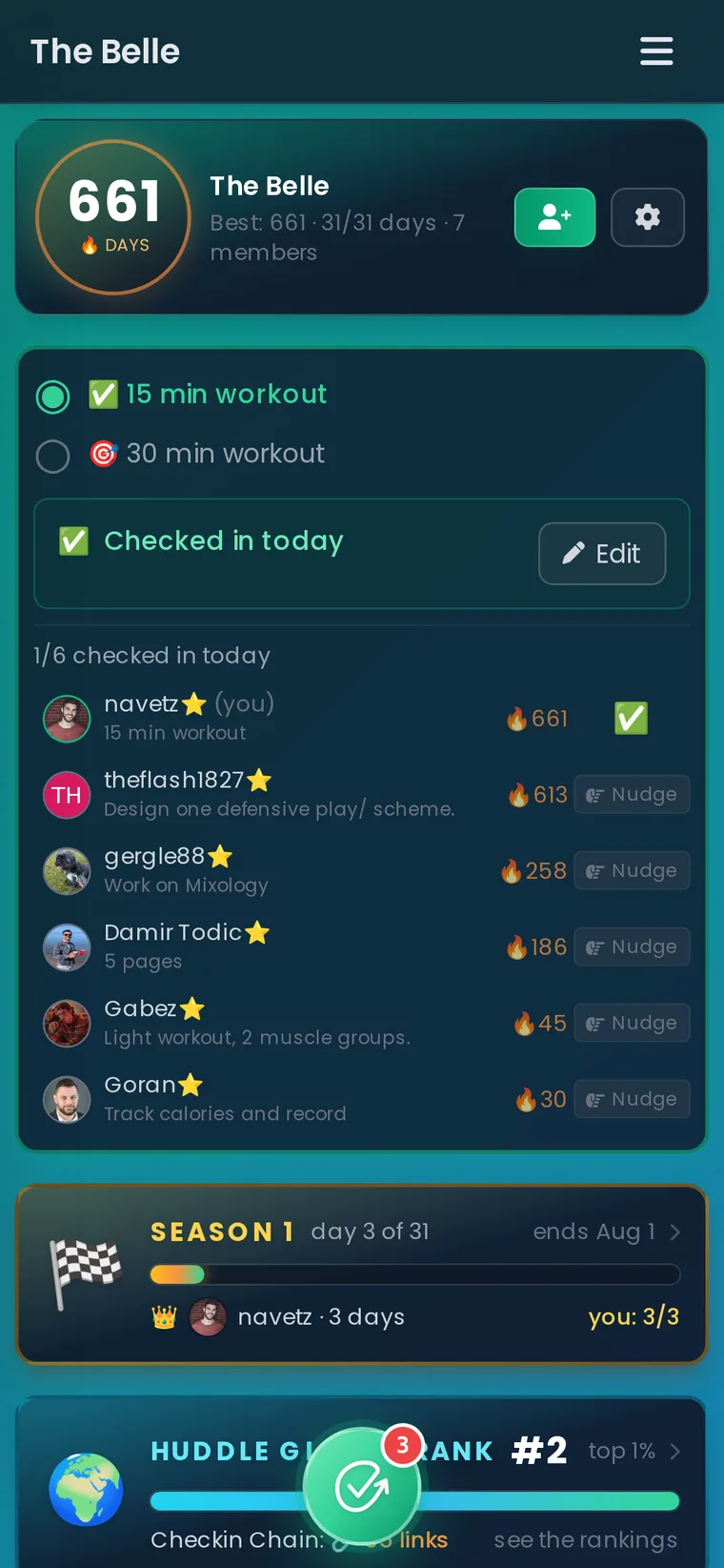
This is our app, so judge the reasoning, not the placement. Habit Huddle is a social habit tracker. You make your study routine a daily habit, invite a few classmates into a huddle, and post one checkin a day when it's done. Everyone in the huddle sees each checkin and can cheer it or reply. Each day, every member who shows up adds a link to the huddle's Checkin Chain. A day without a checkin is never announced to anyone.
Every habit has a Floor: the smallest version that still counts on your worst day, such as "open my notes for 10 minutes". During exam week, stepping on the Floor keeps the habit alive without demanding a two-hour block. Flex Checkins, a pro feature, add a Ceiling for the days you burst through and study far longer.
Classmates can post from the web app, iOS, Android, or with the /checkin command in a connected Discord server, so a class server can run the huddle where everyone already talks.
Trade-offs:
- It has no focus timer. Pair it with Focusmate or Forest for the session itself.
- The free plan covers one active habit. Starting a huddle is free, and joining a classmate's huddle by invite is free. Vacation Mode for a trip home and Night Owl Checkins, which let a checkin after midnight count for the day before, are pro features.
- Checkins are public. An exclusive huddle controls who can join, but anyone can view it. Use a nickname as your display name if you prefer.
Classmates or strangers?
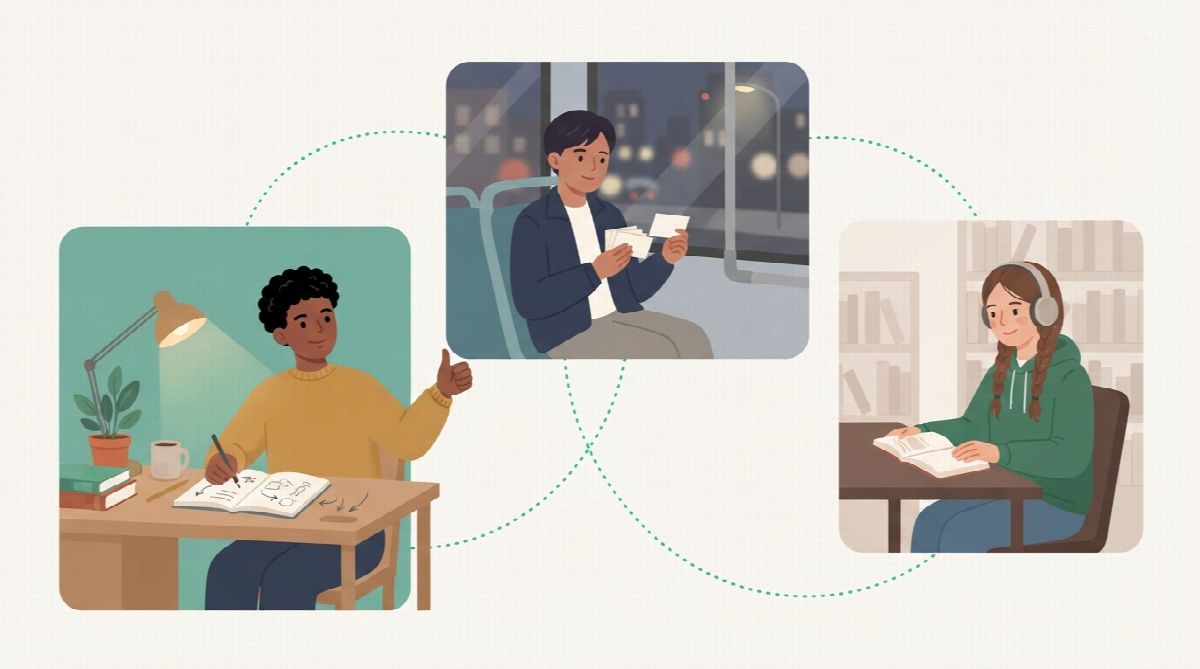
The people in your accountability app matter more than its features. Strangers are good for a session, because a stranger on video only has to be there for an hour. People you know are better for a term, because the habit needs someone who will still be around in week ten.
Research on goals points the same way. At Dominican University of California, psychologist Gail Matthews randomly assigned 149 adults to five groups for four weeks. The group that wrote down goals, made action commitments, and sent weekly progress reports to a supportive friend accomplished significantly more than the group that only thought about their goals.
Our own numbers show the same pattern. Across 3,216 habits with at least one checkin on Habit Huddle between July 3 and October 28, 2026, 11.5% of habits tracked in a huddle with at least one other current member reached 30 checkin days. For habits tracked alone, the share was 2.1%. Part of that gap is selection, since people who invite others may already be more committed, and the numbers cover every kind of habit, not only studying. The direction still matches the research.
An app can remind you to study. People make showing up feel like it counts.

The best study groups cheer each checkin and leave the quiet days alone. Guilt makes people quit groups. Applause on a Tuesday night makes them come back on Wednesday.
How to set up study accountability with classmates
Study accountability with classmates works best as one small daily habit, a few people, and a plan for the hard weeks agreed in advance.
- Pick one study habit, not a whole schedule. "Ace the organic chemistry final" is a goal. "Review today's lecture notes" is a habit you can do every day.
- Set a Floor you can still do in exam week. Ten minutes of flashcards counts. A low Floor keeps the habit alive when three deadlines land at once.
- Invite two to five classmates. People in the same course share your deadlines. Friends in other courses work too, because the shared habit is showing up.
- Post where you already talk. If your class already has a Discord server or Telegram group, connect the huddle there so checkins post in that channel.
- Agree on breaks in week one. Decide what happens during reading week and the trip home before anyone needs the answer.
- Pair it with a session tool. Use Focusmate or Forest for the hour itself, and the huddle for the habit across the week.
If a week falls apart anyway, the next step is small: post tomorrow's checkin. The habit was never one perfect week. It is the next ordinary day.
Is a free accountability app enough for students?
A free accountability app is enough for most students. Focusmate gives three sessions a week. Study Together is free to join. Forest, Flora, Habitica and Finch are free to download, with optional paid extras. Habit Huddle is free for one habit with unlimited friends.
Pay only when a specific feature solves a specific problem: unlimited Focusmate sessions in a thesis semester, or Vacation Mode on Habit Huddle if you go home for two weeks and want your streak to wait for you. Give any free version two weeks first. That is long enough to see whether you keep opening it.
Start a study huddle this week
If a session tool covers tonight but not the semester, add the people. Start a huddle on Habit Huddle, make your study routine the habit, and send the invite link to two classmates. Starting a huddle is free, joining by invite is free, and a quiet day is never announced. For the wider category beyond students, see our best accountability apps comparison.
Ready to Build Habits With Friends?
Stop failing alone. Join thousands using the #1 habit tracker with friends for real accountability and lasting results.
Prefer mobile? App Store · Google Play
Related Guides
More Habit Huddle articles on building habits with accountability.

Sober Streak Tracker: 7 Apps Compared by What Happens After a Slip
Compare 7 sober streak trackers by what happens to your count after a slip and who sees your days. Free picks, prices, and how to track sobriety with friends.

How to Work Out When You Don't Feel Like It: 7 Fixes That Work
Don't feel like working out? Name which kind of unmotivated you are, shrink the workout to your Floor, and use these 7 research-backed fixes. Plus when to rest.

5 stickK Alternatives for 2026 (and What stickK Changed)
stickK changed its terms in 2024: no more friend or charity stakes, and it keeps half of anti-charity money. Five alternatives, for the money or the people.