
Workout Accountability App: 7 Best Picks for Friends, Pairs, and Stakes (2026)
The best workout accountability apps for friends, gyms and pairs, all with free tiers, ranked by the pressure that actually gets you moving, plus a one-week...
📺 Related Video: Can An Accountability Partner Boost Workout Consistency?
Video by: High Energy Training Hub · Watch on YouTube
Most workout apps are built on a quiet lie: that what you need is better tracking. More charts, more metrics, more history. But almost nobody quits the gym because their data was thin. People quit because on a rainy Tuesday in week three, showing up earns them nothing. No text, no cheer, no one waiting at the other end. A workout accountability app with friends changes that one variable: your workout happens in front of people who care that it happened.
The best workout accountability app depends on the kind of pressure that actually moves you: Habit Huddle for small-group daily checkins, GymRats for time-boxed challenges, Fitness Pact for stakes and forfeits, Sweatmates for two-person wagers, Stridekick for mixed-device step challenges, Strava for a public audience, and Hevy for lifters who love logging. Every one of them has a free tier, and the same shortlist covers gym, home-workout and exercise accountability, because the problem is identical in all three: showing up. This guide compares the apps by the pressure each one applies, because that is the real buying decision. It also covers what the research actually supports, how to set up a system with your friends that survives past January, and the mistakes that quietly kill most accountability groups.
Table of Contents
- What the research says about training with friends
- The four kinds of workout accountability
- The best workout accountability apps with friends
- Quick comparison table
- One app or two? Community support plus workout logging
- How to set up workout accountability with friends
- Five mistakes that kill accountability groups
- Start your huddle
What the research says about training with friends
Committing to exercise alongside people you know is one of the best-supported consistency tools in the sports science literature. Four findings hold up well under scrutiny:
Committing with someone you know improves long-term adherence. A twelve-month study of adults who joined a fitness program with a spouse versus without one found markedly better attendance and far fewer dropouts in the joined-together group. The mechanism is not romance; it is that quitting means walking back a promise you made out loud to a specific person.
The right partner increases how much you exercise. A University of Aberdeen study found that simply gaining a new exercise companion increased exercise frequency, and the effect got stronger when that companion offered emotional support and encouragement, not just a shared calendar slot. The support quality mattered more than the logistics.
Team-based games work even inside families. The BE FIT randomized clinical trial (Patel et al., JAMA Internal Medicine, 2017) enrolled 200 adults across 94 families and had family teams earn points together for hitting step goals. The gamification arm hit their step goals on 53% of days versus 32% for controls, and gained roughly 1,000 more daily steps over baseline than the control group did. The design leaned on collaboration and peer support inside a small team, which is exactly the mechanism a good accountability app tries to package.
Groups push intensity upward. Research on group dynamics in exercise, including studies with virtual partners, shows people work harder and longer when someone else is present than they do alone. Exercise scientists call this the Köhler effect: paired with a slightly stronger partner, people persist longer than they would on their own.
One honest caveat before the app list. Many of the accountability statistics floating around fitness blogs (the famous "95% more likely to succeed if you have an accountability partner" line, for example) are recycled endlessly without a traceable primary source. If a number sounds suspiciously round and motivational, it probably started life on a slide, not in a journal. The robust core is simpler and better news anyway: visible commitment to real people, plus encouragement, reliably beats willpower alone. That is the mechanism every app below tries to bottle. The differences are in how they apply the pressure.
The four kinds of workout accountability
Before comparing apps, decide which pressure actually moves you. There are four basic flavors:
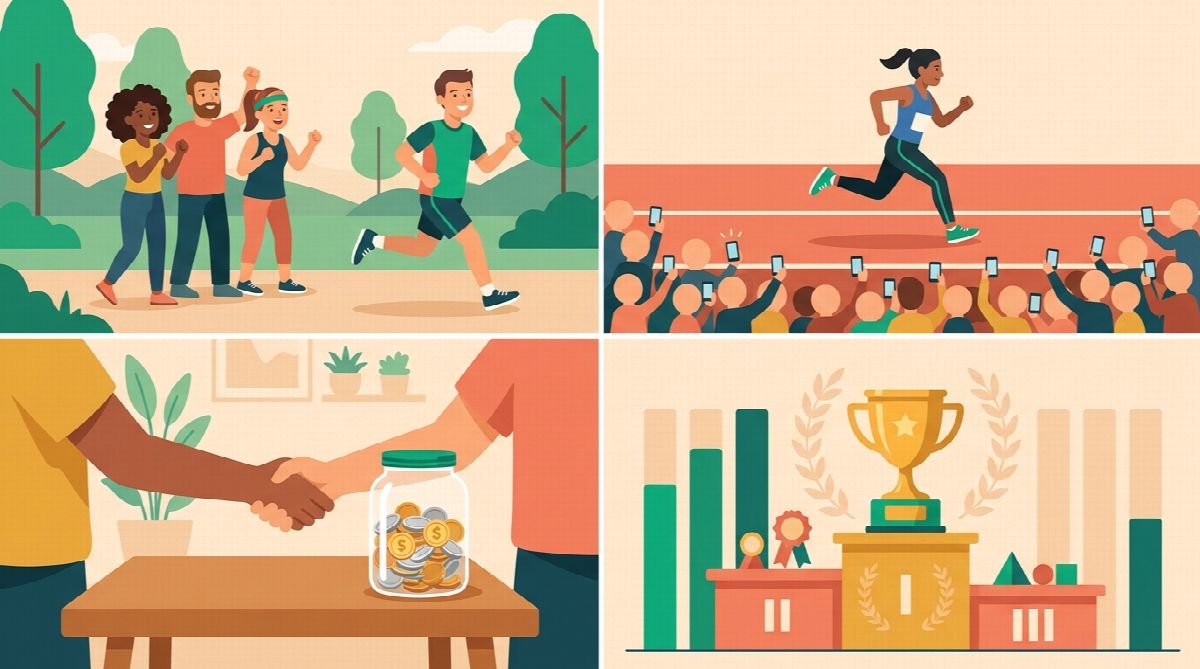
- Small-group visibility. A handful of people you know see your workout the moment you log it, and cheer it. Low drama, high consistency. Works because showing up in front of those specific people feels better than showing up alone.
- Public performance. Feeds and leaderboards where a wide audience sees your training. Motivating if you like being seen, exhausting if you feel judged by every off day.
- Stakes. Money or forfeits on the line when you miss. Sharp, effective, and slightly adversarial. Some friendships thrive on it; some strain.
- Competition and data. Points, rankings, and challenge scoreboards. Excellent for a month-long push, weaker for year-round routine building, because challenges end and routines should not.
A fifth kind, presence during the workout itself, is what live coworking and body doubling apps sell. It is a different product category, but it pairs well with any of the four above.
Most people know immediately which of these describes them. If you are the person who went to a 6 a.m. class only because a friend was saving you a spot, you are type one. If you have ever run further because strangers on the internet would see the map, you are type two. Match the app to your psychology, not to its feature list.
The best workout accountability apps with friends
1. Habit Huddle: small-group visibility and a Checkin Chain
Full disclosure: this is our app, so judge the reasoning, not the ranking. Habit Huddle is built around one idea: a small group (a huddle) commits to a habit, and everyone checks in daily. Your friends see your checkin and cheer it, you see theirs, and together you build the huddle's Checkin Chain. Every checkin adds a link, so three friends showing up today forge three links. The chain is the group's shared scoreboard, measured in links, and the rally cry is simple: add your link today.
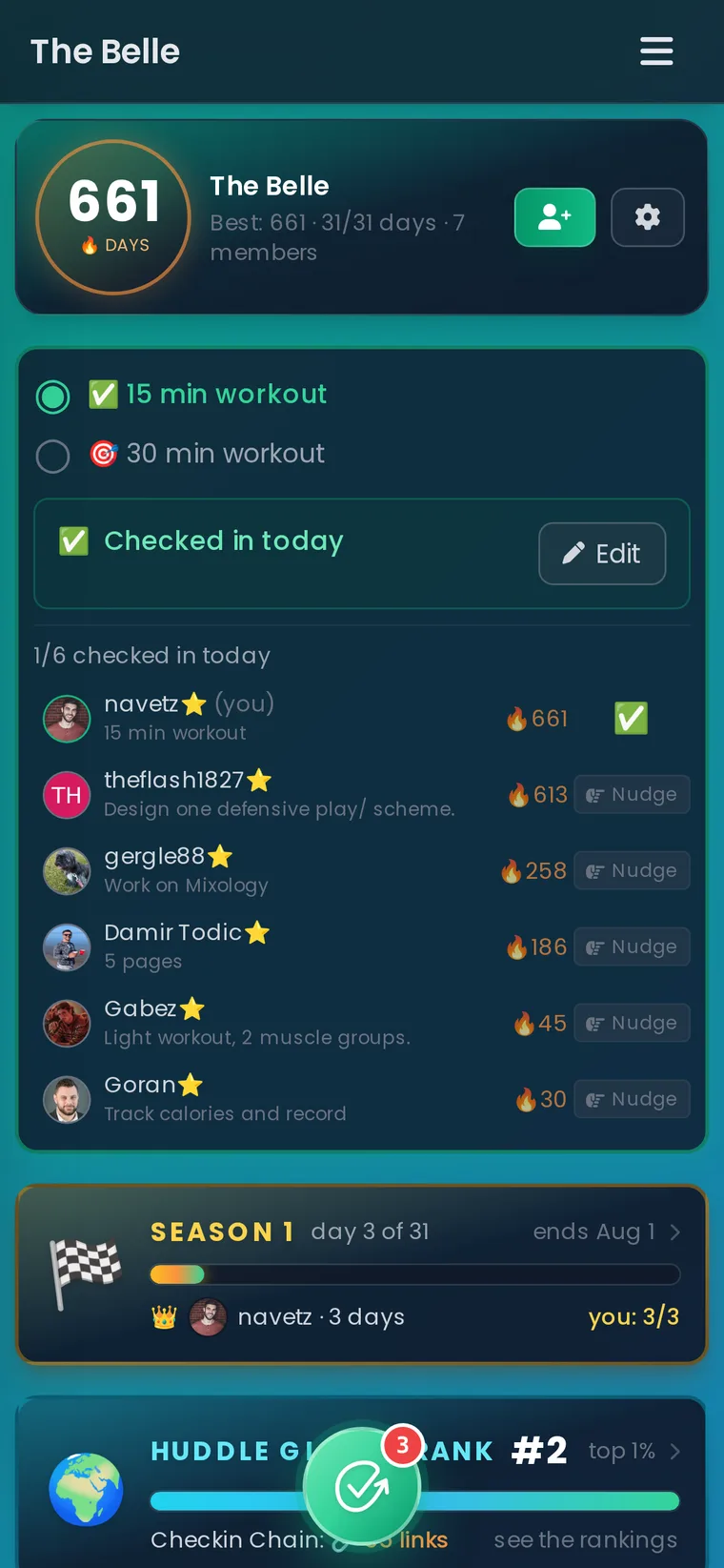
The design choice that matters most for workouts is the Floor and the Ceiling. Each habit has two levels: the Floor is the version you can do on your worst day (15 minutes of movement), and the Ceiling is the full session. On low-energy days you step on the Floor and the chain survives; on good days you burst through the Ceiling. That structure attacks the most common failure pattern in fitness, the all-or-nothing spiral, where one missed "perfect" workout becomes three missed workouts and then a dead routine.
Checkins take one tap and live where your group already talks: iOS, Android, web, or a Discord bot for groups that live in a server. The social layer is warm rather than competitive, applause and replies instead of rankings.
Honest trade-offs: each huddle tracks one behavior rather than being a multi-metric fitness command center, there is no GPS tracking or set-by-set workout logging, and it only works as well as your group participates. If you want deep training analytics, pair it with a logger like Hevy below. The free plan covers one habit you actively track, and huddles of two work as well as huddles of ten.
Best for: friend groups, families, and small communities who want daily consistency on one shared behavior, with the lowest possible friction.
2. GymRats: group challenges and friendly competition
GymRats turns a friend group into a challenge league. Someone creates a challenge, sets the scoring (workout count, minutes, miles, calories, or a custom point system), and everyone posts workouts to the group feed for the duration. Photos are first-class citizens, so the feed reads like a sweatier, members-only Instagram.
It is excellent for a defined push: a New Year sprint, a summer shred, an office competition. The scoring flexibility means a runner, a lifter, and a yoga person can compete fairly in the same challenge, which most competition apps get wrong.
The trade-off is the shape of the motivation. Challenges end, and the week after a challenge ends is exactly when routines die. If your problem is October consistency rather than January enthusiasm, competition alone tends to fade. Many groups run GymRats for the sprint and something steadier for the year.
Best for: groups who light up for a scoreboard and a finish line.
3. Fitness Pact: put stakes on it
Fitness Pact is for groups whose love language is consequences. You and your friends agree on commitments, and missing comes with a forfeit the group chooses, anything from public embarrassment in the group chat to buying the next round. The app leans fun-first, and it deliberately works without everyone doing the same workouts, meeting in person, or living in the same city.
Commitment devices have real evidence behind them; the general principle of pre-committing to a penalty is one of behavioral economics' most reliable tools. The catch is social: stakes sharpen some friendships and strain others, and a forfeit that feels funny in week one can feel punitive in week six. Know your group before you put money or pride on the table.
Best for: competitive friend groups who follow through when something is on the line.
4. Sweatmates: accountability for two
Sweatmates narrows the model to exactly two people: couples, best friends, siblings. You each set weekly goals, and if you miss yours, you owe a wager the two of you agreed on: dinner, a chore, whatever keeps it playful. It deliberately skips stats and metrics in favor of the only question that matters: did you both show up this week?
The two-person design is a real advantage and a real limitation. One reliable partner is the strongest accountability there is; one unreliable partner is a single point of failure with no group to absorb it.
Best for: pairs who want showing up together to be the whole product.
You already know you can change.
You just need to take the first step. Habit Huddle helps you build habits around your goals, alongside friends who keep you accountable.
5. Stridekick: step challenges across any device
Stridekick solves the most boring, most fatal problem of group challenges: everyone owns a different tracker. It syncs most major wearables and phones, so a mixed group of Fitbit, Apple Watch, and Garmin people can compete in the same step challenge without anyone switching ecosystems. Challenge templates and admin tools keep the setup burden low.
It is built for movement, not training: steps and active minutes rather than structured programs. That makes it the right tool for exactly the audiences it targets, workplaces, families, and walking groups, and the wrong tool for a powerlifting crew.
Best for: offices, families, and mixed-device groups who want everyone in the same game.
6. Strava: public accountability for endurance athletes
Strava is the public square. Runs and rides post to a feed, clubs rank participation, segments turn your local hill into a permanent leaderboard, and the knowledge that your training is visible keeps a lot of endurance athletes honest. As a motivation engine for runners and cyclists, nothing else has its gravity.
The trade-off is the flip side of the same coin: public performance can drift into performance theater, where you train for the feed instead of the plan, and rest days start to feel like reputational damage. If a wide audience energizes you, Strava is the pick. If it makes you feel watched, a smaller room works better; we dug into that psychology in our guide to the best fitness accountability apps.
Best for: runners and cyclists motivated by a broad, active audience.
7. Hevy: a lifter's log with a social layer
Hevy is first a serious workout tracker for strength training: routines, supersets, rest timers, progression charts. The social layer sits on top: friends see your logged sessions in a clean feed and can react. The accountability is gentler, more "training diary your friends read" than "group waiting for your next checkin."
That gentleness is fine if logging itself keeps you honest, and many lifters are exactly that person. If not, Hevy pairs naturally with a dedicated accountability app: one tracks the sets, the other makes showing up to do them feel great.
Best for: lifters who want excellent logging with a social bonus, not social pressure.
Quick comparison table
| App | Accountability type | Group size | Free option | Strongest use |
|---|---|---|---|---|
| Habit Huddle | Small-group visibility, Checkin Chain | 2 to small groups | Yes | Daily consistency with friends |
| GymRats | Competition, challenges | Any | Yes | Time-boxed group challenges |
| Fitness Pact | Stakes and forfeits | Small groups | Yes | Groups motivated by consequences |
| Sweatmates | Two-person wagers | Exactly 2 | Yes | Couples and workout pairs |
| Stridekick | Step competition | Any | Yes | Mixed-device step challenges |
| Strava | Public feed, segments | Unlimited | Yes | Endurance athletes |
| Hevy | Social training log | Any | Yes | Lifters who love logging |
Every app here has a workable free tier, so the honest advice is to pick by pressure type first and only think about premium features once the habit is real. And if your crew is specifically a gym crew, we compared apps for that exact case in our gym accountability app guide.
One app or two? Community support plus workout logging
Yes, there are accountability apps that combine community support with workout logging, but the setups that last usually split the two jobs across two apps. Logging and accountability pull in different directions. A logger wants detail: sets, reps, distance, pace. An accountability app wants speed: one tap, everyone sees it, done. An app that asks for both on a tired Tuesday usually gets neither.
Three combinations cover most people. Strava does both for endurance athletes, because the GPS record is the checkin and the feed is the audience. GymRats does both for a challenge, since the workout post is the score. For everyone else, the reliable pattern is a logger for the data (Hevy for lifting, a watch app for running) plus a small-group checkin app for the showing up, so the group only ever sees the one thing that matters: did you go.
If you are choosing a single app, choose the accountability one. Nobody has ever quit because their sets were unlogged. The group that cheers the checkin is the part you cannot rebuild later.
How to set up workout accountability with friends
An accountability system with friends needs four decisions, not an app: who is in, what counts, where checkins happen, and what the group does when someone comes back from a bad week. Here is the setup we see succeed most often, as a one-week plan:
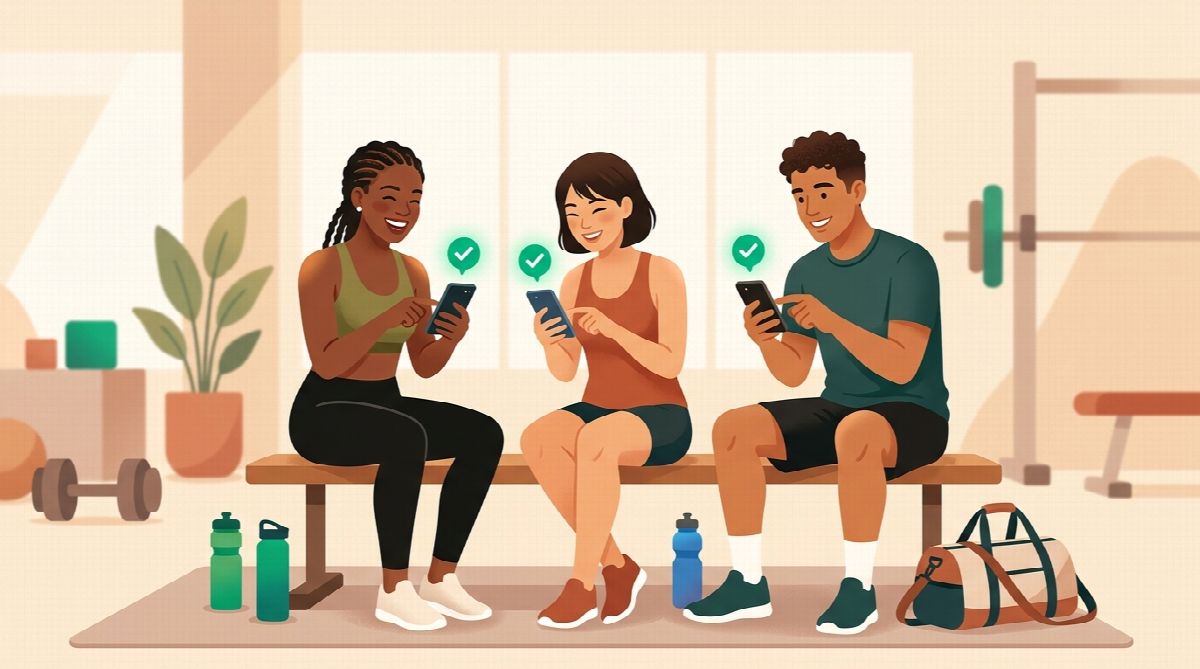
Day 1: Recruit two to four people who actually reply to messages. Accountability dies in silent group chats. Small and responsive beats large and quiet, because in a big group everyone assumes someone else will respond. Your most reliable texter is worth more than your five fittest friends.
Day 1, same conversation: pick one specific behavior, not a goal. "Work out four times a week" beats "get in shape." A behavior is checkable today; a goal is arguable for months. You can always add a second habit later. Most groups fail by starting with five. If the group has never kept a daily habit before, start smaller still: an easy habit challenge sized for beginners for the first month, then raise the bar.
Day 2: define everyone's worst-day version. Decide now what counts when life goes sideways: a 15-minute walk, one set of push-ups, ten minutes of stretching. This is the single highest-leverage trick in habit design. A Floor you can always hit means the streak survives bad weeks, and streaks that survive bad weeks are the ones that become identities. If you want the deeper mechanics, our piece on social fitness apps covers why visible minimums work.
Day 3 to 6: post a checkin daily, visibly, where the group already talks. The checkin is the unit of accountability, not the workout data. One tap, everyone sees it, done. If your crew lives in Discord, use a bot in the server rather than another app nobody opens.
Day 7: agree on the comeback rule, before anyone needs it. Bad weeks happen to every group. Decide now that the comeback checkin, the first one after a rough stretch, gets the loudest applause of the week. Shame produces hiding, and hiding kills groups faster than any missed workout does. Show up, get cheered, start forging the next chain. Need ideas for what to run once the system works? Here are group fitness challenge ideas that scale across mixed fitness levels.
Five mistakes that kill accountability groups
- Starting with too many habits. Five commitments in week one is a resignation letter with extra steps. One behavior, then earn the second.
- Making the daily bar the perfect workout. If only the full session counts, the first bad week ends the streak and the shame ends the group. The worst-day version is the system.
- Letting checkins go unanswered. The deadliest pattern in a group is not a missed workout; it is a checkin nobody reacts to. If showing up earns silence, everyone learns that showing up is optional. Cheer the boring Tuesday checkins hardest; they are the ones that almost did not happen.
- Choosing the wrong pressure. A shame-sensitive person in a stakes app, or a reserved person on a public feed, will quietly disengage. Pick the pressure you can enjoy for a year.
- Confusing tracking with accountability. A spreadsheet knows you skipped. It just does not care. If your current system has data but no witnesses, that is the gap to fix, and it is why we built our habit tracker with friends the way we did.
Start your huddle
If the small-group model fits you, Habit Huddle is free to start: create a huddle, set your workout habit with a Floor and a Ceiling, invite your two most reliable friends, and start forging your Checkin Chain today. Start free with Habit Huddle.
The app you choose matters less than the pressure it applies. Pick the one whose pressure you will still enjoy in six months, rope in friends who reply, and make your worst-day workout so small it is never worth skipping.
Ready to Build Habits With Friends?
Stop failing alone. Join thousands using the #1 habit tracker with friends for real accountability and lasting results.
Prefer mobile? App Store · Google Play
Related Guides
More Habit Huddle articles on building habits with accountability.

HabitShare Alternatives: 6 Apps for Tracking Habits With Friends (2026)
Looking for a HabitShare alternative? Six social habit trackers compared by model, price, platforms, and what happens on a missed day, plus how to switch wit...
What to Do When You Miss a Workout Day: The 5-Step Comeback Plan
Missed a workout day? What one miss does to your body and habit, according to research, plus a five-step plan for the next 24 hours, when to make it up, and...
Habit Streak App With Friends: 7 Apps Compared (2026)
Seven habit streak apps with friends compared: Habit Huddle, HabitShare, Daily Pact, Habitica, Streaks, Habit Streak duels, HabitStreak.io. What friends see,...