
Running Accountability App: 8 Picks Compared (Stakes, Streaks, and Friends)
Eight running accountability apps compared: Strava, Nike Run Club, Runkeeper, Oath, RunMatch, RunHawk, StickK, and Habit Huddle, with prices, how runs are ve...

📺 Related Video: Study: Sharing Running Times, Schedules Increases Accountability, Motivation
Video by: CBS Philadelphia · Watch on YouTube
A running accountability app adds a consequence or a witness to the runs your training plan already told you to do. The best one for you depends on what actually stops you running: nobody noticing, nothing at stake, a streak you do not care about, or a plan sized for a version of you that only exists on good weeks. Below are eight apps compared across four kinds of accountability, with prices read from each company's own site in September 2026 and an honest trade-off for each. One of the eight is ours, and it says so.
If you want the short answer: Nike Run Club is the best free option for challenges with friends, Oath is the best stakes app for runners because it grades the week from your synced runs, and a daily checkin huddle is the best fit when the problem is building the running habit rather than hitting a mileage number.
Four kinds of running accountability
Running accountability comes in four kinds, and most apps only do one of them well: a social feed where friends see your runs, money staked on a weekly target, a streak that dies if you miss a day, and a daily checkin with a small group that cheers you for showing up.
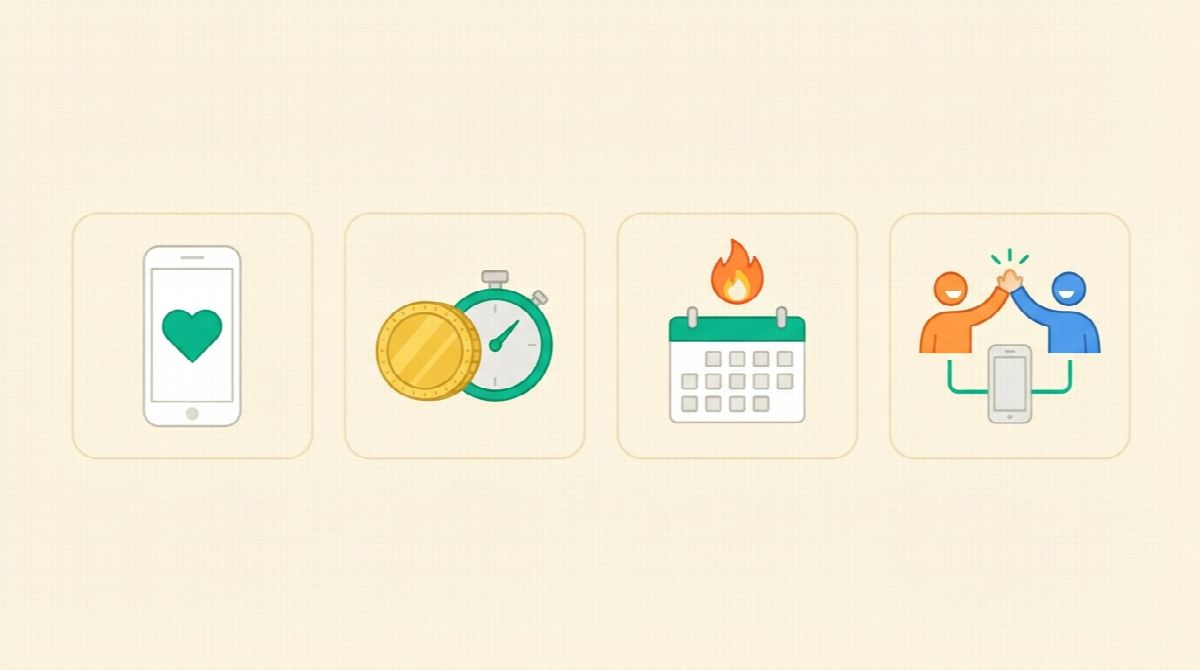
- The social feed. Strava, Nike Run Club, and Runkeeper. Your run posts to people who know you, and the kudos or the silence is the consequence. Works when you already run and want an audience; does nothing on the morning you never leave the house, because nothing posts.
- Stakes. Oath, RunMatch, and StickK. You put money on a target and lose it if you miss. Works fast for people who respond to loss; can turn an injury week into a bill.
- Streak enforcement. RunHawk. One rule, every day, GPS-verified, and the streak dies on a miss. Works for people who want a hard line and nothing else; the all-or-nothing model is the one most habit research argues against.
- The daily checkin. Habit Huddle, or a group chat with rules. You report that you ran, at whatever size you managed, and friends cheer. Works for building the habit itself; does not verify a mile.
Which kind you need is a question about your failure mode, and there is a table for that further down.
8 running accountability apps compared
The table lists what each app does, what you get free, and what the paid part costs. Prices come from each company's own site or App Store listing in September 2026 and can change; treat them as a starting point.
| App | Kind of accountability | Free tier | Paid | Runs verified by | Best for |
|---|---|---|---|---|---|
| Strava | Social feed, clubs, segments, challenges | Tracking and the feed | $11.99/mo or $79.99/yr | GPS | Runners who want friends to see every run |
| Nike Run Club | Challenges with friends, guided runs, run-day streak | Everything | Nothing to buy | GPS | Beginners and free challenges with friends |
| Runkeeper (ASICS) | Groups and challenges, clean tracking | Full tracking | Optional Go subscription, price in app | GPS | Tracking without the Strava feed |
| Oath | Money staked on weekly miles, solo or 1v1 | Sign up free, stakes from $5 | 5% fee only when someone fails | Strava or Apple Health sync | Runners who need a cost for skipping |
| RunMatch | Real-money races and streaks with friends | Free, you set the stakes | Buy-ins per race | Strava required | Friend groups who already trash-talk |
| RunHawk | 5K every day or the streak dies | None | $9.99/mo or $99.99/yr | GPS, outdoors only | People who want one hard rule |
| StickK | Commitment contract with a referee | Free | Optional stakes | A human referee | DIY stakes with a friend as judge |
| Habit Huddle | Daily checkin with friends, Floor and Ceiling | 1 habit you actively track | Paid tiers for more habits | Honor system, friends cheer | Building the running habit, not the mileage |
1. Strava
Strava is the default social layer for runners: every run posts to a feed, friends give kudos, segments turn a regular route into a leaderboard, and clubs give you a group to run with. The free version covers tracking and the feed; the subscription is $11.99 a month or $79.99 a year in the US and adds routes, training analysis, and goals. RunMatch's August 2026 roundup reports that creating and joining group challenges with friends now requires the subscription, so check Strava's plan comparison before relying on the free tier for that.
Best for: runners who already run and want people to see it. Trade-off: the feed only shows runs that happened. On the morning you skip, Strava is silent, and silence is easy to live with.
2. Nike Run Club
Nike Run Club is free with nothing to buy, and its challenges are the most accessible friend-accountability feature on this list: create one like "everyone runs three miles by Tuesday," share it with friends, family, or coworkers, and the app keeps score. It also tracks a run-day streak, offers guided audio runs from real coaches, and can share your live location with someone while you run.
Best for: beginners and anyone who wants free challenges with friends. Trade-off: challenges are distance-based, so a friend whose Floor is a ten-minute jog will always be at the bottom of the board, and the runs must be recorded in the app to count.
3. Runkeeper
Runkeeper, now owned by ASICS, is the clean tracking app for people who find Strava's feed too loud. Free tracking is complete, there are groups and challenges for a lighter social layer, and the optional Go subscription adds training plans and removes ads; the price is shown in the app rather than on a public page, so check before subscribing.
Best for: solo runners who want a record and a small group without a public audience. Trade-off: the social features are lighter than Strava's and the accountability is mostly what you bring to it.
4. Oath
Oath is a stakes app built around a weekly distance. You pick a target sized to your worst week, connect Strava or Apple Health, put money on it from $5, and your synced runs grade the week on their own; there is no manual logging. Solo oaths refund in full when you hit the target. In a 1v1 against a friend, both of you stake, both sync, and whoever covers their distance takes the pot; if you both make it, everyone gets a full refund and no fee is charged. The platform takes 5 percent only when there is a winner and a loser, and a failed solo oath sends half the stake to charity and half to the platform.
Best for: runners who respond to loss and want the week judged by data rather than by honesty. Trade-off: an injury or a sick week costs real money, and the app is on iOS with an Android waitlist at the time of writing.
5. RunMatch
RunMatch turns running into real-money competitions with friends in three formats: a race to a distance, most miles in seven days, or a daily-target streak. Buy-ins and payouts run through Stripe and every run is GPS-verified because a Strava account is required. The app is free; you set the stakes. Its own running apps roundup is candid that the ranking is theirs.
Best for: a friend group that already argues about who is faster. Trade-off: it needs Strava, it needs friends willing to bet, and a money race does nothing for the runner whose problem is getting out the door at all.
6. RunHawk
RunHawk is one rule enforced hard: run 5K outdoors every day, GPS-verified, and the streak dies on the first miss. No rest days, no freezes, no treadmill, and a public leaderboard of the longest active streaks. A crew feature shows your people whether you ran today. It is paid only, $9.99 a month or $99.99 a year, and the site says that is deliberate: money on the line gets you out the door.
Best for: experienced runners who want a single hard line and nothing else. Trade-off: 5K every day with no rest is not a beginner plan, and the streak-dies model is exactly the all-or-nothing logic most habit research warns against. The comeback matters more than the streak, and this app makes the comeback start from zero.
7. StickK
StickK is the original commitment-contract site: write the goal, name the stakes, pick a referee who confirms whether you did it, and choose where lost money goes. It is free to use, stakes are optional, and it runs on the web and mobile. For running, the referee is usually a friend checking your log each week.
Best for: people who want stakes but also want a human in the loop who can hear "I was injured." Trade-off: everything is manual, and the referee has to be someone willing to tell you no.
8. Habit Huddle
Habit Huddle is our app, so read the reasoning and judge it for yourself. It is the daily-checkin end of the list. Every habit you track is a huddle, solo or with friends, and running is one of them. Each habit carries a Floor and a Ceiling, so a running habit might have a Floor of "walk or run for five minutes" and a Ceiling of "run three miles." Both are full checkins; the Ceiling day just gets the flourish. Friends in the huddle cheer each checkin, and the huddle keeps a Checkin Chain that adds one link for every member who checks in that day. Checkins work from the web, the iOS and Android apps, or a Discord bot, so a run club's server can run it in a channel.
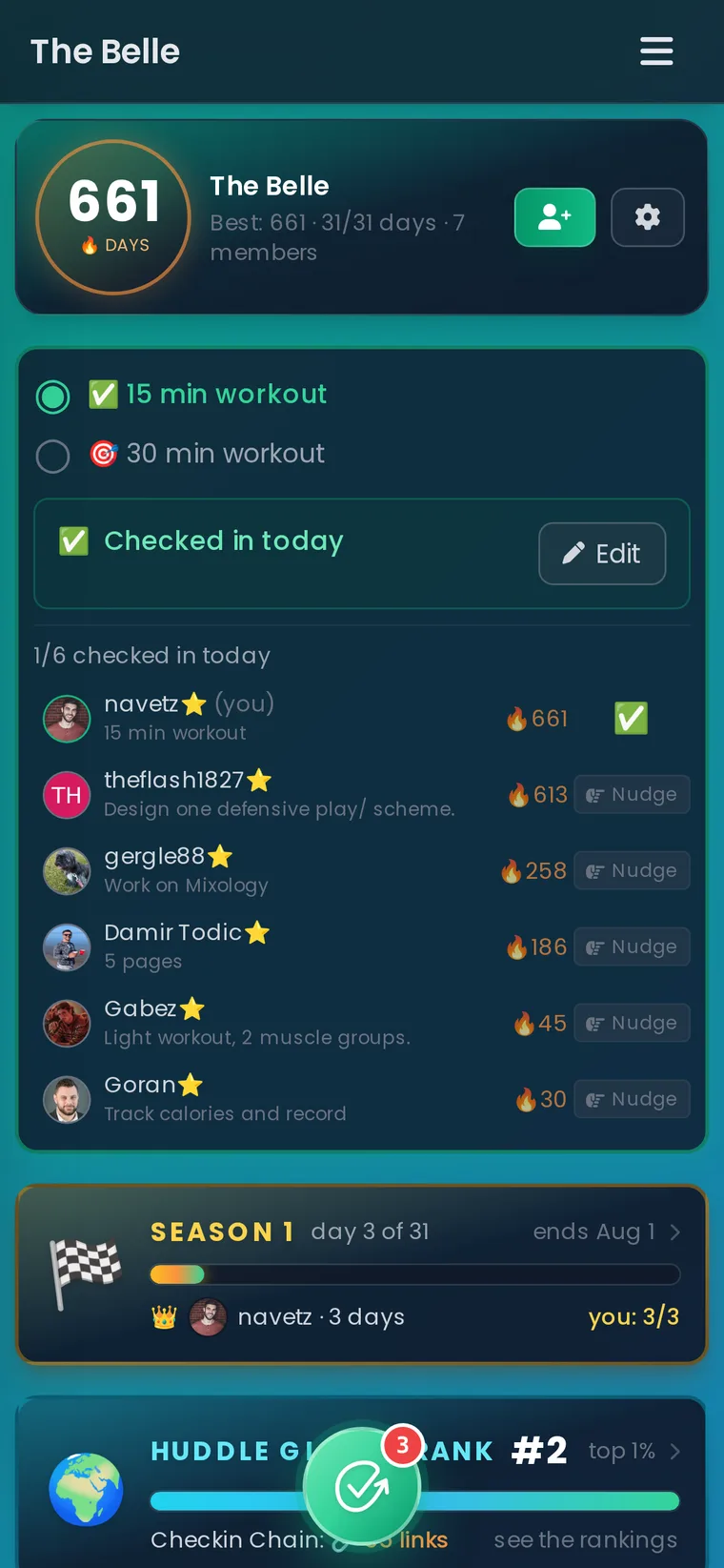
The free plan covers one habit you are actively tracking; paid tiers add more habits and extras. Best for: someone building the running habit itself, especially the first two months, when the win is showing up and not the split. Trade-off: it does not track pace, distance, or a route, and checkins are on the honor system, so it will not settle a bet. Many runners pair it with Strava or Nike Run Club: the tracker records the run, the huddle records that you showed up. If you want the wider field, our best fitness accountability apps page covers gym and workout apps too.
You already know you can change.
You just need to take the first step. Habit Huddle helps you build habits around your goals, alongside friends who keep you accountable.
Match the app to what stops you running
The right running accountability app is the one aimed at your specific failure mode, not the one with the most features. Most people who bounce off an accountability app picked the wrong kind of pressure.
| What actually stops you | Kind of accountability | Apps |
|---|---|---|
| Nobody would notice if I skipped | Social feed | Strava, Nike Run Club, Runkeeper |
| I keep skipping and nothing happens | Stakes | Oath, RunMatch, StickK |
| I want one rule and no decisions | Streak enforcement | RunHawk |
| I cannot get out the door at all yet | Daily checkin with a small Floor | Habit Huddle, a group chat |
| My friends run and I want to race them | Stakes with friends | RunMatch, Oath 1v1 |
| I run alone and want someone to know | Checkin plus a tracker | Habit Huddle plus Strava or Nike Run Club |
Two questions settle it. Is the problem the mileage or the habit? Mileage problems want verification and stakes. Habit problems want a small Floor and a cheer. And do you respond to loss or to encouragement? Stakes apps run on loss aversion, and for some people that is rocket fuel; for others it turns a run into a bill and the whole thing ends in a cancelled subscription.
What the research says about running with other people
Running is socially contagious, which is the strongest argument for putting other people in your running accountability at all. A 2017 study in Nature Communications by Sinan Aral and Christos Nicolaides used weather as a natural experiment across a global fitness network of about 1.1 million runners who logged more than 350 million kilometres over five years. When a runner's friends ran more, the runner ran more. The detail worth knowing: less active runners influenced more active ones, not the reverse, which means the slowest person in your group is doing real work for everyone else just by showing up.
Partners also make individual sessions longer. In a randomised trial at Michigan State, people who exercised with a virtually present partner whose performance was tied to theirs kept going for about 22 minutes on average, against about 11 minutes for people exercising alone. That is roughly double, from nothing more than a partner on a screen.
And the miss matters less than the return. The 2021 megastudy that tested 54 interventions on more than 61,000 gym members found the most effective one was a small reward for coming back after a missed workout. Apps that punish the miss are betting against that finding. Apps that make the return easy are betting with it.
Set it up so you keep running
Whatever app you pick, three setup decisions matter more than the app. Size the target to your worst week, decide in advance what a miss costs, and put one real person in it.

Size the target to your worst week. Oath's own advice for a weekly oath is to pick a distance you can cover in a bad week, not a good one, and it applies everywhere. If a great week is 25 miles and a terrible week is 6, the accountable number is 8. Anything above it is a Ceiling, not a requirement. If the goal is a race, our free goal to daily habit calculator turns the finish line into a daily amount you can actually defend.
Decide what a miss costs before it happens. One missed run costs one run. It does not cost the week, the streak, or the plan. Write that down, because on the day it happens you will not believe it. The megastudy result above is the reason: the return is the thing to reward.
Put one real person in it. A feed of 200 acquaintances is weaker than one friend who expects a checkin. Ask them to cheer when you post, not to police when you don't. If you are choosing between a gym partner and an app, our guide on whether to work out alone or with friends walks through the evidence, and the how to build an exercise habit guide covers the first eight weeks in detail.
The tracker, the huddle, or both
Most runners need two things: a tracker that records the run and something that makes the run happen. Strava or Nike Run Club will do the first job free. For the second, pick the kind of pressure that matches your failure mode: stakes if you skip without consequence, a hard rule if you want no decisions, and a small daily checkin with a friend if the problem is getting out the door.
If it is the last one, start a huddle at /app, set the Floor to a walk-or-run you could do in the rain, and invite the friend who will be glad to see you show up. How long that takes to feel automatic is covered in how long it takes for exercise to become a habit; for most people the checkin habit forms well before the mileage does.
Frequently asked questions
What is a running accountability app?
A running accountability app adds a consequence or a witness to your runs so that skipping one costs something. The four kinds are a social feed where friends see your runs, money staked on a weekly target, a streak that dies if you miss, and a daily checkin with a small group that cheers you for showing up. Strava, Oath, RunHawk, and Habit Huddle are one example of each.
Does putting money on your runs actually work?
For many people, yes, at least for the length of the bet. Stakes apps run on loss aversion, and a $25 stake on a week's miles changes the 6am conversation. The trade-off is that an injury or illness week costs real money, and the effect tends to end when the stakes do, so pair stakes with a habit you can keep after the bet is over.
Is Strava enough for running accountability?
Strava is enough if your problem is wanting an audience for runs you already do. It is not enough if your problem is skipping, because a skipped run never posts and the feed stays quiet. Runners who skip do better adding stakes or a daily checkin with one friend on top of Strava.
What is the best free running accountability app?
Nike Run Club, for challenges with friends and a run-day streak at no cost, with Strava's free tier a close second for the feed. For a free daily checkin with friends, Habit Huddle's free plan covers one habit you are actively tracking, which is enough for a running habit.
How do I stay accountable to running without an app?
Pick one friend, agree on a weekly distance sized to your worst week, and send a one-line message after every run. Ask for a cheer, not a check. A shared calendar on the fridge or a group chat with a daily checkin does the same job as most apps, as long as the target is small enough to hit on a bad day.
Ready to Build Habits With Friends?
Stop failing alone. Join thousands using the #1 habit tracker with friends for real accountability and lasting results.
Prefer mobile? App Store · Google Play
Related Guides
More Habit Huddle articles on building habits with accountability.

How to Restart a Habit After Falling Off (Without Starting Over)
How to restart a habit after falling off: do the Floor version today instead of Monday, hold it for seven days, write one if-then for what knocked you off, a...

Body Doubling App: 7 Options Compared, from Live Video to Daily Checkins (2026)
Seven body doubling apps compared: Focusmate, Flow Club, Focus101, Dubbii, Caveday, Flown and Habit Huddle, with free tiers, prices, and which format fits ta...

Easy Habit Challenge for Beginners: 20 Ideas You Can Actually Finish
20 easy habit challenges for beginners, each with a two-minute Floor and a stretch Ceiling, plus how long to run one, the four rules that get you past week t...