
How Long Does It Take for Exercise to Become a Habit? What Five Studies Found
Exercise takes about six weeks to feel automatic and months to become reliable. What five studies of new gym members actually found, why exercise is slower t...
📺 Related Video: How to Make Exercise a Habit | 10 Tips to be More Consistent
Video by: Dr. Morgan Nolte, Zivli · Watch on YouTube
Exercise takes roughly six weeks to start feeling automatic and several months to become a habit you no longer negotiate with. The studies that tracked real new exercisers put the first milestone at five to six weeks of consistent sessions, four or more a week, and the point of full automaticity somewhere past two months, with large-scale gym attendance data suggesting months rather than weeks for most people.
The 21-day figure you have probably heard has no exercise study behind it. Below is what each study actually measured, why exercise takes longer than most habits, what speeds it up, and what a missed workout does to the clock.
The short answer, by study
Five studies with different methods converge on the same range: a workable exercise habit in about six weeks, a robust one in two to six months. The table shows who was studied and what "habit" meant in each case, because the definition drives the number.
| Study | Who | What "habit" meant | How long it took |
|---|---|---|---|
| Armitage, 2005 | 94 new gym members, tracked 12 weeks | Attendance became stable and self-sustaining | Stable habits formed in the first 5 weeks |
| Lally et al., 2010 | 96 volunteers choosing a daily eating, drinking or exercise habit | Self-rated automaticity reached its plateau | Median 66 days; range 18 to 254; exercise habits took longer than eating and drinking habits |
| Kaushal and Rhodes, 2015 | 111 new gym members, surveyed over 12 weeks | Self-reported habit strength crossed the threshold | At least 4 sessions a week for 6 weeks |
| Buyalskaya et al., 2023 | Over 12 million gym visits, machine-learning model per person | Behavior became highly predictable from context | Typically months, not weeks |
| Singh et al., 2024 | Systematic review, 20 studies, 2,601 participants, 8 of them on physical activity | Self-reported habit or automaticity | Medians of 59 to 66 days; means of 106 to 154 days; individual range 4 to 335 days |
Read the pattern rather than any single number. The studies that asked people how automatic the workout felt landed near two months. The study that watched millions of actual visits landed on months. Both are true: the workout feels routine before it is fully reliable.
Why exercise takes longer than other habits
Exercise is one of the slowest habits to form because it is effortful, it takes time out of the day, and its context keeps changing. The same PNAS study that found gym habits take months found that hospital handwashing habits took only weeks. The difference is not willpower. Handwashing is a ten-second act triggered by the same cue in the same doorway hundreds of times. A workout is a forty-minute act whose cue moves around with your schedule.
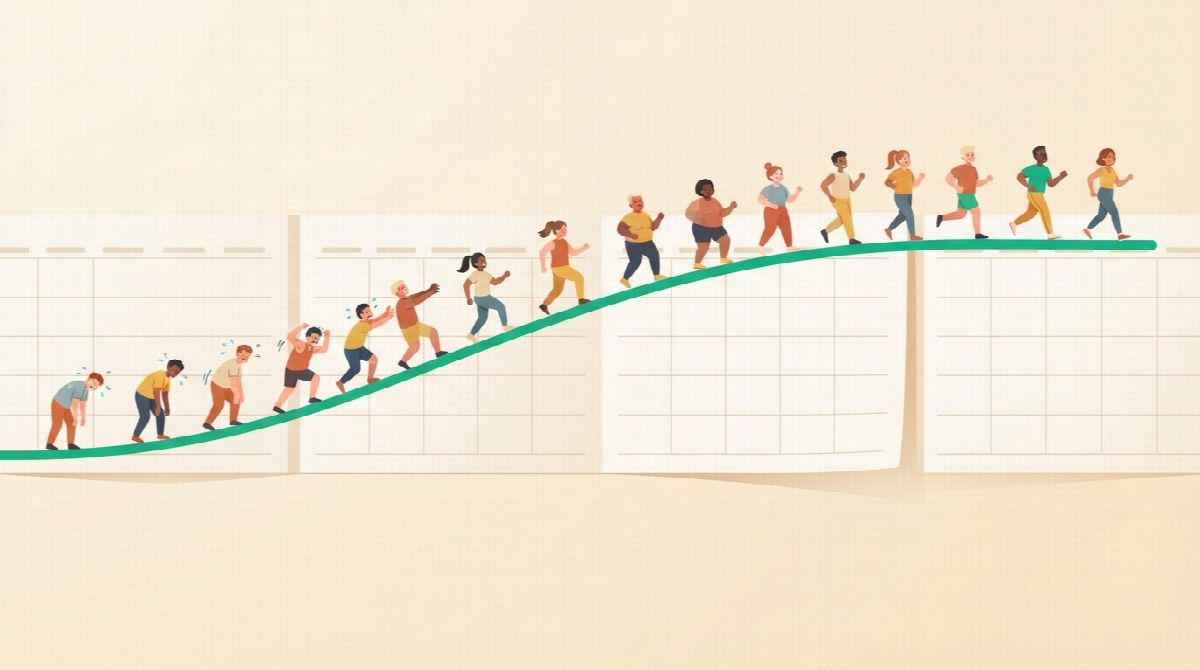
Lally's participants showed the same split inside one study. Drinking a glass of water with breakfast became automatic much faster than doing 50 sit-ups after coffee. The 2024 review found the same drivers across 20 studies: behavioral complexity, timing and whether the habit was self-selected all changed how strong the habit got.
So when someone says "it takes 21 days", the honest reply is that it takes about that long for a glass of water, and roughly three times that for a run.
What speeds it up
Four factors consistently shortened the time to an exercise habit across the studies above: frequency, a fixed cue, a small and simple version of the workout, and enjoying it. None of them is intensity.
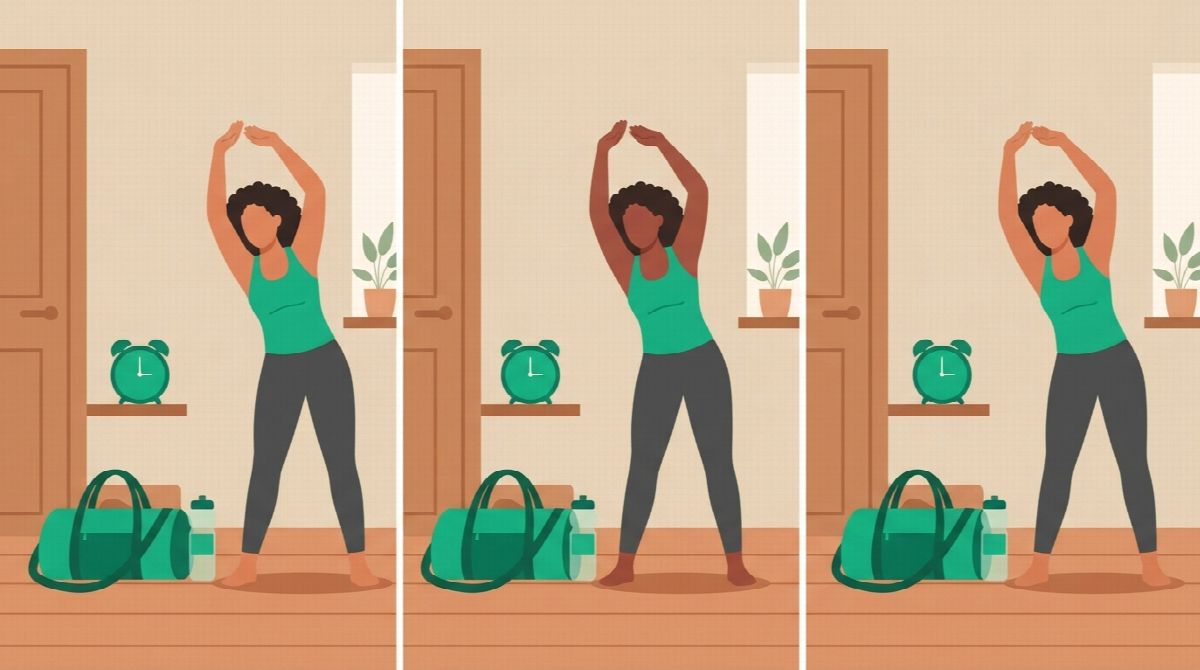
Frequency: four sessions a week. Kaushal and Rhodes found that at least four sessions a week for six weeks was the minimum that produced a habit in new gym members. Each repetition is a rep for the habit as well as for the muscle, and three sessions spread across a week leave too many days for the cue to fade.
Consistency of cue: same time, same place. In the Kaushal and Rhodes model, consistency was the strongest predictor of habit growth, ahead of the workout being simple, the environment supporting it, and the person enjoying it. The PNAS study defined habit formation as the moment behavior became predictable from context, which is another way of saying the cue had become fixed. The 2024 review added that morning habits came out stronger than habits scheduled later in the day.
Simplicity: a Floor you can hit on a bad day. Low behavioral complexity was the second-strongest predictor in the 2015 model. The practical version is to define two sizes of the workout. The Floor is the smallest version that still counts: shoes on and ten minutes out the door. The Ceiling is the full session. On good days you burst through the Ceiling. On bad days you step on the Floor, keep the repetition count going, and lose nothing. A habit is built by the number of times the cue led to the action, not by the average length of the action.
Enjoyment. Affective judgment, meaning whether the session felt good, was the fourth predictor. Pick the exercise you dislike least, not the one that burns the most. Katherine Milkman's temptation bundling, pairing the workout with a show or an audiobook you only get while exercising, is one way to raise the enjoyment without changing the exercise.
For the full method, from picking the cue to a four-week starting plan, see how to build an exercise habit. For the general version of the timeline question, see how long it takes to form a habit.
What a missed workout does to the clock
A single missed workout does not reset habit formation. Lally's team checked this directly and found that missing one opportunity made no measurable difference to the final automaticity score. The habit is built by the trend, not by an unbroken run.
What does slow the clock is the second and third miss that follow the first, because those are decisions rather than accidents. The largest exercise experiment run to date, a megastudy of 61,293 gym members testing 54 different four-week programs, found that the single most effective intervention was a small reward for returning to the gym after a missed workout. Not a reward for perfect attendance. A reward for coming back.
So plan the miss before it happens. Decide today that a missed session costs one day and nothing more, and that the next scheduled session goes ahead as if nothing happened. If you are counting days, count the days you showed up. A personal streak is a record of appearances, and one gap in it is information, not a verdict.
How to tell when exercise has become a habit
Exercise has become a habit when skipping it takes more deliberation than doing it. That flips the usual question. Early on, you decide whether to go. Later, you would have to decide not to go, and the decision feels slightly wrong.
The self-report habit index researchers use asks versions of these questions, and you can ask them yourself around week six:
- Do I start getting ready without thinking about it when the cue arrives?
- Would I feel odd, restless or off if I skipped today?
- Is the session part of my routine in the way brushing my teeth is?
- Do I do it without having to consciously remember?
Two or three yeses means the habit is forming. All four, held steady for a month, means it has formed. The PNAS finding adds a useful footnote: gym-goers whose behavior had become highly predictable were less responsive to a new incentive program, which is the good news and the bad news of a real habit. It runs on its own, and it is hard to change.
A 12-week timeline for a new exercise habit
A realistic plan for turning exercise into a habit spans 12 weeks, matching the tracking window in the Armitage and Kaushal studies. Each phase has one job.
Weeks 1 to 2: prove the cue. Four sessions a week at the same time and place, at Floor size. The goal is eight repetitions of cue leading to action, not eight good workouts. Motivation is high; spend it on logistics: the bag by the door, the slot in the calendar, the person you tell.
Weeks 3 to 6: survive the dip. Motivation drops and the first miss arrives. This is the stretch where the four-sessions-a-week minimum matters most and where the Floor earns its keep. By the end of week six most people in the studies reported that the session felt routine.
Weeks 7 to 12: grow the Ceiling. With the cue reliable, raise the length or intensity on the good days. Keep the Floor where it is. Somewhere in this stretch the deliberation drops away and you notice you have stopped negotiating.
Beyond 12 weeks: expect a wobble. Holidays, illness and travel break context, and a habit is context. The fix is the same as week one: return to the cue at Floor size and let the reps rebuild. The second time is faster.
You already know you can change.
You just need to take the first step. Habit Huddle helps you build habits around your goals, alongside friends who keep you accountable.
Where friends fit, and where Habit Huddle fits
Other people shorten the timeline because they add a cue that does not depend on your mood. A friend expecting a checkin at 7 a.m. is a fixed context of exactly the kind the studies reward, and a cheer for showing up is the return-after-a-miss reward the megastudy found most effective. In one of Milkman's studies, as reported in the BBC's coverage of the field, people were 35% more likely to exercise with a friend than alone. We compared the trade-offs in is it better to work out alone or with friends.

Habit Huddle is our app, so judge the reasoning rather than the recommendation. Every habit you track is a huddle, solo or with friends. Each habit carries a Floor and a Ceiling, so the ten-minute day counts as a checkin and the repetition count keeps growing. Your streak is counted in days. When friends join the huddle, it also keeps a Checkin Chain that adds one link for every member who checks in that day, which gives the group a number that only ever rewards showing up. Checkins and cheers work from the web app, the iOS and Android apps, or the Discord bot.
The trade-off: it tracks the habit and connects the friends, and it will not write your program or count your reps. If you want the friend-shaped cue for the six weeks that matter most, start a huddle at /app and invite one person before your first session. For the broader options, see our gym accountability app roundup.
FAQ
How long does it take for exercise to become a habit?
About six weeks of consistent sessions for the workout to start feeling automatic, and two to six months for it to become fully reliable. New gym members in a 2015 study needed at least four sessions a week for six weeks; a 2023 analysis of over 12 million gym visits found full habit formation typically took months.
Is it true that it takes 21 days to form a habit?
No. The 21-day figure comes from a 1960s plastic surgeon's observation about patients adjusting to their appearance, not from behavior research. Habit studies put the median near 66 days, with simple habits forming faster and effortful ones like exercise forming slower.
How many days a week should I exercise to make it a habit?
Four or more. In the Kaushal and Rhodes study of new gym members, four sessions a week for six weeks was the minimum that produced a habit. Three sessions can maintain fitness, but they leave more gaps for the cue to fade while the habit is forming.
Does missing a workout reset habit formation?
No. Lally's 2010 study found a single missed day made no measurable difference to whether the habit formed. Repeated misses do slow it, so plan for the first miss in advance and treat the next scheduled session as normal.
How do I know if exercise has become a habit?
When skipping takes more thought than going. Signs include starting to get ready without deciding to, feeling off when you miss, and no longer needing a reminder. If those hold steady for a month, the habit has formed.
Ready to Build Habits With Friends?
Stop failing alone. Join thousands using the #1 habit tracker with friends for real accountability and lasting results.
Prefer mobile? App Store · Google Play
Related Guides
More Habit Huddle articles on building habits with accountability.

The Fresh Start Effect: Why January 1 Feels Different, and How to Make It Last
The fresh start effect explained: the 2014 Wharton research behind January motivation, the numbers for Mondays and birthdays, a 2026-2027 fresh start calenda...

New Year Stream Ideas: 25 Streams to Plan for New Year's Eve and January (2027)
25 New Year stream ideas for Twitch, YouTube and Kick: New Year's Eve countdown formats, first-stream-of-the-year resets, January series that hold viewers pa...

New Year's Resolution Ideas for Couples: 30 You Can Actually Keep Together (2027)
30 New Year's resolution ideas for couples sorted by health, connection, money and growth, each with a daily floor you can both hit, plus a January 1, 2027 p...