
New Year Workout Challenge With Friends: Formats, Rules, and Apps for January 2027
How to run a new year workout challenge with friends: six formats compared, the rules that survive a missed day, a December setup checklist, where to track i...

📺 Related Video: 30 Day Workout Challenge At Home For Beginners
Video by: The Fit Champion · Watch on YouTube
A new year workout challenge with friends is a fixed window, usually January 1 through January 31, in which a small group each commits to a daily or weekly workout at their own level and checks in somewhere everyone can see. The friends are not a bonus. They are the reason the challenge is still running on January 20 when a solo resolution is not.
The best version has four parts: a start and end date, one commitment per person sized to that person, a shared place to check in, and rules that survive a missed day. Get those right and the workouts themselves matter less than people think.
This guide covers why a challenge with friends outlasts a solo resolution, the six formats worth choosing between, the rules that keep a January challenge alive, a December setup checklist, where to track it, and a week-by-week map of January 2027. If your group's challenge is broader than fitness, how to run a new year habit challenge with friends covers the general version.
Why a workout challenge with friends outlasts a solo resolution
People exercise longer, and keep exercising for longer, when someone else is in it with them. That is not a motivational slogan; it is one of the more repeatable findings in exercise psychology.
In a Michigan State University study, women who cycled with a partner whose performance depended on theirs kept going for an average of almost 22 minutes per session, against about 10 and a half minutes for those exercising alone. The partner did not even have to be in the room; the study used a virtually present one. What mattered was that quitting affected someone else.
A University of Zurich study took a different angle and found the same direction. Participants who were asked to find a new exercise companion and train with them for eight weeks received more emotional support, and that support raised their confidence, planning, and self-monitoring, which in turn raised how much they exercised. The companion worked through belief, not pressure.
The resolution research adds the timeline. John Norcross tracked 200 New Year's resolvers for two years and found that social support did not predict success in the first six months but did after that. A workout challenge with friends in January is the start of something whose biggest payoff arrives in the summer, if the group is still there.
The quotable version: a solo workout resolution ends the first morning you negotiate with yourself; a challenge with friends ends only when everyone stops at once, and everyone rarely does.
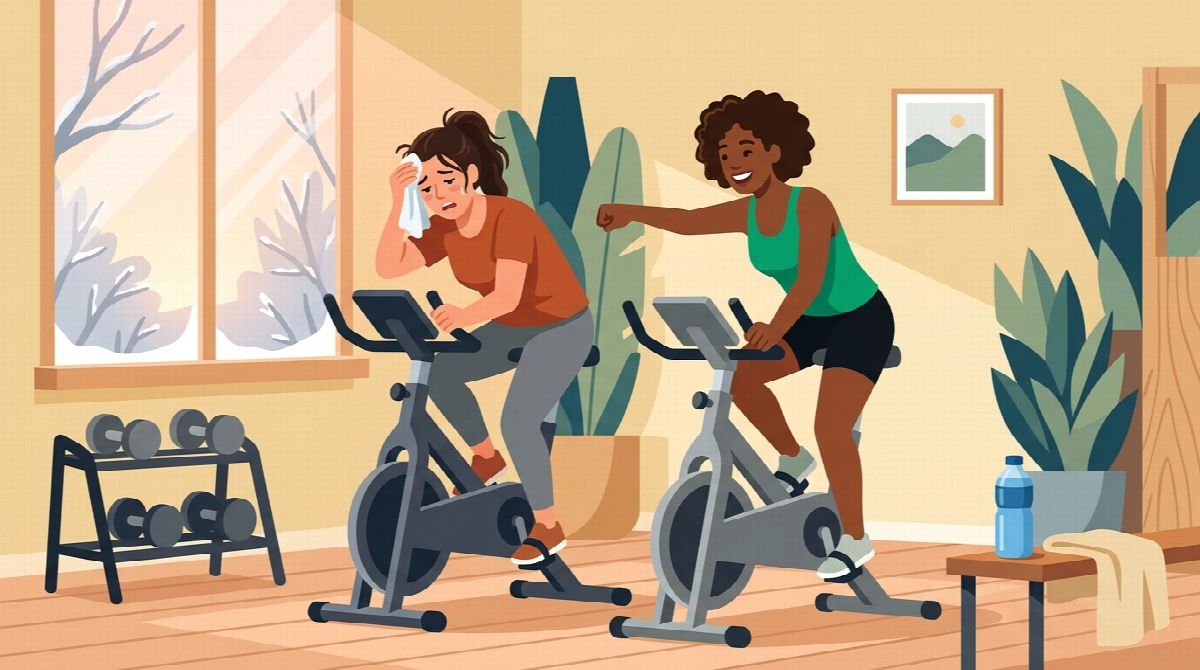
Six new year workout challenge formats compared
The right format for a new year workout challenge with friends is the one your least fit friend can finish, because a challenge only the fittest person completes is a solo challenge with an audience.
| Format | How it works | Best for | Watch out for |
|---|---|---|---|
| Daily movement streak | Everyone moves every day, any activity, minimum duration set per person | Mixed fitness levels, first challenge together | Rest-day guilt; build rest into the definition (a walk counts) |
| Minutes bank | Each person banks workout minutes toward a personal monthly total | People with irregular weeks (shift work, kids, travel) | Cramming on weekends and doing nothing midweek |
| Step challenge | Daily step target per person, tracked by phone or watch | Big groups, offices, families, anyone who dislikes "workouts" | Comparing raw totals across very different bodies and jobs |
| Session count | A set number of workouts per week (three, four, five), any type | People who already train and want consistency, not novelty | Zero-day weeks that end the challenge on a technicality |
| Floor and Ceiling | Each person sets a worst-day Floor (5 minutes) and a great-day Ceiling (full session); both count | Most real friend groups; the format to reach for | Nothing serious; the only trap is making the Floor too big |
| Team vs team | Two sides, total checkin days per side | Bigger groups, offices, Discord servers, families | The losing side losing interest in week three |
Floor and Ceiling is the format that survives contact with a real friend group, because it lets everyone commit to the same daily checkin at different intensities. The marathoner's Floor is a 20-minute easy run. The beginner's Floor is a walk around the block. Both check in, both count, and nobody has to pretend their level is someone else's. For a longer list of formats, including workplace and family versions, see group fitness challenge ideas.
The rules that keep a January workout challenge alive
Workout challenges with friends fail from bad rules more often than from weak legs. Five rules do most of the work.
1. Everyone sets their own Floor before January 1. The Floor is the smallest workout that still counts on the worst day. Ten minutes, one set, a walk. It is written down in December, not negotiated on a bad Tuesday. The Floor is what turns "I skipped" into "I did the Floor," and that difference is the whole challenge.
2. A missed day costs one day, not the challenge. Someone will get sick, travel, or have a week from hell. If the rules say they are out, they go quiet and the group loses them, usually from the chat too. If the rules say the day is missed and tomorrow is a fresh checkin, they stay. Habit research from University College London found that missing one day made no measurable difference to how a habit formed, so the rule is not soft; it is accurate.
3. Cheer the checkin, never audit the miss. What gets a reaction is what gets repeated. A checkin that earns a cheer brings people back. A missed day that earns a comment teaches people to stop reporting. This is the line between accountability and surveillance, and only one of them is still running in February.
4. No money forfeits. Penalties sound like commitment in December and feel like pressure by mid-January, and they push out the person who is struggling most, who is the person the group exists for. Positive stakes work better: the group books something on February 1 that everyone wants to do.
5. Fix the end date and the decision. A challenge with no end is a resolution, and resolutions decay. January 31 is the finish. February 1 is when the group decides, out loud, whether to run it again, change the habit, or stop. The worst outcome is silence.
One rule that is really a safety note: rest days are part of training, not a failure of it. A daily challenge should define rest as an active-recovery Floor (a walk, mobility work, stretching) rather than as a miss, and anyone new to exercise or with a health condition should check with a doctor before starting, especially if the plan is intense. A challenge that produces a January injury produces a February of nothing.
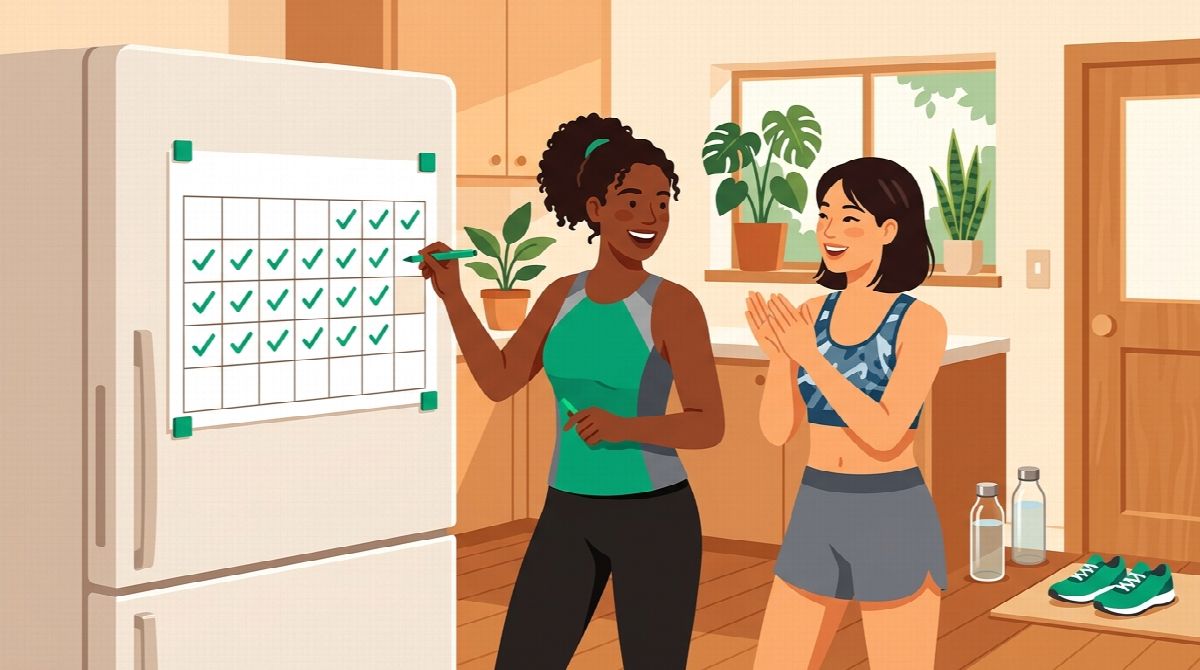
Set it up in December, not on January 1
A new year workout challenge with friends that starts on January 1 was decided on December 18. Groups that sort the format, the rules, and the tracking in the last two weeks of December start clean; groups that start the group chat on New Year's Day spend the first week arguing about definitions.
A two-week checklist that works:
- Around December 18. Invite the group. Three to six people is the sweet spot; more than eight and the checkins stop feeling personal. Say what it is in one line: "daily movement, your own Floor, January 1 to 31, we check in every day."
- By December 26. Agree the format and the five rules above. Each person writes down their Floor and their Ceiling and shares them once, so nobody is guessing what "counts" for anyone else.
- By December 30. Pick the place you will track it and get everyone set up in it, with a test checkin done. A challenge that starts with three people still installing something is already behind.
- December 31. Decide the first day's workout in advance. January 1, 2027 is a Friday and a holiday, which makes it either the easiest or the hardest day of the month depending on whether anyone planned it.
If your group is starting from zero rather than restarting, how to build an exercise habit covers how small the first weeks should be.
You already know you can change.
You just need to take the first step. Habit Huddle helps you build habits around your goals, alongside friends who keep you accountable.
Where to track a workout challenge with friends
A group challenge needs a shared home for its checkins, and the group chat that created it is the worst place to keep them.
Chat checkins work for about a week. Then conversation buries them, nobody can tell who checked in today, and the person who missed Tuesday has to scroll past everyone else to come back. A spreadsheet keeps the record and loses the feeling: it shows everything and cheers nothing. A printed 30 day challenge tracker on the fridge is great for one person's record and shows the group nothing. Here is how the usual options compare for a friend group specifically.
| Tracker | What it is | Group features | Cost | Best for |
|---|---|---|---|---|
| Group chat | Whatever messaging app the group already uses | Everyone sees messages; no record, no per-person view | Free | Week one, then move somewhere else |
| Strava | Activity tracker with a social feed, clubs, and monthly challenges | Kudos on activities, club leaderboards by distance or time | Free, paid tier for deeper stats | Runners and cyclists whose challenge is measured in miles |
| GymRats | Challenge app built around photo proof and a leaderboard | Create a challenge, invite friends, score by workouts or points | Free with paid extras | Groups who like a scoreboard and posting gym photos |
| Apple Fitness competitions | Seven-day ring competitions between two Apple Watch owners | Head-to-head points for closing rings | Included with Apple Watch | Two friends who both wear the watch |
| Habit Huddle | Social habit tracker: each person's own daily habit in a shared huddle | Group checkins, cheers, and a Checkin Chain the whole group builds | Free for the core group tracking | Groups with mixed fitness levels doing a Floor and Ceiling challenge |
The fitness-specific apps are better than a habit tracker at measuring the workout: distance, pace, calories, a leaderboard. If your challenge is a race between similar athletes, Strava's clubs or GymRats' scoreboard fit better. If your challenge is five people at five different levels trying to show up every day, a leaderboard is the thing most likely to end it, and a checkin app fits better. For apps aimed at pairs rather than groups, workout buddy apps covers that end of the field.
How Habit Huddle runs a workout challenge with friends
Habit Huddle is our app, so judge the reasoning, not the ranking. We built it around the Floor and Ceiling format this guide recommends.
Each friend sets their own daily workout habit with its own Floor and Ceiling: "move 10 minutes" at the Floor and "full session" at the Ceiling for the beginner, "easy 5k" and "long run" for the runner. Everyone tracks inside one exclusive huddle for the group, and every checkin gets seen and cheered. A member who steps on the Floor on a hard Thursday and bursts through the Ceiling on Saturday has checked in twice, and both count.
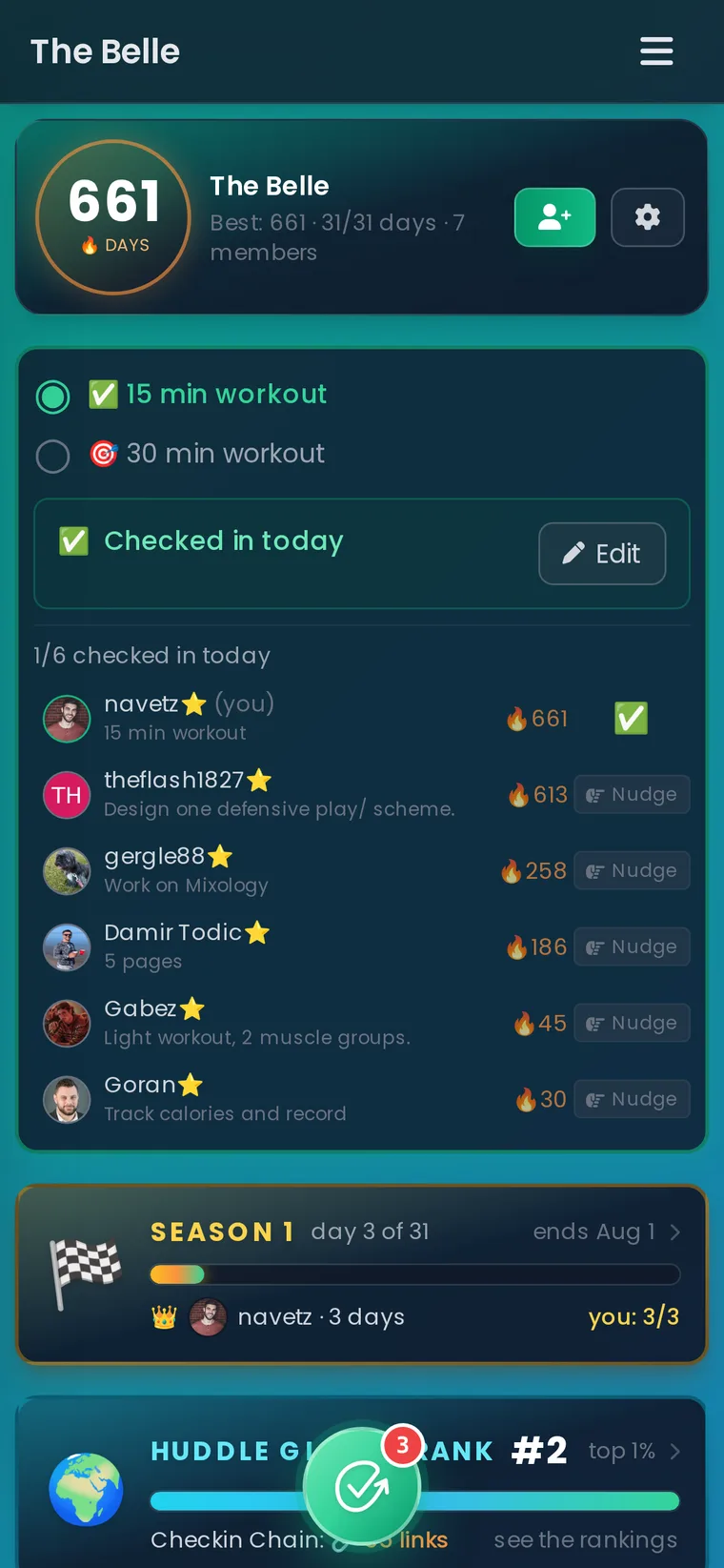
The group's metric is the Checkin Chain: every member who checks in on a given day adds a link. It measures the group showing up together, not any one person's perfection, so a missed day costs a link and never the challenge. The app deliberately never shows anyone a wall of another person's gaps. That is the same bet this guide makes: people stay for cheers, not surveillance.
Honest trade-offs: Habit Huddle counts days, not miles or reps, so it will not tell you who ran furthest. Everyone in the group needs an account, which is a real ask. Checkins are manual, and the cheering comes from your friends rather than from the app, so it works exactly as well as the group you bring. The free plan covers one tracking habit per person, which is the right constraint for a January challenge and the wrong one for someone who wants to track six things. If that fits, start your huddle in December and invite the group before the holidays scatter everyone. If your group wants a version aimed squarely at gym accountability, the workout accountability app page covers that use in more detail.
A week-by-week map of January 2027
January 2027 has a specific shape, and a group that knows it in advance handles it better than one that discovers it.
Week 1 (Fri Jan 1 to Thu Jan 7). The novelty week. Everyone checks in, the chat is lively, Floors go unused because everyone is hitting Ceilings. Use the energy to do the one boring thing: make sure every person has checked in at least once in the shared tracker, so the habit of checking in exists before the habit of working out gets tested.
Week 2 (Fri Jan 8 to Thu Jan 14). Quitter's Day week. Strava's analysis of over 800 million activities found resolution-driven exercise collapses around the second Friday of January, now widely called Quitter's Day. In 2027 it lands on January 8. This is the week the Floor exists for. Tell the group the date in advance and make Floor checkins the expected thing, not the fallback.
Week 3 (Jan 15 to 21). The quiet dip. The chat goes quieter, results have not shown up, the first person misses two days. The rule that matters here is never miss twice: one line from a friend, "Floor day tomorrow?", is usually enough. This is also the week the cheering matters most, because it is the week it is least automatic.
Week 4 (Jan 22 to 31). The finish. Sunday January 31 is the last checkin. Plan one thing the group does together that week, in person if you can, and make the last checkin a shared one.
February 1. The decision. Who keeps going, who changes the habit, what the group does next. Some groups roll straight into February with the same habit and a slightly higher Floor. Some switch to a different habit and keep the checkin ritual. The group that decides out loud usually continues; the group that goes quiet usually does not. For keeping the rhythm going after the challenge ends, how to work out consistently picks up where January leaves off.
FAQ
How do I start a workout challenge with friends for the New Year? Invite three to six friends in mid-December, agree a format where each person sets their own daily Floor and Ceiling, agree that a missed day costs one day and not the challenge, pick one shared place to check in, and have everyone do a test checkin before January 1. Fix the end date as January 31 and decide together on February 1 what happens next.
What is a good New Year fitness challenge for a group with different fitness levels? A Floor and Ceiling challenge: everyone commits to the same daily checkin, but each person defines their own smallest workout that counts and their own great-day version. The beginner's Floor is a walk; the runner's Floor is an easy run. Both count, so nobody is competing against a body they do not have.
How long should a New Year workout challenge last? One month is the sweet spot for a first challenge with friends. It is long enough to get past Quitter's Day and the week three dip, and short enough that the finish line is visible from the start. Groups that want to continue can roll straight into February rather than committing to 90 days on January 1.
What if someone in the group misses a day? Nothing dramatic. The day is missed, tomorrow is a fresh checkin, and they stay in the group. Habit research found a single missed day makes no measurable difference to how a habit forms. The one rule worth having is never miss twice: a friendly nudge after the second miss, not a penalty after the first.
Which app is best for a workout challenge with friends? It depends on what you are measuring. For distance and pace among similar athletes, Strava's clubs work well. For a scoreboard with photo proof, GymRats. For two Apple Watch owners, the built-in Fitness competitions. For a group at mixed levels trying to show up every day, a social habit tracker like Habit Huddle that counts checkins rather than miles fits better.
Ready to Build Habits With Friends?
Stop failing alone. Join thousands using the #1 habit tracker with friends for real accountability and lasting results.
Prefer mobile? App Store · Google Play
Related Guides
More Habit Huddle articles on building habits with accountability.

HabitShare Alternatives: 6 Apps for Tracking Habits With Friends (2026)
Looking for a HabitShare alternative? Six social habit trackers compared by model, price, platforms, and what happens on a missed day, plus how to switch wit...
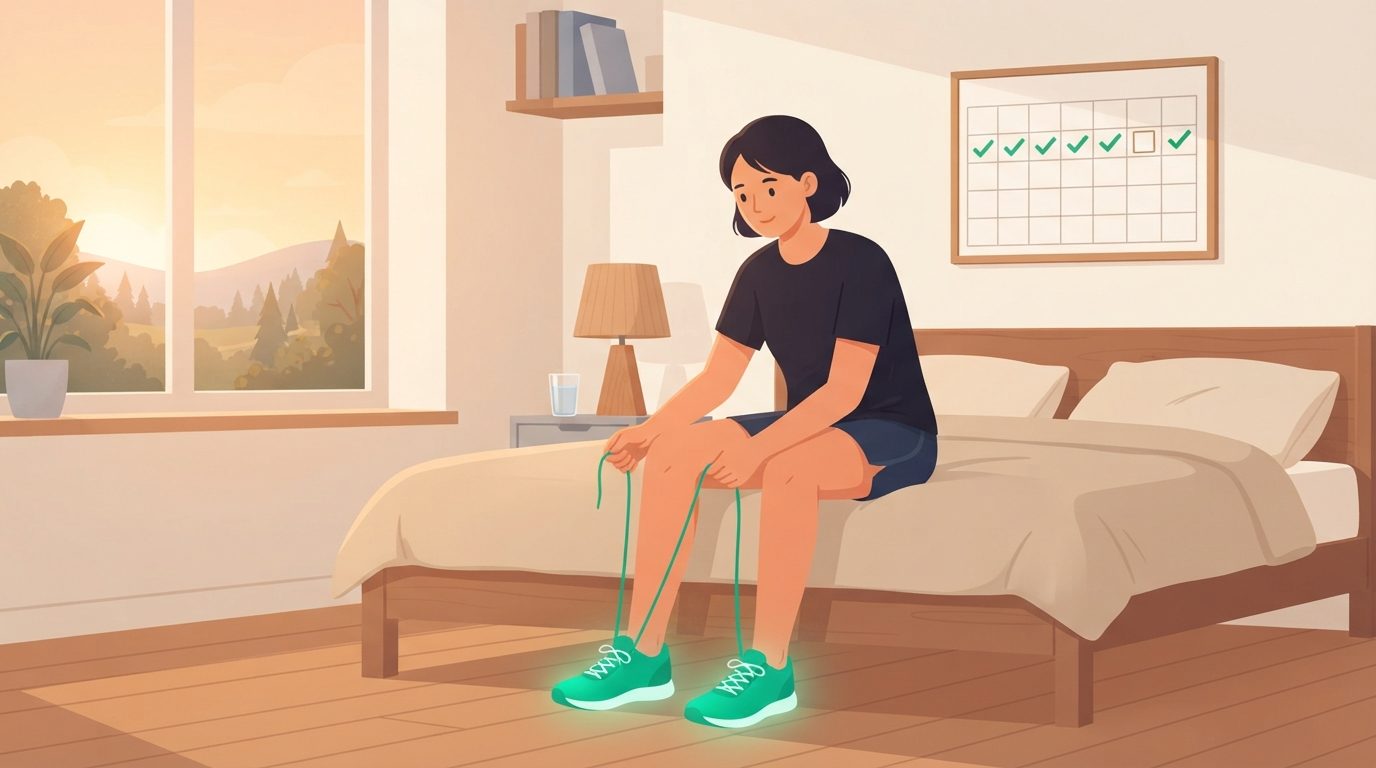
What to Do When You Miss a Workout Day: The 5-Step Comeback Plan
Missed a workout day? What one miss does to your body and habit, according to research, plus a five-step plan for the next 24 hours, when to make it up, and...

Habit Streak App With Friends: 7 Apps Compared (2026)
Seven habit streak apps with friends compared: Habit Huddle, HabitShare, Daily Pact, Habitica, Streaks, Habit Streak duels, HabitStreak.io. What friends see,...