
New Year Habit Challenge With Friends: How to Run One for 2027
How to run a 2027 new year habit challenge with friends: pick a format, set rules that survive January, and keep the whole group going past Quitter's Day.

📺 Related Video: How Accountability Partners Keep You Committed | Atomic Habits Book Summary Chapter 17
Video by: Alexander Emmanuel · Watch on YouTube
A new year habit challenge with friends is a fixed run of days, usually 30 to 75, where each person commits to one daily habit starting January 1 and everyone can see each other's checkins. The group format fixes the exact thing that kills solo resolutions: nobody is watching when you quietly stop.
For 2027 the timing is friendly. January 1 lands on a Friday, so your group gets a clean weekend of easy wins before the first full work week tests anyone.
This guide covers how to pick a format your friends will actually agree to, the rules that keep a group challenge alive past the second week, and where to run it, from a group chat to a dedicated app. If you want the general design principles first, the new year habit challenge guide covers solo setups in depth.
Why a challenge with friends beats a solo resolution
A resolution kept alone runs on mood; a challenge run with friends runs on a schedule other people can see. That difference is worth more than any amount of January motivation.
Strava analyzed over 800 million logged activities and found that resolution-driven exercise collapses around the second Friday of January, now widely called Quitter's Day. The pattern is not a willpower shortage. It is what happens when the only person tracking your habit is the same person deciding whether to skip it.
Friends change the payoff structure in three ways:
Showing up gets witnessed. A checkin someone else sees and cheers is a small social reward on top of the habit itself. Solo trackers only get the reward on milestone days. Groups get it daily.
Quitting becomes a decision instead of a drift. Solo resolutions rarely end with an announcement. They just fade. When four friends are mid-challenge, stopping means actually deciding to stop, and most people will do one more day before they will do that.
Bad days get company. Everyone hits a day where the habit feels pointless. In a group, someone else already checked in that morning, and that is often the only push you need.

Pick a format your friends will actually agree to
The best group challenge format is the one where nobody has to pretend to want someone else's goal. You have four workable shapes, and choosing deliberately avoids the most common January argument.
| Format | How it works | Best for | Watch out for |
|---|---|---|---|
| Same habit for everyone | Everyone does the identical daily habit (walk 20 minutes, read 10 pages) | Groups with one shared goal, like a group fitness challenge | People joining out of politeness, then fading |
| Same commitment, different habits | Everyone picks their own habit but commits to the same daily checkin | Most friend groups; this is the default to reach for | Habits so different that progress feels incomparable |
| Buddy pairs | Two people, matched habits or matched schedules | Couples, gym partners, close friends | No group energy to absorb a bad week |
| Team vs team | Two sides compete on total checkins | Bigger groups, offices, Discord servers | The losing side disengaging in week three |
Same commitment, different habits is the format that survives contact with real friend groups. Your runner friend runs, your night-owl friend journals, and the thing you share is the daily yes.
Duration matters less than people think, but 30 days is the honest default for a first group challenge. It is long enough to matter and short enough that a friend on the fence will still say yes. Save the 66-day and 75-day formats for round two, when the group has proof it can finish something together.
The rules that keep a group challenge alive
Group challenges die from bad rules more often than from weak people. Four rules do most of the work:
1. One habit per person. The January urge is to fix everything at once. Hold the line: each person names one repeatable daily action. Anyone who wants a full lifestyle overhaul can run the challenge on the keystone habit that makes the rest easier.
2. Everyone sets a floor they can hit on their worst day. The floor is the smallest version of the habit that still counts: five minutes of movement, one page, one glass of water swapped for the soda. Big ambitious versions are the ceiling, and good days are for stepping past the floor and bursting through the ceiling. Groups whose members set worst-day floors finish; groups whose members set best-day targets are done by January 10.
3. One miss never ends anyone's challenge. In the most cited real-world study of habit formation, Lally and colleagues tracked 96 people and found that missing a single opportunity made no measurable difference to how strongly the habit formed. Write this into the group rules explicitly: a missed day costs one link, not the challenge. The alternative is watching friends go silent after their first bad Tuesday because they think they have already failed.
4. Checkins are daily and visible. The entire value of the group is that showing up gets seen. Each person marks their habit done where the others can see it, every day. Keep the ritual to seconds, not paragraphs. A challenge that requires a daily essay is two challenges, and one of them will lose.
One rule to leave out: penalties. Money pots and forfeit rules sound motivating in December and read as pressure by mid-January, and the friend who is struggling most is the one they push out first. Cheering the days that happen works better than taxing the days that do not.

Set it up in December, not on January 1
A group challenge assembled on New Year's Day is a group chat that dies by Epiphany. The groups that finish do three things the week before:
Get real commitments, not vibes. "We should totally do this" is not a yes. Ask each friend for their habit, their floor, and a confirmation they are in for the full run. Three committed friends beat eight enthusiastic maybes.
Write the rules down once. One message, pinned: the dates, each person's habit and floor, the no-reset rule, and where checkins happen. If your group likes a bit of ceremony, a habit contract makes the commitment concrete without adding penalties.
Decide where checkins live before day one. Moving the challenge from chat to spreadsheet to app in week two is how groups lose the thread. Pick the home up front.
You already know you can change.
You just need to take the first step. Habit Huddle helps you build habits around your goals, alongside friends who keep you accountable.
Group chat, spreadsheet, or app
A group chat is the easiest place to start a challenge with friends, and the hardest place to still be running one on February 1. It deserves an honest comparison.
Chat checkins work for about a week. Then normal conversation buries them, nobody can tell who has checked in today, and the person who missed two days has to scroll past everyone else's messages to rejoin. Nothing in a chat shows the group's progress, so the challenge exists only as memory.
Spreadsheets fix the record and lose the feeling. The grid shows everything and celebrates nothing, and on phones, where your friends actually are, editing a shared sheet daily is enough friction to quietly end participation.
A dedicated habit app gives the challenge a home: one tap to check in, a visible group record, and streaks that make showing up feel like progress. The trade-off is asking everyone to install something, which is a real cost. For a seven-day experiment, stay in the chat. For a 30-day challenge you intend to finish, the app is worth the ask. If you want the full landscape, we compared the options in best group challenge apps.
How Habit Huddle runs a new year challenge
Habit Huddle is our app, so judge the reasoning, not the ranking. We built it specifically for the same-commitment, different-habits format this article recommends.
Each friend tracks their own habit with its own Floor and Ceiling, inside one exclusive huddle for the group. Everyone sees everyone's checkins, and each checkin gets cheered. The group metric is the Checkin Chain: every member who checks in on a given day adds a link, so the chain measures the group showing up together, not any one person's perfection.
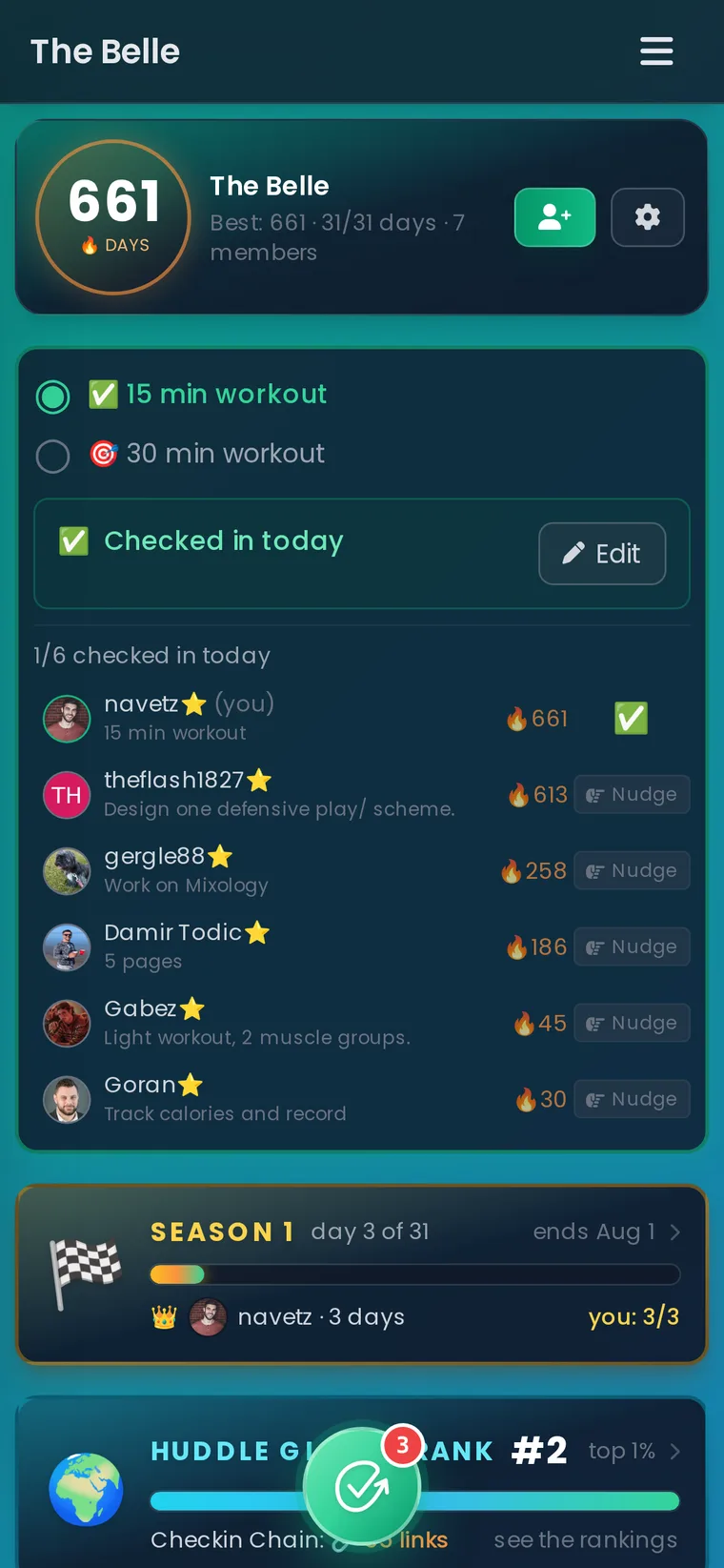
Misses cost a link, never the challenge, and the app deliberately never shows anyone a wall of your gaps. The design bet is the same one this guide makes: people stay for cheers, not surveillance.
Honest trade-offs: everyone in your group needs an account, and Habit Huddle is built around the daily-habit format, so a weekly-target challenge fits less naturally. The core group tracking is free, which for a January challenge is all you need. If that fits your group, start your huddle and invite them before the holidays scatter everyone. More on the general setup in how to build habits with friends online.
Getting the group past January 8
In 2027, Quitter's Day falls on January 8, and a group that plans for it usually sails through it. Three moves help:
Name it in advance. Tell the group on day one that the second week is where challenges die. A slump that was predicted feels like part of the plan instead of proof it is not working.
Cheer the floors, not just the ceilings. The friend who did five tired minutes on January 8 is the challenge working exactly as designed. Say so. Groups that only celebrate big days teach their strugglers to hide.
Schedule a halfway checkpoint. One message at day 15: who wants to adjust their floor? Adjusting beats abandoning, and giving people an official moment to shrink their habit keeps them from quietly dropping out instead.
Finish the 30 days, then decide together what round two looks like. Most groups that complete a January challenge do not need convincing to keep going. They need someone to ask.
FAQ
What is a good new year habit challenge to do with friends? The most reliable format is 30 days where each friend picks one daily habit and everyone checks in visibly every day. Shared-habit versions like a group walking or reading challenge also work when the goal is genuinely shared.
How many people do you need for a group habit challenge? Three to six committed people is the sweet spot. Two works but has no slack for one person's bad week; past eight or so, a challenge usually needs team structure to stay coherent.
Should everyone do the same habit? Only if everyone genuinely wants that habit. Otherwise let each person pick their own habit and share the commitment instead: same dates, same daily checkin, different goals.
What happens when someone misses a day? Nothing dramatic, by design. Research on habit formation shows a single missed day does not measurably hurt habit strength. The miss costs that day's link and the challenge continues. Challenges with reset-to-zero rules lose their strugglers first.
When should we start a 2027 new year challenge? Commit in December and start January 1, which is a Friday in 2027. Starting with a weekend gives the group two easy wins before the first full week. If your group is ready earlier, start earlier; January 1 is a focal point, not a requirement.
Ready to Build Habits With Friends?
Stop failing alone. Join thousands using the #1 habit tracker with friends for real accountability and lasting results.
Prefer mobile? App Store · Google Play
Related Guides
More Habit Huddle articles on building habits with accountability.

HabitShare Alternatives: 6 Apps for Tracking Habits With Friends (2026)
Looking for a HabitShare alternative? Six social habit trackers compared by model, price, platforms, and what happens on a missed day, plus how to switch wit...
What to Do When You Miss a Workout Day: The 5-Step Comeback Plan
Missed a workout day? What one miss does to your body and habit, according to research, plus a five-step plan for the next 24 hours, when to make it up, and...
Habit Streak App With Friends: 7 Apps Compared (2026)
Seven habit streak apps with friends compared: Habit Huddle, HabitShare, Daily Pact, Habitica, Streaks, Habit Streak duels, HabitStreak.io. What friends see,...