
How to Hold Yourself Accountable to Work Out: 6 Systems That Stick
How to hold yourself accountable to work out: six proven systems including minimums, tracking, partners, stakes, and a plan for missed days.

📺 Related Video: Reaching Your Fitness Goals is All About Accountability | Ron 'Boss' Everline
Video by: Bodybuilding.com · Watch on YouTube
Learning how to hold yourself accountable to work out comes down to one shift: stop relying on how you feel and start building a system that works when you feel nothing. The people who train for years are not more motivated than you. They have made skipping harder than showing up.
This guide covers six accountability systems that survive a bad week: a minimum so small you cannot refuse it, tracking you can see, other people, real stakes, a fixed schedule, and a plan for missed days. You do not need all six. Pick two or three and run them for a month.
Why motivation fails and accountability works
Motivation is a feeling, and feelings are the least reliable foundation you can build a fitness routine on. Motivation shows up when you are rested, inspired, and stress-free, which is exactly when you least need help. It disappears on the days that decide whether you actually change.
Accountability is different. It is structure that exists outside your mood: a tracked calendar, a friend expecting you, money already spent, a plan already written. When the structure is external, showing up stops being a daily negotiation with yourself.
Here is the sentence worth remembering: you do not rise to the level of your motivation, you fall to the level of your system.
Most advice about workout consistency skips this and jumps straight to tips. The tips below only work because each one moves the decision out of your head and into the world. If you want the broader foundation first, read our guide on how to build an exercise habit.
1. Set a minimum so small you cannot say no
A workout minimum is the single most effective accountability tool because it removes your best excuse: not enough time or energy. Your minimum is the smallest version of your workout that still counts. Ten minutes of movement. One set of pushups. A walk around the block.
The rule is simple. On good days, do your full session. On terrible days, do the minimum. The only thing you are never allowed to do is nothing.
This works because consistency is a skill you train separately from fitness. A ten-minute workout barely changes your body, but it completely changes your identity. You become a person who trains every scheduled day, no exceptions, and that identity is what carries you through month three when the novelty is gone.
Set your minimum before the bad day arrives, and write it down. A minimum invented at 9 pm on a stressful Tuesday will always be zero.

Pair the minimum with lower friction: pack the bag the night before, sleep in your running shirt if you train at dawn, keep dumbbells where you can see them. Every step you remove between deciding and doing makes the minimum easier to hit.
2. Track every workout where you can see it
Tracking works because it converts a vague intention into a visible record you do not want to break. Research backs this up: in a goal-setting study at Dominican University, psychology professor Gail Matthews found that people who wrote down their goals and sent weekly progress updates to a friend achieved significantly more than those who only thought about their goals, with roughly 76 percent reporting progress versus 43 percent in the think-only group (study summary).
The medium matters less than the visibility. A wall calendar with an X for every workout works. So does a notes app, a spreadsheet, or a habit tracking app that shows your streak.
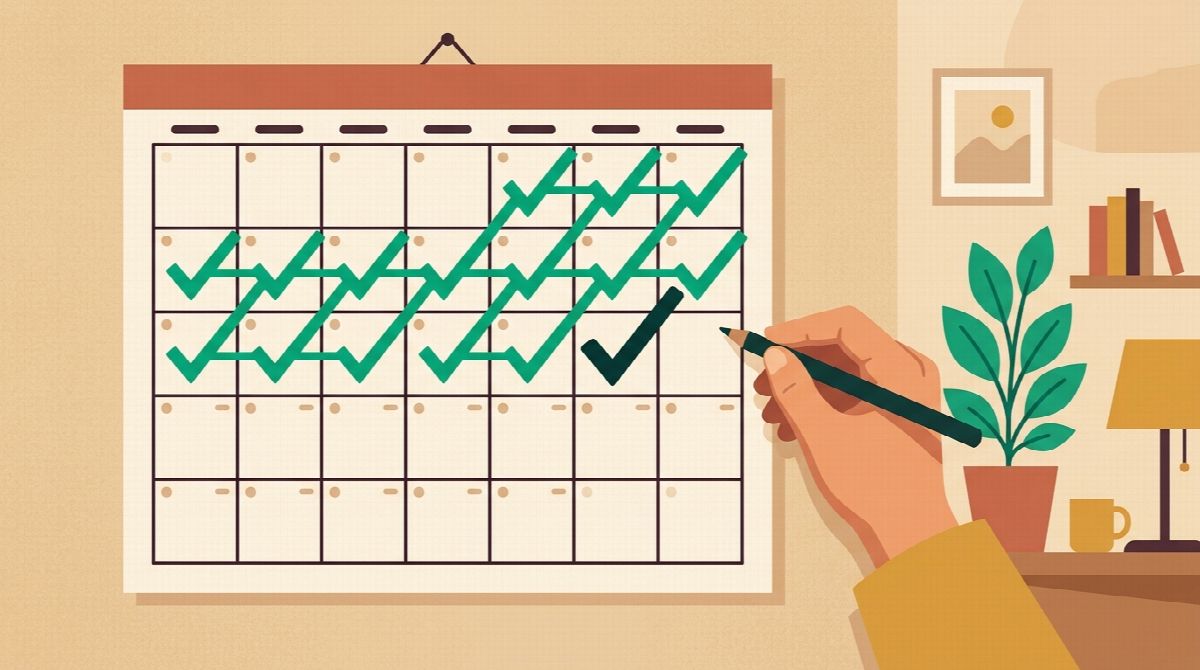
Two tracking rules make the difference:
- Track the showing up, not the performance. Count the session, not the weight lifted. Performance fluctuates and punishing yourself for a weak session teaches you to avoid tracking on weak days, which is when you need it most.
- Put the record somewhere you cannot avoid seeing it. A tracker you have to remember to open is a tracker you will quietly abandon. A calendar on the fridge or an app that pings you at your workout time does the remembering for you.
For a deeper look at staying consistent once tracking is in place, see how to work out consistently.
3. Get other people involved
External accountability is the strongest kind because another person is the one part of your system you cannot silently edit. You can move a calendar reminder. You cannot move a friend who is already stretching at the park at 7 am.
There are three levels, in rising order of strength:
- Tell someone your plan. Announce your goal and your schedule to a friend or partner. Saying it out loud makes it real.
- Get an accountability partner. Agree to share your workouts with each other and celebrate the ones that happen. If you are new to the idea, here is what an accountability partner is and how to pick one.
- Train together, in person or through an app. A workout planned with another person is an appointment, and an appointment with someone else is far stronger than an appointment with yourself.

One important note: good accountability runs on encouragement, not policing. The partner setups that last are the ones where showing up earns a cheer. Nobody sticks with a system that feels like a probation officer. If your partner lives far away, a workout accountability app with friends gives you the same effect over distance.
You already know you can change.
You just need to take the first step. Habit Huddle helps you build habits around your goals, alongside friends who keep you accountable.
4. Put something real on the line
Stakes work because they make skipping cost something today instead of someday. Health consequences are real but distant, and distant consequences lose every argument with a comfortable couch.
Practical ways to add stakes:
- Prepay for something specific. A class pack, a personal training session, a race entry. Money already spent shows up on the days motivation does not.
- Book classes with cancellation fees. The fee turns "maybe I'll skip" into a concrete price.
- Use a commitment contract. Some apps let you pledge money that you forfeit if you miss your target. Effective, though it makes fitness feel like a bill for some people. Know yourself.
- Sign up for an event with a date. A 10k in twelve weeks converts training from optional to required.
Stakes are the strongest medicine on this list, and like strong medicine, the dose matters. Stakes that are too harsh make you quit the whole system the first time life genuinely gets in the way.
5. Make it a standing appointment
A workout without a scheduled time is a wish. Deciding when to train every single day drains willpower, and every open decision is an opening for an excuse. The fix is to schedule workouts like work meetings: fixed days, fixed times, written in your calendar.
Same time, same days, every week. Monday, Wednesday, Friday at 6:30 works better than "four times this week whenever I can" even though the second sounds more flexible. Flexibility is where workouts go to die.
If a slot genuinely stops working, change the schedule deliberately at the end of the week. Never renegotiate it in the moment.
6. Plan for the miss before it happens
Everyone misses workouts, so the difference between a blip and a collapse is what you have decided to do next. Missing is not failure. Quitting because you missed is the only real failure in fitness.
Use the "never miss twice" rule: one missed workout is a rest day, two in a row is the start of a new pattern. After any miss, the next scheduled session becomes your most important workout of the month, and hitting only your minimum on that day still counts as a full win.
Build this into your system now, while things are going well. Decide what your comeback workout looks like, keep it easy, and treat completing it as proof that a miss cannot take you out.
Put it together with Habit Huddle
Full disclosure: Habit Huddle is our app, so judge this recommendation with that in mind. We built it around exactly the systems in this article.
In Habit Huddle, every habit you track is a huddle, solo or with friends. You set a daily minimum you can always hit and a stretch goal for good days, log a checkin each day you show up, and watch your personal streak grow. Invite a friend or two and they see your checkins and cheer you on, which turns your workout plan into the kind of appointment other people are part of.
It is free to start, works on the web, iOS, Android, and even Discord. If you want to compare options first, here is our honest roundup of the best accountability apps.
The bottom line
Holding yourself accountable to work out is not a character trait. It is a set of structures: a minimum you can always hit, a visible record, people who expect you, something on the line, a fixed schedule, and a plan for the inevitable miss.
Pick two or three, set them up this week, and let the system do the heavy lifting on the days you cannot.
Ready to Build Habits With Friends?
Stop failing alone. Join thousands using the #1 habit tracker with friends for real accountability and lasting results.
Prefer mobile? App Store · Google Play
Related Guides
More Habit Huddle articles on building habits with accountability.

HabitShare Alternatives: 6 Apps for Tracking Habits With Friends (2026)
Looking for a HabitShare alternative? Six social habit trackers compared by model, price, platforms, and what happens on a missed day, plus how to switch wit...

What to Do When You Miss a Workout Day: The 5-Step Comeback Plan
Missed a workout day? What one miss does to your body and habit, according to research, plus a five-step plan for the next 24 hours, when to make it up, and...

Habit Streak App With Friends: 7 Apps Compared (2026)
Seven habit streak apps with friends compared: Habit Huddle, HabitShare, Daily Pact, Habitica, Streaks, Habit Streak duels, HabitStreak.io. What friends see,...