
Accountability Buddy App: The 5 Best Picks for 2026 (Honest Comparison)
The 5 best accountability buddy apps of 2026, whether your buddy is a friend, a matched stranger, or a session partner. Prices, trade-offs, and what research...

📺 Related Video: Why you need an accountability buddy (+ where to find one!)
Video by: The Bliss Bean · Watch on YouTube
An accountability buddy app connects you with at least one other person who sees your daily progress, so a goal you would quietly drop on your own becomes a commitment someone else is watching you keep. The best one for you depends on who the buddy is: a friend you recruit, a stranger the app matches you with, or a rotating partner who works alongside you in timed sessions.
Here is the short version. If you have a friend willing to join you, use Habit Huddle or HabitShare. If you need the app to find the buddy for you, use Supporti. If what you really want is company while you work, use Focusmate. Prices below run from free to about $16 a month, and every pick has a real trade-off listed.
What counts as an accountability buddy app
An accountability buddy app is any app whose core loop is "I did it today" being seen by a specific person, not broadcast to a feed of strangers. That reporting step is what separates these apps from ordinary habit trackers, which only report to you.
The research behind that loop is solid. A meta-analysis of 138 studies (Harkin et al., 2016) found that prompting people to monitor their goal progress reliably improved attainment, and the effects grew when progress was physically recorded and reported to someone else. A buddy app automates exactly that: record the win, and a person you picked sees it land.
Buddy, partner, coach: the words blur together, but the mechanics differ. A buddy is a peer working on their own goal alongside you. A paid coach checks on you but is not chasing a goal of their own, and a commitment contract replaces the person with money on the line. This article covers peer options; our accountability partner app guide compares all four models if you want the full map, and what is an accountability partner covers the setup conversation.
The 5 best accountability buddy apps in 2026
One disclosure before the list: Habit Huddle is our app. We put it first because buddy accountability with people you know is exactly what it was built for, but every entry includes real trade-offs, so judge the reasoning.
| App | Who your buddy is | Best for | Price |
|---|---|---|---|
| Habit Huddle | A friend or small circle you invite | Daily habits with people you know | Free plan, optional paid plans |
| Supporti | A matched partner with similar goals | Finding a buddy when you have none | $15.99/mo or $129.99/yr |
| Focusmate | A rotating session partner on video | Getting focused work done | Free for 3 sessions/week, $9.99/mo unlimited |
| HabitShare | Friends you already have | Dead-simple habit sharing | Free |
| Habitica | A small party in an RPG | Gamers who want teamwork stakes | Free, optional $4.99/mo |
1. Habit Huddle: best for buddying up with someone you know
Habit Huddle is built around huddles, exclusive invite-only groups where each member tracks a habit and posts a daily checkin. A two-person huddle is the buddy system with structure: every checkin adds a link to your shared Checkin Chain, so you and your buddy build one visible thing together instead of comparing separate logs. Checkins carry notes, GIFs, applause, and replies, which keeps the loop warm rather than transactional.
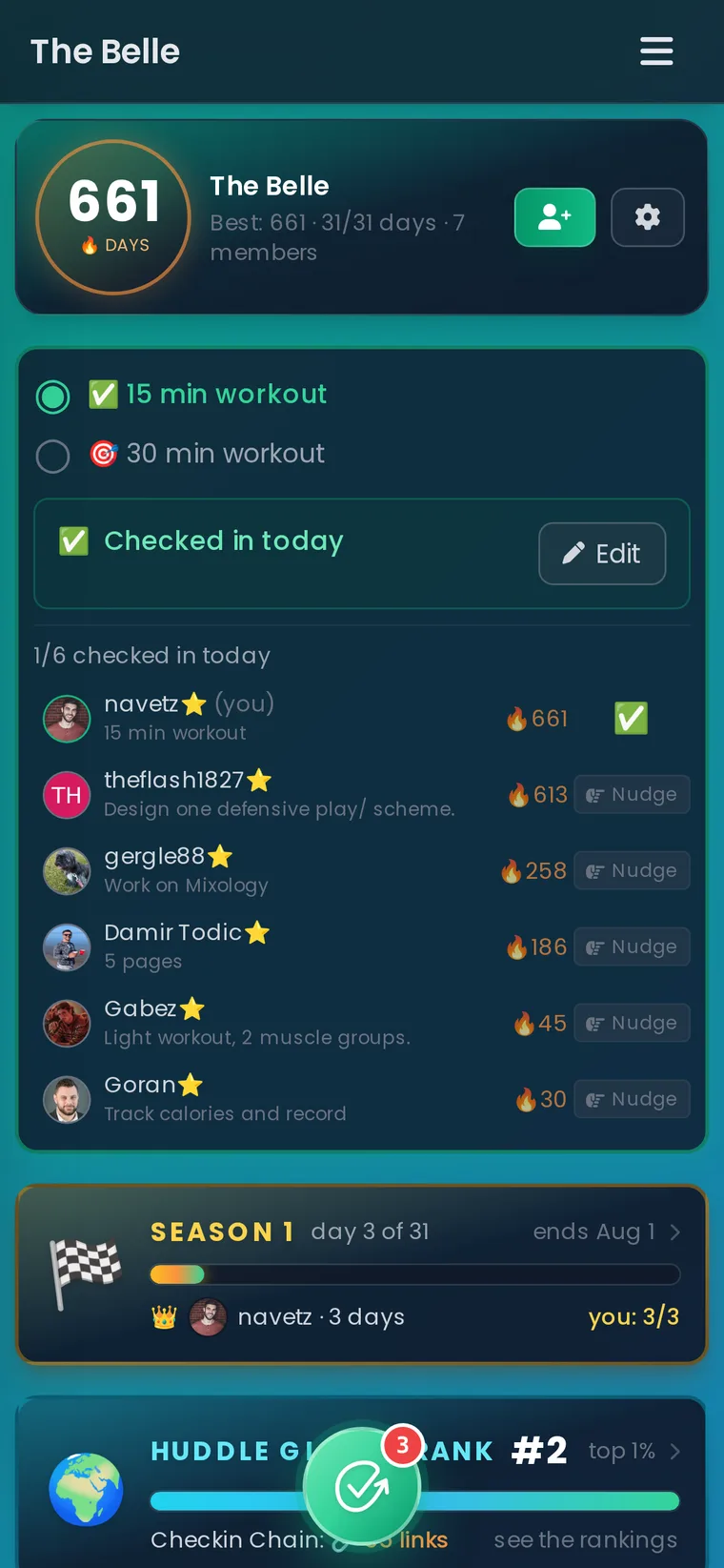
Each habit gets a Floor, the smallest version that counts on a hard day, and a Ceiling to burst through on a strong one. That matters in a buddy setup because it gives both of you a bar you can clear even on the worst day, which keeps rough weeks from turning into quiet exits.
Trade-offs: Habit Huddle does not match you with strangers by default, so you need at least one person willing to join you (opt-in smart matching exists, but the friend route is the main path). There are no live video sessions, and the community is smaller than the big-name trackers. The free plan covers a full huddle around one habit.
2. Supporti: best when you need the app to find your buddy
Supporti matches you with an accountability partner who shares similar goals, then gives the pair a shared space to set goals, track progress, and message each other. Matches run in seven-day stretches, after which you keep the same partner or get a new one, so a bad match costs you a week, not a commitment.
Trade-offs: it is subscription-only at $15.99 a month or $129.99 a year, with no meaningful free tier, and the quality of your experience depends heavily on who you draw. A stranger who ghosts is still a stranger, and the app cannot make a match care.
3. Focusmate: best for session-based work accountability
Focusmate pairs you with a partner for a scheduled video session: you greet each other, state what you are going to do, then work side by side in silence. It is the buddy system compressed into 25, 50, or 75 minutes, and it is remarkably effective for task-level procrastination, especially for ADHD-style task initiation trouble.
Trade-offs: your buddy changes every session, so nobody tracks your long-term goal, and it does nothing for habits that happen away from a desk. A gym session or a 10pm no-phone rule cannot be Focusmate'd. Free covers three sessions a week; unlimited is $9.99 a month, cheaper on the annual plan.
4. HabitShare: best free option with existing friends
HabitShare is a habit tracker where you and your friends see each other's habit calendars, with per-habit privacy controls and a built-in chat. It is free, it is simple, and if all you want is mutual visibility on a shared goal, it delivers with zero learning curve.
Trade-offs: the structure ends at visibility. There is no equivalent of a shared chain to build together, no floor for hard days, and the interface has aged. Light structure works fine while motivation is high and gives you nothing to lean on when it dips.
5. Habitica: best for buddies who want to play together
Habitica turns your habits into an RPG where you and your party members (2 to 10 people) take damage or progress together based on whether everyone does their dailies. Joining a party gives you instant teammates, and boss quests make your consistency matter to other people in a way that is genuinely motivating for the right brain.
Trade-offs: the game layer is the point, and if RPG mechanics do not appeal to you the whole system reads as chores with extra steps. Party accountability is also about your tasks mattering to the team's quest, not a conversation about your actual life.
If none of these fit because what you really want is money on the line or a paid human coach, those are different tools for a different problem: the accountability partner app guide covers Forfeit, StickK, and GoalsWon honestly.
You already know you can change.
You just need to take the first step. Habit Huddle helps you build habits around your goals, alongside friends who keep you accountable.
Why buddy systems fail, and what fixes it
Most buddy arrangements do not end in a fight; they end in silence. One person misses two days, feels awkward, delays the reply, and the other person stops asking. Nothing failed loudly, which is exactly why nobody fixed it.

Two design choices protect against the fade. The first is lowering the bar on hard days: a buddy system where the smallest acceptable version of the habit still counts gives both people a way to show up imperfectly instead of disappearing. Missing a day is survivable; vanishing is what kills the arrangement. That is the problem the Floor solves in Habit Huddle, and you can improvise it anywhere by agreeing up front what a minimum day looks like.
The second is adding a third person. A pair goes quiet the moment one person stalls, but in a trio the loop keeps moving, and the stalled person has something live to rejoin. If you can recruit two friends instead of one, do it; our group accountability app comparison covers tools built for exactly that scale.
How to choose in 60 seconds
Match the app to your situation instead of downloading all five.
- You have a willing friend and a daily habit. Habit Huddle for structure, HabitShare for simplicity.
- You have nobody to ask. Supporti if you want one ongoing matched partner, Focusmate if company during work sessions is enough. Finding a buddy in a community works too; our guide to finding an accountability partner online lists the places that actually work.
- Your problem is starting tasks, not sustaining habits. Focusmate, no contest.
- You and your buddy both love games. Habitica's party system will do more for you than any tracker.
For a wider comparison that includes group and stakes-based options, see our best accountability apps roundup.
Set up the buddy system so it survives week two
Whatever app you pick, the first week runs on novelty and the third week runs on structure. Agree on three things before you start: what the daily action is at minimum, when checkins happen, and what you do after a missed day (the answer is "say so and keep going", not "apologize and disappear").

If your buddy is a friend rather than a stranger or a session partner, start a huddle in Habit Huddle. Pick the habit, set its Floor and Ceiling, and send your friend one link; it runs on the web, so there is nothing to install. Every checkin adds a link to your shared Checkin Chain, and the free plan covers a full huddle around one habit. Two people building one chain beats two people negotiating with separate apps.
FAQ
Is there a completely free accountability buddy app?
HabitShare is free with no meaningful paywall. Habit Huddle's free plan covers a full huddle around one habit, and Focusmate is free for three sessions a week. Supporti is the only pick here with no real free tier.
What is the difference between an accountability buddy and an accountability partner?
In everyday use they mean the same thing: a peer who sees your progress while working on goals of their own. "Partner" is also used more broadly to include paid coaches and commitment contracts, which is why comparison guides often split them into separate categories.
How do I find an accountability buddy if my friends are not interested?
Use an app that does the matching (Supporti for an ongoing partner, Focusmate for session partners), or recruit from goal-focused communities like Discord accountability servers and subreddits such as r/GetMotivatedBuddies. Matched strangers work best when the app gives the pair structure rather than just a chat window.
Do accountability buddy apps actually work?
The mechanism they automate does. Across 138 studies, prompting people to monitor progress improved goal attainment, with stronger effects when progress was recorded and reported to another person (Harkin et al., 2016). The app only works if the reporting loop actually runs, which is why picking one your buddy will genuinely use matters more than features.
Ready to Build Habits With Friends?
Stop failing alone. Join thousands using the #1 habit tracker with friends for real accountability and lasting results.
Prefer mobile? App Store · Google Play
Related Guides
More Habit Huddle articles on building habits with accountability.

HabitShare Alternatives: 6 Apps for Tracking Habits With Friends (2026)
Looking for a HabitShare alternative? Six social habit trackers compared by model, price, platforms, and what happens on a missed day, plus how to switch wit...
What to Do When You Miss a Workout Day: The 5-Step Comeback Plan
Missed a workout day? What one miss does to your body and habit, according to research, plus a five-step plan for the next 24 hours, when to make it up, and...
Habit Streak App With Friends: 7 Apps Compared (2026)
Seven habit streak apps with friends compared: Habit Huddle, HabitShare, Daily Pact, Habitica, Streaks, Habit Streak duels, HabitStreak.io. What friends see,...