
Group Accountability App: The 7 Best Picks for 2026 (Honest Comparison)
Compare the 7 best group accountability apps of 2026: shared checkins, group challenges, leaderboards, and coaching. Honest trade-offs plus real research.

📺 Related Video: Check Yourself - Accountability | Charlie Johnson | TEDxNormal
Video by: TEDx Talks · Watch on YouTube
A group accountability app is a habit tracker built around other people. Instead of logging progress in private, you join a small group, everyone reports their daily habits, and the group can see and celebrate each checkin. That single change, making effort visible to a few people who care, is why group apps keep working after solo trackers get deleted.
This guide covers the seven best group accountability apps in 2026, what the research says about why groups outperform willpower, and how to set up a group that survives past week two.
What is a group accountability app?
A group accountability app connects your daily habits to a small circle of people who expect your checkin and cheer when it lands. A solo tracker records what you did. A group app changes what it feels like to show up, because showing up happens in front of people you picked.
The strongest versions share a few core elements:
| Element | Why it matters |
|---|---|
| Small group structure | A handful of people keeps every member visible and reduces lurking |
| Shared daily checkins | A recurring reporting rhythm keeps the habit in motion |
| Visible progress | Streaks and completion history make consistency easy to read |
| Peer response | Applause, replies, and nudges keep the social loop alive |
The app itself does not create discipline. It creates social conditions that make discipline easier to repeat. If the tool does not create a real social loop, it is still mostly self-tracking with extra steps. For the psychology underneath this, see our guide to social accountability.
The 7 best group accountability apps in 2026
One disclosure before the list: Habit Huddle is our app. We put it first because this is exactly the use case it was built for, but every entry includes real trade-offs, so judge the reasoning.
| App | Built around | Group challenges | Price |
|---|---|---|---|
| Habit Huddle | Small friend groups with shared daily checkins | Yes | Free plan, optional paid plans |
| HabitShare | Sharing solo habits with chosen friends | No | Free |
| Daily Pact | Friend group challenges with leaderboards | Yes | $0.99/mo after a 14 day trial |
| Habitica | Turning habits into a group RPG | Yes (quests) | Free, optional subscription |
| Habitat | Group streaks on iPhone | Yes | Free, $2.99/mo premium |
| Focusmate | 1-on-1 video coworking sessions | No | Free 3 sessions/week, $8/mo annual |
| GoalsWon | Daily messages from a human coach | No | Paid coaching, free trial |
1. Habit Huddle: best for friend groups building daily habits together
Habit Huddle is built around huddles, small invitation-only groups where each member tracks a habit and checks in daily. Every member who checks in adds a link to the group's Checkin Chain, so the group builds one shared thing together instead of comparing separate scores. Checkins carry notes, GIFs, applause, and replies, so the feed feels like a group chat about showing up. Each habit has a Floor, the smallest version that counts on a hard day, and a Ceiling to burst through on a strong one, which keeps one rough day from turning into a quit. It works on web, iOS, Android, and Discord, so nobody has to install anything to join.
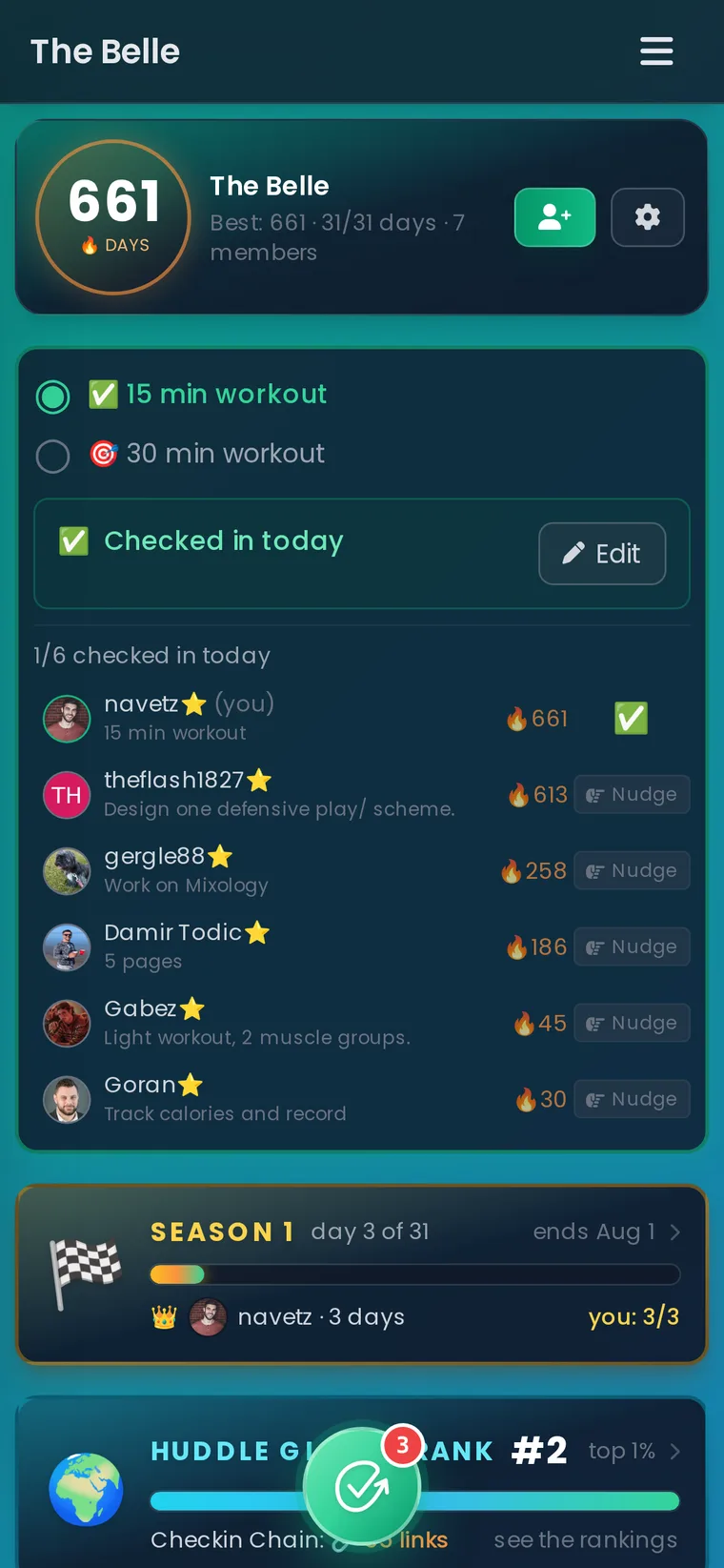
Trade-offs: it is newer than the big names on this list, so the community is smaller, and there are no wearable integrations, checkins are deliberately manual. The free plan covers one active habit with full social features; running several habits at once is where paid plans start.
2. HabitShare: best for sharing solo habits with a few friends
HabitShare keeps it simple: create habits, track them, and share the ones you choose with the friends you choose. Its per-habit privacy control is genuinely good, every habit starts hidden and you decide who sees it, which makes it a comfortable pick for sensitive goals. It is completely free on iOS and Android.
Trade-offs: the habits stay individual. There are no group challenges, no shared goal, and nothing the group builds together, so it feels more like watching each other's charts than doing something as a team. If your group wants a shared project rather than parallel solo tracking, you will outgrow it.
3. Daily Pact: best for competitive friend groups
Daily Pact is a newer app built for friend groups that like a scoreboard. You create a group with an invite code, set daily or weekly challenges, and a leaderboard ranks everyone by completion percentage. A group-voted pause feature protects your streak when life intervenes, which is a smart touch. It lists at $0.99 a month after a 14 day trial.
Trade-offs: it is mobile only with no web version, and it is young, so the community and track record are thin. The leaderboard-first design is great for competitive groups and worse for groups where ranking would make quieter members go silent.
4. Habitica: best for gamers
Habitica turns your habits and to-dos into an 8-bit RPG. Completing tasks earns experience and gold for your avatar, and the group layer comes through parties: you and your friends take on quests together, and everyone's daily follow-through affects the party's progress. It is free with an optional subscription, and it has a huge community and a deep wiki.
Trade-offs: setup takes real effort and the RPG metaphor is the whole product, so people who do not care about leveling an avatar tend to bounce. The social mechanics also sit on top of what is fundamentally a solo productivity system, so the group feel is thinner than in group-first apps.
You already know you can change.
You just need to take the first step. Habit Huddle helps you build habits around your goals, alongside friends who keep you accountable.
5. Habitat: best for iPhone-only groups
Habitat is a small iOS app where each habit lives in a group, called a habitat, and the group holds a shared streak that only grows when everyone completes their goal. It rates 4.6 on the App Store and the free version covers the basics, with a $2.99 monthly premium.
Trade-offs: it is iPhone only, so one Android friend rules it out for the whole group, and user reviews note a glitchy group chat. The everyone-or-nobody streak rule is motivating for tight groups and brutal for larger ones, where one busy member stalls the whole group's progress.
6. Focusmate: best for body doubling, not habit tracking
Focusmate pairs you with another person for a 25, 50, or 75 minute video coworking session. You state your task, work quietly on camera, then report how it went. For deep work and ADHD-style task initiation it is excellent, and the free tier includes three sessions a week, with unlimited sessions at $8 a month billed annually.
Trade-offs: it is not a habit tracker at all. There are no streaks, no groups, and you are matched with strangers rather than friends. Use it for focus sessions, and pair it with an actual group app if you want daily habit accountability.
7. GoalsWon: best if you want a professional, not a group
GoalsWon matches you with a human accountability coach who messages you every day: you report progress, they respond with feedback and tactics. It is 1-on-1 coaching rather than peer accountability, with a free trial and a paid subscription after.
Trade-offs: there is no group and no friends involved, and paying a professional changes the dynamic. A coach is consistent and skilled, but the research below suggests part of accountability's power comes from people you actually know expecting you to show up. It is the premium option for people whose friends will not commit.
Why group accountability works
People repeat behaviors that are visible and socially reinforced, and abandon behaviors that stay private and brittle. That is the whole mechanism, and it is well documented.

In the STEP UP randomized clinical trial of 602 overweight and obese adults, every social gamification arm significantly increased physical activity, and the competition arm added about 920 steps per day over controls, according to the trial published in JAMA Internal Medicine. It was also the only arm whose gains held after the intervention ended. Separately, a survey of 552 adults found fitness app and tracker users had almost twice the odds of meeting aerobic activity guidelines as non-users (odds ratio 1.91).
The design details matter, though. A 2024 study of social features in fitness apps found they help through two distinct pathways, support and comparison, and that comparison can backfire for people who hate being ranked. That is worth remembering when you pick an app: a leaderboard energizes some groups, while a support-first feed with applause and replies works for almost everyone.
The practical takeaway: accountability works best when showing up is visible and celebrated, not when the group turns into surveillance. You want a few people who expect your checkin and are glad when it arrives. For more on how visibility changes behavior, see our piece on behavior change psychology.
Features that actually matter in a group app
Most app comparisons rank themes, widgets, and habit limits. For actual behavior change, four things matter more:
Low-friction checkins. If reporting takes more than a few seconds, people postpone it, and postponed checkins become skipped ones. One tap plus an optional note is the right amount of ceremony.
Small group architecture. Accountability stays personal in a group small enough that each person's showing up is legible. Big communities add energy, but reliable follow-through comes from three to eight people who know each other.
Flexible completion rules. This is the most overlooked one. Some days the full habit will not happen, and an all-or-nothing tracker turns that day into a collapse. Look for a two-tier system, like Habit Huddle's Floor and Ceiling, that lets you step on the Floor on a hard day and burst through the Ceiling on a strong one. Continuity beats intensity.
Fast peer response. Silence kills social loops. The app should make it effortless to applaud, react, or reply, because a checkin that lands to no response starts feeling like solo tracking again.
If a group runs on Discord already, the app should meet it there instead of forcing everyone into a new install. That is exactly why we built a Discord accountability bot that connects a server channel to a huddle.
How to launch a group that lasts
Most groups do not fail because of the app. They fail because nobody agreed what the group was doing.

- Pick one specific habit. "Read 20 minutes" works. "Improve myself" does not. One group, one behavior, so every checkin means the same thing to everyone.
- Keep it to three to five committed people. Enough for energy, few enough that everyone stays visible. You can always grow later.
- Define what counts. Agree on the smallest version that earns a checkin before anyone faces a hard day. This is the Floor conversation, and having it up front prevents quiet rule-bending later.
- Set a daily rhythm. Groups stabilize when checkins cluster around a predictable window, like evenings. Reminders help, but the rhythm is what carries it.
- Agree on tone before anyone struggles. The best groups respond to a rough patch with "what is the smallest version you can do tomorrow?" rather than guilt. Cheering effort keeps people honest; shame teaches people to hide.
Sensitive goals deserve one extra thought: not every habit belongs in every group. Pick the audience you would be comfortable reporting reality to, and keep goals tied to mental health, money, or body image in a smaller circle you trust. Honesty is the whole asset. Protect it first.
For a deeper set of levels, from solo tracking up to structured groups, our guide to habit accountability walks the full ladder, and if your group's habit is fitness, we compare the options in best accountability apps.
Start your group in about a minute
If you want the group-first version of all this, create a huddle in Habit Huddle. Pick a habit, set its Floor and Ceiling, and invite your friends with a link, no install required. Each daily checkin adds a link to your group's Checkin Chain, and the free plan covers a full group around one habit. Bring three friends and see how much further the chain gets than the streak you kept alone.
Ready to Build Habits With Friends?
Stop failing alone. Join thousands using the #1 habit tracker with friends for real accountability and lasting results.
Prefer mobile? App Store · Google Play
Related Guides
More Habit Huddle articles on building habits with accountability.

Body Doubling App: 7 Options Compared, from Live Video to Daily Checkins (2026)
Seven body doubling apps compared: Focusmate, Flow Club, Focus101, Dubbii, Caveday, Flown and Habit Huddle, with free tiers, prices, and which format fits ta...
Easy Habit Challenge for Beginners: 20 Ideas You Can Actually Finish
20 easy habit challenges for beginners, each with a two-minute Floor and a stretch Ceiling, plus how long to run one, the four rules that get you past week t...
How Long Does It Take for Exercise to Become a Habit? What Five Studies Found
Exercise takes about six weeks to feel automatic and months to become reliable. What five studies of new gym members actually found, why exercise is slower t...