
6 Best Accountability Partner Apps: Friend, Match, or Coach
The 6 best accountability partner apps of 2026 by partner type: a friend, a matched buddy, a coach, or money on the line. Plus what research supports.
📺 Related Video: People With These Traits Make Great Accountability Partners
Video by: Dr. Henry Cloud · Watch on YouTube
An accountability partner app connects your daily goals to another person, so following through stops being a private negotiation with yourself. The best one for you depends on who that person should be: a friend you already know, a matched stranger, a paid coach, or a referee holding your money.
This guide compares the six best accountability partner apps in 2026 across those models. It also covers what the research actually supports, why most partner setups collapse by week three, and when a small group works better than a pair.
The 6 best accountability partner apps in 2026
The right accountability partner app matches the kind of partner you want, not the longest feature list. Most tools in this category fit one of four models: a friend, a matched stranger, money on the line, or a professional.
One disclosure before the list: Habit Huddle is our app. We put it first because friend-based accountability is exactly what it was built for, but every entry includes real trade-offs, so judge the reasoning.
| App | Your partner is | Best for | Price |
|---|---|---|---|
| Habit Huddle | A friend or small circle you invite | Daily habits with people you know | Free plan, optional paid plans |
| Focusmate | A matched stranger on video | Deep work and task initiation | Free 3 sessions/week, $8/mo annual |
| HabitShare | Friends you choose per habit | Simple habit sharing | Free |
| Forfeit | Money you stake on each task | Hard deadlines, proof-based tasks | Stake your own money, fee on failure |
| StickK | A referee plus an optional stake | Commitment contracts | Free |
| GoalsWon | A paid human coach | Daily 1-on-1 coaching | Paid subscription, free trial |
1. Habit Huddle: best for partnering with people you already know
Habit Huddle is built around huddles, exclusive invite-only groups where each member tracks a habit and posts a daily checkin. A huddle works at partner scale: you and one friend can run a two-person huddle, and every checkin adds a link to your shared Checkin Chain, so the two of you build one visible thing together instead of comparing separate logs. Checkins carry notes, GIFs, applause, and replies, which keeps the loop warm rather than transactional. Each habit gets a Floor, the smallest version that counts on a hard day, and a Ceiling to burst through on a strong one, so one rough Tuesday never turns into a quiet exit.
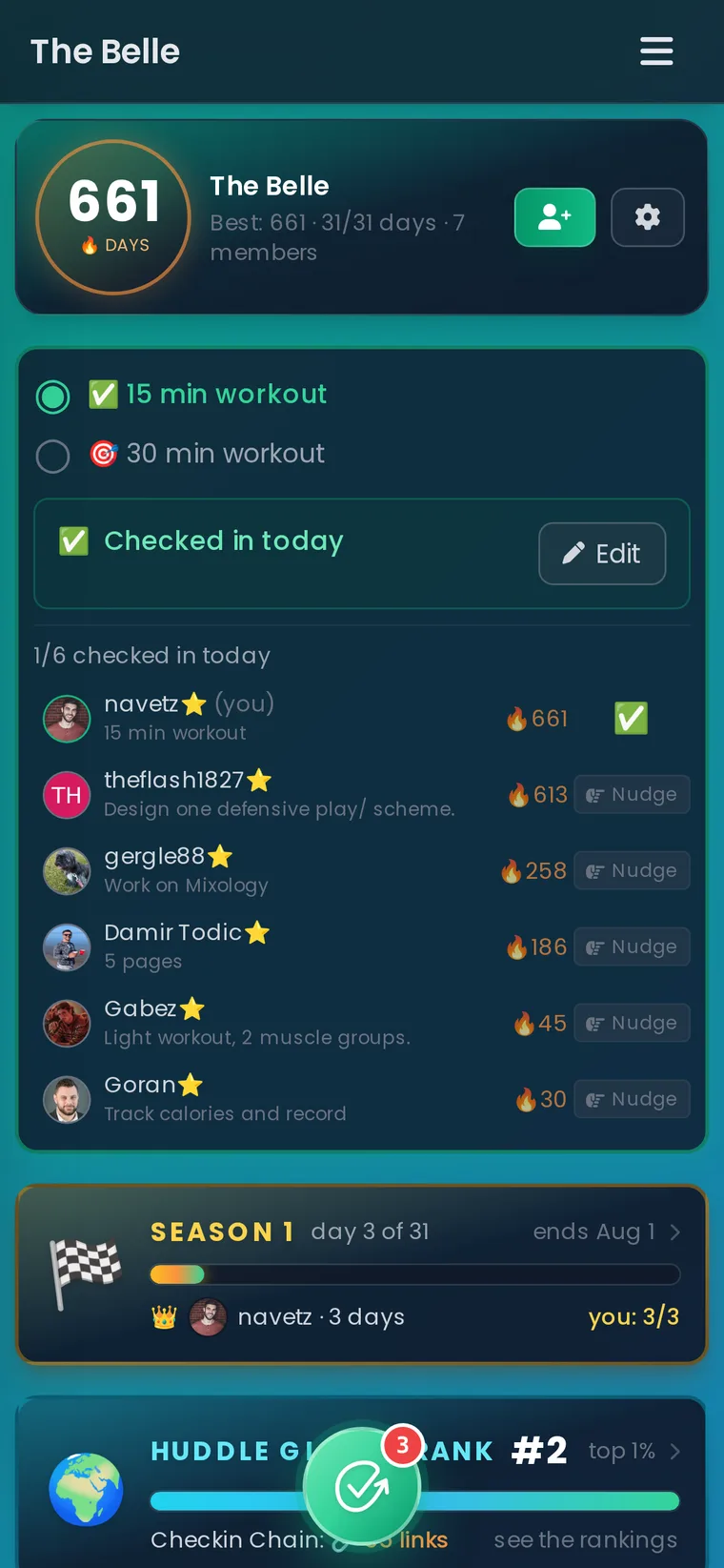
It runs on web, iOS, Android, and Discord, so your partner can join from a link with nothing to install. And if your pair grows into three or four people, the same huddle absorbs them.
Trade-offs: it is newer than the big names here, so the community is smaller, and checkins are deliberately manual with no wearable integrations. The free plan covers one active habit with full social features; tracking several habits at once is where paid plans start. It also will not find a partner for you. You bring your own person, which is the point.
2. Focusmate: best for matched strangers and body doubling
Focusmate pairs you with another member for a 25, 50, or 75 minute video coworking session. You state your task, work quietly on camera, then report how it went. As an accountability partner app for getting started on hard tasks it is excellent, and this kind of body doubling is especially popular with ADHD users, something we cover in our ADHD habit tracker guide. The free tier includes three sessions a week, with unlimited sessions at $8 a month billed annually.
Trade-offs: your partner changes session to session, so nobody is tracking your week or cheering a long run of good days. There are no habits, no streaks, and no history. It solves "start the work right now" brilliantly and does not attempt "stay consistent for months."
3. HabitShare: best free option for sharing habits with friends
HabitShare keeps it simple: create habits, track them, and share each one with the friends you choose. Every habit starts hidden and you decide who sees it, which makes it a comfortable pick for sensitive goals. It is completely free on iOS and Android.
Trade-offs: habits stay individual. There is no shared goal and nothing you build together, so it can feel like watching each other's charts rather than doing something as a team. Accountability depends on you and your friend actually messaging each other, because the app itself applies little structure.
4. Forfeit: best when you want money on the line
Forfeit makes you stake real money on a task, then submit photo or timelapse proof by the deadline. Miss it and you lose the stake. The site reports over 686,000 forfeits set and $8.7M staked, and it has an AI mode that can enforce phone blocks and morning routines with escalating penalties. For deadline-shaped tasks where a gentle nudge does nothing, it is the bluntest instrument on this list.
Trade-offs: the partner here is fear of loss, not a person, and research on habit formation favors adding support over adding threat for long-term consistency. Proof submission adds friction to every single completion, which some people find clarifying and others find exhausting. Money stakes also stop working the moment you decide you can afford the loss.
5. StickK: best free commitment contracts
StickK is a free goal platform created by behavioral economists at Yale University. You sign a commitment contract, optionally put money on the line (with charity or anti-charity as the destination), and appoint a referee, a real person who confirms your reports. That referee role makes it a genuine accountability partner app rather than a solo tracker, and the underlying commitment-device research pedigree is real.
Trade-offs: the product itself is dated, with a web-era interface and clunky mobile experience. Structure lives in the contract, not in daily social contact, so weeks can pass without meaningful interaction. It works best for a single well-defined goal with a firm end date, not an open-ended daily habit.
You already know you can change.
You just need to take the first step. Habit Huddle helps you build habits around your goals, alongside friends who keep you accountable.
6. GoalsWon: best if you want a professional, not a peer
GoalsWon assigns you a human accountability coach who messages you every day: you report progress, they respond with feedback and tactics. It is the most reliable partner on this list because reliability is literally what you are paying for, with a free trial and a paid subscription after.
Trade-offs: it is the premium option, and paying a professional changes the dynamic. A coach will never be a friend who genuinely cares whether your life improves, and the research below suggests that being known matters. It fits people whose friends will not commit, or who want expert tactics along with the checkin.
Which partner model fits you
Match the app to your failure pattern, not to the marketing. The way you usually fall off is the most useful piece of information you have.
- You know what to do but skip it when nobody notices the wins. Pick a friend-based app where showing up is visible and celebrated. Habit Huddle or HabitShare.
- You stall at the moment of starting. Body doubling. Focusmate.
- You renegotiate your goals with yourself daily. A contract with a referee or a stake. StickK or Forfeit.
- You keep changing the plan itself. A coach who can see the pattern. GoalsWon.
- Your last three buddy pacts faded quietly. Skip the pair entirely and use a small group. More on that below.
Why most accountability partnerships fail
Most accountability partnerships fail from weak structure, not weak people. Two friends feel motivated on day one and promise to text each other. One gets busy, the other feels awkward chasing, and the arrangement fades without either person deciding to stop.
An informal pact depends on memory, energy, timing, and mutual initiative all holding at once. That is a fragile stack. A good accountability partner app replaces that fragility with structure:
| Common failure point | What structure fixes it |
|---|---|
| "Work out" is vague | One clear habit with a defined daily checkin |
| Bad days feel like failure | A Floor: the smallest version that still counts |
| Reporting is optional | A daily rhythm the app expects and prompts |
| Effort goes unnoticed | Visible checkins that earn applause and replies |
The Floor deserves special attention because it fixes the most common collapse. When the only acceptable outcome is the full version, people go quiet after a hard week, and quiet is how partnerships end. When a five-minute version still earns a checkin and a cheer, the thread never breaks. Step on the Floor on a bad day, burst through the Ceiling on a good one.
If your setup relies on both people feeling motivated at the same time, it will not survive a normal month.
What the research actually says
The research case for accountability partners rests on recording and reporting progress, not on being watched. A meta-analysis of 138 studies (Harkin et al., 2016) found that prompting people to monitor their goal progress reliably improved attainment, with larger effects when progress was physically recorded and reported to someone else. That is the exact loop a good partner app automates: record the checkin, share it with someone who expects it.
The social layer adds measurable force. In the STEP UP randomized clinical trial of 602 adults, published in JAMA Internal Medicine, every social gamification arm significantly increased physical activity, and the competition arm added about 920 steps per day over control. A separate survey of 552 adults found fitness app users had nearly twice the odds of meeting aerobic activity guidelines (odds ratio 1.91).
One caution: a claim that telling a partner your goal gives you a 65% chance of success, and a scheduled accountability appointment a 95% chance, appears on many sites in this category. We could not trace it to any published study, so we are not repeating it as fact. The verified evidence above is strong enough without it.
Design matters too. A 2024 study of social features in fitness apps found they work through two pathways, support and comparison, and comparison can backfire for people who dislike being ranked. If a leaderboard makes you want to hide, choose a support-first app where the social loop is cheering, not ranking.
One partner or a small group?
A pair is the most fragile accountability structure, because it has a single point of failure. When your one partner gets sick, travels, or loses steam, the whole system stops with them. A small group of three to five keeps the rhythm alive even when one member has a bad week.
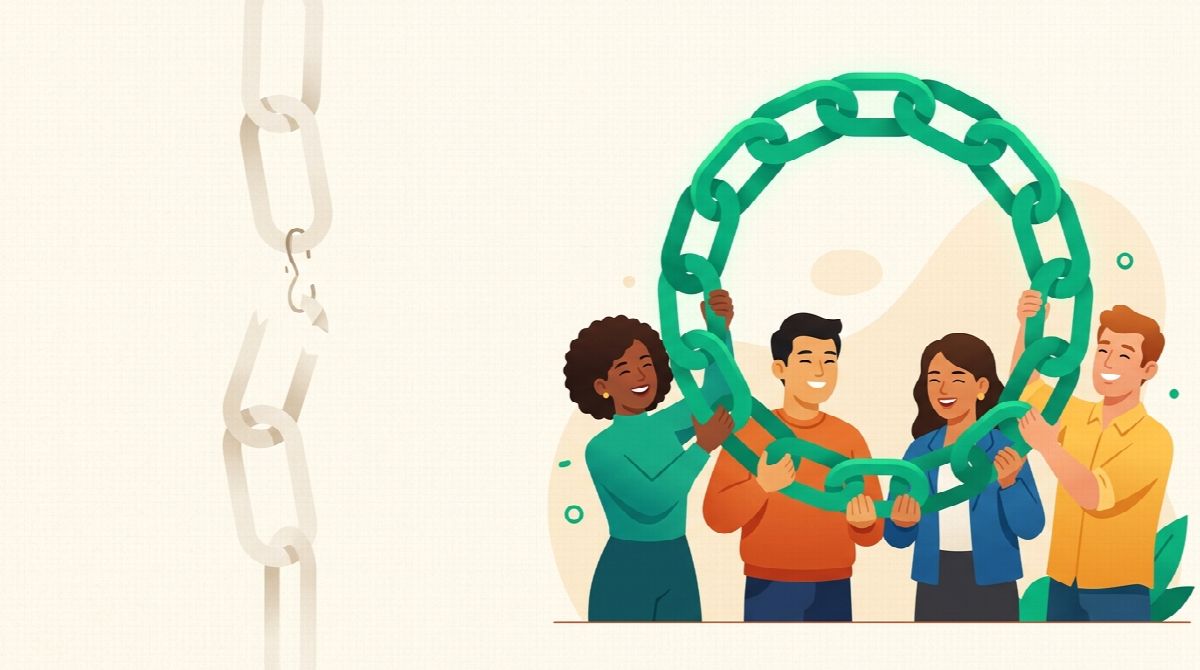
Groups also spread the emotional load. In a pair, one person ends up as coach, cheerleader, and friend at once, and that weight is a common reason pairs quietly dissolve. In a group, encouragement comes from multiple directions and checkins cluster into a shared daily rhythm that no single member has to carry.
Start with a partner if that is who you have. But if your last few pairs faded, the fix is usually one or two more people, not a stricter app. We wrote a full guide to group accountability apps for that step up, and our comparison of the best accountability apps covers both shapes.
How to set up a partnership that survives week two
However you pair up, five agreements up front do more than any feature:
- Pick one specific habit each. "Read 20 minutes" works. "Get healthier" does not.
- Define the Floor before the first hard day. Agree on the smallest version that earns a checkin, so a rough day produces a small win instead of silence.
- Set a daily checkin window. Partnerships stabilize when reports cluster at a predictable time, like evenings.
- Cheer effort, especially the small stuff. The partnerships that last celebrate the five-minute day, because that is the day that was hardest to show up for.
- Review weekly, adjust monthly. A quick "is this still the right habit?" conversation beats silently drifting apart.
If you are still deciding whether this whole approach fits you, our explainer on what an accountability partner is covers the role itself before the tools.
Try it with one friend
If your partner is a friend rather than a stranger or a coach, start a huddle in Habit Huddle. Pick a habit, set its Floor and Ceiling, and send your friend one link, nothing to install. Each daily checkin adds a link to your shared Checkin Chain, and the free plan covers a full huddle around one habit. Two people showing up for each other beats one person negotiating with an app.
Ready to Build Habits With Friends?
Stop failing alone. Join thousands using the #1 habit tracker with friends for real accountability and lasting results.
Prefer mobile? App Store · Google Play
Related Guides
More Habit Huddle articles on building habits with accountability.

HabitShare Alternatives: 6 Apps for Tracking Habits With Friends (2026)
Looking for a HabitShare alternative? Six social habit trackers compared by model, price, platforms, and what happens on a missed day, plus how to switch wit...
What to Do When You Miss a Workout Day: The 5-Step Comeback Plan
Missed a workout day? What one miss does to your body and habit, according to research, plus a five-step plan for the next 24 hours, when to make it up, and...
Habit Streak App With Friends: 7 Apps Compared (2026)
Seven habit streak apps with friends compared: Habit Huddle, HabitShare, Daily Pact, Habitica, Streaks, Habit Streak duels, HabitStreak.io. What friends see,...