
Dry January Challenge With Friends: How to Run One That Lasts All 31 Days (2027)
How to run a Dry January challenge with friends in 2027: formats for mixed goals, rules that survive a slip, where to track it together, and what to do on Fe...

📺 Related Video: Dry January Benefits, Staying Motivated & Meeting Sober-Curious Friends
Video by: Recoverycast · Watch on YouTube
A Dry January challenge with friends is 31 alcohol-free days, January 1 through January 31, that a small group commits to together and tracks somewhere everyone can see. The group is not decoration. It is the mechanism: the people most likely to finish a dry month are the ones who told someone, and the ones who told someone and then checked in daily finish most of all.
In 2027 the month opens on a Friday, which means your group's first real test arrives on day one. Plan for that and the rest of the month gets easier.
This guide covers how to set the challenge up so friends actually say yes, the rules that keep a group dry past the second weekend, where to track it, and what to do with the group on February 1. If you are running a longer alcohol-free stretch, the 60 days no alcohol guide covers the week-by-week timeline in more depth.
Why Dry January works better with friends
A dry month run with friends turns a private willpower test into a shared schedule, and shared schedules survive bad Fridays that private tests do not.
The research on Dry January itself points the same way. The University of Sussex tracked 857 Dry January participants through the month and six months after. Success during the month was predicted by "drink refusal self-efficacy" in social situations, in plain terms how confident you are saying no to a drink when other people are drinking. Six months later, participants were drinking less and refusing drinks more confidently, and the researchers found almost no "rebound" of heavier drinking afterward.
Two things follow from that. Saying no in a social setting is the skill Dry January trains, so a group that practices it together is practicing the exact thing that matters. And the month is not a one-off detox. Alcohol Change UK, which runs the official campaign, reports that six months after the challenge seven in ten participants are still drinking less riskily than before.
Harvard Health's advice for the month says it directly: create a support group, tell friends and family your intentions, and better yet, enlist someone to do the challenge with you. A group challenge is that advice taken seriously.
The quotable version: a dry month alone tests your willpower; a dry month with friends tests your calendar, and calendars are easier to keep.

Pick a format your friends will agree to
The best Dry January format for a friend group is the one where nobody has to pretend their goal is someone else's goal. Most groups have a mix: one person who wants a fully dry month, one who wants to cut back, and one who is mostly there for the company.
| Format | How it works | Best for | Watch out for |
|---|---|---|---|
| Everyone fully dry | Zero alcohol for all 31 days, same rule for all | Groups where everyone genuinely wants the full month | The friend who slips on day 9 quietly disappearing |
| Dry-ish, or damp January | Each person sets their own limit (dry weekdays, two drinks a week, no drinking at home) | Mixed groups, first-timers, anyone nervous about "all or nothing" | Limits so loose that the month changes nothing |
| Same checkin, different goals | Everyone commits to the same daily checkin, but some are dry and some are cutting back | Most real friend groups; this is the format to reach for | Comparing progress across different goals, so do not |
| Team challenge | Two sides, total alcohol-free days per side | Bigger groups, offices, Discord servers | The losing side losing interest in week three |
Same checkin, different goals is the format that survives contact with a real group chat. The dry friends stay dry, the cutting-back friends track their limit, and what you share is the daily yes. It also removes the most common January argument, which is one person policing another person's definition of success.
Whichever you pick, agree the definition before January 1. "Dry" means no alcohol at all, including the splash in the cooking and the 0.5% beer if that matters to anyone in the group. "Damp" means a written limit, not a vibe. If your group likes a little ceremony, write the agreement on one page and pin it, without adding penalties.
The rules that keep a group dry all month
Group Dry January challenges fail from bad rules more often than from weak resolve. Four rules do most of the work.
1. A slip is one day, not the end. Build this in from the start. Someone in your group will have a drink at a wedding, a work thing, or a rough Tuesday. If the rules say they are out, they go quiet, and you lose them for the rest of the month and probably from the group chat too. If the rules say the day costs one link in the group's chain and tomorrow is a fresh checkin, they stay. The Sussex study found that even people who did not complete the month were drinking less at six months, so the month is worth finishing even after a slip.
2. Check in every day, visibly. The daily checkin is the whole product. Each person marks their day done where the others can see it. Keep it to seconds: a tap, a tick, a single message. The friend who has to write a paragraph about their evening stops writing by day 6.
3. Cheer the day, never audit the miss. The tone of the group is set by what gets a reaction. When a checkin gets a cheer and a missed day gets silence, people come back. When a missed day gets a comment, people leave. This is the difference between accountability and surveillance, and only one of them survives January.
4. No money pots, no forfeits. Penalty rules sound fun in December and read as pressure by mid-January, and they push out the person who is struggling most, who is exactly the person the group exists for. If you want stakes, make them positive: the group books something on February 1 that everyone has been looking forward to.
One more rule that is really a safety note. If anyone in the group drinks heavily every day, stopping abruptly can cause withdrawal, and Harvard Health lists shaky hands, sweating, and insomnia as mild symptoms, with severe symptoms that need immediate medical help. A dry month is for people who drink more than they would like, not a substitute for treatment. If that describes someone in your group, the kindest thing the group can do is encourage a conversation with a doctor first.
Plan for the first Friday, not the first Monday
Dry January 2027 starts on a Friday, so your group's hardest day is day one, and the groups that finish decide in December how they will handle it.
The most useful thing you can do before the month starts is name the three moments each person expects to be hardest. For most people it is the first Friday evening, the first social event, and the first genuinely bad day at work. Each person writes down what they will drink instead in each of those moments and what they will do with the hour that normally involves a drink.
Then clear the house. Alcohol Change UK and Harvard both put "keep it out of the house" near the top of their advice, and it costs nothing. Give it to a neighbor, put it in the garage, or bring your own alcohol-free options to other people's houses so you are never relying on their fridge.
Finally, stock the alternatives. The group's standing question in week one is "what are you drinking instead," and having a real answer matters more than it sounds. Sparkling water with citrus, alcohol-free beer, a decent tonic, tea after dinner. Check the label on alcohol-free beer if a full zero matters to anyone, since some contain up to 0.5% alcohol.
You already know you can change.
You just need to take the first step. Habit Huddle helps you build habits around your goals, alongside friends who keep you accountable.
Where to track a Dry January challenge together
A group Dry January needs a shared home for its checkins, and the group chat that started it is the worst place to keep it.
Chat checkins work for about a week. Then conversation buries them, nobody can tell who has checked in today, and the person who slipped on day 9 has to scroll past everyone else's messages to come back. A spreadsheet fixes the record and loses the feeling: it shows everything and cheers nothing, and editing a shared sheet from a phone on a Friday night is enough friction to end participation. A printed Dry January tracker on the fridge works for one person's record, but it shows the group nothing.
A dedicated app gives the challenge a home: one tap to check in, a visible group record, and a chain of days that makes showing up feel like progress. Here is how the common options compare for a friend group specifically.
| Tracker | What it is | Group features | Cost | Best for |
|---|---|---|---|---|
| Try Dry (Alcohol Change UK) | The official Dry January app: tracks drinks, dry days, money and calories saved | Individual tracking; the campaign's community is separate | Free | Solo participants, or the official experience |
| Sunnyside | Mindful-drinking app built around a weekly drink plan and text-based coaching | Individual plans plus a members' community | Paid membership | Damp January and cutting back rather than quitting |
| Sober app | Free sobriety toolkit with a January challenge and team pages | Create a team, invite friends, see shared savings stats | Free | Groups where everyone is fully dry |
| Habit Huddle | Social habit tracker: each person's daily habit in a shared huddle with visible checkins | Group checkins, cheers, and a Checkin Chain the whole group builds | Free for the core group tracking | Groups with mixed goals and other January habits alongside |
The drink-specific apps are better than Habit Huddle at counting drinks. If your group is doing damp January with numeric limits, Try Dry or Sunnyside will show units and money saved in a way a habit tracker will not. Before you start, work out what a month's drinking costs and what that money buys instead; for most groups the number is a better motivator than any health statistic.
How Habit Huddle runs a group Dry January
Habit Huddle is our app, so judge the reasoning, not the ranking. We built it for the same-checkin, different-goals format this guide recommends.
Each friend sets their own daily habit, "no alcohol today" for the dry members and "under my limit today" for the damp ones, each with its own Floor and Ceiling. The Floor is the worst-day version that still counts, and the Ceiling is what a great day looks like, so a member who is cutting back can step on the floor on a hard Friday and burst through the ceiling on an easy Sunday. Everyone tracks inside one exclusive huddle for the group, and every checkin gets seen and cheered.
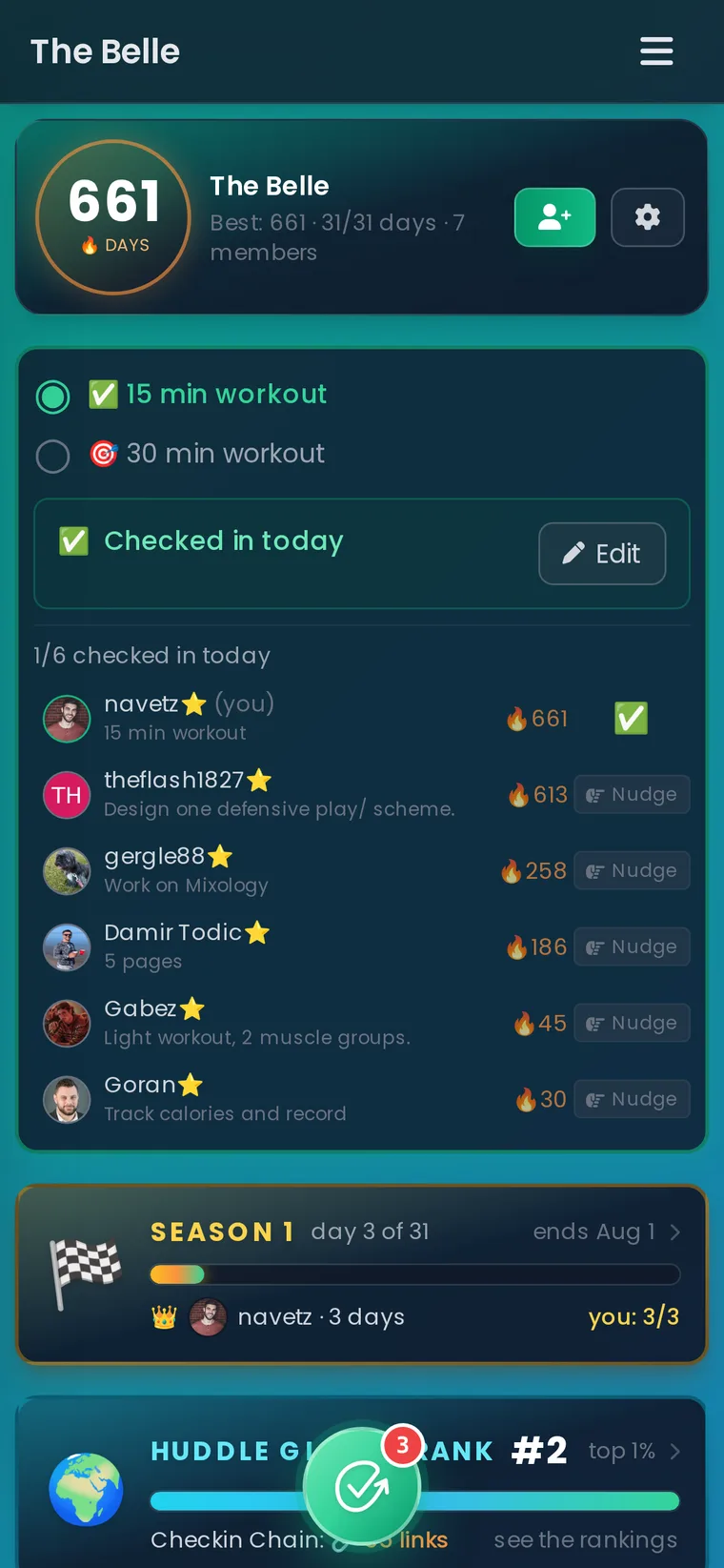
The group metric is the Checkin Chain: every member who checks in on a given day adds a link. It measures the group showing up together, not any one person's perfection, and a slip costs a link, never the challenge. The app deliberately never shows anyone a wall of another person's gaps. The design bet is the same one this guide makes: people stay for cheers, not surveillance.
Honest trade-offs: Habit Huddle counts days, not drinks, so it will not tell you units or money saved. Everyone in the group needs an account, which is a real ask. Checkins are manual, and the cheering comes from your people rather than from the app, so it works exactly as well as the group you bring. If that fits, start your huddle in December and invite the group before the holidays scatter everyone. More on the general shape in how to run a new year habit challenge with friends.
Things to do together that do not involve a drink
Most of the difficulty in a dry month is not the craving, it is the empty hour where the drink used to be, and a group can fill that hour for each other.
The list does not need to be clever. Groups that finish tend to do a few of these:
- A standing weekend morning walk or run, which also gives the Saturday-night no a reason.
- A weeknight dinner rotation at each other's places, host provides the alcohol-free drinks.
- One thing nobody would do with a hangover: an early hike, a 7am class, a long drive somewhere.
- A film or game night on the first Friday, at home, on purpose.
- A halfway meal out on January 16, ordering the most interesting non-alcoholic thing on the menu.
The point of all of it is that "I'm not drinking this month" is easier to say to a bartender when three people at the table are saying it with you.
What to do on February 1
February 1 is the most important day of a group Dry January, because what the group decides that morning determines whether the month meant anything.
The Sussex research is reassuring here: participation was linked to drinking less at six months regardless of whether people completed the month, and very few people reported drinking more afterward. Cardiovascular researchers at UCL found that a single month off in moderate-to-heavy drinkers lowered blood pressure, weight, and insulin resistance compared to a group that kept drinking. The month itself does real work.
The group's job on February 1 is to make the next decision explicit. Ask three questions in the chat: who wants to keep going, who wants to set a new limit for February, and what does the group do next. Some groups roll straight into a 60-day version. Some switch to a different shared habit and keep the same checkin ritual. The worst outcome is silence, because silence is how the old pattern comes back. If the group wants to keep running challenges past January, virtual accountability groups covers how to keep one alive long-term.
FAQ
How do I do a Dry January challenge with friends? Agree the format in December (fully dry, damp with written limits, or a mix), agree that a slip costs one day and not the month, pick one place where everyone checks in daily, and plan the first Friday in advance. Three to six committed people is the sweet spot.
What if one of us slips up during Dry January? Nothing dramatic. The day is missed, tomorrow is a fresh checkin, and the person stays in the group. Research on Dry January participants found that even people who did not complete the month were drinking less six months later, so finishing after a slip is still worth it.
Is Dry January better with a group? Yes for most people. The strongest predictor of completing the month in the Sussex study was confidence refusing drinks in social situations, which is exactly what a group practices together. Harvard Health's advice for the month includes enlisting someone to do it with you.
Can we do Dry January if not everyone wants to quit completely? Yes. Use the same-checkin, different-goals format: dry members track "no alcohol today," cutting-back members track "under my limit today," and everyone checks in daily. Mixed groups last longer when nobody is asked to adopt someone else's goal.
What is the best app for a group Dry January challenge? Try Dry or Sunnyside if you need drinks and money counted. Sober app if everyone is fully dry and wants a team page. Habit Huddle if your group has mixed goals or wants to run other January habits alongside, since it tracks each person's daily habit in one shared huddle.
Ready to Build Habits With Friends?
Stop failing alone. Join thousands using the #1 habit tracker with friends for real accountability and lasting results.
Prefer mobile? App Store · Google Play
Related Guides
More Habit Huddle articles on building habits with accountability.

HabitShare Alternatives: 6 Apps for Tracking Habits With Friends (2026)
Looking for a HabitShare alternative? Six social habit trackers compared by model, price, platforms, and what happens on a missed day, plus how to switch wit...
What to Do When You Miss a Workout Day: The 5-Step Comeback Plan
Missed a workout day? What one miss does to your body and habit, according to research, plus a five-step plan for the next 24 hours, when to make it up, and...
Habit Streak App With Friends: 7 Apps Compared (2026)
Seven habit streak apps with friends compared: Habit Huddle, HabitShare, Daily Pact, Habitica, Streaks, Habit Streak duels, HabitStreak.io. What friends see,...