
Health Accountability App: Which Type Actually Keeps You on Track?
Health accountability apps use friends, coaches, or money on the line. Compare Habit Huddle, HabitShare, Noom, stickK, and Beeminder to find your fit.

📺 Related Video: How to Stay Accountable With Your Health Goals
Video by: Nutrition Stripped · Watch on YouTube
A health accountability app keeps you working on a health goal by making your progress visible to someone or something outside your own head: friends, a coach, or money you stand to lose. The three types work very differently, and picking the wrong one for your personality is why most people's first accountability app gets deleted in a month.
This guide explains the three models, compares the best apps in each, and gives you a quick way to tell which one fits you.
What a health accountability app does (and what it can't)
An accountability app changes one variable: whether anyone notices when you make progress. The workouts, the meals, and the sleep are still yours to do.
That single variable is worth more than it sounds. In a randomized trial of a web-based depression intervention, researchers found adherence rose sharply when a human was expecting to see the participant's progress, a mechanism the authors named "supportive accountability" (Mohr et al., 2011, Journal of Medical Internet Research). A separate meta-analysis of 138 studies found that prompting people to monitor progress toward a goal reliably increased attainment, with stronger effects when progress was reported to someone else (Harkin et al., 2016).
What no app can do is supply the goal. Accountability amplifies a commitment you've already made; it doesn't create one.
The three models of health accountability
Every health accountability app is built on one of three pressures: social, professional, or financial.

| Model | How it works | Best apps | Typical cost |
|---|---|---|---|
| Social | Friends see your checkins and cheer you on | Habit Huddle, HabitShare | Free to low |
| Professional | A coach or program reviews your progress | Noom, Lark | Subscription, often $50+/month |
| Financial | You lose money if you miss your commitment | stickK, Beeminder | Free to join, you set the stakes |
Social accountability is the cheapest and the most durable, because the relationship outlives any subscription. It requires at least one person willing to join you.
Professional accountability buys expertise along with attention. It works well for structured goals like weight loss, and stops working the day you cancel.
Financial accountability is the bluntest tool. Loss aversion is real, and for some people a $20 stake does what no amount of encouragement can. Others just pay the fine and feel worse.
Best health accountability apps by model
stickK and Beeminder: money on the line
stickK lets you sign a commitment contract, name a referee, and set stakes that go to a charity (or, for extra spite, an organization you dislike) if you fail. Beeminder charts your progress toward a quantified goal and charges you when you go off track, with escalating pledges.
Both are effective for deadline-shaped goals and people who respond to loss. The trade-off: the motivation is negative. When the stakes stop scaring you, nothing else in the app keeps you coming back.
Noom and Lark: a program that watches your progress
Noom pairs a psychology-based curriculum with human coaching for weight loss; Lark uses an AI coach that nudges you about meals, activity, and sleep. Both give you the feeling of being expected, which is the active ingredient in supportive accountability.
The trade-offs are cost and dependency. These are real subscriptions, and the accountability is rented: progress reviews end with the billing.
You already know you can change.
You just need to take the first step. Habit Huddle helps you build habits around your goals, alongside friends who keep you accountable.
HabitShare: share habits with chosen friends
HabitShare is a free habit tracker where each habit can be shared with specific friends, who can see your log and message you. It's private by default and simple to use.
The trade-off is that it's built for pairs and loose sharing rather than a group working as a unit. There's no shared goal object, so the accountability is only as strong as whichever friend remembers to look.
Habit Huddle: a group habit with friends
Full disclosure: Habit Huddle is our app, so judge the reasoning and not the placement.
Habit Huddle turns a health habit into a huddle: you set a Floor (the minimum that counts, like 10 minutes of movement) and a Ceiling (the goal you're building toward), then invite friends to track their own version alongside you.
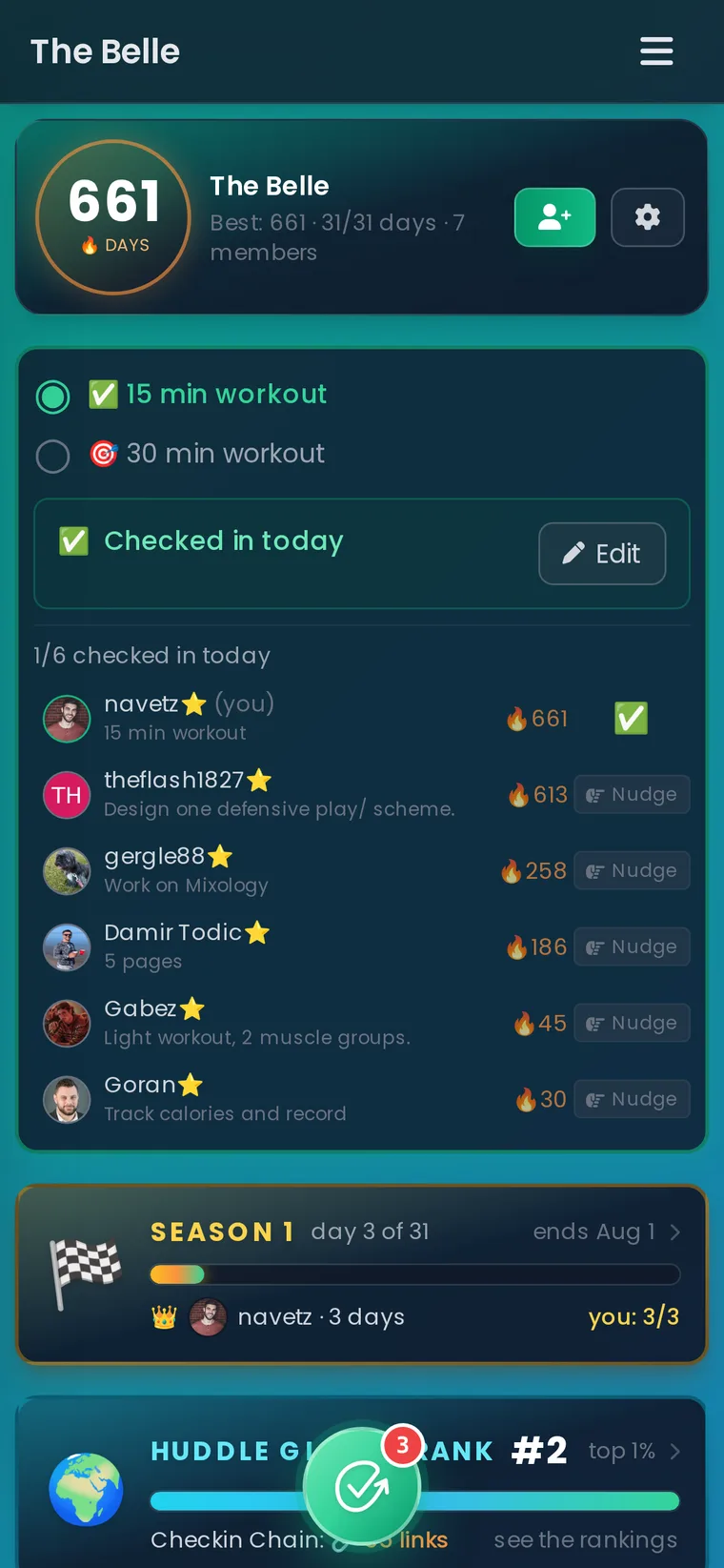
Each member's daily checkin adds a link to the group's Checkin Chain, and friends cheer the checkins as they land. The design is deliberately positive-only: your friends celebrate the days you show up, and the app never broadcasts anyone's missed days to the group.
Trade-offs: checkins are manual, there's no coach and no meal or biometric tracking, and it works best when you bring at least one friend (though solo huddles work, and you can find members). If you want a professional reviewing your bloodwork or macros, this is not that.
How to choose in 60 seconds
Answer one question honestly: what has ever actually made you follow through?
If the answer involves other people (a workout partner, a class you didn't want to skip, a team), pick social accountability. Start with a friend and a shared app before paying anyone.
If the answer is structure and expertise (a trainer, a program, a plan), pick professional accountability and budget for it like a gym membership.
If the answer is deadlines and consequences (you finish everything the night it's due), try financial stakes, starting small.

Two more rules of thumb. First, match the app to the goal's shape: quantified goals with an end date suit stakes and coaching, while ongoing daily habits suit social tracking. Second, if you've already failed with one model, switch models rather than switching to a prettier app built on the same one.
For the social route, an accountability partner plus any shared tracker beats a solo app with better charts. We compare the options in our guide to accountability partner apps, and there are solid free accountability apps if budget is the constraint.
Try the social model free
If friends are your answer, Habit Huddle is free to start: create a huddle for your health habit, set your Floor, and invite one or two people who are working on something too. Their habits don't need to match yours; the huddle tracks everyone's own habit side by side.
The goal is a group where showing up gets noticed and cheered. That's the whole mechanism, and it's the one that still works a year from now.
FAQ
What is a health accountability app? It's an app that makes your progress on a health goal visible to someone outside yourself: friends who see your checkins, a coach who reviews your data, or a service holding money you forfeit if you quit. The visibility, not the tracking, is what changes behavior.
What's the best free health accountability app? Habit Huddle and HabitShare are the strongest free options, both built on sharing progress with friends. stickK is also free unless you choose to put money on the line.
Do accountability apps really work? The mechanism does: research on supportive accountability and progress monitoring shows adherence improves when a person expects to see your progress. An app only works if it connects your progress to someone who expects to see it.
Is it better to have a coach or a friend for health accountability? A coach adds expertise and works well for structured, time-boxed goals like a weight-loss program. Friends are free, mutual, and more durable for ongoing daily habits. Many people do best with a coach for the plan and friends for the daily follow-through.
Can I use a health accountability app without sharing private health data? Yes. Social habit trackers like Habit Huddle only share your checkins, so friends see that you did your habit, not your weight, meals, or medical details.
Ready to Build Habits With Friends?
Stop failing alone. Join thousands using the #1 habit tracker with friends for real accountability and lasting results.
Prefer mobile? App Store · Google Play
Related Guides
More Habit Huddle articles on building habits with accountability.

HabitShare Alternatives: 6 Apps for Tracking Habits With Friends (2026)
Looking for a HabitShare alternative? Six social habit trackers compared by model, price, platforms, and what happens on a missed day, plus how to switch wit...
What to Do When You Miss a Workout Day: The 5-Step Comeback Plan
Missed a workout day? What one miss does to your body and habit, according to research, plus a five-step plan for the next 24 hours, when to make it up, and...
Habit Streak App With Friends: 7 Apps Compared (2026)
Seven habit streak apps with friends compared: Habit Huddle, HabitShare, Daily Pact, Habitica, Streaks, Habit Streak duels, HabitStreak.io. What friends see,...