
10 Best Free Accountability Apps and Software for 2026
The 10 best free accountability apps and software for 2026, sorted by how they keep you on track: social groups, money stakes, and live coworking.

📺 Related Video: What is a "body double," and how does it help?
Video by: How to ADHD · Watch on YouTube
The best free internet accountability apps fall into three groups: social apps where a small group cheers your daily progress, commitment apps that put money on the line, and live coworking apps that pair you with a focus partner in real time. The right pick depends on why you drift online in the first place, not on which app has the longest feature list.
One clarification saves a lot of wasted downloads. "Internet accountability" also names a separate software category: monitoring tools like Accountable2You, Ever Accountable, and Canopy that report your browsing to a trusted partner. Those are covered near the end. The ten apps below solve the other side of the problem: building the habits and focus sessions that crowd the aimless scrolling out.
All ten have a genuinely usable free tier, not just a trial. For a wider look at the category beyond free options, see our guide to the best accountability apps.
Match the app to your accountability type

Accountability tools work through three different mechanisms, and picking the wrong one is the most common reason people conclude the whole category is useless.
Social accountability makes your progress visible to people who cheer it. It fits if you show up more consistently when your wins are seen. Financial accountability attaches a consequence to a measurable rule. It fits if stakes move you more than encouragement. Real-time accountability gives you a live partner for the work session itself. It fits if your problem is starting, not planning.
The evidence behind the general approach is solid. A meta-analysis of 138 studies found that prompting people to monitor their goal progress reliably improved goal attainment, and the effect was larger when progress was reported to someone else or made public. Accountability apps are essentially that finding turned into software.
If you already know a partner setup is what you want, our breakdown of accountability partner apps goes deeper on that specific format.
1. Habit Huddle
Full disclosure: Habit Huddle is our app, so judge the reasoning, not the placement.
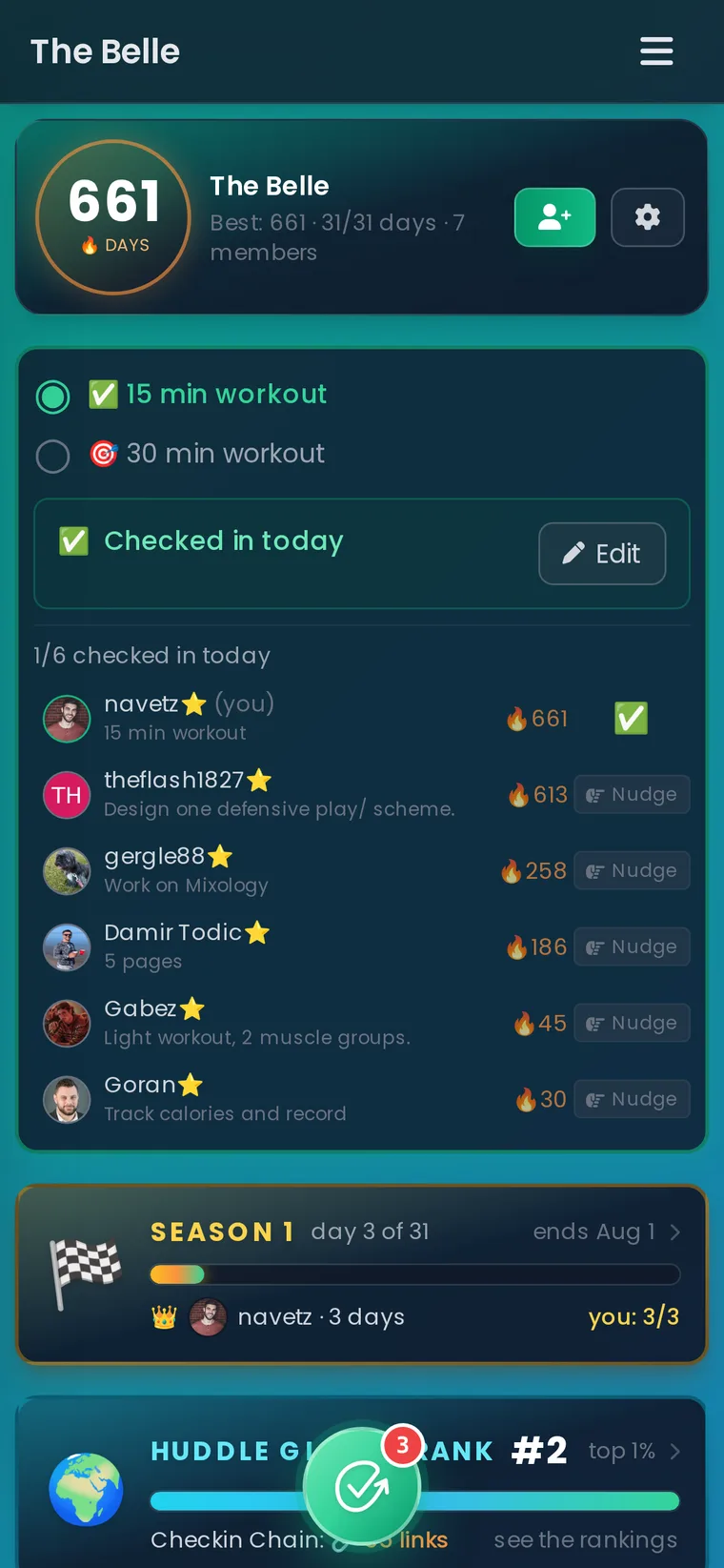
Habit Huddle is social accountability built around small groups instead of monitoring. You join or start a huddle with friends, pick the habit you are working on, and post a daily checkin. Each habit has a Floor, the minimum that keeps the habit alive on a busy day, and a Ceiling to burst through when you have more in the tank. Every member who checks in adds a link to the huddle's Checkin Chain, so the group builds something together.
The design choice that matters for this list: nobody's missed days are put on display. The huddle sees the checkins you post and cheers them. That makes it the opposite of surveillance-style internet accountability, and a natural fit for replacing scroll time with a visible habit like reading, training, or focused work.
- Free angle: Free to start with the core huddle loop, on web, iOS, Android, and Discord. Paid tiers add extras, not the basics.
- Main trade-off: It is habit accountability, not screen monitoring. It never sees your browsing, and if you want a dense dashboard tracking a dozen habits solo, a solo tracker fits better.
Here is a live huddle if you want to see the format before signing up:
2. HabitShare
HabitShare is for people who do not want a system, just a friend who can see the habit. You track habits, choose per habit which friends can see it, and lean on reminders. That per-habit privacy control matters more than it first appears. Plenty of people want accountability on one sensitive habit without opening up their whole routine.
HabitShare positions itself as 100% free, and it is mobile-first and intentionally simple.
- Best for: Pairs of friends or couples who want lightweight visibility without structure.
- Main trade-off: No desktop workflow, light reporting, and no group container. Compared with Habit Huddle it is more casual and more individual; there is no shared chain to build, which is exactly what some people prefer.
3. Goalify
Goalify sits between a minimal social tracker and a full planning system. It blends goals, reminders, stats, and accountability groups, and its free tier is enough to test whether group accountability works for you before paying.
It is a good pick when internet distraction is one symptom of a broader execution problem: a morning routine, a study schedule, a weekly review, all held together in one place. If you are weighing structure against simplicity, our piece on habit-building app design covers why clarity usually beats feature count.
- Best for: Planners who want goals, reminders, and progress in one system at Goalify.
- Main trade-off: Free-tier limits are real, and the extra knobs overwhelm people who just want to show up daily.
4. Habitica
Habitica turns habits and tasks into an RPG. You earn rewards, level an avatar, and join parties where shared quests fail when members skip their dailies. If plain checklists fade into wallpaper for you after a week, the game loop keeps the habit visible longer.
The free core on Habitica is generous, spanning web, iOS, and Android.
- Best for: People who need play to make repetition bearable, and communities that enjoy team quests.
- Main trade-off: Managing your life through avatars and quest mechanics is stimulation some people need less of, not more. The party damage mechanic also punishes the whole group for one member's rough week, which reads as pressure rather than support for many people.
5. Coach.me
Coach.me is the steady utility of this list. Free habit tracking with streaks and a community answer layer, with paid human coaching as a clearly separated upgrade lane at Coach.me. Many apps blur what is free and what is paid; Coach.me keeps the lanes obvious.
- Best for: Self-directed users who want a visible streak, light community encouragement, and the option of real coaching later without migrating systems.
- Main trade-off: The group coordination is thin next to small-group apps, and parts of the interface show their age. It reinforces replacement habits like writing or reading rather than addressing internet use directly.
6. Beeminder
Beeminder is the pick when encouragement has stopped working. You set a measurable goal, follow a bright red line on a graph, and put money at risk if you cross it. Per Beeminder's pricing, starting is free, you can begin with nothing at risk, and the first real pledge after a derail is $5.
- Best for: Data-driven people with clearly measurable goals: writing minutes, workouts, study sessions, task counts.
- Main trade-off: Vague goals like "be less distracted" do not fit the model, setup takes effort, and money-based pressure stresses some people into avoiding the app entirely. If you have ever rage-quit a fine, choose social over financial.
You already know you can change.
You just need to take the first step. Habit Huddle helps you build habits around your goals, alongside friends who keep you accountable.
7. stickK
stickK also runs on commitment contracts but adds people to the money. You name supporters and a referee who verifies whether you kept the commitment, with optional cash stakes at stickK. The free basic contract is enough to test the model.
The simplest way to choose between the two: Beeminder if you like charts and automation, stickK if you want another human ruling on whether your promise counted. That human layer helps with internet rules like "no social media before lunch," which are easy to reinterpret after the fact when nobody is checking.
- Best for: People who have gotten good at bargaining with themselves.
- Main trade-off: Wager-based systems backfire on people who respond to slips with shame instead of correction.
8. Focusmate

Focusmate is real-time accountability, often called body doubling. You book a session, meet a partner on video, each declare a goal, then work quietly for 25, 50, or 75 minutes. Most distraction happens in the gap between intending to work and starting; a scheduled human presence closes that gap.
Focusmate's free plan includes 3 sessions per week with no card required; unlimited sessions run $8/month billed annually.
- Best for: Procrastinators and deep-work tasks you keep delaying: writing, admin, studying.
- Main trade-off: You need a quiet space, camera comfort, and tolerance for partner variability. It carries the work block, not the long-term habit; pairing it with a tracker covers both. Our explainer on what an accountability partner does covers why presence during the task changes behavior fastest.
9. Stridekick
Stridekick is deliberately narrow: movement. It syncs with major wearables and turns steps and activity into challenges, leaderboards, and virtual races with friends at Stridekick.
It will not touch your browsing or your writing habit. It earns its slot indirectly: when scrolling has replaced walking or training, making the competing physical habit social is often a better intervention than blocking the scroll.
- Best for: Friend groups and workplaces running step or activity challenges, with the wearable doing the logging for you.
- Main trade-off: Fitness-only. For anything a wearable cannot count, you need a general tracker alongside it.
10. Flora
Flora is the lightest touch here: a focus timer where a virtual tree grows while you stay off your phone, and dies if you bail. Shared planting sessions add a small social layer, and tags and to-dos give sessions purpose at Flora.
- Best for: Reflexive phone-checkers who know exactly when they are vulnerable, like the first hour of work or an evening study block.
- Main trade-off: The accountability ends when the timer does. It protects sessions, not habits, so it works best paired with something that tracks the longer arc.
Free accountability apps compared
| App | Accountability type | Free tier | Best for |
|---|---|---|---|
| Habit Huddle | Social, small groups | Free to start, core loop included | Friends building habits together |
| HabitShare | Social, 1-to-1 | Positioned as 100% free | Lightweight friend visibility |
| Goalify | Social + planning | Free with limits | Multi-goal planners |
| Habitica | Social, gamified | Generous free core | People who need play |
| Coach.me | Community + coaching | Free tracking | Streaks with an upgrade path |
| Beeminder | Financial | Free until you derail, then $5 pledge | Measurable, data-friendly goals |
| stickK | Financial + referee | Free basic contracts | Self-bargainers who need a verdict |
| Focusmate | Real-time | 3 sessions/week | Task starters and deep work |
| Stridekick | Social, fitness | Free for small groups | Step and activity challenges |
| Flora | Focus timer | Free with in-app purchases | Phone-checkers in focus blocks |
When monitoring software is the better fit
If your goal is strict visibility into browsing itself, the habit-side apps above are the wrong tool. Screen accountability products like Accountable2You, Ever Accountable, Covenant Eyes, and Canopy monitor devices and send reports or alerts to a partner you choose. They are built for situations where the content itself is the problem and a trusted person has agreed to receive reports.
Be aware that genuinely free options are rare in that category; most run on subscriptions with trials. And the model only works with a willing partner on the other end. For everyone whose real issue is aimless time rather than harmful content, visible habits and protected focus sessions solve the actual problem with far less friction.
How to choose in 60 seconds
Ask why the internet wins. If you drift because nobody sees your effort, pick social: Habit Huddle for a group with one shared rhythm, HabitShare for a single friend. If you drift because breaking a rule costs nothing, pick financial: Beeminder for graphs, stickK for a referee. If you drift at the starting line, pick real-time: Focusmate, with Flora guarding the phone.
Then give one app a fair month. Tool-hopping every four days is its own form of procrastination.
If the social route sounds like yours, start a huddle on Habit Huddle with two or three friends and one honest habit each. It is free to start, checkins take seconds, and the Checkin Chain gives the whole group a reason to keep showing up.
Ready to Build Habits With Friends?
Stop failing alone. Join thousands using the #1 habit tracker with friends for real accountability and lasting results.
Prefer mobile? App Store · Google Play
Related Guides
More Habit Huddle articles on building habits with accountability.

HabitShare Alternatives: 6 Apps for Tracking Habits With Friends (2026)
Looking for a HabitShare alternative? Six social habit trackers compared by model, price, platforms, and what happens on a missed day, plus how to switch wit...

What to Do When You Miss a Workout Day: The 5-Step Comeback Plan
Missed a workout day? What one miss does to your body and habit, according to research, plus a five-step plan for the next 24 hours, when to make it up, and...
Habit Streak App With Friends: 7 Apps Compared (2026)
Seven habit streak apps with friends compared: Habit Huddle, HabitShare, Daily Pact, Habitica, Streaks, Habit Streak duels, HabitStreak.io. What friends see,...