
New Year Resolution Tracker App: What Actually Keeps a Resolution Alive Past January (2027)
What a new year resolution tracker app needs to work past January: daily actions, a worst-day floor, no reset after a miss, and a friend who sees it. Types c...

📺 Related Video: Best FREE Habit Tracking Apps Ranked (Simple, Effective & Easy to Stick With)
Video by: Lewis Bertus PA-C · Watch on YouTube
A new year resolution tracker app is a daily habit tracker pointed at one January goal, and the ones that work past January share four traits: they track a daily action instead of an outcome, they let you set a worst-day minimum, they survive a missed day without resetting you to zero, and someone other than you can see that you showed up.
Most "resolution tracker" apps in the store are none of those things. They are seasonal checklists that get abandoned around the second Friday of January, right on schedule with the resolutions inside them.
This guide covers why that happens, what to look for in a tracker that lasts, how to turn a resolution into something an app can actually track, and an honest comparison of the tracker types, including our own. If you want the group-challenge version of January, the new year habit challenge guide covers formats and rules.
Why most resolution trackers get abandoned with the resolution
Resolution trackers fail because they track the resolution, and a resolution is an outcome that cannot be done on a Tuesday.
"Lose 20 pounds," "read more," and "save money" are results. Nothing about them tells you what to do at 7am on January 12, so the tracker sits there with nothing to tick until the whole project quietly ends. Strava's analysis of over 800 million logged activities found that resolution-driven exercise collapses around the second Friday of January, now widely called Quitter's Day. In 2027 that is January 8.
The research on resolutions is more hopeful than the folklore, and it points at what the tracker should do instead. A University of Scranton study followed 159 people who made a New Year's resolution and 123 comparable people who wanted the same changes but made no resolution. At six months, 46% of the resolvers were continuously successful compared to 4% of the non-resolvers. Making the resolution matters. What predicted success before January 1 was confidence, concrete skills, and readiness, and what predicted it after January 1 was doing things, not feeling things: successful resolvers used more practical, behavioral strategies and fewer awareness and emotion-based ones.
A Stockholm University experiment with 1,066 participants added a second finding. A year later, 55% considered their resolution a success, and people with approach goals ("start running") did better than people with avoidance goals ("stop eating junk"): 58.9% versus 47.1%. The group that received a little goal-setting support also did better than the group that received none.
Put together: a resolution has a real chance, but only when it is translated into a daily approach behavior with a bit of structure around it. That translation is the tracker's job.

What to look for in a resolution tracker app
A resolution tracker earns its place on your phone by doing five things, and the seasonal apps usually do one.
It tracks a daily action, not a yearly outcome. The unit of tracking has to be something you can complete today: a walk, ten pages, a transfer to savings, an alcohol-free evening. If the app's main field is a target and a progress bar, it is a goal tracker, and it will go quiet the moment the goal is far away.
It lets you set a worst-day minimum. The single most useful feature in any habit tracker is a version of the habit small enough to clear on your worst day. Ten minutes instead of the full workout, one page instead of a chapter. Trackers that only know "done" or "not done" at full size teach you to skip on bad days, and bad days are where resolutions die.
It survives a miss without resetting you. In the most cited real-world study of habit formation, Lally and colleagues tracked 96 people and found that missing a single opportunity made no measurable difference to how strongly the habit formed. A tracker that flashes a broken streak and a zero after one miss is teaching you something that is not true. Look for streak protection, a freeze, or a design that simply does not punish a gap.
Someone can see you showed up. The Scranton finding that behavioral strategies beat emotional ones has a practical translation: the most reliable behavioral strategy is telling someone. A tracker that lets a friend or two see your daily checkin adds a small social reward to every ordinary day, not just milestone days. Solo trackers rely entirely on you noticing your own progress, which is exactly the thing you stopped doing on January 8 last year.
It works in September. A resolution tracker that only makes sense in January is a countdown, not a tracker. The app should be one you would use for any habit in any month, because the resolution that succeeds becomes an ordinary habit by March and needs an ordinary place to live.
The quotable version: the best resolution tracker is a habit tracker that makes you show up on the days the resolution feels pointless, and lets someone see it when you do.
Turn the resolution into something you can track
The translation from resolution to daily habit is a five-minute exercise, and doing it before January 1 is worth more than any app feature.
Start with the resolution as written, then ask "what would I do today if I were already the person who achieved this?" That gives you the daily action. For numeric resolutions, the free goal to daily habit calculator turns a yearly target like 24 books or $5,000 saved into the daily number. Then set two sizes: the smallest version that still counts, which is your Floor, and the version a good day looks like, which is your Ceiling. You step on the floor when the day is bad and burst through the ceiling when it is good, and both count as showing up.
| Resolution | Daily habit | Floor (worst day) | Ceiling (good day) |
|---|---|---|---|
| Lose 20 pounds | Move every day | 10-minute walk | 45-minute workout |
| Read more | Read before bed | 2 pages | A chapter |
| Save $5,000 | Transfer to savings | $1 | $20 |
| Drink less | Alcohol-free evenings | Under my limit today | No alcohol today |
| Get better sleep | Phone out of the bedroom | Phone charging outside the door by midnight | Lights out by 10:30 |
| Be less stressed | Ten minutes of quiet | 2 minutes of breathing | 15-minute meditation |
Notice that every daily habit in the table is an approach goal. "Drink less" became "alcohol-free evenings" and "be less stressed" became "ten minutes of quiet." That is the Stockholm finding applied: track the thing you do, not the thing you avoid.
One resolution at a time. The January instinct is to fix everything at once, which is why the store apps that let you enter twelve resolutions on one screen feel so satisfying on December 31. Pick the one habit that makes the others easier and track that. If you genuinely cannot choose, our guide to staying consistent with goals walks through how to pick.
You already know you can change.
You just need to take the first step. Habit Huddle helps you build habits around your goals, alongside friends who keep you accountable.
Paper, spreadsheet, or app
Resolution trackers come in four shapes, and the right one depends on whether you want a record, a reminder, or a reason.

| Tracker type | What it is good at | Where it fails | Best for |
|---|---|---|---|
| Printable or paper tracker | Zero setup, satisfying to tick, lives where the habit happens | No reminders, nobody sees it, easy to stop noticing on the fridge | One simple habit you do at home |
| Spreadsheet | Full control, shows everything at once, free | Celebrates nothing, painful on a phone, no social layer | Data-minded people tracking numbers, not habits |
| Seasonal resolution apps | Fun on January 1, lets you list many resolutions | Outcome-focused, no worst-day floor, usually abandoned by February | Nobody past the first week, honestly |
| Solo habit apps (Streaks, Habitica, Loop, and similar) | Daily reminders, streaks, good design | The streak is the only motivator, and one miss can feel like the end | Self-motivated people who do not want anyone else involved |
| Social habit apps | Daily checkins a friend or small group can see and cheer | Everyone needs an account; works only as well as the people you bring | Anyone whose past resolutions died from nobody noticing |
The honest summary: paper is better than most apps for the first two weeks, and worse than a good app from week three on, because week three is where you need something other than your own attention to keep going. If you are choosing between solo apps, best habit tracker app compares them in more depth.
How Habit Huddle tracks a resolution
Habit Huddle is our app, so judge the reasoning, not the ranking. It was built around the four traits this article opened with, and it is a year-round habit tracker rather than a January product.
Your resolution becomes one daily habit with a Floor and a Ceiling, exactly as in the table above. Every day you check in, and the checkin lands in a huddle: solo if you want, or with a few friends who see it and cheer. Every habit you track is a huddle, solo or with friends, so a resolution you start alone in January can add a friend in February without starting over.
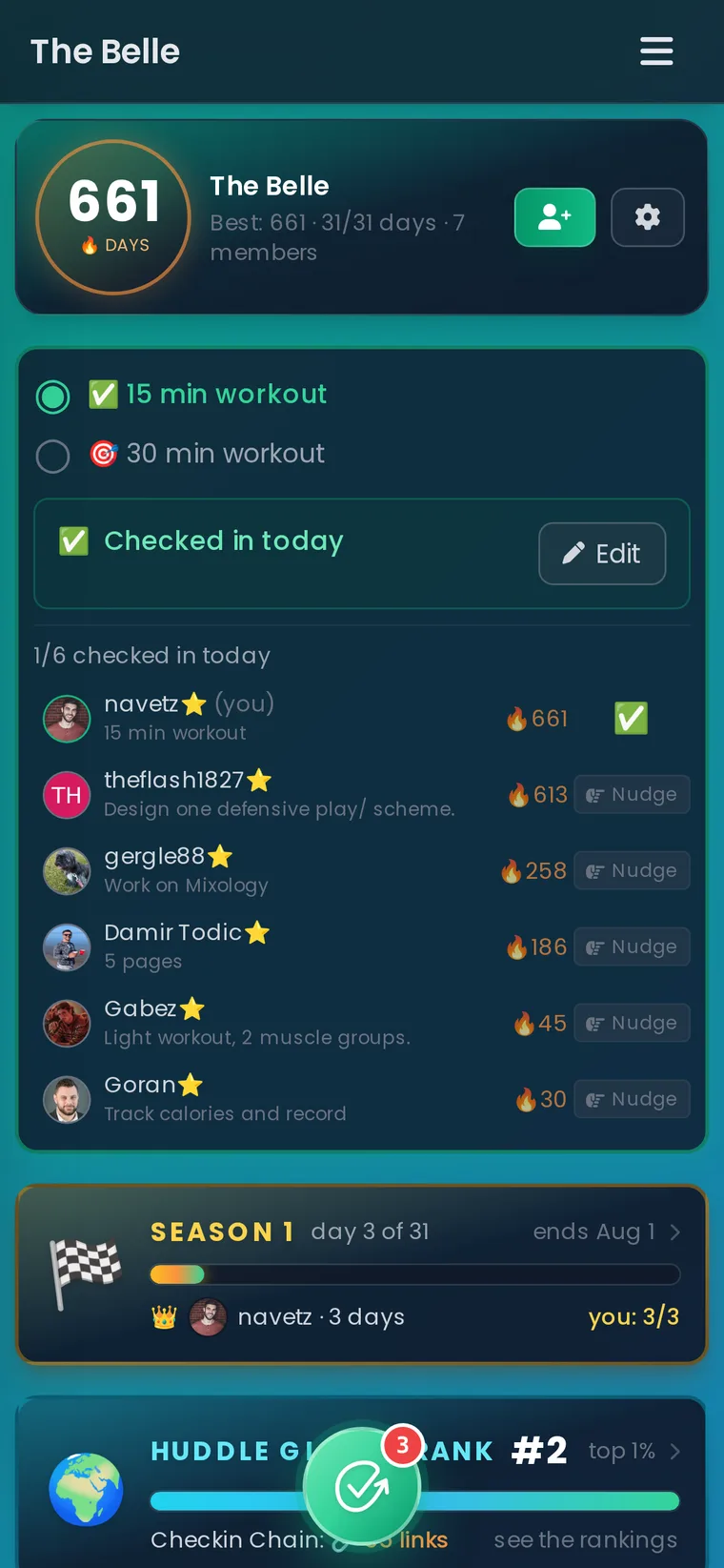
A missed day costs that day and nothing else. Your personal streak has a starter freeze on the free plan, and the group's Checkin Chain counts links from everyone who showed up, so one person's bad Tuesday never wipes out what the group built. The app deliberately never shows anyone else your gaps. It shows people the days you showed up, and those get cheered.
Honest trade-offs: the free plan covers one active habit, which for a resolution is the point, but people who want to track several habits at once will hit that limit. Checkins are manual, there is no automatic step or workout syncing, and the cheering comes from your people rather than from the app, so it is only as good as the friend or two you invite. If that fits, start your habit before January 1 and add a friend or two when you are ready. If you want the free and group angles compared first, free habit tracker with friends covers what the free tier does and does not include.
Set it up before January 1
A resolution tracker set up on New Year's Day is a resolution tracker set up hungover and in a hurry, and that shows by January 8. Four steps the week before:
1. Pick one resolution and translate it. Use the table above. Write the daily habit, the Floor, and the Ceiling in the app before December 31.
2. Decide the time and the trigger. "After I make coffee," "when I get home," "phone on the charger at 11." A daily habit without a slot in the day is a wish.
3. Tell one person, and let them see it. This is the behavioral strategy the Scranton study found in successful resolvers. In a social tracker, invite the friend. In any other tracker, send them your first checkin manually and keep doing it.
4. Plan January 8. Quitter's Day is predictable, so pre-decide what the floor looks like that week. A slump that was planned for feels like part of the plan instead of proof it is not working.
Then check in every day, including the days you only stepped on the floor. Those are the days the tracker exists for.
FAQ
What is the best app to track New Year's resolutions? The best resolution tracker is a daily habit tracker rather than a seasonal resolution app: it tracks a daily action, lets you set a worst-day minimum, does not reset you after one miss, and lets a friend see your checkins. Habit Huddle is built around those four traits; solo apps like Streaks or Loop work for people who want no one else involved.
Do resolution tracker apps actually work? The tracking itself is only as good as what it tracks. Research on resolvers found that practical, behavioral strategies predicted success and that people with a resolution were far more likely to succeed at six months than people without one. A tracker that turns the resolution into a daily action and makes showing up visible supports exactly those strategies.
How many resolutions should I track at once? One. Pick the habit that makes the others easier and track that daily. Apps that let you list a dozen resolutions feel productive on December 31 and are usually abandoned within weeks.
What should I do if I miss a day of my resolution? Check in the next day at the floor level and keep going. Habit-formation research found that a single missed day made no measurable difference to how strongly a habit formed. The only thing that ends a resolution is stopping, so the rule is never miss twice.
Is a paper resolution tracker better than an app? For the first two weeks, often yes: paper is fast and satisfying. From week three on, an app with reminders and a person who can see your checkins is usually better, because that is when your own attention stops being enough.
Ready to Build Habits With Friends?
Stop failing alone. Join thousands using the #1 habit tracker with friends for real accountability and lasting results.
Prefer mobile? App Store · Google Play
Related Guides
More Habit Huddle articles on building habits with accountability.

HabitShare Alternatives: 6 Apps for Tracking Habits With Friends (2026)
Looking for a HabitShare alternative? Six social habit trackers compared by model, price, platforms, and what happens on a missed day, plus how to switch wit...
What to Do When You Miss a Workout Day: The 5-Step Comeback Plan
Missed a workout day? What one miss does to your body and habit, according to research, plus a five-step plan for the next 24 hours, when to make it up, and...

Habit Streak App With Friends: 7 Apps Compared (2026)
Seven habit streak apps with friends compared: Habit Huddle, HabitShare, Daily Pact, Habitica, Streaks, Habit Streak duels, HabitStreak.io. What friends see,...