
How to Stay Consistent with Goals: A System That Works
Tired of starting strong and then quitting? Learn how to stay consistent with goals using a practical system that beats willpower, even when life gets messy.
Most advice about consistency starts in the wrong place. It tells you to be more disciplined, want it more, wake up earlier, or push harder when motivation dips. That sounds tough-minded, but it breaks the moment life gets loud.
Real consistency doesn't come from performing well in calm conditions. It comes from building a system that still works when you're tired, overloaded, behind on sleep, caring for someone else, or dealing with a week that blew up your plan by Tuesday. That's the difference between a goal you restart every month and a goal that survives real life.
If you're trying to learn how to stay consistent with goals, stop asking, “How do I become more motivated?” Ask a better question. “What system will still function on my worst week?” That shift changes everything.
Table of Contents
- Why Willpower Is Not a Strategy for Consistency
- Connect Your Goal to Your Identity
- Design Your Minimum and Daily Targets
- Engineer Your Environment with Cues and Streaks
- Build Momentum with Social Accountability
- How to Troubleshoot Setbacks Without Quitting
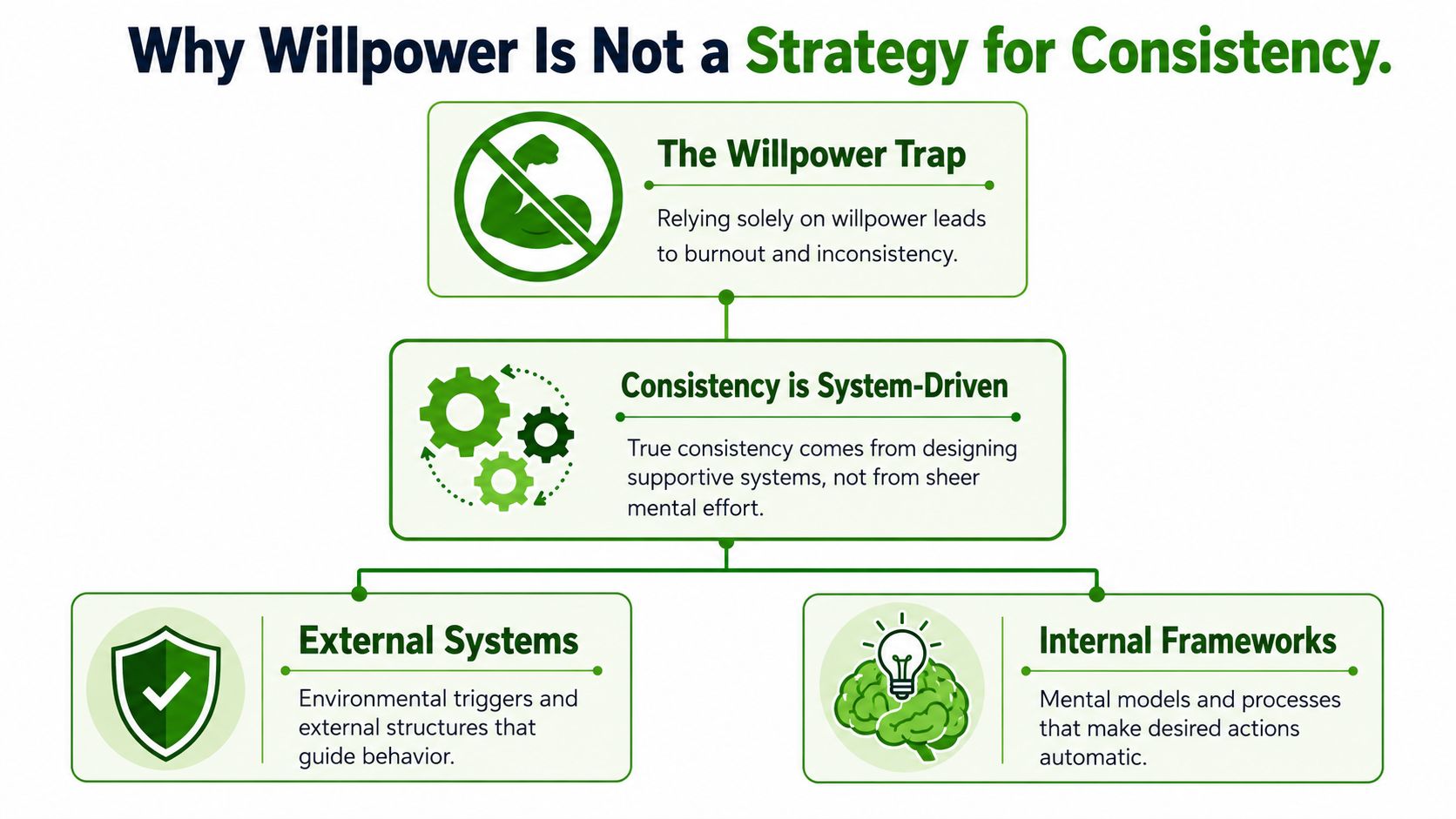
Why Willpower Is Not a Strategy for Consistency
People love to say, “Just be disciplined.” That's not a strategy. That's a demand. It assumes your energy, focus, and emotional bandwidth will stay stable long enough to support repeated action. They won't.
Behavioral science cited in a 2025 analysis argues that continuity, not intensity, is the strongest predictor of long-term adherence during high-load periods, and that 90% of existing guides focus on stable routines instead of messy real life (analysis on staying consistent when life gets messy). That matches what coaches see every day. People usually don't fail because they lack ambition. They fail because their plan only works on good days.
The real problem is system fragility
A fragile system has one mode. Full effort. If you can't do the full workout, full study block, full writing session, or full cleanup routine, you do nothing. That's why so many smart people keep “falling off.”
A resilient system has built-in downgrade options. It expects stress. It expects interruptions. It expects your brain to resist effort some days.
Practical rule: Build for the week you don't want to have, not the week you wish you had.
This is the core of a turbulence-first approach. You design for continuity first, then volume second. If your goal is fitness, the first question isn't how many hard sessions you'll complete in a perfect week. It's what counts when work runs late and your head is fried. If your goal is career growth, the same principle applies. Plans that help you supercharge your career only matter if they survive ordinary pressure, not just January enthusiasm.
A lot of this comes down to understanding behavior as a design problem, not a character test. Habit loops, friction, triggers, and reward timing matter. If you want a useful primer on that lens, behavior change psychology is a better starting point than another pep talk about grinding harder.
What a turbulence-first system includes
A consistency system that survives chaos usually has five parts:
- Identity before output: You act from the kind of person you're becoming, not just the result you want.
- A minimum version: You define the smallest action that still counts on unstable days.
- Visible cues: You stop relying on memory and make the next action obvious.
- External accountability: Someone else can see whether you showed up.
- Fast recovery: You know exactly what to do after a miss, so one bad day doesn't become a lost month.
Willpower still has a role. It helps at the point of decision. But it can't carry the whole structure. When people ask how to stay consistent with goals, they're usually asking how to stop breaking promises to themselves. The answer is rarely “try harder.” It's “make the promise easier to keep under pressure.”
Connect Your Goal to Your Identity
Outcome goals sound clear, but they often create a brittle relationship with effort. “Write a book.” “Lose weight.” “Get promoted.” “Meditate every day.” These goals can work, but they also make your behavior feel transactional. If the result feels far away, today's action feels optional.
Identity works differently. You're no longer trying to force a result through daily effort. You're proving something about who you are through repeated action. “I am a writer.” “I am a person who trains.” “I am someone who keeps commitments.” “I am a calm person who resets before reacting.”
A 2025 meta-analysis of over 50 studies found that identity-aligned habits had a 3.2 times higher retention rate after the initial novelty wears off compared to reward-based systems (summary of the identity-based habit evidence). That's the practical reason identity matters. Motivation drops. Identity lasts longer.

Outcome goals create pressure
When people chase outcomes alone, they tend to ask the wrong daily question. “Did I do enough?” That question creates anxiety because “enough” keeps moving.
Identity changes the daily question to, “Did I cast a vote for the person I said I want to be?” That is much more stable. A writer who writes one paragraph still behaved like a writer. A runner who laces up and walks ten minutes still behaved like a runner. The action is smaller, but the identity remains intact.
You don't need to feel motivated to act in line with identity. You only need to recognize the next behavior that fits it.
This also protects you from one of the most common traps in goal pursuit. People think identity has to be earned after success. In practice, it works better in reverse. You claim the identity first, then reinforce it through evidence.
Use identity statements that shape action
Try this exercise. Don't start with your goal. Start with the person who would achieve it consistently.
Complete these prompts:
- I am the kind of person who... shows up even when the day isn't clean.
- When life gets busy, I still... do the minimum that keeps the pattern alive.
- People like me... prepare the next step before they need motivation.
- My proof today is... one action that confirms the identity.
A few examples make this concrete:
| Goal | Weak framing | Identity framing |
|---|---|---|
| Writing | I need to finish my draft | I am a person who writes regularly |
| Fitness | I need to lose weight | I am someone who trains even on messy weeks |
| Studying | I need better grades | I am the kind of learner who reviews daily |
| Money | I need to save more | I am someone who makes deliberate money decisions |
Keep the identity close to behavior. “I am disciplined” is too vague. “I am a person who opens the document after breakfast” is usable.
If you want consistency, don't wait until you feel inspired enough to act. Build a self-definition that makes action feel normal.
Design Your Minimum and Daily Targets
Most goals fail because they're written as a single standard. You either hit the full target or you miss. That structure invites all-or-nothing thinking. It also ignores the obvious truth that your capacity changes day to day.
The fix is simple. Use two targets. A Minimum for hard days, and a Daily Goal for normal days.

A 2023 study found that 92% of individuals who set minimum viable goals maintained consistency for at least six months, compared with 45% of those who set ambitious, high-intensity goals. The low-bar group sustained habits for a median of 214 days versus 48 days for the high-bar group (write-up on minimum viable goals and consistency). Smaller targets aren't a compromise. They're often the structure that keeps the habit alive long enough to matter.
Use two targets instead of one
Your Minimum should be so small that resistance has very little room to hide. Your Daily Goal should still be meaningful, but realistic for an ordinary day.
Here are examples:
Reading
- Minimum: Read one page
- Daily Goal: Read for twenty minutes
Exercise
- Minimum: Put on workout clothes and do five minutes
- Daily Goal: Complete the planned session
Writing
- Minimum: Write one sentence
- Daily Goal: Write for thirty minutes
Studying
- Minimum: Review one flashcard set
- Daily Goal: Complete a focused study block
The point isn't to game the system. The point is to preserve continuity. If you keep the pattern, you protect the identity and reduce the friction of restarting.
You already know you can change.
You just need to take the first step. Habit Huddle helps you build habits around your goals, alongside friends who keep you accountable.
What good minimums look like
A good minimum has three qualities:
- It starts fast. No setup maze, no long warm-up, no equipment hunt.
- It survives stress. You can still do it when you're annoyed, late, or mentally cooked.
- It counts clearly. No debate at night about whether you “kind of” did it.
If your minimum still feels heavy, it's too big. Cut it again.
For people who like a visible framework, measure your project's success offers a useful way to think about tracking targets and signals. The same logic applies to personal goals. If you don't define what counts, you can't accurately evaluate consistency.
Daily tracking matters here too. The mechanics matter more than people think. A written plan plus tracking creates clarity around what happened, what counted, and where friction showed up. If you want a practical breakdown of check-ins, scoreboards, and review loops, this guide on how to track progress is useful.
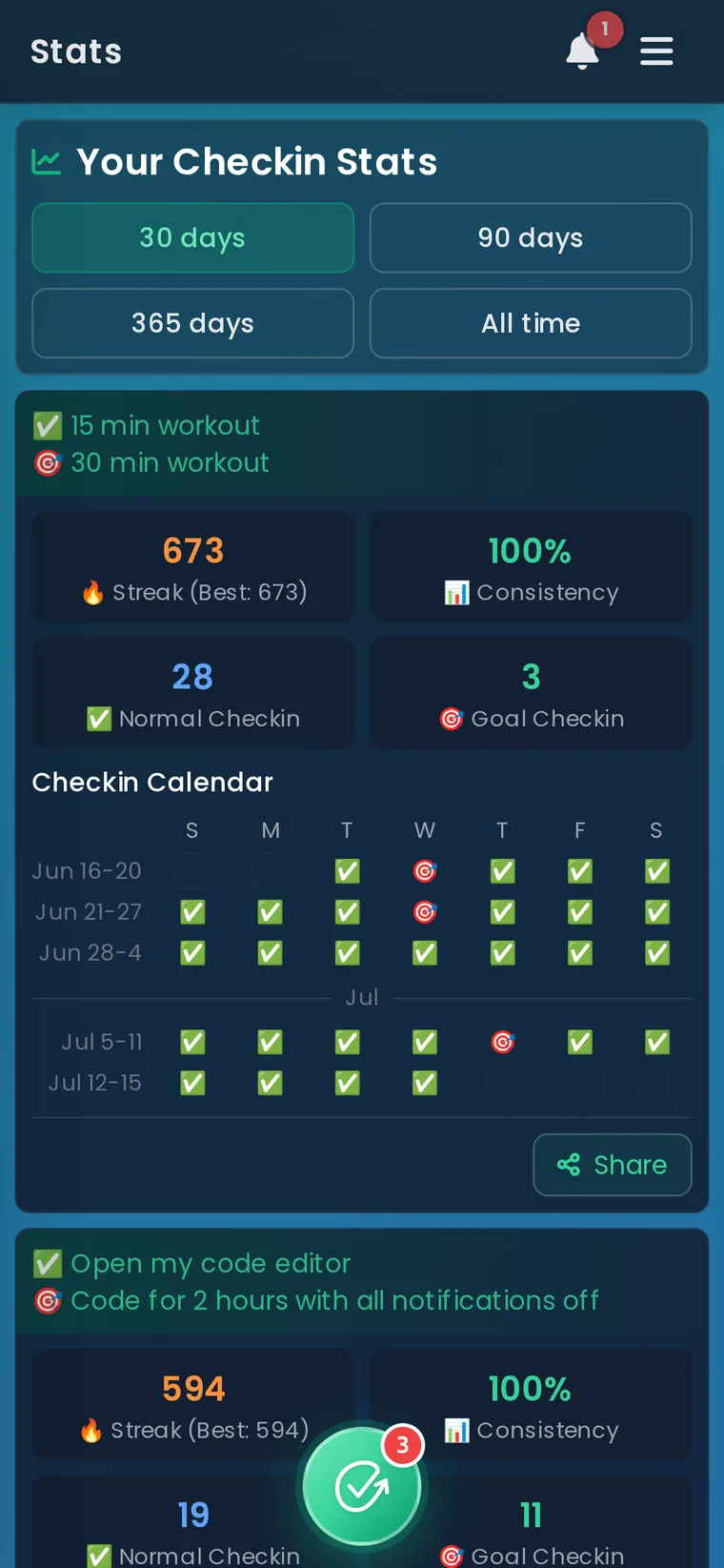
Later, when you need a tool for this structure, Habit Huddle uses a two-tier check-in model with Minimum and Daily Goal, which fits this approach well. It lets people keep a streak alive without pretending every day has the same capacity.
Before moving on, watch this. It pairs well with the two-target idea and helps show why shrinking the start often increases follow-through.
Engineer Your Environment with Cues and Streaks
People often think their problem is inconsistency. Often it's poor initiation. They don't have a reliable start cue, so each day becomes a fresh negotiation.
That drains energy. The more often you ask, “When should I do this?” or “What should I do first?” the easier it is to drift.
Make the start automatic
A cue should tell you exactly when the habit begins. The easiest way to do that is to attach the new action to something you already do.
The formula is simple: After [current habit], I will [new habit].
Examples work better than theory:
- Fitness: After I brush my teeth, I put on my training clothes.
- Writing: After I pour my morning coffee, I open my draft.
- Learning: After lunch, I review my notes for ten minutes.
- Mindfulness: After I plug in my phone at night, I sit for one minute of breathing.
The cue matters more than intention. “I'll do it later” is weak because later isn't a trigger. “After coffee” is a trigger. “When I get home and put my keys down” is a trigger. “After my last meeting ends” is a trigger.
A lot of people try to optimize the habit before they automate the start. That's backward. Starting is the hard part on most days. Reduce the gap between cue and action.
The easier you make the first motion, the less often you need to argue with yourself.
Use streaks as feedback, not ego
Streaks work because they make consistency visible. They turn an abstract identity into a chain of observable actions. You stop asking whether you're “becoming consistent” and start seeing proof.
But streaks only help if you use them correctly. If the streak becomes a perfection trophy, it creates panic after one miss. If the streak becomes feedback, it helps you spot weak points in your system.
Use streaks to answer practical questions:
| If the streak breaks... | Ask this instead of blaming yourself |
|---|---|
| You forgot | What cue was missing or too vague? |
| You resisted starting | Was the first step too large? |
| You ran out of time | Did I schedule the habit too late in the day? |
| You skipped after stress | What's my lower version for turbulent days? |
A visible streak should create momentum, not pressure. If you protect it with tiny honest actions, it becomes one of the strongest reinforcers in your system.
Build Momentum with Social Accountability
Private goals feel safe. They also make quitting too easy. If nobody knows what you said you would do, your brain can rewrite the story every evening. “I'll start again tomorrow” becomes a private ritual.
Accountability changes the cost of drift. It doesn't need to be dramatic or punitive. It just needs to make your effort visible to another person who expects you to show up.
Research summarized by Mooncamp reports that writing down your goals makes you 42% more likely to achieve them, adding an accountability partner boosts success rates by an additional 28%, and combining a written plan, daily tracking, and peer support brings total achievement probability to 85% (goal-setting statistics summary). That's a strong argument for not doing this alone.
Why private goals often stall
A private goal depends on internal honesty every day. That's hard when you're tired. People lower the standard, skip reviews, and avoid the evidence that they're slipping.
The right kind of accountability solves several problems at once:
- It creates a check-in point. You stop relying on vague self-assessment.
- It reduces disappearing acts. Someone notices when you vanish.
- It normalizes adjustment. A good partner helps you reset instead of judge.
- It turns consistency into something observable. Progress isn't a feeling anymore.
This is also why accountability works in more than personal development settings. Communities that want to achieve accountability in your church use the same underlying principle. Shared visibility changes behavior.
What useful accountability actually looks like
Bad accountability is vague, heavy, or performative. It's someone asking, “How's it going?” once a week, or a group chat full of motivation with no structure.
Useful accountability is specific. It answers four questions:
- What is the habit?
- What counts today?
- Who can see whether it happened?
- What happens after a miss?
Social habit tools can make this cleaner because they remove friction from reporting. If you want to understand the mechanics behind group follow-through, this breakdown of social accountability systems is worth reading.
A strong setup often includes a small group, one shared check-in rhythm, and a visible record of who showed up. That's enough to create positive pressure without turning the goal into theater.
Accountability works best when the group cares about repetition, not heroics.
That's an important trade-off. Many people want an inspiring community. What they need is a structured micro-community where showing up stays visible even on ordinary days.
How to Troubleshoot Setbacks Without Quitting
The moment that decides most goals isn't the hard workout, the early alarm, or the deep work block. It's the day after the miss.
People rarely quit because of one skipped action. They quit because they interpret the skip as proof that the plan is broken or that they are. That interpretation creates the spiral.
The bigger danger is all-or-nothing thinking. Studies summarized by Pretty Progress report that 80% of abandoned goals are dropped because the person expected perfect execution, and that better systems treat missed days as feedback rather than failure (analysis of the all-or-nothing consistency trap). If you don't build a reset process, your brain will build a shutdown process instead.
A missed day is a design signal
Take a common scenario. Someone plans to train four evenings a week. Monday goes well. Tuesday runs late. Wednesday they feel guilty, so they avoid the workout because they “already messed up.” By Friday, the whole week feels lost.
That isn't a motivation problem. It's a recovery problem.
A missed day usually points to one of four issues:
- The goal was too rigid
- The cue was weak
- The minimum wasn't defined clearly enough
- The person treated interruption as failure
The response should be mechanical, not emotional.
Missed days are data. Use them to edit the system.
A simple reset after a bad week
When a client slips, I don't ask for a speech about commitment. I ask for a reset sequence.
Use this three-step script:
Acknowledge the miss without drama.
“I missed yesterday. That's information, not identity.”Name the obstacle precisely.
“I scheduled the habit too late.”
“My minimum was still too demanding.”
“I had no cue after travel.”Complete the smallest valid version quickly.
Do the minimum today, even if it's tiny. Re-establish motion before you chase volume.
That last part matters most. People often try to compensate for a miss with a big comeback. That's ego talking. Recovery works better when it's modest and immediate.
A strong consistency practice doesn't ask, “How do I never fail?” It asks, “How fast can I return?” If you can return quickly, turbulence stops being fatal. It becomes part of the system.
If you want a practical way to run this system with daily check-ins, visible streaks, a Minimum and Daily Goal structure, and small-group accountability, Habit Huddle is built for exactly that. It gives you a simple place to keep showing up, especially when life isn't neat.
Ready to Build Habits With Friends?
Stop failing alone. Join thousands using the #1 habit tracker with friends for real accountability and lasting results.
Prefer mobile? App Store · Google Play
Related Guides
More Habit Huddle articles on building habits with accountability.

HabitShare Alternatives: 6 Apps for Tracking Habits With Friends (2026)
Looking for a HabitShare alternative? Six social habit trackers compared by model, price, platforms, and what happens on a missed day, plus how to switch wit...
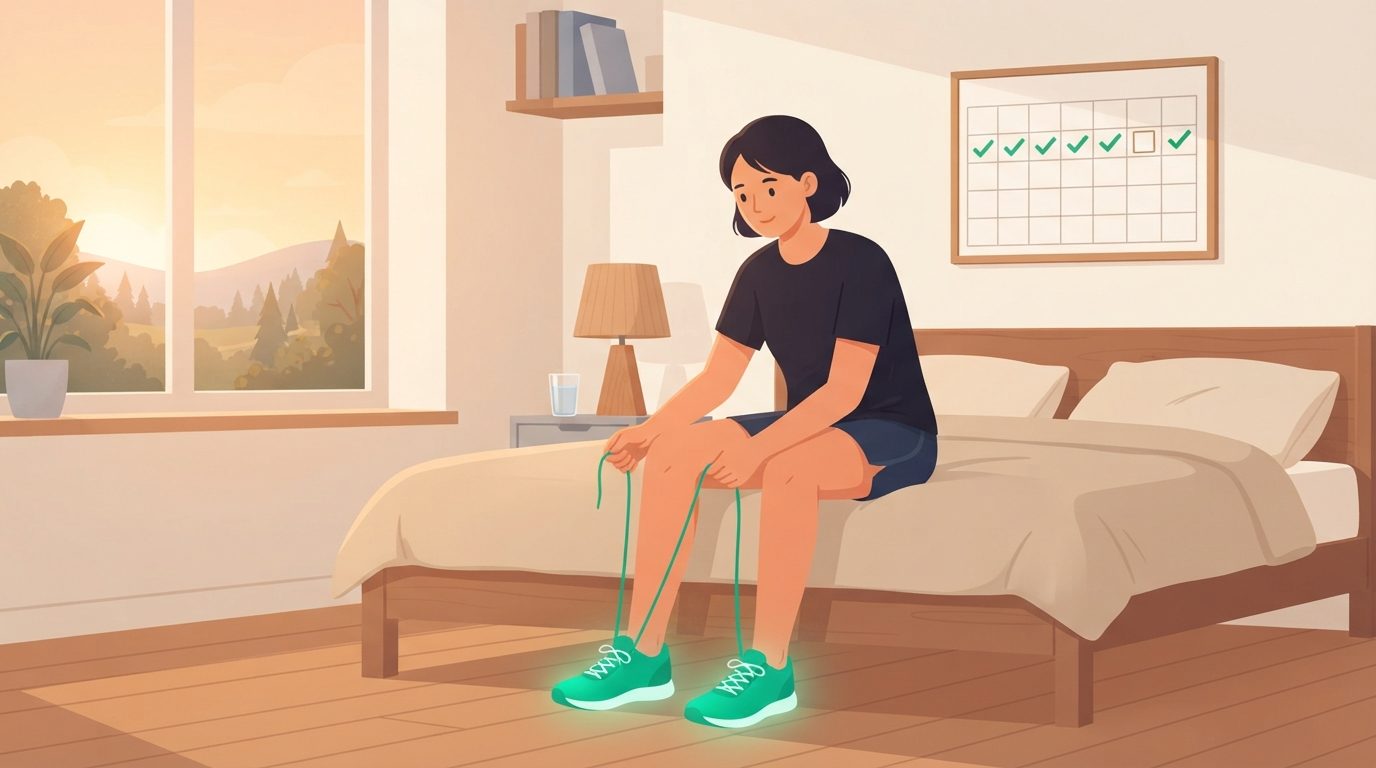
What to Do When You Miss a Workout Day: The 5-Step Comeback Plan
Missed a workout day? What one miss does to your body and habit, according to research, plus a five-step plan for the next 24 hours, when to make it up, and...

Habit Streak App With Friends: 7 Apps Compared (2026)
Seven habit streak apps with friends compared: Habit Huddle, HabitShare, Daily Pact, Habitica, Streaks, Habit Streak duels, HabitStreak.io. What friends see,...