
Corporate Fitness Challenge Apps in 2026: Real Pricing, Honest Picks by Company Size
Corporate fitness challenge apps compared by lane: wellness platforms from $1-6/user/mo, event platforms from $15/week, and free options for small teams.

📺 Related Video: Tips to Organize Steps Challenges at the Workplace
Video by: MantraCare · Watch on YouTube
The right corporate fitness challenge app depends on one question: who is running the program, and with what budget? An HR leader with 2,000 employees and a wellness line item needs admin dashboards and wearable sync. A team lead with 12 people and no budget needs none of that, and most lists never mention it.
This guide covers both. We compared the major platforms on published pricing, checked August 2026, and split them into three lanes so you can skip the two that do not apply to you.
One disclosure up front: Habit Huddle, our app, appears in the third lane. It is there for small teams without procurement, not as a Vantage Fit replacement. Judge the reasoning.
The three lanes of corporate fitness challenge apps
Every corporate fitness challenge app falls into one of three lanes: full wellness platforms, event platforms, and free team apps. Picking the wrong lane wastes more money than picking the wrong app inside the right lane.
| Lane | Built for | Typical pricing | Examples |
|---|---|---|---|
| Wellness platform | HR programs, 500+ employees, year-round | $1 to $6 per user per month | Vantage Fit, inKin, WeMove, GoJoe |
| Event platform | One challenge, any size, no long contract | Per event or per week | ChallengeRunner, Pacer for Teams, Big Team Challenge |
| Free team apps | Single teams, small companies, no budget | Free | Habit Huddle, StepUp, spreadsheet + group chat |
The first lane sells to the person who signs contracts. The second sells to the person who got told "sure, run something for wellness month." The third is for the person who just wants their team moving and answers to nobody.
Wellness platforms: for HR programs that outlive one challenge
A wellness platform makes sense when fitness challenges are one part of a year-round program with rewards, reporting, and renewals. The admin layer is the product: enrollment by department, engagement dashboards, and automatic gift card fulfillment.
Vantage Fit is the reference point in this lane. It runs gamified step challenges with wearable sync, redeemable points, and the group-level analytics a program owner needs at renewal time. Published pricing starts at $2.50 per employee per week and falls to $0.75 at 2,000+ employees, which tells you who it is for: this is enterprise software, priced for scale.
inKin publishes the clearest pricing in the category: $6 per user per month billed monthly, $4 quarterly, $3 annually. It supports many challenge formats beyond steps and is one of the few platforms a mid-size company can price without a sales call.
WeMove (formerly Reaction Club) advertises self-serve challenges from about $2 per user per month, and GoJoe leans social with 60+ activity types but quotes price on request. As a rule, "book a demo" pricing in this lane means the real number depends on your headcount and negotiating patience.
Two honest cautions about the whole lane. First, most vendor blogs ranking for this keyword put their own product first, so read their comparisons the way you would read ours: for the reasoning, not the ranking. Second, ask every vendor what happens between challenges, because the platform bills every month whether or not anything is running.
Event platforms: one challenge, no contract
An event platform is the right buy when you are running one challenge, not a program. You pay for the weeks the challenge runs and stop paying when it ends.
ChallengeRunner is the budget pick and surprisingly flexible: walking challenges, team challenges, tournaments, raffles, and custom metrics, with Slack and Microsoft Teams integrations. Its sandbox is free for up to 10 participants and 7 days, and paid challenges start at $15 per week or $259 per year. The interface is dated; the price is not.
Pacer for Teams and Big Team Challenge both run polished one-off step events priced per event and per participant. They shine for big seasonal pushes, the January kickoff or a summer walking month, where you want a map, a leaderboard, and zero long-term commitment.
One planning note that applies to every option here: Fitbit itself can no longer run your challenge, because Google retired Fitbit's built-in Challenges feature in 2023. Wearables in your company are now data sources, not platforms, so the app you pick has to do the competing.
If steps are definitely your format, we compared that slice of the market in more depth in step challenge apps for work.
The no-procurement lane: small companies and single teams
Most fitness challenge advice assumes someone has a budget, and most teams do not. If you lead 5 to 20 people, the honest answer is that you do not need admin analytics, SSO, or reward fulfillment. You need a shared place to show up daily, visible to the team, free.
This is the lane Habit Huddle was built for, and the disclosure again: it is our app.
Habit Huddle runs a fitness challenge as a huddle, a group formed around one habit. You set a Floor, the minimum that counts on a busy day, and a Ceiling to burst through when you have more in the tank. Each day, every member's checkin adds a link to the team's Checkin Chain, so the score is showing up together, not who ran the most miles.
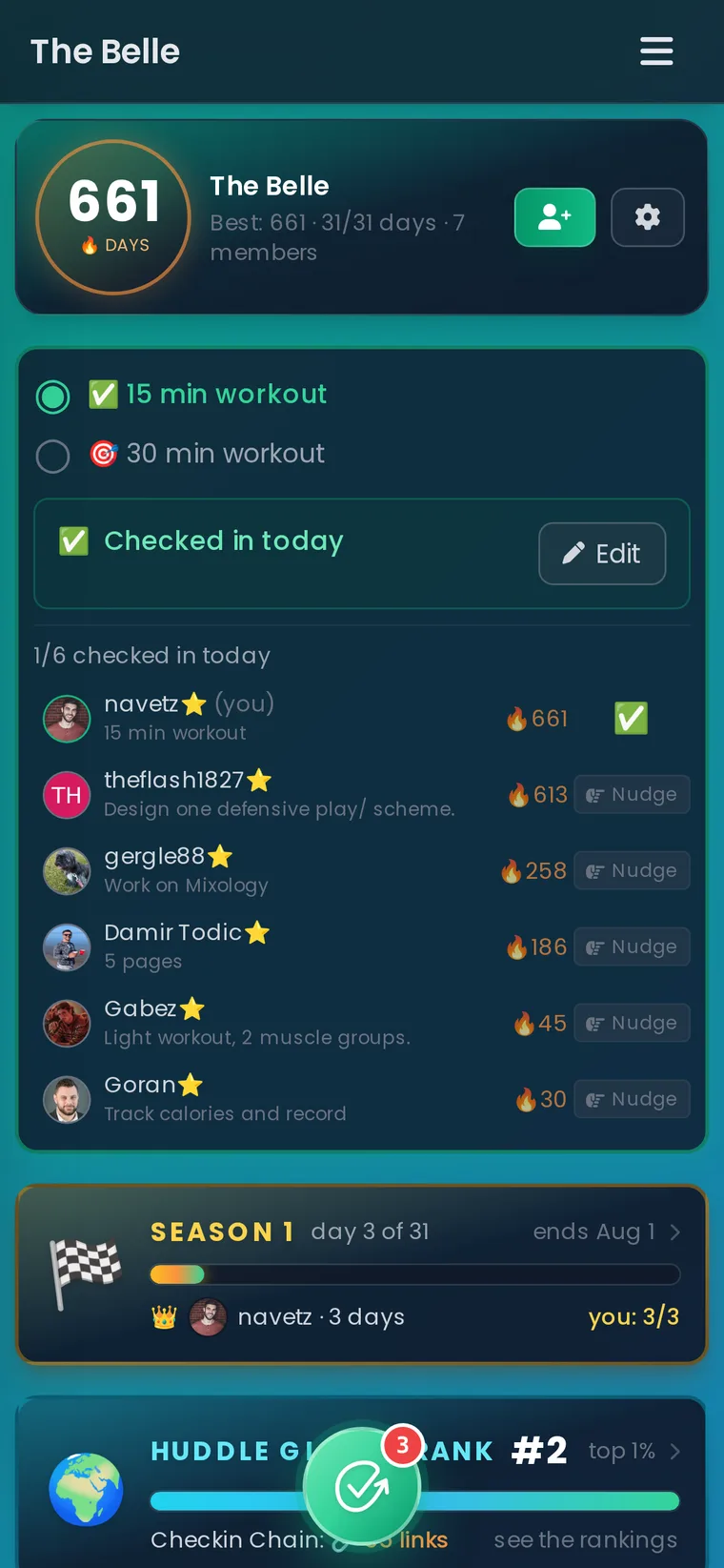
Two design choices matter for workplace use. Checkins are manual, a deliberate act rather than a passive step count, which means no wearable requirement and no arguments about whose phone undercounts. And the app never shows anyone else's missed days, so a quiet week is invisible; teammates see checkins and cheer them, and that is all they see. In a workplace, that difference decides whether the reluctant half of the team joins at all.
The honest trade-offs: there is no step syncing, no admin dashboard, and no HR reporting, so if you need department-level engagement numbers for a renewal deck, this is the wrong lane entirely. The free plan covers one active habit per person, which fits a single team challenge and not a multi-program rollout. It is free to start a huddle on web, iPhone, or Android, and we wrote more about the surveillance problem in habit trackers for teams.
The other genuinely free option is a plain pedometer app like StepUp plus a spreadsheet, which works until the third week of manual data entry, which is usually when the spreadsheet dies.
What corporate fitness challenge apps cost in 2026
Published pricing for corporate fitness platforms runs from under $1 to $6 per user per month, and the billing model matters more than the sticker. Per-user pricing is a rounding error at 50 employees and a budget line at 5,000.

Three patterns worth knowing before a sales call:
- Annual billing cuts the rate hard. inKin drops from $6 to $3 per user per month on annual terms, and that shape repeats across the category.
- Volume discounts are steep. Vantage Fit's published rate falls by two thirds between small and 2,000+ employee tiers.
- Event pricing beats platform pricing for one-offs. A six-week ChallengeRunner event can cost less than one month of a platform contract for the same headcount.
Model your real scenario: participants, not headcount, since typical opt-in is well below 100%, and count the weeks you will actually run challenges. A platform billing 12 months for 8 weeks of programming is the most common way these budgets quietly double.
Why challenges die in week two, and the design choices that prevent it
Corporate fitness challenges rarely fail at signup; they fail in week two, when the leaderboard sorts everyone into contenders and spectators. The people the program was meant to reach are the spectators.

Four choices consistently keep the middle of the pack engaged:
Set the daily goal near 7,000 steps, not 10,000. A 2025 Lancet Public Health meta-analysis of daily step counts found health benefits accumulate steeply up to about 7,000 steps per day and plateau beyond it. A lower bar keeps desk-bound beginners in the game and costs the athletes nothing.
Make the format cooperative or relative, not a raw leaderboard. In the STEP UP randomized trial, gamified challenges raised activity by roughly 900 steps per day versus control, and formats where your performance affects a team consistently outperform solo tracking. Percentage-of-goal scoring or a team chain beats crowning whoever was already fittest.
Keep it four to six weeks. Long enough for a routine to form, short enough that nobody is limping toward a finish line in month four.
Make progress visible and celebrated, not policed. A large meta-analysis found that monitoring goal progress, especially when reported publicly, reliably increases goal attainment. Celebrate the checkins that happen; do not build anything that highlights who is behind, because that is the feature people quit over.
For challenge formats beyond steps, our workplace wellness challenges list has ten that survive contact with a real office, and team fitness challenge apps compares the enterprise-versus-free decision in more detail.
You already know you can change.
You just need to take the first step. Habit Huddle helps you build habits around your goals, alongside friends who keep you accountable.
The bottom line
Buy a wellness platform when you own a program, buy an event platform when you own an event, and spend nothing when you own a team.
If yours is the third case, Habit Huddle gives your team one habit, a Floor anyone can hit, and a Checkin Chain that grows every day someone shows up. Start your team's huddle free, and the first checkin can happen today.
Frequently asked questions
What is the best corporate fitness challenge app?
For a full HR wellness program at 500+ employees, Vantage Fit is the strongest all-rounder. For a single budget-conscious event, ChallengeRunner starts at $15 per week. For one team with no budget, Habit Huddle (our app) runs a free cooperative challenge without wearables or admin overhead.
How much does a corporate fitness challenge app cost?
Published rates run from under $1 to $6 per user per month, with steep discounts for annual billing and larger headcounts. Event platforms price per challenge instead; ChallengeRunner starts at $15 per week, and its sandbox is free for up to 10 participants.
How do I run a fitness challenge at work with no budget?
Pick one habit, set a low daily minimum, and use a free app your team will actually open. Habit Huddle lets a team form a huddle around one habit and build a shared Checkin Chain for free; the alternative is a pedometer app plus a spreadsheet, which needs a volunteer to maintain.
What is a good daily step goal for a workplace challenge?
About 7,000 steps per day. A 2025 Lancet Public Health meta-analysis found health benefits plateau around that level, and a 7,000-step goal keeps sedentary beginners engaged where a 10,000-step goal pushes them out by week two.
How long should a corporate fitness challenge last?
Four to six weeks. Shorter than three weeks is not enough time for a daily routine to form; longer than six, engagement decays and the challenge limps. Run two or three short challenges a year rather than one long one.
Ready to Build Habits With Friends?
Stop failing alone. Join thousands using the #1 habit tracker with friends for real accountability and lasting results.
Prefer mobile? App Store · Google Play
Related Guides
More Habit Huddle articles on building habits with accountability.

HabitShare Alternatives: 6 Apps for Tracking Habits With Friends (2026)
Looking for a HabitShare alternative? Six social habit trackers compared by model, price, platforms, and what happens on a missed day, plus how to switch wit...

What to Do When You Miss a Workout Day: The 5-Step Comeback Plan
Missed a workout day? What one miss does to your body and habit, according to research, plus a five-step plan for the next 24 hours, when to make it up, and...

Habit Streak App With Friends: 7 Apps Compared (2026)
Seven habit streak apps with friends compared: Habit Huddle, HabitShare, Daily Pact, Habitica, Streaks, Habit Streak duels, HabitStreak.io. What friends see,...