
Fitness Challenge Software 2026: Work, Gym, Friend Groups
Compare fitness challenge software and apps for corporate wellness, gyms, races, and friend groups, with published pricing and honest trade-offs.

📺 Related Video: How to Plan a Group Fitness Challenge | Do THIS First
Video by: ABC Trainerize · Watch on YouTube
Fitness challenge software is the layer of tools an organizer uses to create a group fitness challenge, enroll participants, track their activity, and keep a leaderboard honest for the length of the event. If you are searching for it, you are probably the person who got volunteered to run the thing: an HR or people-ops lead planning a step challenge, a gym owner trying to re-engage members, a race director moving an event online, or just the friend who keeps the group chat motivated.
Here is the short answer up front. For a company wellness challenge, look at ChallengeRunner or MoveZenGo. For a virtual race or distance challenge with automatic activity syncing, Challenge Hound is the specialist. For a gym or studio, challenges usually come bundled inside a business platform like Exercise.com. And for a friend group, small team, or online community that cares more about daily consistency than step counts, that is the exact gap our own app, Habit Huddle, was built for. The rest of this guide explains how to make that call for your situation, with real pricing where the vendors publish it.
What fitness challenge software actually does

Every platform in this category handles some version of the same five jobs:
- Challenge setup: define the goal (steps, distance, minutes, workouts completed, or any custom behavior), the duration, and whether people compete as individuals or teams.
- Enrollment: invite links, rosters, or open signup pages so participants can join without the organizer doing data entry.
- Activity tracking: either automatic syncing from wearables and apps (Fitbit, Garmin, Strava, Apple Health) or manual entry, sometimes with photo proof.
- Leaderboards and progress: the public scoreboard that creates the actual motivation, updated in real time or daily.
- Communication: reminders, milestone announcements, and somewhere for the trash talk to live, whether that is built-in chat, email, or an integration with Slack, Microsoft Teams, or Discord.
Where platforms differ is which of those jobs they take seriously. Corporate tools invest in reporting and device integrations. Race platforms invest in route maps and results. Community tools invest in the daily social loop. That difference is why picking by feature checklist fails; pick by use case instead.
Five questions to answer before you compare platforms
1. Who is organizing, and for how many people?
A 12-person friend group, a 200-person company, and a 2,000-person virtual race have almost nothing in common operationally. Corporate platforms price and build for admins managing large rosters. Community tools assume the group is small enough that people actually know each other. Be honest about your real number, not the number you hope for.
2. What will you actually measure?
This is the biggest fork in the road. Device-synced metrics (steps, kilometers, active minutes) are objective and scale to big groups, but they exclude people whose activity a wearable does not capture well, and they turn the challenge into a hardware contest. Reported behaviors (I did my workout today, I stretched, I got my walk in) include everyone and build habits directly, but they run on trust, which only works in groups with real social connection. Big anonymous group: sync devices. Small connected group: daily checkins work better.
3. How do you want to pay: per participant, per challenge, or per organizer?
Pricing models in this category vary more than features do. Challenge Hound charges organizers from $149 per challenge, or $2.99 per participant for friend groups. ChallengeRunner starts around $15 per week for a live challenge, with an annual plan from $259 per year. Corporate wellbeing platforms like MoveZenGo price by quote. And some tools, including ours, are free for a basic challenge with a subscription for the organizer who wants more. Match the model to your cadence: a one-off event suits per-challenge pricing, a year-round program does not.
4. Where do participants already spend their day?
The best predictor of challenge participation is friction. Office teams live in Slack or Microsoft Teams, and ChallengeRunner's integrations there are a real advantage. Online communities live in Discord, which is exactly why Habit Huddle runs checkins through a Discord bot as well as its app. If joining requires installing yet another app nobody opens, expect a drop-off by week two.
5. What happens the day after the challenge ends?
Most fitness challenges produce a burst of activity that decays the week the leaderboard freezes. If the challenge is a one-time event (a fundraiser, a race), that is fine. If the goal is lasting behavior change, ask whether the platform has any answer for week five. This is the question most of the category ignores, and it is the one our own product is most opinionated about.
The best fitness challenge software by use case
For employee wellness programs: ChallengeRunner
ChallengeRunner is a dedicated employee fitness challenge platform, and it feels like a tool built by people who have run hundreds of them. You can build a challenge around almost any criteria (walking, weight loss, hydration, multi-activity point systems), organize teams, and let participants log data from the web, smartphone apps, synced trackers, or even text message, which matters for workforces that are not desk-bound. It integrates with Slack, Microsoft Teams, and Webex so the challenge lives where work chat already happens. Pricing is unusually transparent for the corporate category: a free sandbox for up to 10 participants and 7 days, live challenges starting around $15 per week, and an annual plan from $259 per year. The trade-off is polish; it is an admin's utility, not a consumer-grade app, and your participants will notice the difference. For challenge formats to run on it, our roundup of workplace wellness challenges pairs well.
For large, device-synced team challenges: MoveZenGo
MoveZenGo is a corporate team wellbeing platform that runs step, distance, time-based, and custom challenges with broad fitness device support and team leaderboards. It positions itself for scale, from 10 to 10,000 or more participants, offers co-branding so the challenge looks like your organization's own program, and lists customers like NASA, USC, and Lenovo. The company claims a 92 percent average engagement score for its initiatives; treat vendor-reported numbers as marketing, but the client list is real. Pricing is quote-based, which tells you the intended buyer: an HR or wellbeing budget, not a team lead's credit card. Trade-off: for a small group this is a battleship where a rowboat would do, and you cannot even see the price without a sales conversation.
For virtual races and distance challenges: Challenge Hound
If your challenge is measured in kilometers, Challenge Hound is the specialist. It supports distance, elevation, duration, activity-count, step, and point-based challenges across dozens of activity types, syncs automatically with Garmin, Fitbit, Strava, and (through its app) Apple Health and Health Connect, and can draw your challenge as progress along a real route map, which is a genuinely motivating touch for virtual 5Ks and team mileage goals. Creating a challenge is free; organizers pay from $149 per challenge (up to 50 participants), friend groups can instead pay $2.99 per participant, and an unlimited season pass runs $1,500 per year. Fundraisers can charge entry fees with a 5 percent plus $1.50 processing cut. Trade-off: it is built around endurance activities and synced data, so a challenge about daily behaviors (mobility work, workouts done, sleep routines) is not its shape.
You already know you can change.
You just need to take the first step. Habit Huddle helps you build habits around your goals, alongside friends who keep you accountable.
For gyms and studios: Exercise.com
Gym owners searching for challenge software usually discover that the challenge feature comes bundled inside gym management platforms, and Exercise.com is a clear example: challenges sit alongside booking, billing, workout logging, leaderboards, and custom-branded member apps. That bundling is the point. A challenge inside the same app members already use for classes and workouts gets participation that a separate tool never will, and the results feed member retention, which is why gyms run challenges in the first place. The trade-off is the reverse side of the same coin: you are buying a business platform with demo-gated pricing, not signing up for a $15 tool. If you only want to run one challenge and already have management software, this is the wrong aisle.
For friends, small teams, and online communities: Habit Huddle
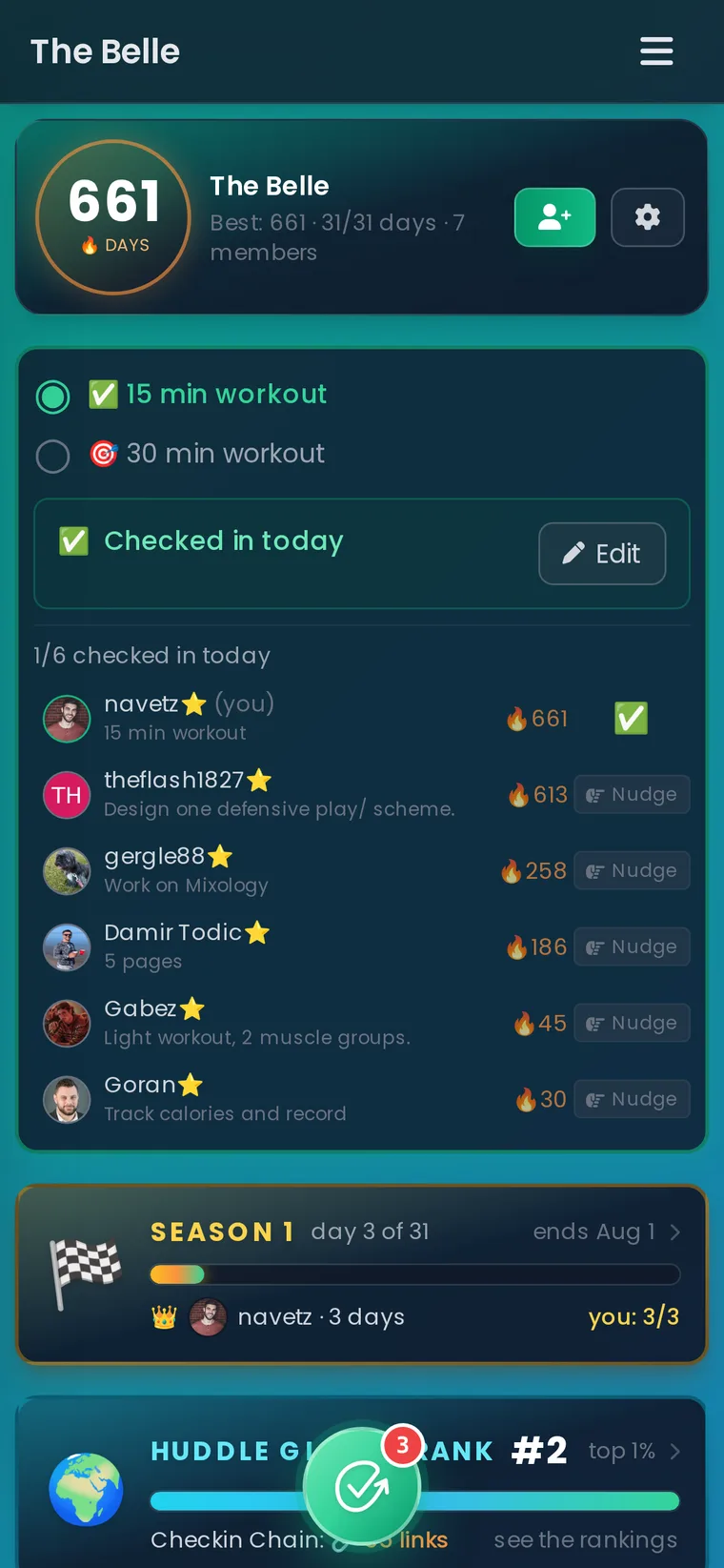
Full disclosure: Habit Huddle is our app, so judge the reasoning, not the ranking. It approaches fitness challenges from the habit side rather than the event side. Instead of syncing workout data, each person picks one habit, joins a huddle (the group) for it, and checks in daily. The group metric is the Checkin Chain: every member who checks in that day adds a link, so the chain's length measures the whole huddle showing up together, not one athlete carrying the team. Season leaderboards give a challenge its start and finish, personal streaks keep individuals honest between rounds, and a Discord bot brings checkins directly into a community server. Running a basic challenge is free for everyone, organizer included; one paid plan, Habit Huddle Champion at $30 a month or $200 a year, unlocks the flexible checkin experience for every member of the huddles you lead without any of them paying. The trade-offs are real: there is no fitness tracker syncing (checkins are on your word, with optional photo proof), no corporate reporting, and a 1,000-person step competition is simply the wrong shape for it. It is built for groups small enough that the names on the leaderboard are people you would text.
Quick comparison
| Platform | Best for | Pricing (published) | Device syncing | Standout |
|---|---|---|---|---|
| ChallengeRunner | Employee wellness challenges | Free sandbox; from ~$15/week; annual from $259/yr | Yes, plus manual and SMS entry | Slack, Teams, and Webex integration |
| MoveZenGo | Large corporate programs | Quote-based | Yes, broad device support | Co-branding and 10,000+ participant scale |
| Challenge Hound | Virtual races and distance goals | From $149/challenge or $2.99/participant | Garmin, Fitbit, Strava, Apple Health | Map-route virtual challenges |
| Exercise.com | Gyms and studios | Demo-gated | Via its own member apps | Challenges inside full gym management |
| Habit Huddle | Friends, small teams, communities | Free; Habit Huddle Champion $30/mo or $200/yr | No (manual checkins, photo optional) | Daily checkins, Checkin Chain, Discord bot |
Pricing checked July 2026 on each vendor's public pricing page; treat it as a snapshot.
Design for the day after the challenge ends

Whichever platform you pick, the challenge itself is the easy part. The organizer decisions that actually determine success are format and follow-through. Keep the goal achievable by everyone (a participation streak beats a raw step count for mixed-fitness groups), keep teams small enough for peer accountability, and decide before launch what happens when it ends. Roll the group into a second season, convert the challenge habit into a standing daily practice, or at minimum tell people the next start date. If you need format inspiration, we keep a working list of group fitness challenge ideas with scoring templates, and a broader guide to choosing a challenge tracker app if you are a participant rather than the organizer.
Run a challenge that outlasts the finish line
If your group is a company of hundreds with wearables on every wrist, pick one of the corporate platforms above and you will be well served. If your group is a handful of friends, a small team, or a Discord community, and the real goal is that everyone is still working out in month three, try starting a huddle on Habit Huddle. Pick the habit, invite the crew, and see how long the group can keep the Checkin Chain growing. It is free, it takes about two minutes, and the first season usually teaches you more about your group than any feature list will. Our guide to habit tracking with friends covers how the group mechanics work.
Frequently asked questions
What is fitness challenge software?
Fitness challenge software lets an organizer create a group fitness challenge, enroll participants, track activity automatically or through manual entries, and display leaderboards. Corporate platforms add reporting and device integrations; community tools focus on daily participation and social accountability.
How much does fitness challenge software cost?
Published pricing in 2026 ranges from free (Habit Huddle's basic tier, ChallengeRunner's 10-person sandbox) to per-challenge fees ($149 and up on Challenge Hound), weekly rates (around $15 per week on ChallengeRunner), and annual plans ($259 to $1,500 per year). Enterprise wellbeing platforms typically price by quote.
Can I run a fitness challenge without fitness trackers?
Yes. Honor-system challenges based on daily checkins work well for groups with real social connection, and they include people whose training a wearable measures poorly, like lifters or yoga practitioners. For large groups of strangers, device syncing keeps the leaderboard credible.
Is there any good free fitness challenge software?
Habit Huddle is free for unlimited participants with one active habit each. ChallengeRunner's free sandbox covers up to 10 participants for 7 days, and Challenge Hound is free to set up, with fees only when participants join under a paid model.
How long should a fitness challenge run?
Two to six weeks is the common range. Shorter than two weeks rarely changes behavior; longer than six, participation decays unless the format resets. Running consecutive short seasons with visible start and end dates usually sustains engagement better than one long challenge.
Ready to Build Habits With Friends?
Stop failing alone. Join thousands using the #1 habit tracker with friends for real accountability and lasting results.
Prefer mobile? App Store · Google Play
Related Guides
More Habit Huddle articles on building habits with accountability.

HabitShare Alternatives: 6 Apps for Tracking Habits With Friends (2026)
Looking for a HabitShare alternative? Six social habit trackers compared by model, price, platforms, and what happens on a missed day, plus how to switch wit...

What to Do When You Miss a Workout Day: The 5-Step Comeback Plan
Missed a workout day? What one miss does to your body and habit, according to research, plus a five-step plan for the next 24 hours, when to make it up, and...

Habit Streak App With Friends: 7 Apps Compared (2026)
Seven habit streak apps with friends compared: Habit Huddle, HabitShare, Daily Pact, Habitica, Streaks, Habit Streak duels, HabitStreak.io. What friends see,...