
Challenge Tracker App: 7 Best Picks for Friends, Work, and 30-Day Challenges (2026)
Comparing challenge tracker apps? The best picks for friend groups, work step challenges, 30-day challenges, and 75 Hard, with free options and honest trade-...

📺 Related Video: 4 Guys Do a Push up Challenge For 30 Days, These Are The Results
Video by: Browney · Watch on YouTube
Searching for a challenge tracker app usually means one of five different things: a 30-day challenge with friends, a step competition at the office, a virtual distance challenge, a solo grind like 75 Hard, or a company wellness program you have been volunteered to run. The apps that dominate this search are each built for exactly one of those, and picking the wrong shape is why so many challenges fizzle by week two.
So here is the short answer up front. For a challenge with friends that you want to survive past the finish line, use Habit Huddle (disclosure: that one is ours). For step challenges at work, use StepUp. For virtual distance challenges and races, use Challenge Hound. For a solo 75 Hard run, use a dedicated 75 Hard tracker. For a formal corporate wellness program, use ChallengeRunner. The rest of this guide explains those picks, what each app genuinely does well, and where each one falls short, so you can match the tool to the challenge you are actually running.
First, name the challenge you are running
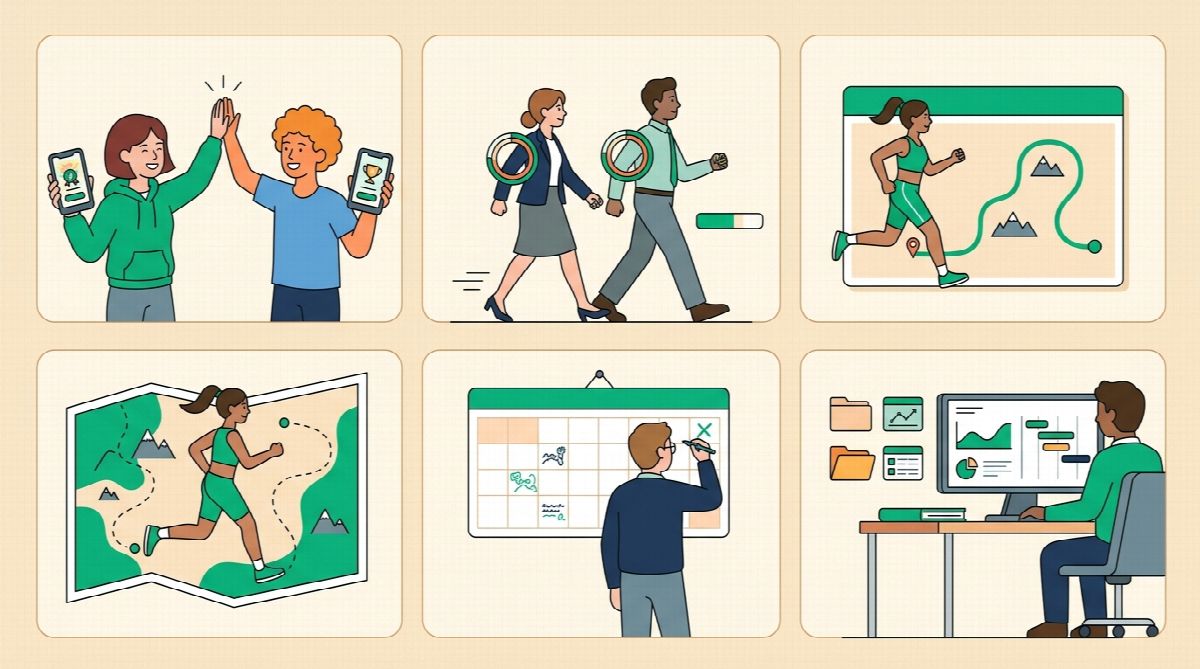
"Challenge tracker" hides five different jobs. Before comparing features, find yourself in this list:
- A group challenge with people you know. Friends, family, a Discord server, a book club. The goal is daily participation, and the momentum comes from checking in alongside people whose opinion you care about.
- A step or activity competition at work. Mixed devices, mixed fitness levels, a leaderboard, maybe a prize. The goal is broad participation without anyone feeling humiliated.
- A virtual distance challenge or race. Run or ride a set distance over weeks, tracked automatically from Strava, Garmin, or Fitbit, ideally with a map to move across.
- A solo timeboxed program. 30 days of journaling, 100 days of no takeout, 75 Hard. The goal is personal completion, and the tracker is a contract with yourself.
- A formal wellness program. You are the administrator. You need registration, team management, reporting, and winner selection more than you need motivation for yourself.
Two name collisions worth clearing up before you compare anything. "My Challenge Tracker" is Beachbody's (now BODi's) companion app, and it only works if a coach runs your group through their program; the Orangetheory Challenge Tracker lives inside that studio's member app. Neither is a general-purpose tracker, and this guide covers tools you can run with any group.
Most disappointment with these apps comes from crossing categories: a corporate platform feels bureaucratic to a friend group, and a friend-group app has no admin console for a 400-person company. Pick the row, then pick the app.
The best challenge tracker apps
1. Habit Huddle: group challenges that outlive the finish line
Full disclosure: this is our app, so judge the reasoning rather than the ranking. Habit Huddle is built for the first job on the list, a group of people you actually know committing to a daily behavior together. Your group forms a huddle around a habit, everyone checks in with one tap each day, and every checkin adds a link to the huddle's shared Checkin Chain, so three people showing up today forges three links. Monthly leaderboard seasons give the group a fresh competitive window where rank comes from days checked in, so one rough day costs a day, never your whole season.
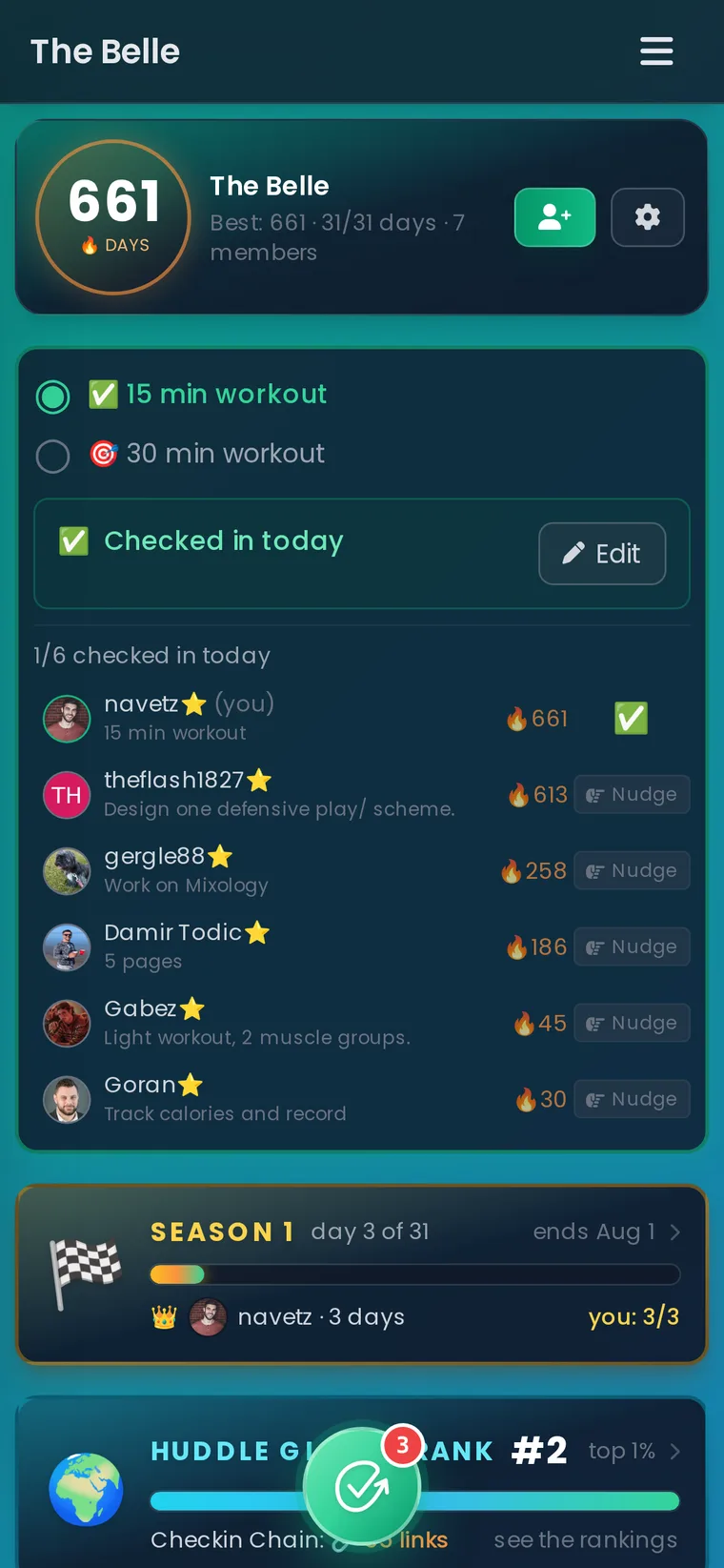
The design choice that matters most for challenges is the Floor and the Ceiling. Every habit has a worst-day version (the Floor) and a full version (the Ceiling). On a rough day you step on the Floor, the chain keeps growing, and the challenge keeps its momentum; on a good day you burst through the Ceiling. That single mechanic attacks the way most group challenges actually die, which is not laziness but the all-or-nothing spiral after the first imperfect day. Checkins work on iOS, Android, the web, and through a Discord bot, so server communities can run a challenge where they already talk.
Honest trade-offs: there is no wearable sync or GPS, a checkin is a deliberate tap rather than harvested sensor data, and each huddle tracks one behavior, not a multi-metric scoreboard. There is no admin console for prizes or CSV exports either, so a formal corporate program will want a platform from further down this list. The free tier covers a full huddle with friends.
Best for: friend groups, families, and Discord communities who want a 30-day challenge to turn into a year-round habit.
2. Challenge Hound: virtual distance challenges and races
Challenge Hound is the strongest pick for mileage-based challenges. You set a distance, elevation, duration, activity count, step, or point-based goal, and it pulls activities automatically from Strava, Garmin, Fitbit, and the major fitness apps, with Apple Health and Health Connect covering nearly everything else. Its signature feature is the map: attach a route, and individuals or teams progress along it in real time as their miles accumulate. It also runs proper virtual races with qualifying rules and live results, and it supports both individual goals and aggregate team goals.
The trade-off is the flip side of all that automation. Challenge Hound measures logged activity, so it suits behaviors a watch can see, and it is priced and structured for organizers running events for clubs, nonprofits, and companies rather than for a casual group of five friends. If nobody in your group owns a tracker, the manual-entry experience is workable but not the point of the product.
Best for: running and cycling clubs, event organizers, and any group whose challenge is measured in miles.
3. StepUp: free step challenges for work and friends
StepUp does one thing with almost no setup friction: shared step leaderboards. Everyone installs the app, joins a group, and daily, weekly, and monthly leaderboards update automatically from phones and wearables via Apple Health and Health Connect. Groups scale to 1,500 members, admins can set fixed date-range challenges, and a Mystery Mode hides step counts until the next day so office rivalries stay friendly. It is free, supported by minimal ads.
The limits are the shape of the product: steps and distance only, so lifters, swimmers, and yoga people are invisible to it, and there is no true team-vs-team leaderboard (you approximate it with one group per team and exported reports). Accountability is also purely passive; the app counts what your phone saw rather than asking you to show up and say you did the thing.
Best for: offices, schools, and big mixed groups where walking is the common denominator.
4. challenges.app: team-based fitness competition
Challenges turns fitness into a small-sided league: join a challenge solo or in teams of four, sync your activity tracker, and compete on effort. The team-of-four format is a clever middle ground, big enough that no single bad week sinks you, small enough that your effort visibly matters, and the app leans into rewards and friendly competition to keep people moving.
The trade-offs are commitment to that format. Fixed team sizes fit some groups and not others, the experience is built around synced activity data rather than deliberate checkins, and like every competition-first app, it is strongest during a defined contest and quieter between them.
Best for: small teams who want an ongoing fitness competition rather than a one-off challenge.
You already know you can change.
You just need to take the first step. Habit Huddle helps you build habits around your goals, alongside friends who keep you accountable.
5. Challenge Accepted: a personal challenge bucket list
Challenge Accepted is the tinkerer's pick for solo and casual challenges. You browse a library of ready-made challenges (30-day fitness programs, reading lists, habit builders), build your own as checklists or calendar trackers, set reminders, and add friends to see what each other are working on and complete challenges together.
It is deliberately lightweight, which is both the appeal and the ceiling: the social layer is closer to "friends can see my list" than to a group cheering each day's checkin, and self-created challenges rely on self-enforced honesty. As a personal challenge organizer it is charming; as an accountability system it is gentle.
Best for: individuals who like collecting and designing challenges, with light social visibility.
6. ChallengeRunner: the corporate wellness admin console
ChallengeRunner is for the person running the program, not just playing in it. It is an employee wellness platform with organization registration, team-based challenges, raffle-style winner selection, single-elimination tournaments, map leaderboards, badges, and integrations into Microsoft Teams, Slack, and Webex. If HR asked you to run a quarter-long wellness initiative with reporting, this is the category to shop in.
The trade-off is exactly what you would expect: it feels like workplace software because it is workplace software. A friend group does not need raffle winner selection, and the admin-first design means more setup than any consumer app on this list.
Best for: HR teams and wellness coordinators running structured programs with reporting requirements.
7. 75 Hard trackers: one challenge, done strictly
If your challenge is specifically 75 Hard, a purpose-built tracker like 75 Hard Tracker beats a general app because the program's rules are fixed and unforgiving, and a dedicated tracker encodes them so you are not configuring five daily tasks by hand. The same logic applies to any famous named challenge: a tracker built for exactly that program removes setup decisions.
The trade-off is that single-purpose tools end when the program ends, and 75 Hard's all-or-nothing structure (miss anything, restart from day one) is the opposite of sustainable habit design. Finish it if it calls to you, but have a plan for day 76; if the strictness itself is what worries you, we compared gentler programs in our guide to 75 Hard alternatives.
Best for: committed 75 Hard participants who want the rules enforced as written.
Quick comparison
| App | Built for | Tracking style | Group shape | Free option |
|---|---|---|---|---|
| Habit Huddle | Group challenges that become habits | One-tap daily checkins | Two people to small groups | Yes |
| Challenge Hound | Distance challenges and virtual races | Auto-sync from fitness apps | Individuals, teams, events | Trial for organizers |
| StepUp | Step challenges | Auto-sync steps | Up to 1,500 per group | Yes |
| challenges.app | Team fitness competition | Auto-sync from trackers | Teams of 4 or solo | Yes |
| Challenge Accepted | Personal challenge lists | Manual checklists | Solo plus friends | Yes |
| ChallengeRunner | Corporate wellness programs | Data entry and integrations | Whole organizations | Trial |
| 75 Hard Tracker | The 75 Hard program | Manual daily tasks | Solo | Yes |
How to run a challenge people actually finish
Most group challenges fail for predictable, fixable reasons, and the research on exercising with others points to the same few fixes.
Keep the group small and known. Studies of group dynamics in exercise show people work harder and persist longer when they exercise with others, and the effect depends on the others being real to you. Five friends who reply to messages beat forty acquaintances who do not.
Pick one metric everyone can move. A step count, a daily checkin, a page count. Mixed-ability groups die when the metric favors the fittest member; that is why handicapped scoring and days-participated rankings outperform raw totals. We collected more formats in our list of group fitness challenge ideas that scale across fitness levels.
Define the worst-day version before day one. Decide now what counts when someone is sick, traveling, or slammed at work: a ten-minute walk, one page, one glass of water. A challenge with a Floor survives bad weeks; a challenge where only the full workout counts ends the first time life happens.
Make showing up a visible, cheerable act. The unit of a challenge is the checkin, not the data. A study of adults who joined a fitness program with a spouse versus without one found dramatically better twelve-month adherence in the joined-together group, and the mechanism is having a specific person to show up with, day after day. Choose an app where each checkin is something the group can see and cheer, and agree up front that every one gets a reaction.

Decide in advance what happens when it ends. This is the step almost everyone skips, and it is the subject of the next section.
The day after the challenge ends
Here is the uncomfortable pattern with challenge apps: the week after the challenge ends is precisely when the behavior dies. The leaderboard freezes, the group chat goes quiet, and the routine that thirty days built evaporates in ten. Time-boxed competition is a brilliant ignition system and a terrible engine.
That is the reason Habit Huddle is structured around habits with challenge mechanics on top, rather than challenges with nothing underneath. The Checkin Chain does not care that the calendar flipped; monthly seasons restart the leaderboard automatically so there is always a fresh window to win without anyone re-creating the challenge; and the habit itself keeps its Floor and Ceiling long after the sprint mood fades. If your real goal is the behavior rather than the event, start with a habit tracker built for friends and let challenges be seasons of it, not the whole story. Our guides to picking a fitness challenge app and the best workout accountability apps with friends go deeper on that trade-off.
Whichever app you choose, the ranking rule is simple: match the tool to the challenge you are running now, and give a thought to the person you want to be when it is over.
Ready to Build Habits With Friends?
Stop failing alone. Join thousands using the #1 habit tracker with friends for real accountability and lasting results.
Prefer mobile? App Store · Google Play
Related Guides
More Habit Huddle articles on building habits with accountability.

HabitShare Alternatives: 6 Apps for Tracking Habits With Friends (2026)
Looking for a HabitShare alternative? Six social habit trackers compared by model, price, platforms, and what happens on a missed day, plus how to switch wit...
What to Do When You Miss a Workout Day: The 5-Step Comeback Plan
Missed a workout day? What one miss does to your body and habit, according to research, plus a five-step plan for the next 24 hours, when to make it up, and...
Habit Streak App With Friends: 7 Apps Compared (2026)
Seven habit streak apps with friends compared: Habit Huddle, HabitShare, Daily Pact, Habitica, Streaks, Habit Streak duels, HabitStreak.io. What friends see,...