
Discord Accountability Bot: How to Pick One and Set It Up Right (2026)
What a Discord accountability bot should actually do, how Habit Huddle, Accountability Bot, and self-hosted options compare, and how to set one up that lasts.

📺 Related Video: Using Discord To STUDY?? An AMAZING Way To Study Better! (Discord Study Bot Tutorial)
Video by: Ari Horesh · Watch on YouTube
A Discord accountability bot turns a channel into a place where goals are public: members declare what they are working on, checkin daily with one command, and the bot keeps score, posts reminders, and names who showed up and who did not. The accountability is not a feature of the bot; it is what happens when your progress is visible to people you actually talk to every day.
If you are choosing one right now, here is the short version. Habit Huddle (that is our bot, so judge the reasoning rather than the ranking) is built for groups holding each other accountable around a shared habit, with personal streaks, a group Checkin Chain, and a daily summary posted in the channel. Accountability Bot on top.gg is a solid pick for individual goals with a partner who gets notified when you miss. Self-hosting a small open-source bot works for programmer-run communities that want custom pairing rules. The rest of this guide covers how bot-based accountability actually works, what separates the options, and how to set one up so the channel is still alive in month two.
Why accountability works better inside Discord
Most accountability tools fail for the same reason most habits fail: nobody notices when you quit. A tracking app on your phone reports your misses to exactly one person, and that person is very easy to negotiate with. The fix is other people, and the research is fairly direct about it. In a well-known study by psychology professor Gail Matthews at Dominican University of California, participants who wrote down goals and sent weekly progress reports to a friend achieved significantly more than those who only thought about their goals. You can read the research summary from Dominican University yourself; the biggest jump came from reporting progress to another human, not from the tracking itself.
A Discord server you already hang out in is close to ideal ground for that mechanism, for three reasons:
- The audience already exists. Accountability requires witnesses, and recruiting witnesses is the hard part. Your server already has them, and they already show up daily without being asked.
- Checkins are public by default. A checkin posted in a channel is a small public commitment, and a miss in that same channel is a visible gap. Nobody has to police anyone; the channel does it by existing. That ambient visibility is the core of how habit accountability works at every level, from a single partner up to money on the line.
- The group absorbs flakiness. A one-on-one arrangement dies when either person disappears for a week, which is the classic failure mode of an accountability partner. A channel with eight people tracking together keeps functioning when any one of them goes quiet.
A bot is what makes this durable. Humans are good at encouraging and terrible at bookkeeping. The bot does the bookkeeping: it remembers who committed to what, counts the streaks, posts the reminder, and reports the misses, so no member has to burn social capital playing enforcer.
What a Discord accountability bot should actually do
The category is small, and the bots in it make genuinely different design choices. Whatever you evaluate, check it against this list:
- A one-command daily checkin. The whole loop rests on a daily action people will still do on their worst day. One slash command, done. Anything longer gets skipped, and skipping is contagious.
- Public results, including misses. This is the defining question for an accountability bot: does it surface misses where the group can see them, or does it only celebrate? Accountability that hides misses is decoration. Some bots DM a partner privately instead, which softens the social pressure but keeps it real; pick the visibility level your group can sustain.
- Both an individual score and a group score. Personal streaks keep individuals honest. A number the whole channel builds together is what makes it accountability rather than parallel solo tracking.
- Reminders that respect people. A reminder that pings members who already checked in trains the server to mute the channel. The ping list should shrink as the day's checkins come in.
- Per-member timezones. "Today" ends at a different hour for every member. A bot without timezone handling will call someone's late-evening checkin a miss, and being wrongly marked absent kills trust in the system fast.
- Proof and context. A checkin that carries a photo or a one-line note is worth ten bare confirmations. It is harder to fake and it gives the channel something to react to.
- A record that outlives the chat scroll. Channels scroll away. If the bot has no dashboard or app behind it, your history is trapped in the message log, and nobody reviews a message log.
Habit Huddle: accountability built around the group
Full disclosure: Habit Huddle is our product, and this section explains the reasoning so you can judge it. The bot's design bet is that group accountability beats partner accountability for most people, so everything it does is built around a shared channel rather than private nudges.
The bot turns a channel into a huddle: a group committed to one habit, tracked together. Members join with /join, set their timezone, and then the entire daily job is /checkin, optionally with a note up to 1,000 characters or a photo as proof. Each habit has a Floor, the smallest action that fully counts, and a Ceiling, the ambitious version, so bad days still count when you step on the floor and good days let you burst through the ceiling.
Two numbers do the accountability work. Each member keeps a personal streak in days. The group builds a Checkin Chain, measured in links: every member's first checkin of the day adds one link, so ten people checking in grows the chain by ten. When a contributing member misses, the chain breaks and the channel starts forging a new one. The chain makes the group's consistency one shared, breakable thing, which is exactly the pressure a solo streak cannot produce. New members only start adding links after a three-day personal streak, so a wave of drive-by joins cannot inflate or wreck the number.
The visibility layer is a daily stats embed posted in the channel: current Checkin Chain, the longest chain on record, top streaks, and who missed yesterday. Reminders are deliberately polite. The daily ping skips everyone who already checked in, muted the huddle, or is on vacation mode, and the bot never DMs your members, period. Everything it has to say, it says in the channel, because public visibility is the mechanism.
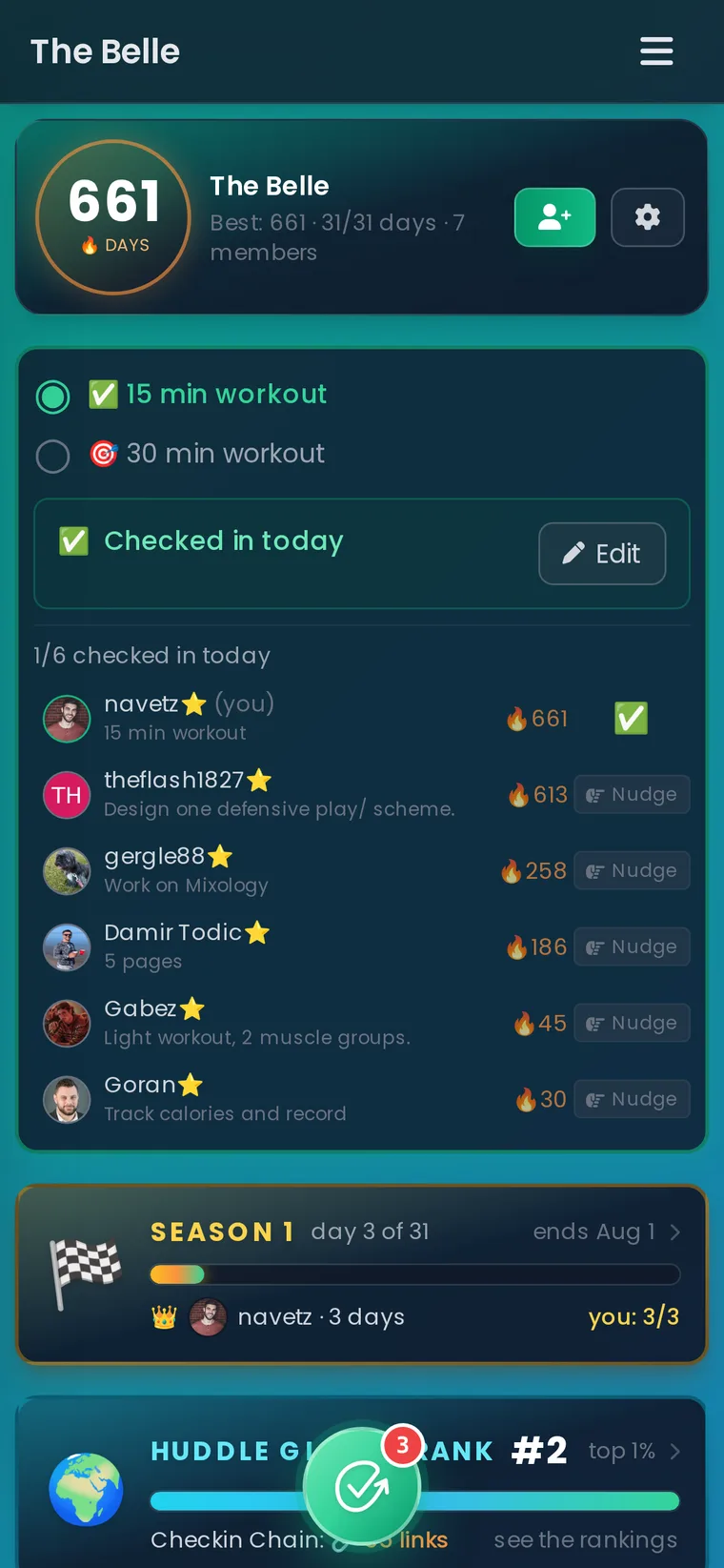
Checkins sync in real time with the Habit Huddle web app and the iOS and Android apps, which hold the things chat is bad at: long-term history, achievements, 30-day competitive Seasons, and leaderboards.
The honest trade-offs: a huddle tracks one habit per channel, so a server holding people accountable for gym, reading, and shipping code runs three connected channels. There is no private mode and no partner-DM feature at all, by design; if you want accountability that stays between two people, Accountability Bot below fits that shape better. And the free plan covers one active habit per person; unlimited habits and flexible checkins come with Habit Huddle Builder at about $8 a month.
The other ways to run accountability on Discord
Accountability Bot (top.gg listing) is the strongest option for individual goals inside a shared server. Members set a personal daily goal with /goal set and confirm it with /goal done. Its signature feature is the partner mechanic: assign someone with /partner, and they get a DM when you miss a day. It layers on a monthly streak freeze, milestone celebration roles at 7 through 365 days, a top-10 streak leaderboard, and a monthly report card by DM. The shape is different from a huddle: everyone tracks their own separate goal, and the pressure is a designated person rather than the whole room. For a server of people with unrelated goals, that is arguably the right shape.
Self-hosting an open-source bot is worth it only if your community includes someone happy to run one. Projects like this Python accountability bot automate weekly partner pairing and daily checkins, and you can bend the rules to anything your group wants. The cost is that you are now the maintainer, the host, and the on-call engineer for your accountability system, which is itself a habit you will need to keep.
Joining an accountability server instead. If your problem is that you have no group at all, adding a bot to an empty server solves nothing. Public directories list servers tagged accountability full of strangers running study rooms and daily-goal channels. It can work, but accountability from strangers is weaker than accountability from people whose opinion of you matters, and stranger servers churn hard. If even a couple of friends will commit, a bot in your own server beats a stranger community. For the wider app-versus-community decision, our best accountability apps comparison covers the trade-offs.
Setting it up so it survives month two
The setup itself takes about five minutes. Getting a channel that is still alive in sixty days takes a few deliberate choices:
- Invite the bot and run
/setup. For Habit Huddle, add the bot to your server or start from the Discord feature tour. A server admin picks or creates the channel and configures the habit, its Floor, and optionally its Ceiling. The bot stays quiet until setup is finished, then posts a single pinned announcement with the habit details and a Join button. - Give accountability its own channel. A checkin habit inside a busy general chat gets buried and forgotten. In a dedicated channel, every message is a checkin, a reaction, or the daily summary, and scrolling it reads as progress.
- Set the Floor embarrassingly low. This is the single highest-leverage decision. "10 minutes of movement" survives a terrible week; "90 minute workout" does not. The Floor is the commitment; the Ceiling is where the ambitious days go.
- Let the bot be the bad guy. Agree as a group, out loud, that the bot reports misses and humans only encourage. Servers where a moderator personally calls people out burn friendships; servers where the bot reports and the people cheer keep both the accountability and the community.
- React to checkins. The cheapest retention tool on Discord is an emoji reaction. A checkin that gets two reactions teaches that member that showing up is seen, and seen is the entire point.
If your community tracks habits specifically, our companion guide to the Discord habit tracker bot side of this covers streaks, the Checkin Chain, and habit mechanics in more depth.
Start the chain
An accountability bot cannot make anyone want a goal. What it does is remove every job that used to require a diligent human: remembering who committed, counting the days, chasing the quiet ones, and saying the awkward thing when someone disappears. Your server already has the people. Add Habit Huddle to your server, set one habit with a Floor you can hit on your worst day, and see how long a chain your group can forge. It is free to start, and everything the bot tracks stays synced to the full app for anyone who wants the long view.
You already know you can change.
You just need to take the first step. Habit Huddle helps you build habits around your goals, alongside friends who keep you accountable.
Frequently asked questions
What is the best accountability bot for Discord?
It depends on the shape of your accountability. For a group holding each other to one shared habit, Habit Huddle turns a channel into a huddle with personal streaks, a group Checkin Chain, and a daily summary that includes misses. For individuals tracking separate goals with a designated partner, Accountability Bot's partner-DM mechanic fits better. Communities with a developer on hand can also self-host an open-source bot.
How does a Discord accountability bot work?
Members commit to a goal or habit, then confirm progress once a day with a slash command such as /checkin in a shared channel. The bot records each checkin in the member's own timezone, tracks streaks, posts reminders to people who have not checked in yet, and publishes a daily summary so the group sees who showed up. The visibility is what creates the accountability; the bot just does the bookkeeping.
Can an accountability bot notify my partner when I miss a day?
Some can. Accountability Bot lets you assign a partner with a command, and that person gets a DM when you miss. Habit Huddle deliberately works the other way: it never DMs anyone, and misses appear in the channel's daily summary instead, so the accountability stays with the whole group rather than one enforcer.
Are Discord accountability bots free?
The main options are free to add and free for core use. Habit Huddle's free plan covers one active habit per person with full streak and Checkin Chain tracking; unlimited habits and flexible checkins come with Habit Huddle Builder at about $8 a month. Accountability Bot's listed features, including goals, partners, and leaderboards, are free at the time of writing.
Should I add a bot to my server or join an accountability server?
If you already have a server where a few people will commit, add a bot there: accountability from people you know beats accountability from strangers. Join an existing accountability server only when you genuinely have no group, and expect higher churn. Directories like Disboard list active servers if you go that route.
Ready to Build Habits With Friends?
Stop failing alone. Join thousands using the #1 habit tracker with friends for real accountability and lasting results.
Prefer mobile? App Store · Google Play
Related Guides
More Habit Huddle articles on building habits with accountability.

HabitShare Alternatives: 6 Apps for Tracking Habits With Friends (2026)
Looking for a HabitShare alternative? Six social habit trackers compared by model, price, platforms, and what happens on a missed day, plus how to switch wit...

What to Do When You Miss a Workout Day: The 5-Step Comeback Plan
Missed a workout day? What one miss does to your body and habit, according to research, plus a five-step plan for the next 24 hours, when to make it up, and...
Habit Streak App With Friends: 7 Apps Compared (2026)
Seven habit streak apps with friends compared: Habit Huddle, HabitShare, Daily Pact, Habitica, Streaks, Habit Streak duels, HabitStreak.io. What friends see,...