
Do Pushups Work Forearms? Not Much. Here's What Does
Pushups mostly work forearms as static grip support, not size builders. See the science, plus pushup variations and moves that actually build forearms.
Most advice on this topic skips the important distinction. People say pushups work your forearms, so readers assume standard pushups should build thicker forearms over time. Then they do lots of reps, feel their chest and triceps improve, and wonder why their grip and lower arms barely change.
That confusion makes sense.
If you've been doing pushups consistently and your forearms still don't look or feel much stronger, you're not missing some secret cue. You're running into a basic training principle. A muscle can be active during an exercise without getting a strong growth stimulus from that exercise. That difference matters more than almost anything else when you ask, do pushups work forearms.
Table of Contents
- The Short Answer and The Real Question
- Why Standard Pushups Wont Grow Your Forearms
- 5 Pushup Variations That Actually Build Forearms
- Programming Forearm Pushups for Real Growth
- Build Consistency With a Habit Tracking System
- Common Mistakes and Your Path Forward
The Short Answer and The Real Question
Yes, pushups work your forearms. But standard pushups don't work them very well for growth.
That's the answer most people actually need.
Your forearms do participate in a pushup. They help you hold your wrist position, keep your hand stable on the floor, and transfer force from the ground up through the arm. But that role is very different from the role of your chest, shoulders, and triceps, which are driving the movement.
A simple way to think about it is this. In a normal pushup, your forearms are more like the clamps holding a machine steady than the motor moving it. Clamps matter. They just aren't doing the main job.
Bottom line: A muscle can be involved without being challenged in the way that usually leads to visible development.
This is why someone can do pushups every day and still feel that their grip is weak, their wrist endurance is mediocre, or their forearms haven't changed much. You're not imagining that gap. Standard pushups train the pushing pattern well. They don't automatically turn into forearm builders just because your hands are on the floor.
The better question isn't only "Do pushups work forearms?" It's "What kind of forearm work happens during a pushup, and is it enough for the result I want?"
If you want stronger, more noticeable forearms, the key is changing the type of demand. Instead of just asking the forearms to stabilize, you want variations that force the hands and forearms to grip, resist slipping, and stay under harder tension. That's where pushups start becoming useful for forearm development instead of just upper-body pressing.
Why Standard Pushups Wont Grow Your Forearms
Standard pushups have a reputation for being a complete upper-body exercise. That's true in a broad sense. But broad involvement isn't the same thing as direct development.
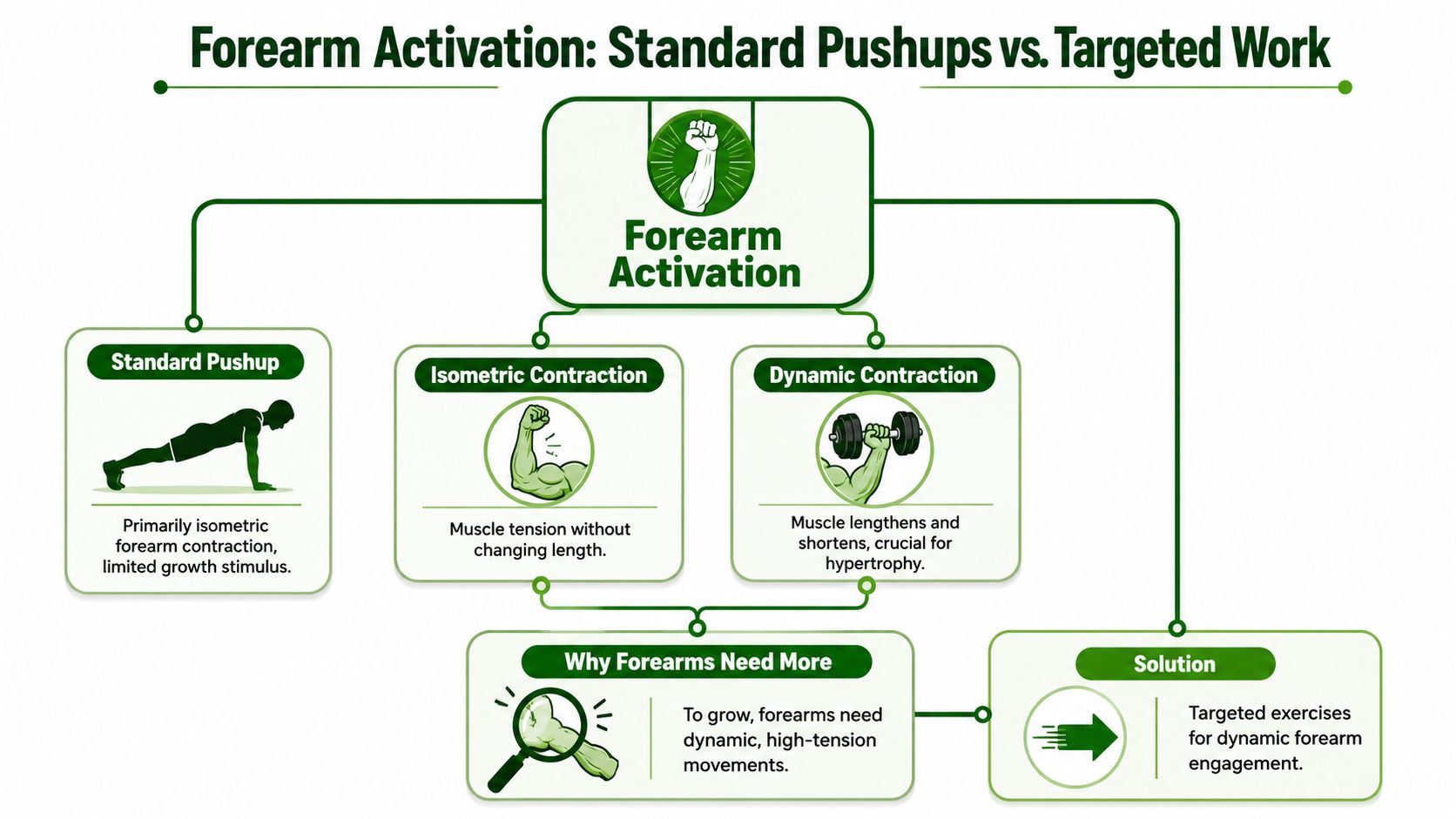
According to this explanation of forearm involvement in conventional pushups, the forearms are recruited only in a stabilizing or isometric capacity, which means they contract to keep the body in place without producing dynamic movement. That creates very low potential for hypertrophy, so pushups are ineffective for significant forearm development even though the muscles are technically engaged.
Activation is not the same as growth
The easiest analogy is a crane.
The base of a crane has to stay rigid and stable while the arm moves the load. If the base fails, the whole system fails. But the base isn't doing the lifting motion itself. In a standard pushup, your forearms act more like that base. Your chest, front shoulders, and triceps are the moving arm.
That matters because muscles usually grow best when they're exposed to enough tension in a way they have to keep producing force through demanding positions. In a normal pushup, your forearms mostly hold shape. They brace. They don't get much of the movement challenge.
A lot of readers get stuck here because they think, "But I feel my forearms during pushups." You probably do. Feeling a muscle isn't proof that the exercise is a strong builder for that muscle. Sometimes you feel tension because a muscle is preventing wobble, not because it's being trained as a primary target.
Why the forearms feel involved anyway
Your forearms still have jobs to do in a pushup:
- Wrist control: They help keep the wrist from collapsing.
- Hand stability: They help distribute pressure through the hand.
- Force transfer: They connect your hand contact with the rest of the arm.
- Position maintenance: They help you stay stacked and controlled at the bottom.
Those jobs are real. They're just limited.
Think of standard pushups as a great chest and triceps exercise with forearm attendance, not forearm leadership.
That's why people who want forearm size or grip strength usually need something else. Sometimes that means separate forearm work. Sometimes it means changing the pushup so the hands and forearms stop being passive supports and start becoming high-tension contributors.
Once you understand that principle, the exercise choices get much clearer. You stop chasing more standard reps and start choosing variations that ask the forearms to do harder work.
5 Pushup Variations That Actually Build Forearms
If you want pushups to challenge your forearms, you need to change the hand demand. The most useful variations make your fingers, grip, and wrist stabilizers fight to maintain position instead of just resting on the floor.

A useful benchmark comes from Gainful's forearm workout guide, which notes that fingertip push-ups and towel-grip push-ups significantly increase forearm activation by forcing the forearm flexors to resist dynamic slippage, creating a higher isometric load that can make the forearms fatigue before the main pushing muscles.
Which variation fits your level
Before the list, use this quick comparison.
| Variation | Forearm Engagement | Primary Benefit |
|---|---|---|
| Fingertip pushup | High | Finger strength and forearm flexor tension |
| Knuckle pushup | Moderate | Wrist position change and fist stability |
| Towel-grip pushup | High | Grip tension and anti-slip forearm work |
| Bar-grip pushup | Moderate to high | Crush grip and neutral wrist position |
| Crab walk pushup | High | Continuous forearm tension with bodyweight support |
The five variations
1. Fingertip pushups
This is the cleanest way to make your forearms earn the rep. Instead of spreading force through the whole palm, you support yourself through the fingers. That drives a lot more demand into the finger flexors and the muscles that stabilize the wrist.
Start on an incline, from the knees, or with partial range if full fingertip pushups are too aggressive. Keep the fingers spread and don't let them collapse inward.
2. Knuckle pushups
Knuckle pushups don't create the same grip challenge as fingertip work, but they can still help by changing wrist position and asking the fist to stay packed and stable. For some people, this also feels friendlier than flat-hand pushups.
Keep the wrist straight, the fist solid, and the shoulders stacked. If your knuckles are sensitive, use a mat.
3. Towel-grip pushups
This variation is underrated. Put a towel under each hand or grip rolled towels so your hands have to squeeze and resist movement. That creates the anti-slip demand many people never get from regular pushups.
The towel changes the assignment. Your forearms aren't just stabilizing your wrist anymore. They're actively trying to keep the setup from sliding apart.
Coaching cue: If the towel feels like it might slip, you're probably in the right neighborhood. Your forearms should notice that immediately.
Here's a demonstration format many lifters find helpful before trying the harder versions:
4. Bar-grip pushups
Use dumbbells, pushup bars, or parallettes and squeeze the handles. A lot of people miss that part. If you just rest on the bars, you lose the forearm benefit. If you crush the handles while pressing, the forearms get a much more direct job.
This one also reduces wrist extension, so it can be a smart option for lifters who dislike floor pushups on flat palms.
5. Crab walk pushups
This is the oddball variation, but it's useful. In the crab position, your forearms help manage support while your hands work in a less familiar angle. If you slightly arch the back and keep the arms active, the tension climbs quickly.
Move slowly. Fast crab walks usually turn sloppy before they become productive.
You already know you can change.
You just need to take the first step. Habit Huddle helps you build habits around your goals, alongside friends who keep you accountable.
Programming Forearm Pushups for Real Growth
Good exercise selection matters. Good programming matters more.
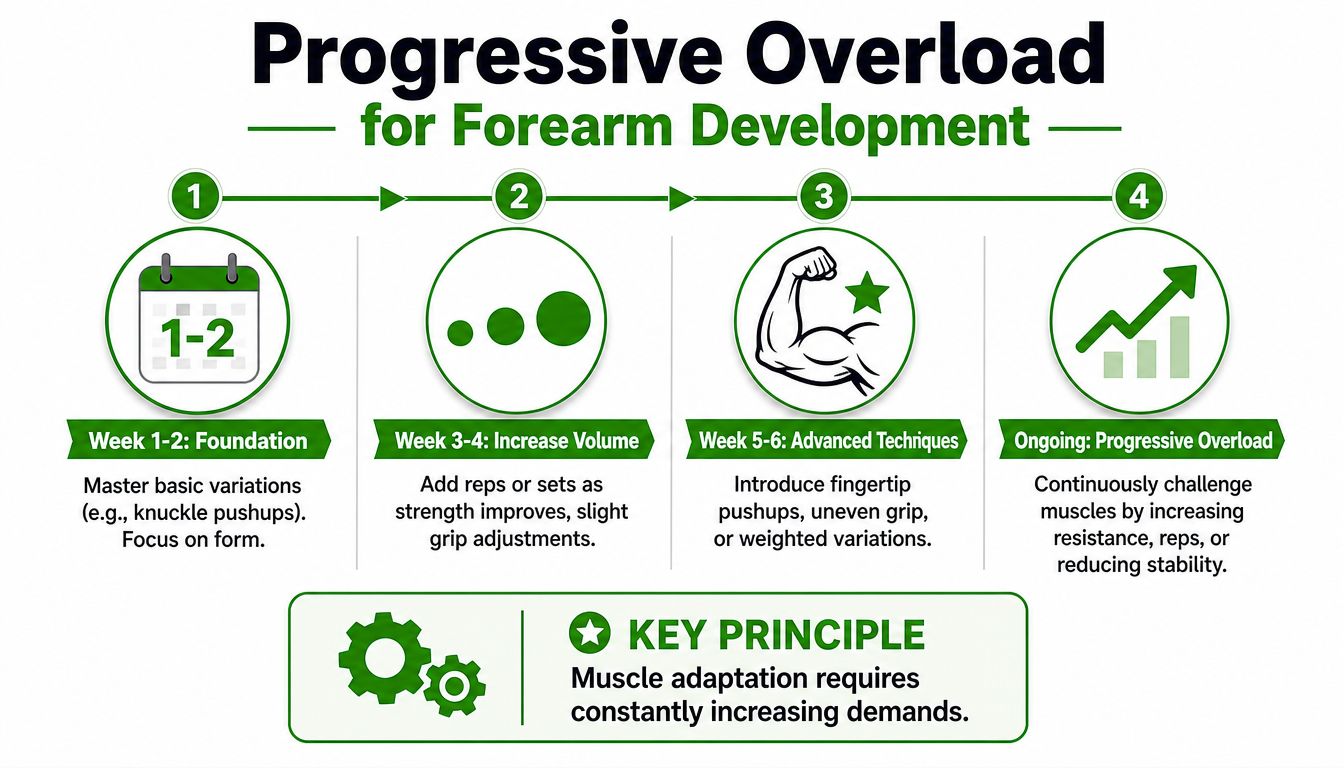
A lot of people find the right variation, do it hard for a few sessions, then stall because they never build a progression. Forearms respond to the same basic training rule as every other muscle group. You need a reason for the body to adapt.
If you want a deeper framework for that process, it helps to learn progressive overload principles so you can stop guessing and start adjusting your training on purpose.
Use progression instead of random effort
The practical version is simple. Keep one variation in your plan long enough to improve it. Don't switch every workout just because a harder move looks impressive.
One useful guideline from the earlier forearm-focused source is to use 12–15 repetitions per set for fingertip contact work, and progress to 15–20 reps with grippers as muscles adapt. The same source also notes that slightly arching the back in crab walks can increase forearm tension.
That doesn't mean every person should force those targets immediately. It means you need a range to grow into. The progression can come from cleaner reps, more challenging mechanics, more control, or a more demanding hand position.
A simple weekly habit plan
Use a small rotation instead of trying everything every day.
Day one, skill and tension Choose fingertip pushups or incline fingertip pushups. Focus on controlled reps and stable fingers.
Day two, grip emphasis Use towel-grip pushups or bar-grip pushups. Squeeze hard on every rep.
Day three, support and endurance Use crab walks or knuckle pushups for slower, cleaner sets.
Keep the total amount manageable at first. Your forearms and wrists often adapt more slowly than your motivation does. That's why breathing and pacing matter too. If your pushup sets get messy when you're straining, this guide on how to breathe when doing push-ups can help you keep tension where you want it instead of leaking it through the neck and shoulders.
Progression isn't only adding reps. It's making the same rep harder to fake.
Here are practical ways to overload these variations without gimmicks:
- Vary the body's angle: Move from wall or incline to floor.
- Increase the grip demand: Go from bars to towels, or from palms to fingertips.
- Slow the lowering phase: More control usually means more forearm time under tension.
- Tighten the standard: Cleaner setup, stronger squeeze, less shifting.
If you stay patient, these become habits rather than "challenge" workouts. That's where real change usually happens.
Build Consistency With a Habit Tracking System
Most training plans fail for a boring reason. People rely on motivation instead of a repeatable check-in.
Forearm pushup work is especially easy to skip because it doesn't always feel glamorous. Chest work feels obvious. Arm work feels satisfying. Grip and forearm work often feels like maintenance until you realize it's limiting everything else. A tracking system fixes that by making the small sessions count.
Set a floor and a target
The smartest setup uses two layers.
Your minimum is the version you can do on a busy day without debate. That could be one easy set of knuckle pushups, a short crab walk, or a few controlled towel-grip reps. Your daily goal is the fuller session you hit when time and energy are normal.
That structure matters because it breaks the all-or-nothing pattern. Missing the ideal workout doesn't have to become missing the habit.

A lot of people stay inconsistent because they only count perfect sessions. That's why a habit system should reward showing up, not just peak performance. If your training history is stop-start-stop, it may help to read how to work out consistently and apply that same logic here.
Make consistency visible
Don't just track whether you trained. Track what variation you used, how it felt in the forearms, and whether your wrists handled it well.
A simple note can look like this:
- Variation used: Towel-grip pushups
- Session quality: Strong squeeze, stable wrists
- Adjustment for next time: Raise feet less, slow the lowering
- Minimum completed: Yes
The habit that sticks is the one that still works on low-energy days.
This approach keeps your plan honest. If towel-grip pushups always aggravate your wrist, your notes will show that pattern. If fingertip incline work is steadily getting easier, you'll see that too. Progress becomes something you can review, not just something you hope is happening.
Common Mistakes and Your Path Forward
Many individuals don't fail because forearm training is complicated. They fail because they rush the hard versions, ignore joint feedback, or treat consistency like a mood.
Mistakes that stall progress
Going straight to advanced fingertip work
If your fingers or wrists aren't ready, this becomes a pain test instead of a training plan. Use incline versions, partial range, or bar-grip pushups first.
Letting the hand relax
A towel-grip or bar-grip pushup only trains the forearms if you actively squeeze. Passive contact turns a good variation into a regular pushup with extra props.
Chasing fatigue instead of quality
Forearm burn can trick people. A sloppy, frantic set isn't better than a controlled one. Clean tension beats chaotic effort.
Ignoring wrist comfort
Discomfort is information. It doesn't always mean stop forever, but it does mean adjust angle, body position, or variation selection.
What to do next
Keep the principle simple. Standard pushups involve the forearms. Variations that force harder hand tension train them better. Progress comes from repeating the right level often enough to adapt.
If you tend to overcomplicate new routines, this guide on how to start a habit is a useful reminder to begin smaller than your ego wants. That's not lowering the standard. It's making the standard sustainable.
Your next step doesn't need to be dramatic. Pick one variation. Practice it a few times each week. Write down what improved. Then earn the next progression.
Forearm strength is built the same way solid pushup strength is built. One good rep at a time, repeated long enough to matter.
If you want a simple way to turn that process into a daily routine, Habit Huddle makes it easy to track a minimum version of your forearm work and a full daily goal, so you keep momentum even on busy days.
Ready to Build Habits With Friends?
Stop failing alone. Join thousands using the #1 habit tracker with friends for real accountability and lasting results.
Prefer mobile? App Store · Google Play
Related Guides
More Habit Huddle articles on building habits with accountability.

HabitShare Alternatives: 6 Apps for Tracking Habits With Friends (2026)
Looking for a HabitShare alternative? Six social habit trackers compared by model, price, platforms, and what happens on a missed day, plus how to switch wit...

What to Do When You Miss a Workout Day: The 5-Step Comeback Plan
Missed a workout day? What one miss does to your body and habit, according to research, plus a five-step plan for the next 24 hours, when to make it up, and...

Habit Streak App With Friends: 7 Apps Compared (2026)
Seven habit streak apps with friends compared: Habit Huddle, HabitShare, Daily Pact, Habitica, Streaks, Habit Streak duels, HabitStreak.io. What friends see,...