
How to Breathe When Doing Push Ups (Inhale Down, Exhale Up)
Inhale on the way down, exhale as you push up. The three breathing mistakes that end sets early, goal-based adjustments, and drills that make it automatic.
Inhale as you lower your body, exhale as you push back up. That is the whole rule for breathing during push ups, and getting it consistent is worth more reps than almost any other technique fix.
Most people treat breathing as background noise during push ups. They think about hand placement, elbow angle, and keeping a straight line from head to heel, then leave the breath on autopilot. That is usually where sets fall apart: the chest and triceps have something left, but tension leaks, form gets sloppy, and the set ends early.
This guide covers the core rhythm, the three mistakes that quietly kill sets, how to adjust breathing for endurance, strength, or speed, and drills that make the pattern automatic.
The core rhythm: inhale down, exhale up
Breathe in through your nose on the way down, and out through your mouth as you press away from the floor. The inhale paces the descent; the exhale gives the press a clear finish.
Think of each rep as loading and releasing a spring:
- Set the top position. Lock in your plank before the rep starts, rather than sagging and trying to breathe your way out of it.
- Inhale as you descend. Let the breath match the length of the lowering phase.
- Change direction without a long pause. Hold the bottom just long enough to stay in control.
- Exhale as you press. Push the floor away and let the air out with the effort.
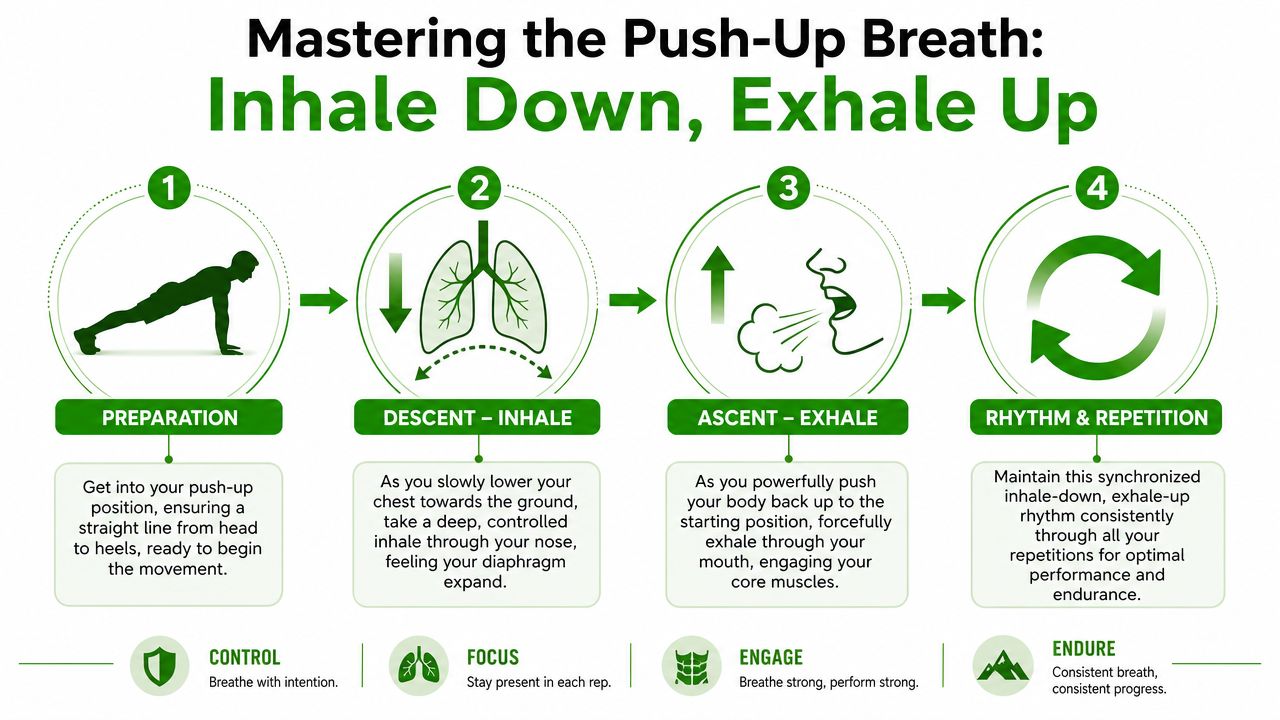
The inhale is not a gasp and the exhale is not a scream. Both should feel deliberate. This timing does two mechanical jobs at once: the inhale helps you settle into a controlled descent instead of collapsing into it, and exhaling through the press lets you drive force through a braced trunk. A strong push up starts in the torso, not just the chest and triceps.
There is a mental payoff too. "Inhale down" tells you to stay patient; "exhale up" tells you when to commit. That rhythm prevents the two most common mental errors in push ups: rushing the descent and panicking at the sticking point.
Three breathing mistakes that kill your reps
Breathing problems in push ups come in three shapes: you stop breathing, you breathe in reverse, or you breathe so shallowly the rhythm never settles.
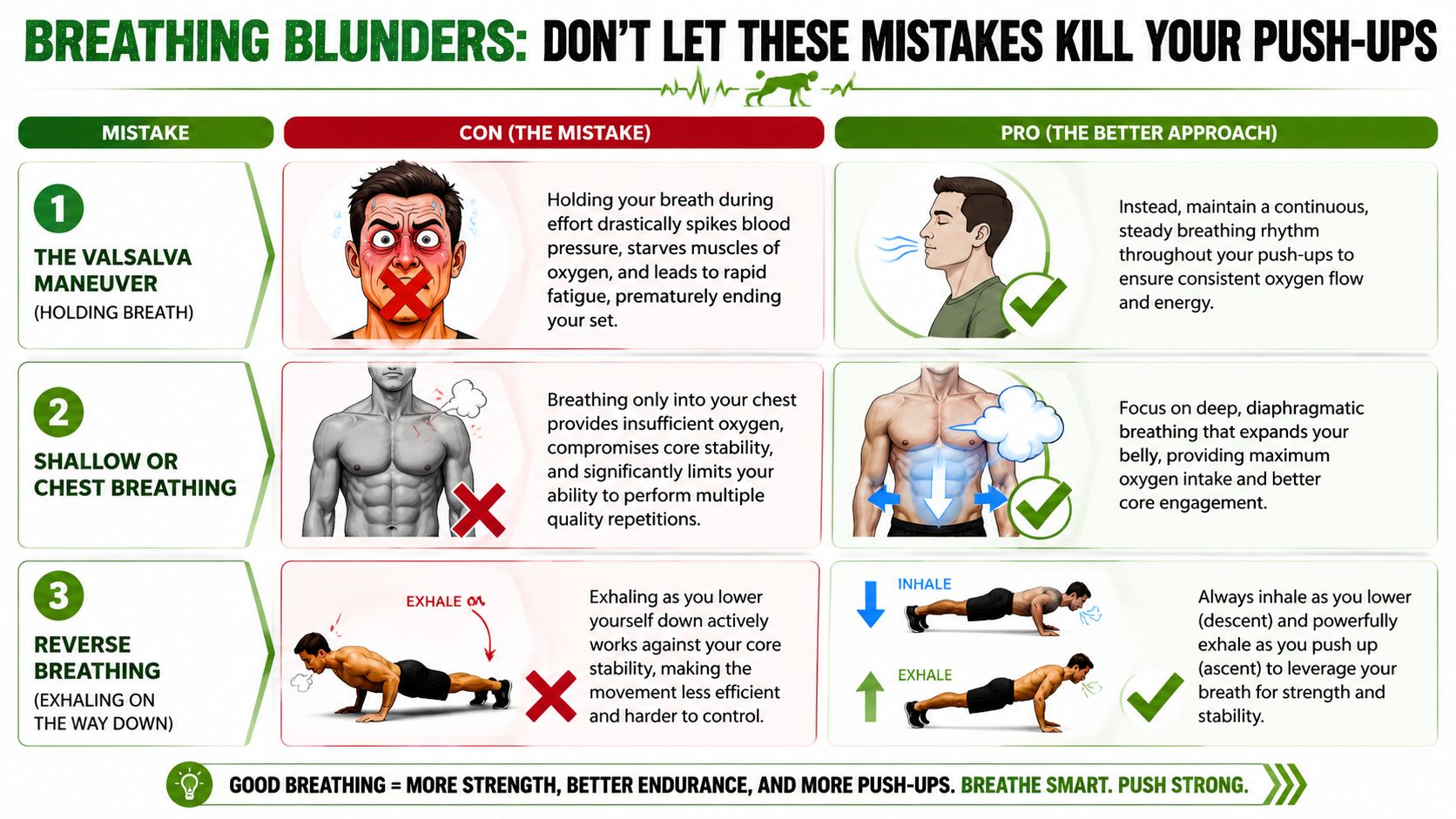
Holding your breath through the whole rep. The classic error: you tense up, lower, hit resistance, and only remember to breathe when the rep is over. The symptoms are a tight face, an overworked neck, and fatigue that arrives earlier than it should. A deliberate short brace has a place in very hard reps, covered below, but accidental breath-holding through ordinary sets makes them sloppier, not stronger.
Breathing in reverse. Exhaling on the way down and inhaling on the press sounds like a minor swap, but it makes the bottom position feel loose and the press feel unsupported. If this is your habit, slow the set down and say the rhythm in your head for a few reps: inhale down, exhale up.
Tiny upper-chest breaths. Some people breathe on every rep, but so shallowly that the shoulders creep up and the body never settles. If you get light-headed, lengthen each breath and slow the cadence. If your shoulders shrug as you breathe, think lower and wider through the torso. If reps speed up as you tire, count the rhythm so the breath does not disappear under fatigue.
If your breathing sounds frantic by rep three, the set is probably too fast or the timing is off.
Adjusting your breathing for endurance, strength, or speed
The standard rhythm works for almost everyone, but the emphasis shifts with the goal.
| Goal | Breathing technique | Why it works |
|---|---|---|
| Endurance | Steady inhale down, steady exhale up, even rhythm across reps | Keeps the set calm and repeatable so breathing is not the first thing to fail |
| Strength | Controlled inhale down, brief brace at the hard part, strong exhale through the press | Creates trunk stiffness and better force transfer for grindy reps |
| Speed | Short inhale down, sharp exhale that snaps with the press | Matches breath timing to fast force production |
For high-rep sets, consistency is everything: no huge inhales, no dramatic force-outs, just enough breath to keep panic out of the set. For weighted, ring, or deficit push ups, a brief brace at the sticking point helps, then return to normal rhythm. For explosive push ups, the exhale should feel like a snap that matches the press; if the breath lags the movement, power leaks.
One honest caveat: if you always run out of breath long before your muscles fail, the limiter is probably conditioning, not breathing technique. Easy cardio work over a few weeks fixes what no breathing cue can.
Drills that make correct breathing automatic
Knowing "inhale down, exhale up" is not the same as owning it under fatigue. Everyone can recite the pattern fresh; the skill is keeping it when the set gets hard, and that takes deliberate, low-pressure repetition.

Drill one: remove the load. Use incline push ups, wall push ups, or a hands-and-knees version, and exaggerate the timing slightly. You are not trying to get tired; you are making the rhythm feel obvious.
Drill two: single perfect reps. Drop into position, do one excellent rep with correct breath, stand up, reset, repeat. Quality stays high and you never slip into survival mode. Singles are also the lowest-friction way to start a habit, because one clean rep done on purpose teaches the pattern better than a long sloppy set.
Drill three: log what works. Track which breathing emphasis fits which workout the same way you log reps and rest periods. A simple note after each session is enough, and our guide on how to track progress covers how to review it without turning training into admin.
Breathing under effort is also a habit loop. If you always tighten up and stop breathing when effort rises, that reaction follows you into harder exercises and stressful moments outside the gym, which is exactly the pattern-building territory of behavior change psychology.
Make the practice stick
Ten slow breathing-focused reps a day beats one heroic set a month, and the hard part is doing it daily, not doing it right.
If consistency is your gap, Habit Huddle turns the daily practice into something friends can see. Set a Floor, even five focused reps counts, checkin when you have done them, and let your huddle cheer the days you showed up. Small daily practice with witnesses is how "inhale down, exhale up" stops being advice you know and becomes the way you move.
You already know you can change.
You just need to take the first step. Habit Huddle helps you build habits around your goals, alongside friends who keep you accountable.
Frequently asked questions
Should you inhale or exhale going down on a push up?
Inhale on the way down, through the nose, matching the breath to the descent. Exhale through the mouth as you press back up. Exhaling during the effort phase keeps your trunk braced while force is highest.
Is it bad to hold your breath during push ups?
Accidentally, yes: it tightens the neck and face, wastes energy, and ends sets early. A brief deliberate brace at the hardest moment of a heavy rep is a legitimate technique, but return to rhythmic breathing immediately after.
Why do I run out of breath doing push ups?
Either your breathing is shallow and mistimed, or your general conditioning is the limiter. Fix the pattern first with slow, deliberately timed reps. If you still gas out long before your muscles fail, add easy cardio work; a bigger engine makes the breathing pattern easy to hold.
How do you breathe during fast or explosive push ups?
Short inhale on the descent, then a sharp, decisive exhale that snaps with the press. The exhale should feel synchronized with force production; if it lags behind the movement, the rep loses crispness.
Ready to Build Habits With Friends?
Stop failing alone. Join thousands using the #1 habit tracker with friends for real accountability and lasting results.
Prefer mobile? App Store · Google Play
Related Guides
More Habit Huddle articles on building habits with accountability.

Habit Streak App With Friends: 7 Apps Compared (2026)
Seven habit streak apps with friends compared: Habit Huddle, HabitShare, Daily Pact, Habitica, Streaks, Habit Streak duels, HabitStreak.io. What friends see,...

Reading Challenge App With Friends: 8 Apps Compared (2026)
Eight reading challenge apps for friends compared: Goodreads, StoryGraph, Fable, Bookclubs, ReadRats, Reading Rivals, BookBuds, Habit Huddle. What friends se...

Why Can't I Stick to a Routine? 7 Real Reasons and the Fix for Each
Routines fail on design, not willpower: sized for your best day, no cue, five changes at once, one miss treated as a quit. Seven reasons, the research, and a...