
How to Start a Habit: A Science-Backed Guide That Sticks
Tired of failed resolutions? Learn how to start a habit with a science-backed framework. Go from picking a goal to building unstoppable momentum together.
Most advice on how to start a habit is incomplete. It tells you to get motivated, set a big goal, and stay disciplined. That sounds good for three days. Then real life shows up. You sleep badly, travel, get stressed, miss once, and the habit collapses.
That failure usually gets framed as a character problem. It isn't. In practice, most failed habits come from bad design: the habit was too big, the cue was vague, the fallback plan didn't exist, and nobody else could see whether you showed up.
A better approach is simpler and more durable. Start one habit. Make it so small it feels almost trivial. Attach it to a fixed cue. Track the minimum version. Then add the missing lever most guides skip: social accountability. That's how you stop depending on mood and start building something that lasts.
Table of Contents
- Why Your Past Habits Failed And Why It Is Not Your Fault
- Choose One Thing And Make It Impossibly Small
- Design Your Automatic Loop With A Cue And Reward
- Track Your Progress And Build Momentum
- Use Social Accountability To Guarantee Consistency
- Troubleshoot Your Habit When You Inevitably Slip Up
Why Your Past Habits Failed And Why It Is Not Your Fault
If you've tried to build a routine before and watched it fade, you're in crowded company. Many people, it turns out, weren't taught how habits form. Instead, they were taught to "want it more."
That advice breaks down fast because motivation is inconsistent. Some days you feel sharp and ready. Other days, even basic tasks feel heavy. If your habit only works when you feel inspired, you don't have a habit yet. You have a good intention.
Willpower is a weak foundation
A lot of mainstream advice still treats habit change like a daily test of self-control. The more useful framing is operational: build a behavior that's easy enough to do when energy is low, anchor it to an existing routine, and protect it with a plan for slips. That's the gap many people feel but can't name.
James Clear puts the recovery side of this well in his guide on habit building. The useful standard isn't perfection. It's abandoning the all-or-nothing mindset and becoming someone who "never misses twice."
Practical rule: A missed day is rarely the real problem. The real problem is letting one miss become a new pattern.
This shift matters because shame makes people redesign nothing. They just recommit emotionally and repeat the same setup. Same oversized goal. Same vague timing. Same dependence on feeling ready.
Habits are systems, not personality tests
I've seen this pattern over and over. Someone decides to "work out every day," "read for an hour," or "meditate every morning." The idea is fine. The system is terrible. The target behavior is too large, the context changes day to day, and there's no fallback version for rough days.
A habit works better when you stop asking, "How can I force myself to do this?" and start asking:
- What exact action counts
- When exactly it happens
- What happens if the day goes sideways
- How I'll know I stayed consistent
If your past attempts felt discouraging, it also helps to reset your timeline expectations. The popular 21-day myth has done real damage. This breakdown of how long habits actually take to form is useful because it reframes the process as repetition over time, not a short burst of discipline.
What usually doesn't work
Some habit plans fail before day one because they're built around fantasy conditions.
| Common approach | What goes wrong |
|---|---|
| Waiting to feel motivated | Action becomes mood-dependent |
| Starting with the ideal version | Friction is too high on normal days |
| Changing five things at once | Attention gets split and progress blurs |
| Treating a miss like failure | One lapse turns into abandonment |
The good news is that this is fixable. When people learn how to start a habit with a smaller target, a fixed trigger, and a recovery plan, the process feels less dramatic and much more repeatable.
Choose One Thing And Make It Impossibly Small
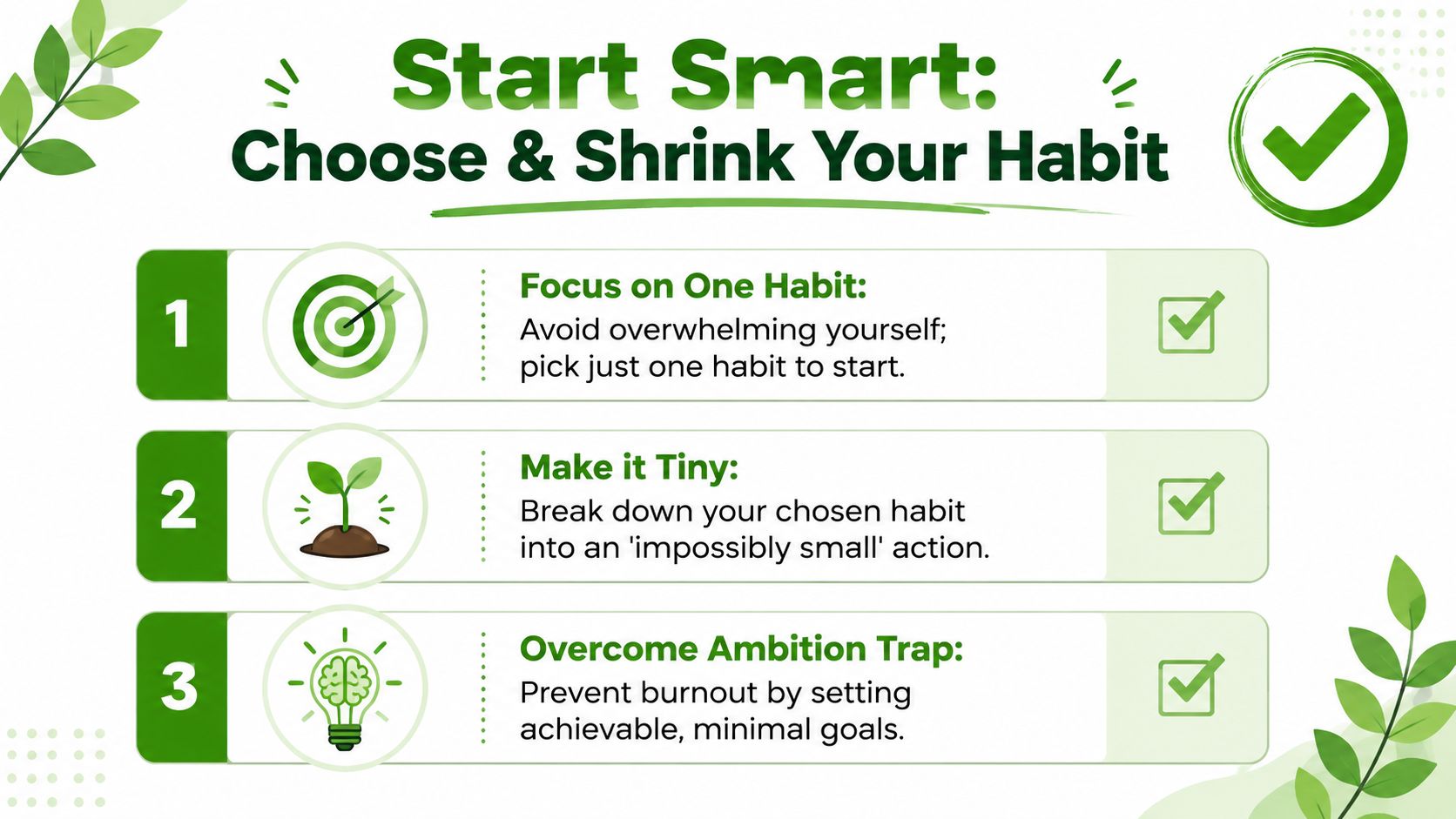
The fastest way to stall a new routine is to start with ambition instead of mechanics. People say they want to build "better habits," but what they usually mean is a bundle of goals: wake up earlier, exercise, eat better, read more, journal, stretch, drink water. That's not one habit. That's a full lifestyle renovation.
Pick one.
One habit creates clarity
When you focus on a single behavior, you remove a lot of hidden friction. You know what "done" means. You know where your attention goes. You can tell whether the system is working.
Good first habits usually have one of these traits:
- They enable other behaviors. A short walk after work often improves sleep, mood, and screen time without forcing those directly.
- They repair a chronic weak spot. If mornings are chaotic, one small reset habit there may matter more than adding something new at night.
- They are easy to repeat in a stable context. Stability beats intensity at the beginning.
If you're unsure what to choose, don't ask what's most impressive. Ask what's most likely to survive a tired Tuesday.
Shrink it below your pride level
A strong evidence-based starting method is to reduce the behavior to a near-frictionless version and tie it to a fixed cue. Guidance grounded in behavioral science recommends starting with a version you can do in under 2 minutes or that feels almost too easy, because repetition in a stable context matters more than motivation at the start, as explained in this behavior-science-based habit guide.
That means:
- "Read every night" becomes read one page
- "Start running" becomes put on running shoes and step outside
- "Meditate daily" becomes sit and take three slow breaths
- "Journal every morning" becomes write one sentence
Small enough to succeed beats meaningful enough to admire.
A lot of people resist this because it feels too easy to matter. That's ego talking. The goal at the beginning isn't improvement volume. It's behavior repetition.
What tiny actually looks like
Here's a simple filter I use. Your starter version should pass all three tests:
- You can do it on a low-energy day
- You know exactly when it happens
- You'd feel slightly silly calling it "too hard"
If it fails any one of those, it's still too big.
A few examples make this concrete:
| Bigger goal | Better starter habit |
|---|---|
| Get fit | Put on workout clothes after work |
| Read more | Read one page after brushing teeth |
| Drink more water | Fill one bottle after making coffee |
| Practice gratitude | Write one line before bed |
What's needed isn't more excitement. Rather, it's less friction. That's the starting line for learning how to start a habit that sticks.
Design Your Automatic Loop With A Cue And Reward
Once the habit is small enough, the next job is making it easier to repeat without debate. Relying on memory in this stage is common. Memory is unreliable. You want a loop.
Recent survey research found that 66.34% of daily behaviors were habitually initiated and 87.6% of habits were habitually executed, which shows how much day-to-day action runs on routine rather than fresh conscious decision-making, according to the University of South Carolina summary of the research.
Start with the cue
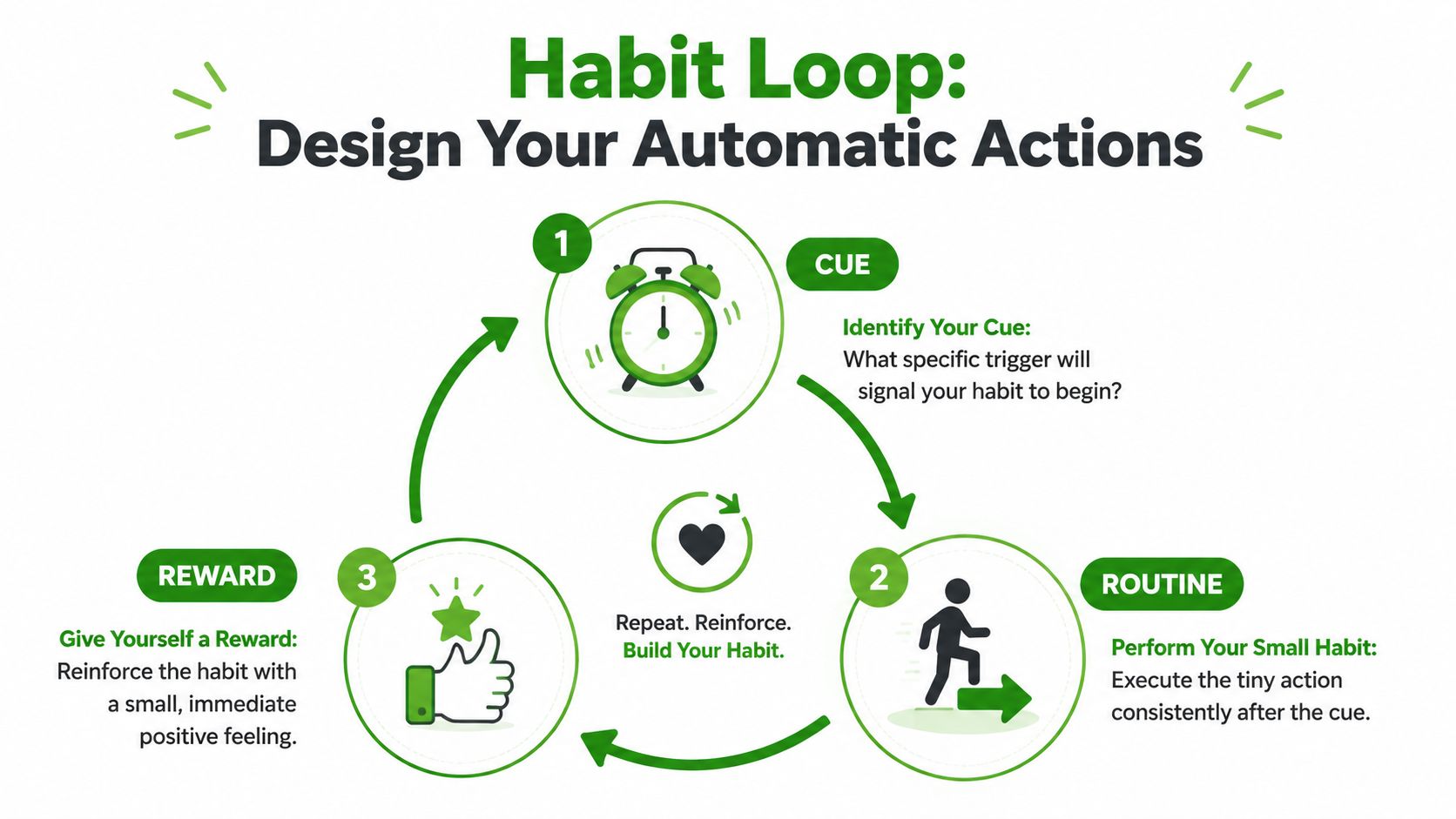
A cue is the event that tells your brain, "Now."
Good cues are concrete. Bad cues are aspirational.
Compare these:
- Weak cue: sometime in the morning
- Strong cue: after I pour my coffee
- Weak cue: when I have time tonight
- Strong cue: after I put my phone on the charger
- Weak cue: before work
- Strong cue: when I sit at my desk
The more stable the cue, the less decision-making you need. That matters because every extra decision creates another place to quit.
Use habit stacking
One of the cleanest ways to start a habit is to attach it to something you already do consistently. Use this formula:
After I [current habit], I will [tiny new habit].
A few examples:
- After I brush my teeth, I will read one page.
- After I start the kettle, I will fill my water bottle.
- After I sit on the edge of the bed, I will take three slow breaths.
- After I close my laptop, I will do five bodyweight squats.
This works because you're borrowing reliability from an existing routine. You're not trying to remember something new from scratch.
Keep the response boring and repeatable
The routine itself should stay small until the loop feels natural. People often sabotage progress at this point. The first few days go well, so they expand too fast. One page becomes twenty. Five squats become a full workout. Three breaths become a twenty-minute meditation session.
That jump feels productive, but it often breaks the pattern.
If the cue is stable but the routine keeps expanding, the habit stops feeling automatic and starts feeling negotiable.
Protect the baseline version. You can always do more after the minimum is complete. Just don't move the minimum target every time you feel motivated.
You already know you can change.
You just need to take the first step. Habit Huddle helps you build habits around your goals, alongside friends who keep you accountable.
Add a reward your brain notices
A reward doesn't need to be dramatic. It just needs to close the loop with a positive signal. Most healthy habits don't give immediate external payoff. That's why people quit early. The workout doesn't transform your body today. The single page doesn't make you a scholar tonight.
You need a reward that happens now.
Try one of these:
- Visible completion: mark the habit done on paper or in an app
- Micro-celebration: a brief "done" moment, fist pump, or verbal acknowledgment
- Immediate comfort: make tea after stretching, or sit in your favorite chair after reading
- Social signal: send your completed check-in to a friend or group
A cue starts the loop. A tiny action keeps it manageable. A reward tells your brain it was worth repeating.
Track Your Progress And Build Momentum
Tracking gets misunderstood. People think it turns habits into a pressure system. In reality, good tracking lowers drama. It gives you evidence.
When someone says, "I've been so inconsistent," I usually want to ask, compared to what? Memory is selective. It magnifies misses and ignores quiet wins. Tracking replaces emotion with a record.
Track completion, not self-worth
A landmark University College London study found that new habits took an average of 66 days to become automatic, with a range from 18 to 254 days, which is why consistency over roughly 2 to 3 months is a more realistic benchmark than the 21-day myth, as summarized by University College London.
That timeline changes how you should think about progress. Early tracking isn't about proving mastery. It's about protecting repetition long enough for the behavior to settle in.
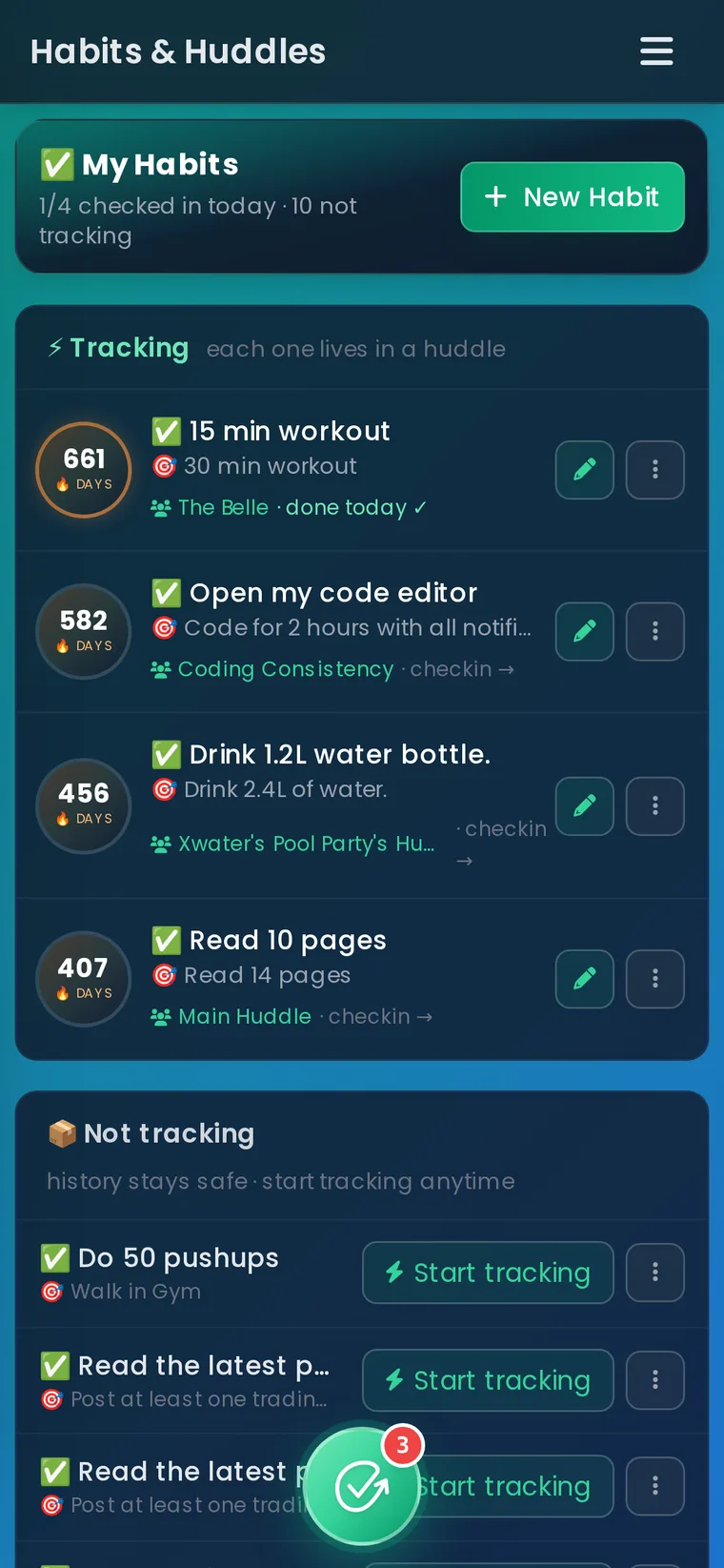
A useful tracker answers only a few questions:
- Did I do the habit
- What version did I do
- If I missed, why
That's enough to spot patterns without turning the habit into homework.
For a practical breakdown of simple check-in methods, this guide on how to track progress without overcomplicating it is worth reading.
Use a minimum and a stretch version
One reason habits collapse is that the daily target is too rigid. On a good day, you can do more. On a rough day, the same target feels impossible. That's when people either skip or decide the streak is over.
A better structure is:
| Type | What it does |
|---|---|
| Minimum | Keeps the habit alive on difficult days |
| Daily goal | Lets you push further when energy is there |
For reading, the minimum might be one page, while the daily goal is twenty minutes. For exercise, the minimum might be five squats, while the daily goal is a full session.
This protects consistency without pretending every day feels the same.
Never miss twice
This is the recovery rule that keeps one lapse from becoming a slide. Missing once can happen for dozens of normal reasons. Missing twice is when avoidance starts to harden.
Recovery rule: Your next win matters more than the reason you missed.
That doesn't mean forcing a perfect rebound. It means doing the easiest valid version of the habit at the next opportunity. If you skipped your walk, your comeback can be walking to the mailbox. If you missed journaling, write one sentence tonight.
Momentum doesn't come from giant efforts. It comes from reducing the number of times you fully disappear.
Use Social Accountability To Guarantee Consistency
Solo systems are good for starting. They're weaker at carrying you through the long middle, when novelty fades and the habit still isn't fully automatic.
That middle matters. A systematic review of 20 studies with 2,601 participants found that health-related habits typically take 2 to 5 months to become automatic, and the review concluded that the familiar 21-day rule isn't supported, as reported in the systematic review on habit formation.
That's where accountability stops being a nice extra and starts acting like infrastructure.
Why other people change your follow-through
Individuals are much better at keeping commitments that are visible. Not because they're weak alone, but because social context changes behavior in practical ways.
A small accountability group does a few useful things at once:
- It makes completion visible. You can't just tell yourself you'll "do it later" when others can see whether you checked in.
- It normalizes the boring middle. When everyone has low-energy days, your own rough patch stops feeling like proof you're failing.
- It creates a return path after misses. Re-entry is easier when someone expects to see you back tomorrow.
- It reduces private bargaining. You're less likely to shrink standards in your head when the routine is shared.
This matters even more for habits with weak immediate rewards, like mobility work, reading, hydration, or studying. Those habits often don't feel exciting. They benefit from being socially reinforced.
For a closer look at the mechanics, this article on social accountability for habits captures why visibility and shared check-ins can outperform private intentions.
What good accountability looks like
Bad accountability is vague. "Text me if you need anything" doesn't change much.
Good accountability is specific:
| Weak setup | Strong setup |
|---|---|
| General encouragement | Daily check-in expectation |
| Too many goals at once | One clear habit per person or group |
| No shared definition of done | A visible minimum standard |
| Silence after misses | Quick reset and next-day return |
The key is not pressure for pressure's sake. It's reducing ambiguity. People do better when the group knows what counts and can see whether it happened.
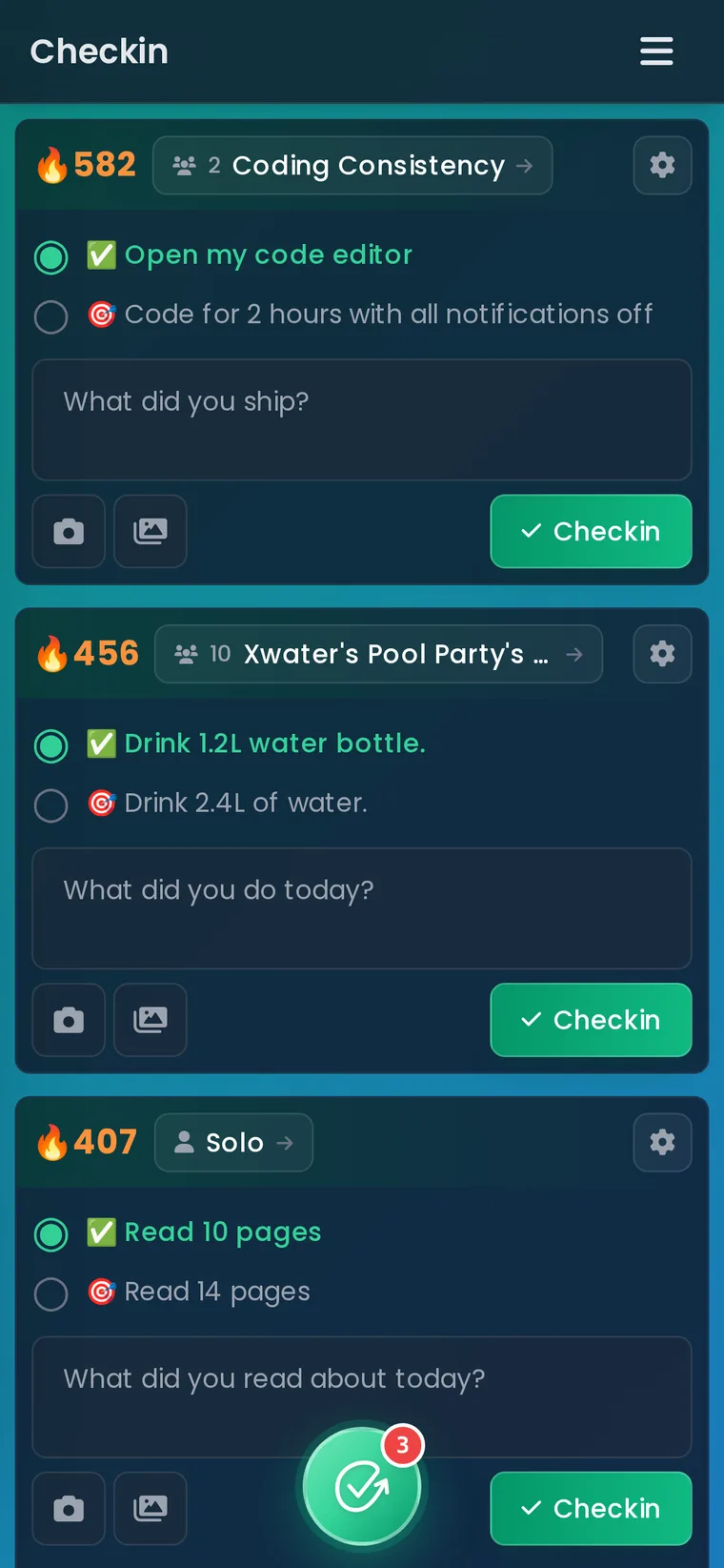
One practical option is Habit Huddle, a social habit tracker built around small groups, personal streaks, and a two-tier checkin system with Minimum and Daily Goal. It also makes consistency visible through a Checkin Chain the group builds together, group ratings, and Discord integration, which can fit communities that already spend time there.
A short demo helps if you want to see what a shared check-in flow looks like in practice.
Build a group that helps instead of drains
Not every social setup works. The most effective groups tend to be small, clear, and focused on showing up rather than performing.
A useful accountability group usually has these traits:
- Shared behavior: everyone is working on one clearly defined habit or a closely related set
- Low-friction check-ins: logging progress takes seconds, not a long explanation
- Acceptance of minimums: rough-day versions still count
- Fast recovery culture: members come back quickly after a miss without shame
Accountability works best when it makes the minimum version easier to complete, not when it turns every miss into a public trial.
If you're learning how to start a habit and keep it going for months, social accountability isn't cheating. It's a design choice that makes consistency more likely.
Troubleshoot Your Habit When You Inevitably Slip Up
You were consistent for a while. Then you got sick, traveled, had a deadline pile up, or your kids woke you up three nights in a row. The habit broke. This is normal.
The wrong response is emotional. "I blew it." "I'm back to zero." "I need to restart properly on Monday." That language turns one interruption into a full identity crisis.
Diagnose the actual failure point
When a habit slips, ask what failed in the system.
| Scenario | Likely problem | Better fix |
|---|---|---|
| You traveled and forgot | Cue disappeared | Create a travel cue tied to something portable |
| You were exhausted | Habit was too big | Cut back to the minimum version for hard days |
| Your schedule changed | Timing was too dependent on one window | Attach the habit to an event, not a clock time |
| You kept postponing it | Reward was weak or delayed | Add immediate visible completion or social check-in |
This is the difference between useful reflection and self-criticism. Self-criticism asks, "What's wrong with me?" Diagnosis asks, "What part of the setup didn't survive real life?"
Use a fast return script
When people miss a habit, they often try to compensate with intensity. That's a mistake. The comeback move should be smaller, not bigger.
Try this simple script:
- Name the interruption plainly. I got sick. I traveled. Work exploded.
- Shrink the next rep. Tomorrow I do the minimum version only.
- Restore the cue. After coffee. After brushing teeth. After closing my laptop.
- Check in immediately after completion. Don't leave the win unmarked.
If you were on a long streak and then missed, your only job is to re-establish continuity. You are not trying to prove anything. You are trying to reconnect the loop.
Plan for disruption before it arrives
The habits that last aren't the ones with perfect streaks. They're the ones with a built-in bad-day version.
A resilient habit has at least three versions:
- Normal day version
- Busy day version
- Disruption day version
For example, a writing habit might be 30 minutes on a normal day, 10 minutes on a busy day, and one sentence on a disruption day. The habit survives because the identity and cue survive.
When people ask how to start a habit, they usually want an ignition strategy. What they really need is a continuation strategy. The habit that sticks is the one you can still do when life gets messy.
If you want a simple way to make your habit visible, keep a minimum version alive, and check in with other people instead of relying on willpower alone, Habit Huddle is built for that. You can create or join a small group, set one habit, track a minimum and a daily goal, and make consistency visible enough that showing up gets easier.
Ready to Build Habits With Friends?
Stop failing alone. Join thousands using the #1 habit tracker with friends for real accountability and lasting results.
Prefer mobile? App Store · Google Play
Related Guides
More Habit Huddle articles on building habits with accountability.
How Long Does It Take for Exercise to Become a Habit? What Five Studies Found
Exercise takes about six weeks to feel automatic and months to become reliable. What five studies of new gym members actually found, why exercise is slower t...

The Fresh Start Effect: Why January 1 Feels Different, and How to Make It Last
The fresh start effect explained: the 2014 Wharton research behind January motivation, the numbers for Mondays and birthdays, a 2026-2027 fresh start calenda...

New Year Stream Ideas: 25 Streams to Plan for New Year's Eve and January (2027)
25 New Year stream ideas for Twitch, YouTube and Kick: New Year's Eve countdown formats, first-stream-of-the-year resets, January series that hold viewers pa...