
Best Fitness Challenge Apps 2026: Friends, Steps, or Stakes
The best fitness challenge apps of 2026, split by what your group wants: synced steps and miles, photo-proof workout counts, daily show-up checkins, or money...
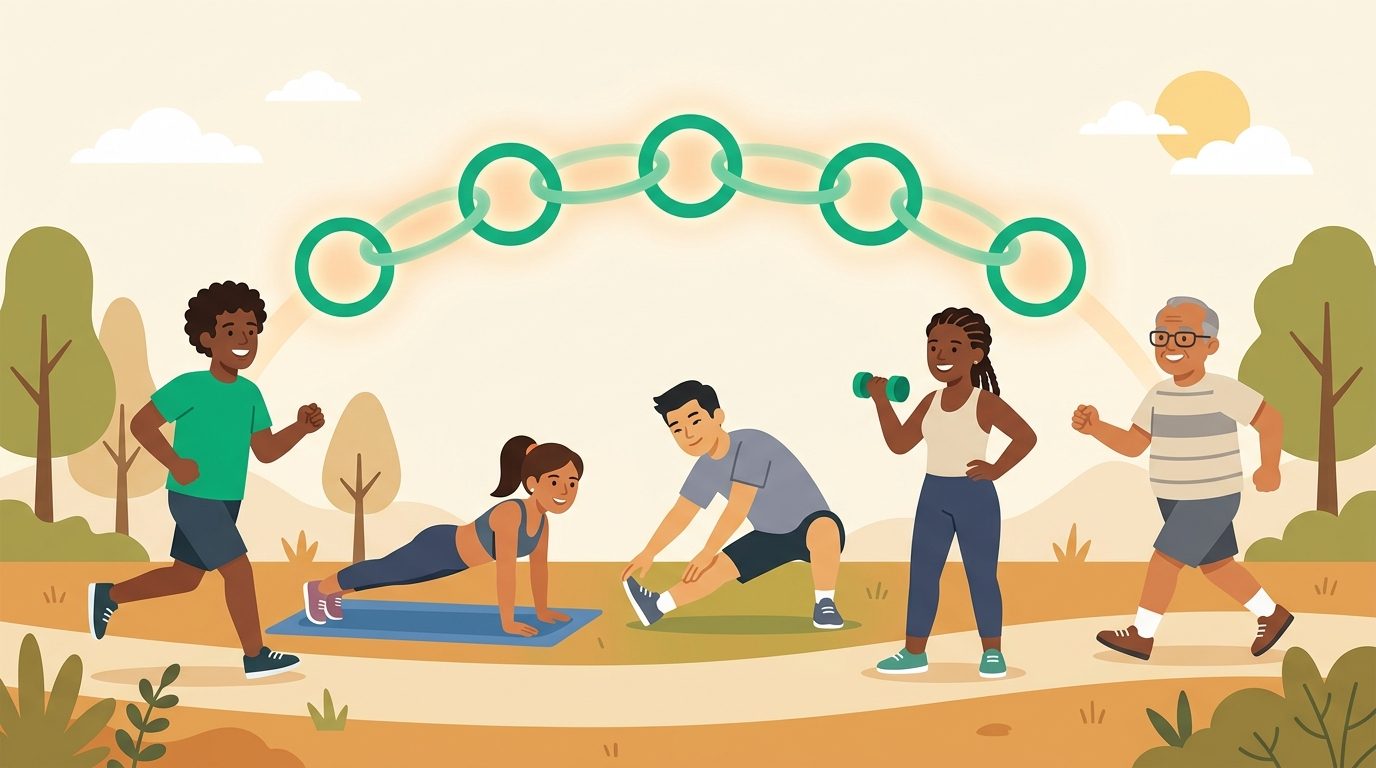
📺 Related Video: How to Plan a Group Fitness Challenge | Do THIS First
Video by: ABC Trainerize · Watch on YouTube
The best fitness challenge app depends on one question: does your group want to compare synced workout data, or prove they showed up every day? Apps like Stridekick and Challenge Hound pull steps and miles straight from wearables and rank everyone automatically. GymRats scores workouts your group posts as photos. Apps like ours, Habit Huddle, skip the sensors and build the challenge around a daily checkin the whole group can see. All of these models work. They just work for different groups, and picking the wrong one is the most common reason a challenge dies by week two.
This guide covers the best fitness challenge apps in 2026 by situation, then the challenge design rules that matter more than the app you pick.
What a fitness challenge app actually has to do
A fitness challenge app has one real job: make showing up visible to people whose opinion you care about. Everything else, the leaderboards, badges, and wearable integrations, exists to serve that.

The evidence points the same way. In a survey of 552 adults, people who used fitness apps or trackers had almost twice the odds of meeting aerobic activity guidelines as non-users (odds ratio 1.91), according to a peer-reviewed study on mobile health app and tracker use. Tracking alone helps. Tracking that other people can see helps more, because every day you show up earns a moment of being seen instead of disappearing into a private log.
So before comparing features, answer three questions:
- What counts as done each day? Steps and miles a watch can measure, or a behavior you report yourself, like completing a workout, stretching, or mobility work?
- Who is in the group? Five friends who text each other need different tools than a 200-person office or a running club.
- Competition or consistency? Ranked leaderboards energize strong performers and quietly push everyone in the bottom half to disengage. Consistency formats keep mixed-ability groups together longer.
Your answers point directly at one or two of the apps below.
The best fitness challenge apps by situation
Habit Huddle: daily consistency challenges with people you know
Full disclosure: Habit Huddle is our app, so judge the reasoning, not the ranking. It is built for the friend group, family, small team, or Discord community whose challenge is about showing up daily rather than out-stepping each other. Your group forms a huddle around one habit, everyone posts a one-tap daily checkin, and the group builds a shared Checkin Chain that grows a link for each member who checks in that day. Monthly leaderboard seasons rank members by days checked in, so the person doing modest workouts every day beats the person who crushed one heroic week.
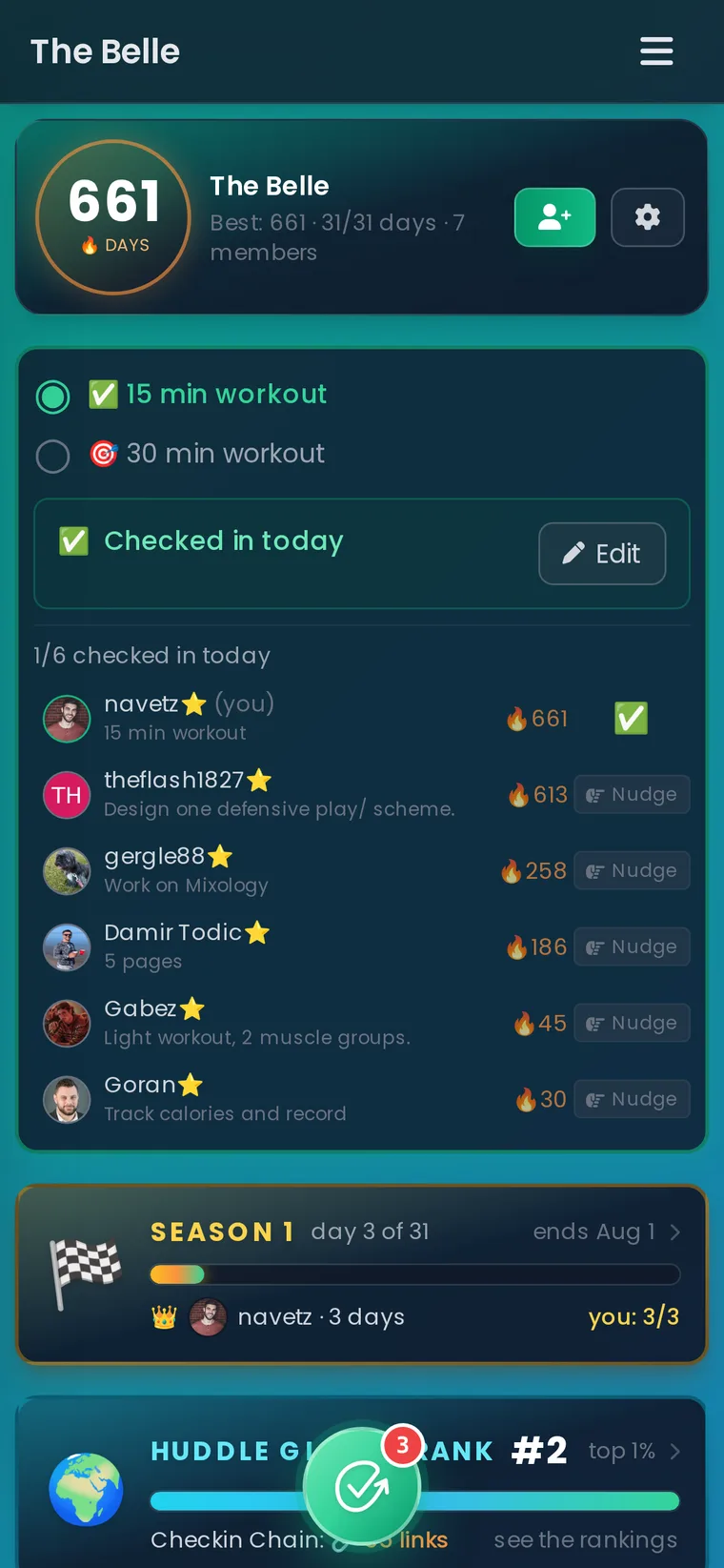
The mechanic that matters most for challenges is the Floor and the Ceiling. Every habit has a worst-day version (the Floor) and a full version (the Ceiling). On a rough day you step on the Floor, a short walk instead of the full session, and the chain survives. On a good day you burst through the Ceiling. That single rule attacks the way most challenges actually end, which is not laziness but the all-or-nothing spiral after the first imperfect day. Checkins work on iOS, Android, the web, and through a Discord bot, so a community can run its challenge where it already talks.
The trade-offs are real. There is no wearable sync or GPS: a checkin is your word, with an optional photo. Each huddle tracks one behavior, not a multi-metric scoreboard, and there is no corporate admin console. A basic challenge is free for everyone in the group.
Best for: friends, families, small teams, and online communities who want the challenge to turn into a lasting habit.
GymRats: workout-count competitions with photo proof
GymRats is the app your friends have most likely already tried, and its model sits between the sensor apps and the checkin apps. You create a group challenge, invite as many people as you like, and every workout is posted to the group as a photo with a title: gym equipment, a sweaty selfie, or a screenshot from another app, whatever your group deems acceptable. Scoring is genuinely flexible, ranking by total workouts, miles, minutes, calories, steps, or a custom point system, and clubs keep a group alive between challenges. The core app is free on iOS and Android, with optional in-app purchases.
The trade-offs: logging is manual, since there is no automatic wearable sync, and the photo feed is the engine, which suits groups that enjoy posting and wears on people who just want to quietly log a walk. Ranking by workout volume also rewards the person who doubles up on gym days over the person who shows up every single day, which is the opposite of what a consistency-minded group wants to celebrate.
Best for: competitive friend groups who want to count workouts rather than steps and enjoy a photo feed.
Stridekick: step challenges with any wearable
Stridekick is the easiest way to run a step challenge with a mixed-device group, because it connects most major wearables or just a smartphone. Its challenge library goes well beyond the classic leaderboard: target goals, streak formats, virtual races along a mapped route, team leaderboards, group targets where everyone's activity combines toward one huge number, and even custom-activity challenges for things like meditation or sleep. Creating a basic challenge is free, with a paid Unlimited tier aimed at corporate and big-group events.
Trade-off: the product is built around movement metrics, so it measures what your device saw rather than asking you to commit to a behavior. Lifters, swimmers, and yoga people are largely invisible to a step count.
Best for: step challenges among friends or coworkers with different devices.
Challenge Hound: distance challenges and virtual races
If the challenge is measured in miles, Challenge Hound is the specialist. It runs distance, elevation, duration, activity-count, and point-based challenges, syncs automatically with Garmin, Fitbit, Strava, and the big health platforms, and can draw the group's progress along a real route map, which makes a virtual 5K or a team mileage goal genuinely fun to watch. Organizers pay from $149 per challenge, or friend groups can pay $2.99 per participant.
Trade-off: it is organizer-oriented and endurance-shaped. A challenge about daily behaviors rather than logged mileage is not its territory, and casual groups may find the event framing heavier than they need.
Best for: running and cycling clubs, race directors, and mileage-based team goals.
StepUp: free step leaderboards for big groups
StepUp does one thing with almost no setup: shared step leaderboards that update automatically from phones and wearables. Groups scale to 1,500 members, admins can set fixed-date challenges, and a mystery mode hides counts until the next day to keep office rivalries friendly. It is free with minimal ads.
Trade-off: steps only, and the accountability is passive. The app counts what your phone recorded; nobody ever has to say "I did it" out loud.
Best for: offices, schools, and large mixed groups where walking is the common denominator.
WayBetter: money on the line
WayBetter, the company behind DietBet and StepBet, turns challenges into games with real stakes: you put money on hitting your goal, and players who make it split the pot. For people who have tried everything else, loss aversion is a legitimately powerful motivator, and the game format with defined start and end dates creates urgency that a plain tracker never will.
Trade-off: stakes cut both ways. The format works best for measurable, short-term goals, and money pressure is the wrong tool for anyone whose relationship with exercise or weight is already stressful.
Best for: solo challengers who want skin in the game.
Strava: challenges inside the biggest endurance community
Strava is not a challenge app first, but its monthly community challenges, segment leaderboards, and clubs make it the default answer for runners and cyclists who already log everything there. The community is enormous, and joining a monthly distance challenge takes one tap.
Trade-off: you cannot build a custom group challenge in any real sense on the free tier, and non-endurance activity is a second-class citizen. It motivates athletes; it does not organize a mixed friend group.
Best for: runners and cyclists who want challenges layered on the logging they already do.
Running a workplace program? Different aisle
A company wellness challenge with reporting requirements, admin rosters, and Slack or Teams integration is a different product category. ChallengeRunner and its corporate peers handle that job well, and we compared them separately in our guide to fitness challenge software for organizers. For a broader look beyond fitness, including 75 Hard trackers and personal challenge lists, see our roundup of challenge tracker apps.
You already know you can change.
You just need to take the first step. Habit Huddle helps you build habits around your goals, alongside friends who keep you accountable.
Quick comparison
| App | Best for | Tracking style | Free option |
|---|---|---|---|
| Habit Huddle | Daily consistency with friends or a community | One-tap checkins, optional photo | Yes |
| GymRats | Workout-count competitions with friends | Photo posts, manual logging | Yes |
| Stridekick | Step challenges, mixed devices | Auto-sync steps and activity | Yes |
| Challenge Hound | Distance challenges, virtual races | Auto-sync from fitness apps | Free to create; from $2.99/participant |
| StepUp | Big-group step leaderboards | Auto-sync steps | Yes |
| WayBetter | Money-stakes solo challenges | Verified checkins per game rules | No (stakes are the point) |
| Strava | Endurance community challenges | GPS and device sync | Yes |
Pricing and features checked August 2026 on each vendor's public site or store listing; treat this as a snapshot.
Design the challenge before you pick the app
A challenge fails in its rules long before it fails in its app. Most groups do not need more features; they need fewer decisions.
 If people are asking what counts, when to post a checkin, or whether a lighter day ruins everything, the structure is too loose.
The rule set should fit in one short message:
- One daily action counts. Make it specific.
- Define a floor and a ceiling. The floor is the smallest version that still counts on a terrible day; the ceiling is the full version. Both are wins.
- Post your checkin by the same time each day. Consistency beats perfection.
- A missed day is a missed day, not a failure. The challenge continues tomorrow.
- Encouragement is part of the game. Members acknowledge effort, not just output.
The floor rule deserves special emphasis because it is the one most challenges skip. People rarely quit after a hard day. They quit after a hard day convinces them the challenge no longer counts. A walking challenge where the floor is a ten-minute walk, or a lifting challenge where the floor is mobility work, keeps the group intact through the exact week that kills most challenges. If you need format inspiration, our list of group fitness challenge ideas has ready-to-run structures with scoring.
One more decision matters: what happens when the challenge ends. A 30-day challenge that simply stops usually takes the habit with it; our 30 day habit challenge guide covers the day-31 handoff in detail. Plan the next round before the first one finishes, or convert the challenge into a standing daily practice with the same group. Momentum is much easier to keep than to rebuild. And if you are setting this up in December or January, the new year habit challenge playbook covers the design choices that get a group past the second Friday of January.
Start a challenge your group will finish
If your group is a company with wearables on every wrist, pick Stridekick, StepUp, or one of the corporate platforms and you will be well served. If your challenge is measured in miles, Challenge Hound is the answer. But if your group is a handful of friends, a family, a small team, or a Discord server, and the real goal is that everyone is still exercising in month three, try starting a huddle on Habit Huddle. Pick the habit, set the Floor and Ceiling, invite the crew, and see how long you can keep the Checkin Chain growing. It is free and takes about two minutes. Our guide to habit tracking with friends explains how the group mechanics work, and if the challenge is a workout habit specifically, our comparison of workout accountability apps for friends goes deeper on that use case.
Frequently asked questions
What is the best fitness challenge app for a group of friends?
For daily-consistency challenges with people you know, Habit Huddle (our app) is built exactly for that shape: one habit, visible daily checkins, and a shared Checkin Chain. For workout-count competitions with a photo feed, GymRats is the crowd favorite. For step-count competition across mixed devices, Stridekick is the strongest free option. Pick by what your group wants to measure.
Can I run a fitness challenge without an Apple Watch or Fitbit?
Yes. Checkin-based apps like Habit Huddle need no wearable at all: you report the behavior yourself, optionally with a photo. Step apps like Stridekick and StepUp can also count steps from just a smartphone. Only distance-and-pace formats genuinely benefit from a dedicated device.
What is the best free fitness challenge app?
Habit Huddle's basic tier is free for a whole group, Stridekick offers free challenge creation, StepUp is free for groups up to 1,500 members, and Strava's free tier includes its monthly community challenges. Paid tiers in this category mostly serve organizers of large or corporate events.
Is there a fitness challenge app for small company teams without enterprise fees?
Yes. Small teams can run free challenges on Stridekick or StepUp for steps, or Habit Huddle for daily workout checkins, including through its Discord bot. Dedicated corporate platforms like ChallengeRunner start around $15 per week and add reporting and Slack or Teams integration when you need admin features.
Does Apple have a built-in fitness challenge feature?
Yes, within its own ecosystem. Apple Watch users can share Activity rings with friends and start week-long Activity Competitions scored on ring closure, right from the Fitness app. It works well when everyone owns an Apple Watch and falls apart the moment one person in the group does not, which is exactly when the cross-device apps above earn their place.
How do I keep a fitness challenge going past the second week?
Give every participant a floor, the smallest daily action that still counts, so imperfect days do not knock people out. Keep the rules short enough to repeat from memory, celebrate consistency rather than top performance, and announce the next round before the current one ends.
Ready to Build Habits With Friends?
Stop failing alone. Join thousands using the #1 habit tracker with friends for real accountability and lasting results.
Prefer mobile? App Store · Google Play
Related Guides
More Habit Huddle articles on building habits with accountability.

HabitShare Alternatives: 6 Apps for Tracking Habits With Friends (2026)
Looking for a HabitShare alternative? Six social habit trackers compared by model, price, platforms, and what happens on a missed day, plus how to switch wit...

What to Do When You Miss a Workout Day: The 5-Step Comeback Plan
Missed a workout day? What one miss does to your body and habit, according to research, plus a five-step plan for the next 24 hours, when to make it up, and...

Habit Streak App With Friends: 7 Apps Compared (2026)
Seven habit streak apps with friends compared: Habit Huddle, HabitShare, Daily Pact, Habitica, Streaks, Habit Streak duels, HabitStreak.io. What friends see,...